The Payment Steps Nobody Wires: Refunds, Failures, Expiries
RedHub AI Editorialupdated November 5, 20266 min read

Jump to a section8
Handling failed payments, refunds and subscription endings is often the part of a payment flow with nothing wired to it. Most builds are tested on the customer who pays on the first try and never asks for money back. Each of these is its own step with its own trigger, the same as charging the card. Each needs the same check: what tells your app it happened, and does it survive happening twice?
TL;DR: The customer whose renewal is declined, whose subscription ends, or who gets a refund is on a different branch of your flow, and that branch is often not built at all. Test each one on purpose in your processor's test mode: let a renewal fail, cancel a subscription, issue a refund, and see whether your own records change. A missing step here fails ordinary customers with nobody attacking anything. Disputes are a further step to name, though the evidence side is a separate job.
You built the path where everyone pays and stays
It is the right thing to build first. Card in, charge succeeds, access granted. That is most of your revenue and most of your test time. The customer whose renewal is declined, the one who cancels and expects access to end, the one who wants a refund and expects to see it reflected: those are branches of the same flow. Branches that get exercised less get built less, and sometimes not at all.
That is not sloppy work. Nobody starts a checkout by asking what happens when it fails. It is a less obvious question than "does the payment work," which is why it is worth asking on purpose, before a customer asks it for you.
Three steps on the losing path
- A failed payment retried later. A declined renewal may be tried again later, on a schedule your provider or your own settings decide, and it may then succeed or be given up on. Test: when a retry succeeds, does your app record it once? If the success notification arrives twice, does it count twice? And when the retries are given up, does anything on your side react?
- Access revoked when a subscription ends. The customer canceled or stopped paying, and access is supposed to stop. Test: cancel a test subscription and see how long access lasts. Does something revoke it, or does it never expire?
- A refund reflected in the customer's account. Money goes back, and something in your own system should show it. Test: issue a test refund and check order status, access, and anything the customer can see. Does it change, or does the refund exist only on the processor's side?
Each of these has to work when nobody is watching. A step that only works because someone checks the dashboard and fixes it by hand is not handled. It is supervised, and supervision runs out at some number of customers.
The worked example: three rows, three ways to be NOT HANDLED
The Money Path Teardown spreadsheet ships with these three steps among its ten example rows. Its example answers show three different routes to the same result.
- Access revoked when a subscription ends: nothing triggers it, and who decides and whether it is safe twice are both can't find. It reads NOT HANDLED, and the unknowns are not counted against it, because nothing they could have been would change the row.
- Refund reflected in the customer account: nothing triggers it, though your server would decide it and it would be safe to repeat. It reads NOT HANDLED. A well-built step that nothing calls does not happen.
- A failed payment retried later: the processor's event triggers it and your server decides, but nobody could say whether it is safe to run twice. Scored as unsafe, it reads NOT HANDLED. In the example flow this is the step the Dashboard names to fix first, because its result rests on an answer nobody found.
Replace those answers with your own. Yours may well be better.
A fourth step, named but not taught here
Disputes are a real step. A customer or their bank can formally contest a charge, and something in your process has to react. The Teardown's ten example rows do not include one, so add a row for it. This guide stops at "does anything in your build notice a dispute happened." What evidence to gather and how to present it is a separate job, handled by the Chargeback-Proof Order Evidence Kit.
Why a missing step outranks a forgeable one
A step that trusts a value it should not needs someone to notice the weakness and try it. A missing revoke-on-cancel step fails every customer who cancels, with nobody attacking anything. That is the reasoning the Teardown uses to rank NOT HANDLED above TAKEN ON TRUST, and to read the whole flow as PATH BREAKS when any NOT HANDLED step is present.
The complication is that a forgeable step can be the costlier one in a given business, if somebody finds it. The ranking is about which fails without an attacker, not which loses more money. Fix both.
Test all three in one afternoon
Each of these can be set off on purpose in test mode. Look in your processor's test-mode docs for a card that declines and a way to run a test subscription. Let a test renewal fail and watch what your app actually does. Cancel a test subscription and time how long access lasts. Issue a test refund and check every place an account shows orders or payments. If any of the three produces a shrug instead of an answer, write that down as the finding.
The pillar, Your Checkout Works. Does Your Money Path?, covers all ten steps. The Teardown grades the build, never the person who built it. It is offline, and reads back what you tell it.
More in this guide
Frequently asked questions
Why don't refunds and failed payments get wired by default?
Most builds are tested on the customer who pays on the first try, because that is the common case. Declined renewals, cancellations and refunds are less-exercised branches of the same flow, so they are often left unbuilt, not built wrong.
What happens if I don't revoke access when a subscription is canceled?
The customer keeps access after they stop paying, and nothing alerts you. It does not throw an error. It shows up later as a mismatch between who is paying and who has access.
How do I test failed payment handling without real customers?
Use your processor's test mode. If it offers a test card that declines and test subscriptions, you can set off a failed renewal, a cancellation and a refund on purpose. After each one, check whether your own records, such as order status and access, changed to match.
Does this cover how to fight a chargeback?
No. It names disputes as a step your build should notice, but what evidence to gather and how to present it is a separate job, covered by the Chargeback-Proof Order Evidence Kit.
Is a missing refund step worse than a forgeable one?
It fails more reliably. A forgeable step needs someone to find it and try it on purpose. A missing step fails every ordinary customer who reaches that branch, with nobody attacking anything. Which one costs more depends on the business, so both need fixing.
Is this accounting or tax advice?
No. It is a check on whether your build reacts when a payment fails, a subscription ends, or a refund is issued. How you record or report that money is a separate question for an accountant or tax professional.
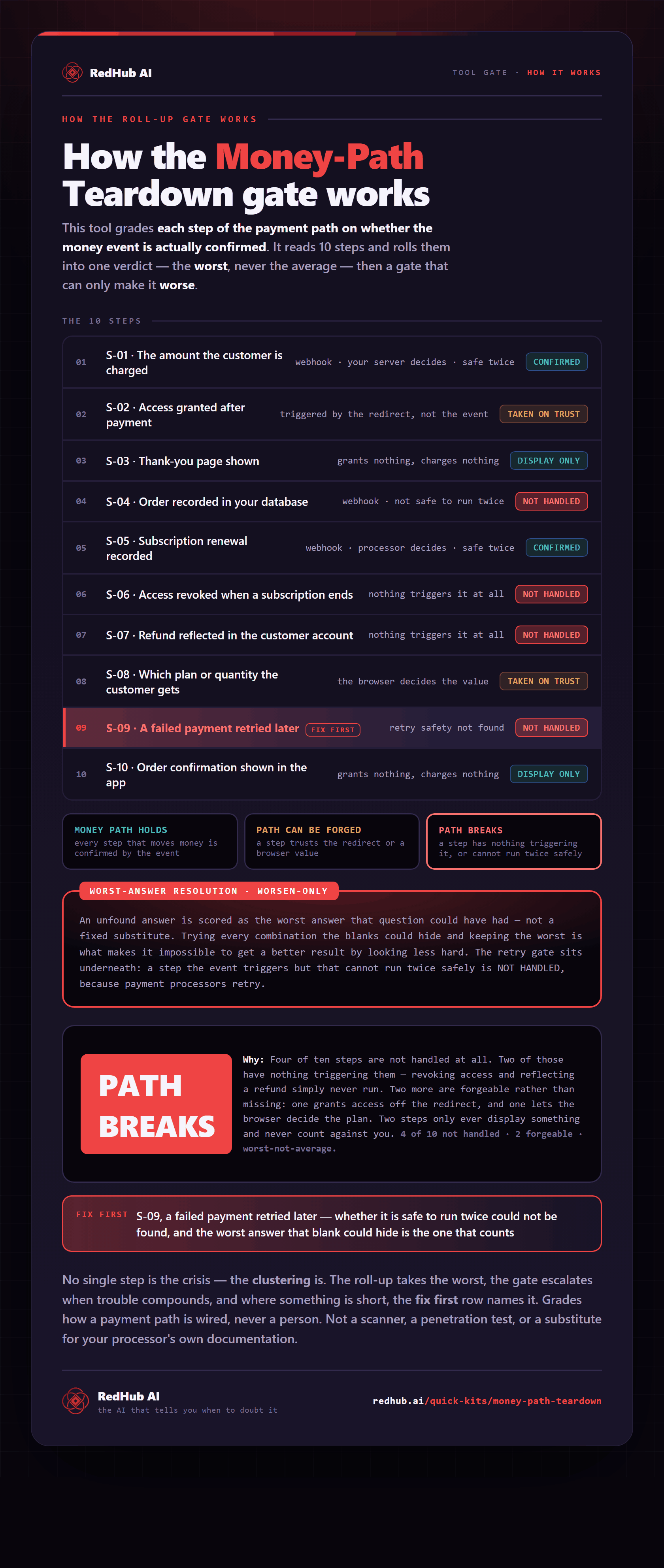
The gate this post refers to, drawn from the tool’s own logic. See the tool.