Why the Redirect Isn't the Receipt
RedHub AI Editorialupdated November 5, 20266 min read

Jump to a section8
A redirect is not a receipt because it only proves the customer's browser reached a page. It says nothing certain about whether the money moved. The receipt is the notification your payment processor sends straight to your server when the payment is recorded. That is Stripe webhooks explained in one line, and the same idea holds for payment processors in general: the server-side event is the proof, and it still arrives for a customer who never makes it back to your site.
TL;DR: Two things can set off a step in your payment flow: the customer's browser landing on a success page, or a notification your processor sends directly to your server. Only the second is evidence the payment happened. Page loads fail for ordinary reasons, and a success URL can be opened by someone who never paid. Use the redirect to show the customer something. If it also triggers anything, have your server confirm the payment with the processor first, and keep the webhook as the trigger that always fires.
A redirect is a page loading
When a payment finishes, most flows send the customer's browser to a new URL: a thank-you page, an order summary, a dashboard. In the ordinary case that happens right after a successful charge, so it is tempting to treat it as proof. But the charge and the page load are two separate events. They usually arrive close together. Usually is the problem.
What each one actually proves
| The redirect proves | The confirmed event proves |
|---|---|
| A browser requested a specific URL | The processor recorded a payment outcome and told your server directly |
| Whatever values were in that URL or form at that moment | Whatever the processor itself has on record for that payment |
| Nothing about the customer who never got that far | Arrives whether or not the customer sees another page |
| Can be bookmarked, shared or opened without paying, depending on how it is wired | Comes from the processor, and can be checked as genuine where the provider signs its notifications, as Stripe does |
| Fine for showing a message | The right trigger for anything that grants access or writes a record |
Neither column is the villain. A redirect is the right tool for "show the customer something." It is the wrong thing to treat as proof of payment.
Why the browser is an unreliable witness
None of the ways a redirect fails to arrive need anyone to do anything wrong. A phone loses signal for four seconds as the page is about to load. The customer closes the laptop because, from their side, they are done: they already paid. They tap back out of habit.
Stripe's Checkout fulfillment guide uses almost exactly this case. It says you can't rely on triggering fulfillment only from your landing page, because customers aren't guaranteed to visit it, and gives the example of someone who pays and then loses their internet connection before the page loads. Its fix is a webhook handler, so payment events go from Stripe to your server and skip the customer's device entirely.
The other failure is the opposite one. If the success page is what grants access, then anyone who has the URL can load it. An old bookmark, a shared link, a guessed path. Whether that works depends on what the page checks, which is exactly the question to ask.
The wrinkle: the redirect can help, if it is not alone
Here is the part a simple "never use the redirect" rule gets wrong. The same Stripe guide also recommends triggering fulfillment from the landing page, because webhooks can sometimes be delayed and a customer who is sitting there should get access right away. But look at how it does it. The page carries a session ID, your server uses that ID to look the payment up with the processor, checks that it is paid, and only then acts. The browser supplies a reference. Your server and the processor supply the proof.
That gives you a cleaner rule. The redirect may start a check, but it can never be the only trigger, and nothing the browser sends may decide what was paid. When both paths can fulfill the same order, both must be safe to run twice, because now two things will try. Charged Twice, Delivered Twice covers that half.
Finding out which of your steps trust which witness
You do not need to read code to start. For each step that grants money or access, ask what has to happen for it to run: a browser reaching a page, or a notification arriving at your server on its own. Then ask a second question that is easy to skip: where does the amount or plan come from? A step can be triggered by the processor's event and still read the plan from a value the browser sent along.
If you, a colleague or your AI builder cannot answer in one sentence, treat that as a finding, not a pass. A quick manual test will not catch this, because you, the tester, always finish the trip. You are patient, you are paying attention, and you have no reason to close the tab.
How the Money Path Teardown grades this
The Money Path Teardown is a spreadsheet you fill in from your own project. For every step where money or access is at stake, it asks what triggers it, with the answers the event, the redirect, neither, or can't find. A step triggered by the redirect lands in TAKEN ON TRUST, with the reason that the customer can close the tab and never arrive, or arrive without paying. A step triggered by the event but whose amount or outcome comes from the browser lands in TAKEN ON TRUST as well.
One limit worth knowing: the sheet takes one answer per question. If a step is wired both ways, as in the Stripe pattern above, answer for the webhook and check separately that the landing-page path asks the processor before acting. The sheet grades what you tell it.
Whether your test wiring and live wiring are genuinely separate is a different question, covered by The Test Mode vs Live Mode Line-Up. The full ten-step chain is in the pillar, Your Checkout Works. Does Your Money Path?
More in this guide
Frequently asked questions
What's the difference between a redirect and a webhook, in plain terms?
A redirect sends the customer's browser to a new page. A webhook is a notification a payment processor sends directly to your server about what happened, independent of the customer's browser. The redirect is for showing something on screen. The webhook is the trigger to rely on for anything that grants access or writes a record.
Why can't I trust the redirect if it works every time I test it?
Because when you test it, you finish the trip on purpose. You do not close the tab early or lose signal. Real customers sometimes do, and a step that waits for their browser never runs for them. A success URL can also be opened by someone who never paid, unless the page checks with the processor first.
Can the success page ever trigger fulfillment?
It can help, as long as it is not the only trigger and the browser does not supply the proof. Stripe's fulfillment guide describes passing a session ID to the landing page, having the server look that session up with Stripe, checking it is paid, and then fulfilling, with a webhook handler still in place for customers who never arrive. Both paths then need to be safe to run twice.
Is this specific to Stripe?
No, and RedHub is not affiliated with Stripe or any other processor. The difference between a browser redirect and a server-side notification applies to payment processors generally. Delivery behavior, retry timing and setup vary by provider, so check the current documentation for the one you use.
How do I check which trigger my own steps use?
For each step that grants money or access, ask what has to happen for it to run: a browser landing on a page, or a notification your server received on its own. Then ask where the amount or plan comes from. If nobody can answer in one sentence, treat that as a finding. The Money Path Teardown asks both questions for every step.
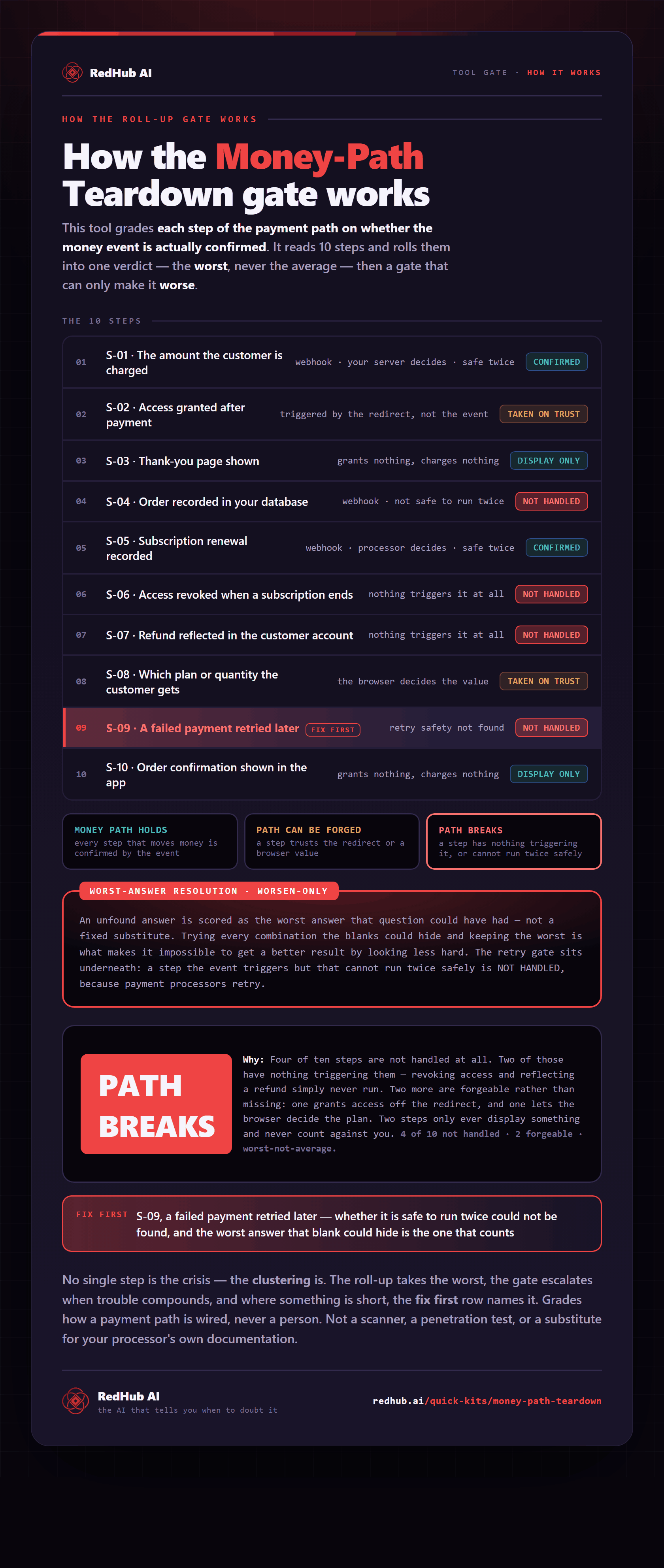
The gate this post refers to, drawn from the tool’s own logic. See the tool.