Fable 5.2 Vibe Coding: From Demo to Product People Trust
Todd Brooks, Founderupdated November 12, 202612 min read

Jump to a section12
- TL;DR
- What is Fable 5.2 vibe coding?
- What changed for people who build this way
- "Prompt engineering is over" is half true
- Five things Fable 5.2's own docs warn about
- What we built with it, and what we still had to check
- Write the acceptance contract before you build
- Build the hard path first
- Five gates between a demo and a launch
- The complication: speed makes you trust more of what you have not seen
- The rest of this set
- Pairs well with
TL;DR
- What changed: Claude Fable 5.2 can carry a loose idea much further on its own, so a working demo can arrive much faster than before.
- What did not change: a demo answers "can this work?" A product answers "can customers rely on it, every time, when something goes wrong?"
- Read the model's own docs: Anthropic warns that Fable 5.2 can end a turn before the work is done, and that when a prompt doesn't say who owns the code, it may report nearby problems instead of fixing them.
- We used it ourselves: Fable 5.2 in Claude Code built the product explainer videos on our channel, and every claim in them still had to be checked against the product page.
- The real risk: the faster an app gets built, the more of it you are trusting without having looked.
What is Fable 5.2 vibe coding?
Fable 5.2 vibe coding means describing what you want in plain language and letting Claude Fable 5.2, Anthropic's top model, write and run the code, usually in a tool like Claude Code. Fable 5.2 can work longer and more independently than earlier models, so a short description can produce a working app or game. Turning that demo into a product still takes a written definition of done, tests on the hard cases, access controls, and a way to recover when something breaks.
Best for: founders and small teams building their own software with AI. Before you ship it, check how much of it you can explain with Can You Explain Your Own App?
A demo answers one question: can this idea work under the conditions I chose? A product answers a harder one: can customers use it again and again, with limits they understand and failures they can recover from? Fable 5.2 vibe coding has made the first answer arrive faster than it ever has. It has not changed the second question at all.
RedHub is not affiliated with Anthropic or any company or creator quoted here. Model behavior described here is from Anthropic's documentation as of November 11, 2026. Nothing in this post is a security audit or legal advice.
This post is about the gap between those two answers: what Anthropic's own documentation says to watch for, what we learned using Fable 5.2 on our own channel, and the gates a vibe-coded app should pass before a customer touches it. For the launch, pricing and benchmarks, start with our Claude Fable 5.2 guide.
What changed for people who build this way
Early testers quoted in Anthropic's launch announcement (opens in a new tab) describe the same shift in different words. A Shopify staff engineer says that "within a few turns I can almost always say 'ok, go do that,' and trust that it'll complete it with little intervention." A Vercel engineer says projects they had been pushing along with other models for weeks "got finished and approved by our teammates in a few days." Those are vendor-selected quotes from experienced engineers. They still describe something real: the model holds the plan for longer and needs less steering to get there.
Anthropic's most extreme example is a prototype operating system built by more than 1,000 coordinated subagents over eight days. That shows how long the model can keep working. It does not show that what comes out of an unattended run is ready for customers, and Anthropic does not claim it is.
Builders outside Anthropic showed the same thing within two days. Matt Shumer posted that Fable 5.2 created a "MIRROR EARTH" as a game (opens in a new tab), a world where, he wrote, the weather matches the real Earth in real time. The next day he posted a second game with the line "Rockstar took 8 years. Fable 5.2 is gonna do it in 7 days," then a clip of himself playing it on a MacBook (opens in a new tab), about 13 hours into the build. Blendi said he made a "hand-painted" game in less than an hour (opens in a new tab), with about 1.5 million brush strokes in every frame, running at 200 frames per second in a browser tab. Those figures are the creators' own, and I have not seen anyone measure them. The direction is not in doubt. The first version of an idea now takes hours.
"Prompt engineering is over" is half true
One line from launch week traveled further than any benchmark. A widely shared first-person shooter came from a few sentences asking for "insanely detailed quality," and its creator, Anthropic engineer Felix Rieseberg, wrote that the age of prompt engineering is "basically over." You can see it in Paul J Lipsky's roundup of 18 Fable 5.2 builds (opens in a new tab).
For starting work, he is right. You no longer need a clever prompt to get something impressive. But a game you play for ten minutes and a booking app that takes deposits are judged differently. The game only has to delight. The app has to be right when the customer's card is declined, when two people book the same slot, and when someone tries to see another person's booking. Short prompts start the work. A written definition of done decides whether it can ship.
Five things Fable 5.2's own docs warn about
The most useful document for a vibe coder this week is not the launch post. It is Anthropic's "What's new in Claude Fable 5.2" page (opens in a new tab), which lists behaviors that "show up without any code change." In plain terms:
- It can stop before the job is done. On long tasks, the model "sometimes ends a turn with a list of what remains, an offer to continue, or a stop at an ordinary obstacle," more often at lower effort settings. A half-finished feature can look finished at a glance.
- It may report problems instead of fixing them. In Anthropic's testing on small coding tasks, when a prompt said nothing about who owns the code, Anthropic found the model "tended to add to the existing structure and to report nearby problems instead of fixing them." Tell it, in writing, what it is allowed to change.
- It can work quietly for a long time. Long runs of tool calls "can pass with little user-facing text," and it may start without saying what it is about to do. Silence is not progress you can see.
- Delegation costs money. In tools that invite it, the model delegates readily, and "subagents can account for a large part of what a session costs." Set a spending limit before a long session, not after.
- It follows style rules closely. Instructions written for older models, such as hard limits on sentence length, can make its output stiff. Old instruction files deserve a reread.
None of these is a flaw in the usual sense. Each one is a place where a person who is not reading closely ships something they did not check.
What we built with it, and what we still had to check
We used Fable 5.2 in Claude Code to make short product explainers for our YouTube channel. It wrote each script and built each animated video from the product's own page, and I reviewed and fixed parts of each one before it went up. Here is the one for the AI Agent Go-Live Readiness Gate:
Making the video was the fast part. The slow part is that a video about a product is a claim about the product. The video says the sample refund agent scores 86 out of 100 and still reads DO NOT DEPLOY. That is only acceptable if the product says so. For this post we checked it against the product page, and the page's own engine output shows a readiness of 86/100 next to DO NOT DEPLOY. We did the same for the Gate-to-Tool Exposure Kit video (opens in a new tab), whose worked example of eight gates across five tools ends, on the product page, with "1 of 5 tools are held."
That checking step is the part no model removes. An AI that can write a convincing script in minutes can write a convincing wrong number just as fast. The work moved from making the video to proving the video is true.
Write the acceptance contract before you build
Before you ask Fable to build anything a customer will use, write half a page covering:
- Who the user is, and the one job the product must do for them.
- What it can rely on as input, and what it must produce.
- Which actions need a person's approval first.
- What counts as failure, and what the user sees when it happens.
- Which tests must pass before release.
For a quoting tool at an industrial supplier, the contract might read:
Extract requested parts and quantities with a reference to where each came from in the document. Flag any part number that matches more than one item. Never substitute a part on your own. Never send a quote or change an order without approval from a named person.
Notice that none of it is about how the screen looks. A polished interface is the easiest thing to demo and the least likely thing to hurt a customer.
Write it down for a second reason: long sessions run out of room. Nate B Jones described a design session (opens in a new tab) in which Fable 5.2 noticed its context window was nearly full, wrote a handoff file on its own, and told him to start a fresh thread for the build. That is one person's report, not documented behavior. The habit is worth copying either way. Settle the design in one thread, write it down, and start the build in a new thread with only that file. The handoff file and the acceptance contract can be the same page.
Build the hard path first
Vibe-coded apps tend to get the happy path first because that is what the demo shows. Flip it. For the quoting tool above, the first tests should be the messy ones: part numbers that could mean two things, mixed units, duplicate lines, an unreadable attachment, missing quantities, and a document with instructions hidden in it that try to change what the tool does. The product should show its uncertainty rather than hide it behind a clean table.
Five gates between a demo and a launch
- Correctness. Does it complete the job on your test set, including the messy cases?
- Access. Can each user see and change only what is theirs? Being logged in is not the same as being allowed.
- Failure. When it breaks, can the user tell, and can they recover?
- Operations. Can you watch it, support it, and roll back a bad change?
- Demand. Does someone want the outcome enough to use it twice?
A faster model helps with the first gate. It does nothing on its own for the other four.
The complication: speed makes you trust more of what you have not seen
Here is the part that does not resolve neatly. A model that builds more in an afternoon also leaves you with more code you have never read. Earlier, a slow build at least forced you to look at every piece. Now an app can arrive with a login, a database, a payment flow and a dozen background jobs, and the honest answer to "how does the payment part work?" might be "I believe it works."
Launch week produced a clean example of both sides. Mike Houser posted (opens in a new tab): "I don't know how to code, but somehow I made this game entirely from scratch in just a few days with AI and it's 2x the size of Skyrim!" He credits Fable 5.2, Opus 5.5, Three.js, Blender and other tools. Take the first half at face value. A person who does not write code built a playable open world in days, and that is worth paying attention to. The second half is a claim that nobody has measured, and the person who built the game says he does not know how to code. For a game, the worst case is a smaller map. For a booking app, the same sentence would read "it handles deposits," and the only person vouching for it would be someone who has never looked.
That belief is the risk. A gap you know about is already on your list. A belief you never checked is the one you skip. We are not going to tell you a vibe-coded app is safe to launch, because no article can see your build. What you can do is find out, area by area, which parts you can explain and which ones you are taking on trust.
Find the parts of your app you are taking on trust
Can You Explain Your Own App? walks nine areas of a small app with two questions each: can you name it, and have you seen it yourself. Each area reads YOU CAN EXPLAIN IT, DOES NOT APPLY, CANNOT EXPLAIN IT, or GOING ON BELIEF, and it deliberately ranks GOING ON BELIEF below CANNOT EXPLAIN IT. Where an area is unexplained, it names the one thing to open first. One spreadsheet, $59. Not a security audit or legal advice.
Get Can You Explain Your Own App? →The rest of this set
- Claude Fable 5.2: what it changes for your business covers pricing and when to pick it over Opus 5.5.
- Can Claude design hardware? applies the same "does it work, and how does it get there" test to a circuit board.
- The Claude Blender connector covers editing 3D scenes without losing the approved version.
- Fable 5.2 business ideas looks at why proof may be worth more than the build.
Pairs well with
If your app includes an AI agent, the AI Agent Go-Live Readiness Gate from the video above rates five controls and returns READY, FIX, or DO NOT DEPLOY. The Vibe-Coded App Pre-Launch Security Gate grades six security controls and bands the app LAUNCH-READY AS DESCRIBED, HARDEN FIRST, or DO NOT SHIP. For agents that can move money or change access, the Gate-to-Tool Exposure Kit reads each guardrail FAIL-CLOSED, FAIL-OPEN, or DECORATIVE.
Keep going: read the vibe coding mistakes that break apps after launch and vibe coding security.
Decision Guide
Ship sooner if: the app is internal, holds no customer data, takes no money, and you can roll it back in a minute.
Slow down if: it takes payments, stores personal details, sends messages to customers, or you cannot explain how a part of it works.
Best first step: write the half-page acceptance contract, then list every area of the app and mark which ones you have seen working yourself.
FAQ
What is Fable 5.2 vibe coding?
It means describing what you want in plain language and letting Claude Fable 5.2 write and run the code, usually inside a tool like Claude Code. Fable 5.2 works longer and more independently than earlier models, so a short description can produce a working demo quickly.
Is prompt engineering over with Fable 5.2?
For starting work, mostly. Short, plain prompts can now produce impressive results. For anything customers rely on, you still need a written definition of done, tests on the hard cases, and clear rules about what the model may change.
Why does Fable 5.2 sometimes stop before finishing?
Anthropic's documentation says that on long, multistep tasks the model sometimes ends a turn with a list of what remains, an offer to continue, or a stop at an ordinary obstacle, more often at low and medium effort. Check that the work is complete, and ask it to finish the whole task.
Should I use Fable 5.2 or Opus 5.5 for vibe coding?
Anthropic recommends starting most coding on Opus 5.5 and moving to Fable 5.2 when Opus at higher effort still falls short. Fable costs twice as much per token, so compare both on your own project before you commit to either.
Is a vibe-coded app safe to launch?
Not by default. Before launch, check that each user can only see and change their own data, that payments and refunds work with real transactions, that failures are visible and recoverable, and that you can explain how each part of the app works.
Did RedHub make videos with Fable 5.2?
Yes. Fable 5.2 in Claude Code wrote the scripts and built the animated product explainers on the RedHub YouTube channel from each product's page. Each one was reviewed and corrected by a person before it was posted.
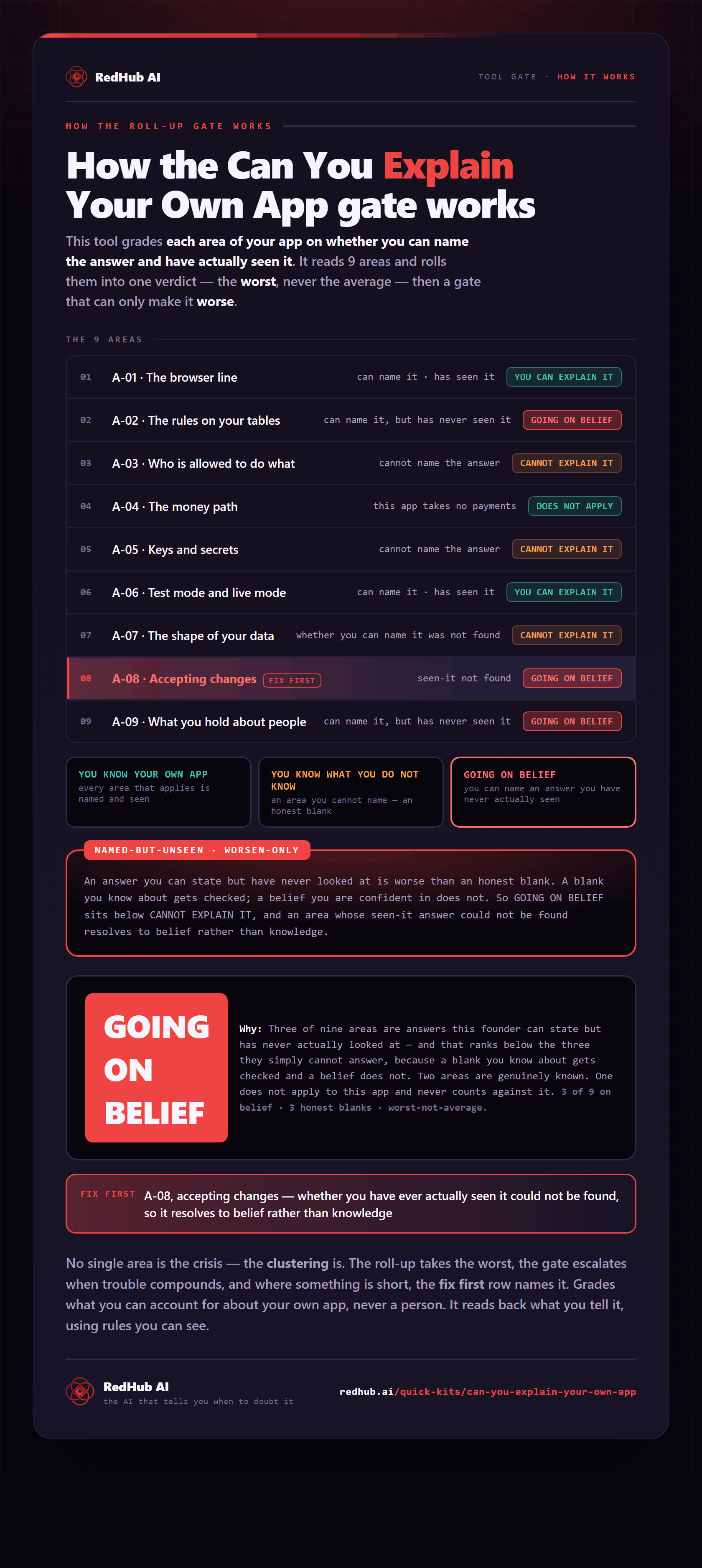
The gate this post refers to, drawn from the tool’s own logic. See the tool.