Rules-Based vs. AI Document Classification: Which One to Trust
RedHub AI Editorialupdated November 5, 20266 min read

Jump to a section8
Rules based vs AI document classification is a choice about which failure you can live with. A rules engine fails by not recognizing something, and it says so. A trained classifier fails by recognizing something wrongly, and it attaches a confidence number to the mistake. For invoices, receipts, contracts and standard forms, the first failure is usually easier to manage. Rules have a quiet failure of their own, though, and it belongs in the comparison.
TL;DR: Rules give you a readable reason for every routing decision and stop at what you wrote down. A model generalizes to document types nobody wrote a rule for, and its score tells you how sure it is, not why. Use rules where you can describe the document in a sentence, and send the leftovers to a person or a model. The Document Classify & Route Kit ($69) is the rules side: no model and no probabilities. The wider picture is in Document Classification & Routing.
What each one is built to do
A rules-based classifier is built for predictability. The same input gives the same output, and you can point to the line responsible. A machine-learning classifier is built for generalization. It tries to label documents it has never seen an exact copy of, using patterns learned from examples.
Those are different jobs. A team that receives the same forty vendors' invoices every month has a predictability problem. A team that receives free-form email about anything has a generalization problem. Asking which approach is smarter skips the real question, which is what your intake looks like.
A confidence score is not a reason
Suppose a classifier labels a file as an invoice with 87% confidence. That figure is made up for illustration. What would it tell you? At best, that out of 100 similar calls, about 87 are right. It does not say what in this document made it an invoice, and it does not say whether this is one of the 13.
The "at best" matters. In a 2017 paper, On Calibration of Modern Neural Networks (opens in a new tab), Chuan Guo and co-authors reported that modern neural networks, "unlike those from a decade ago, are poorly calibrated." The confidence a model reports and how often it is right can drift apart. The same paper found a simple correction, temperature scaling, "surprisingly effective" on most of the datasets they tested, so this is fixable by a team that checks. But even a well-calibrated score answers "how often?" and never answers "why?"
A rule answers "why" directly. In the Document Classify & Route Kit, a routed document comes back with the document type and destination of the rule that fired, and the rule is a line anyone can read: the text contained "invoice" and the amount was under 5,000, so it went to the standard payables queue. There is no score to interpret.
Rules fail quietly too
It would be convenient to stop there. But a rule can be confidently wrong with nothing flagging it.
We ran a test document through the kit's sample rule pack: a memo reading "these hours are uninvoiced," with a small amount attached. The standard invoice rule looks for the fragment "invoice" in the text. It found it inside "uninvoiced." No other rule matched, so there was no conflict to hold. The verdict was ROUTE, to the standard payables queue. A clean result, and wrong.
So both approaches can misfile a document without raising a hand. The difference is what happens when someone finds out. With the rule, you open the rule pack, see that a seven-letter fragment was too loose, and tighten it in a minute. With a model, the usual fix is more labeled examples and a retraining run, and you find out whether it worked by testing again. Rules are easier to repair. They are not immune to error, and a team that stops sampling routed files because "it's deterministic" has swapped one kind of blind trust for another.
Where a model has the edge
Rules stop at what you can describe. If your intake is free-form customer email, scans with no consistent layout, or a stream of formats that changes faster than you can write rules, a trained model can label things a rule list would leave unmatched. An unmatched pile that holds most of your intake is not a sorter.
Models also read things a fixed rule cannot. The kit matches on a filename fragment, a keyword, a sender, an amount threshold and whether a date is present. It does not look at layout or meaning. A model can use both.
Using both
The two can share a front door. Rules take the document types you can describe. What they leave unmatched goes to a person or a model. That keeps a readable reason on every decision the rules make and limits the model to the part of intake where rules had nothing to offer.
We are not going to tell you what share of your documents rules will cover. It depends on your intake, and a borrowed percentage would say nothing true about yours. Run last month's files through a draft rule list and count the unmatched ones. That count is your answer.
A way to decide
- List the document types you received last month.
- For each, try to describe it in one sentence: "it comes from this sender and contains this phrase." If you can, a rule can catch it.
- Ask who might later want to know why a file went where it did. A client or an auditor wants a reason, not a score.
- Count what is left. A small remainder can go to a person. A large one is the case for a model.
The rules side, ready to run
The Document Classify & Route Kit is a deterministic router: a rule pack you write, evaluated in priority order, returning ROUTE, QUARANTINE or UNMATCHED per document. Every match is a fixed rule firing on the document's own signals. It is not a machine-learning classifier and it does not produce a confidence score.
Get the Document Classify & Route Kit — $69Pairs well with
The AI Document Extraction Kit ($99) is where a model does earn its place in this line: it turns invoices, receipts and forms into structured data and flags low-confidence fields for review instead of guessing. The Document Field Validator ($79) is the rules-based check behind it, returning PASS, REVIEW or REJECT per record. The Document Processing Pipeline Diagnostic ($79) scores a document workflow across six stages and returns AUTOMATED, MANUAL DRAG or STALLED, which helps if you are unsure classification is the stage to work on.
More in this guide
Is rules-based document classification more accurate than AI classification?
It depends on the documents. Rules match repeatable, describable document types predictably. A trained model may do better on varied or unstructured ones. The larger difference is that a rule gives a readable reason and a model gives a score.
Can I audit an AI classifier's decision the way I can audit a rule?
Usually not to the same degree. A rule-based decision traces to one rule and the signals that matched. A model's decision comes with a confidence score, which says how sure the model is and not what in the document drove the label.
Can a confidence score be trusted?
Only if someone has checked it. A 2017 paper by Chuan Guo and co-authors reported that modern neural networks were poorly calibrated, and that a simple correction worked well on most datasets tested. Calibration can drift, so it needs measuring on your own documents.
Can a rules engine misroute a document without flagging it?
Yes. A loose keyword can match an unrelated document, and if no other rule matches, it routes with a clean result. The fix is quick once found, but finding it means sampling routed files.
Can I combine rules-based and AI classification?
Yes. Let rules handle the document types you can describe, and send what they leave unmatched to a person or a model. Count the unmatched files from a real month to see how large that remainder is.
Is the Document Classify & Route Kit rules-based or AI-based?
Rules-based. It evaluates a rule pack you write, in priority order, and returns ROUTE, QUARANTINE or UNMATCHED. There is no model, no probability and no confidence score.
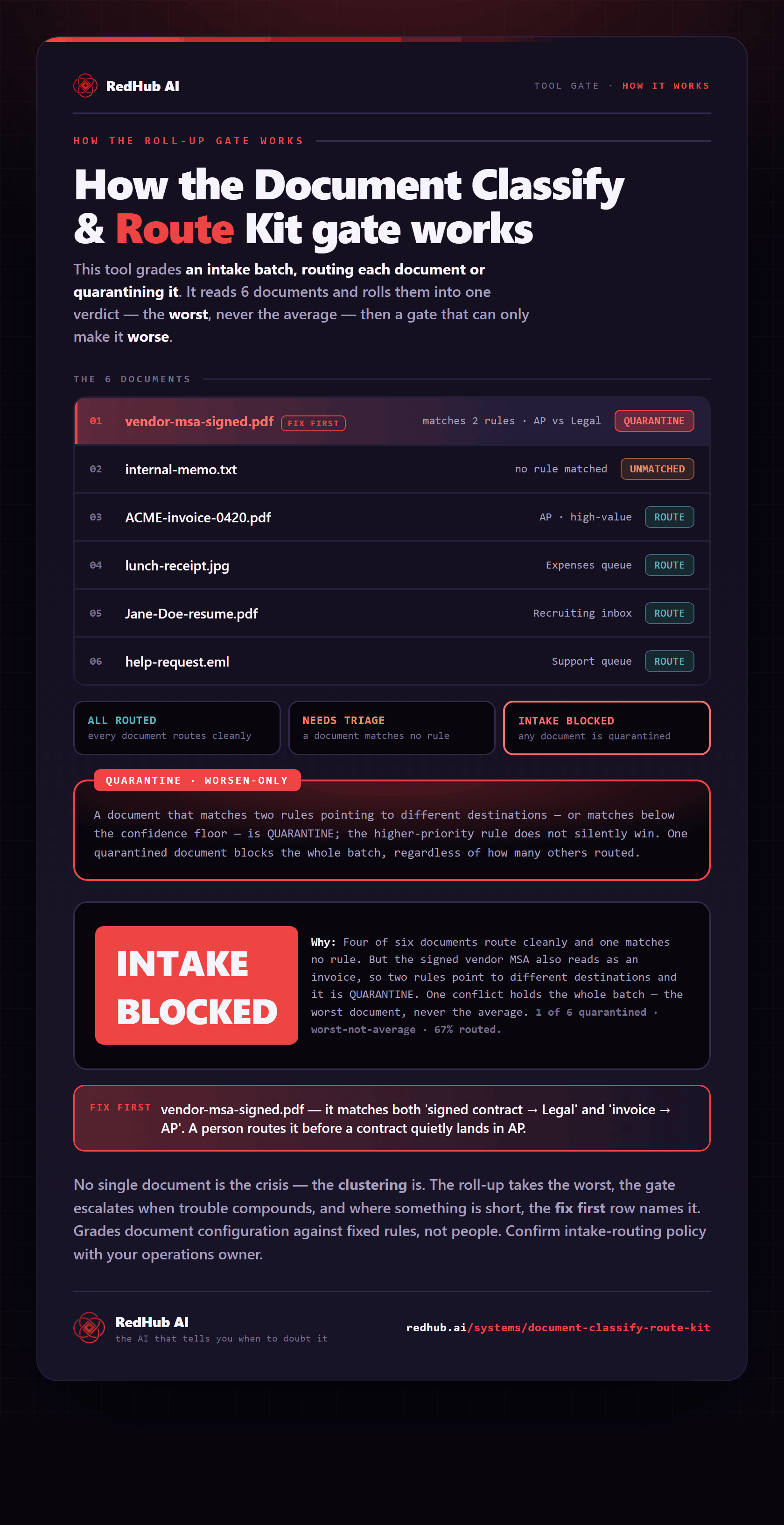
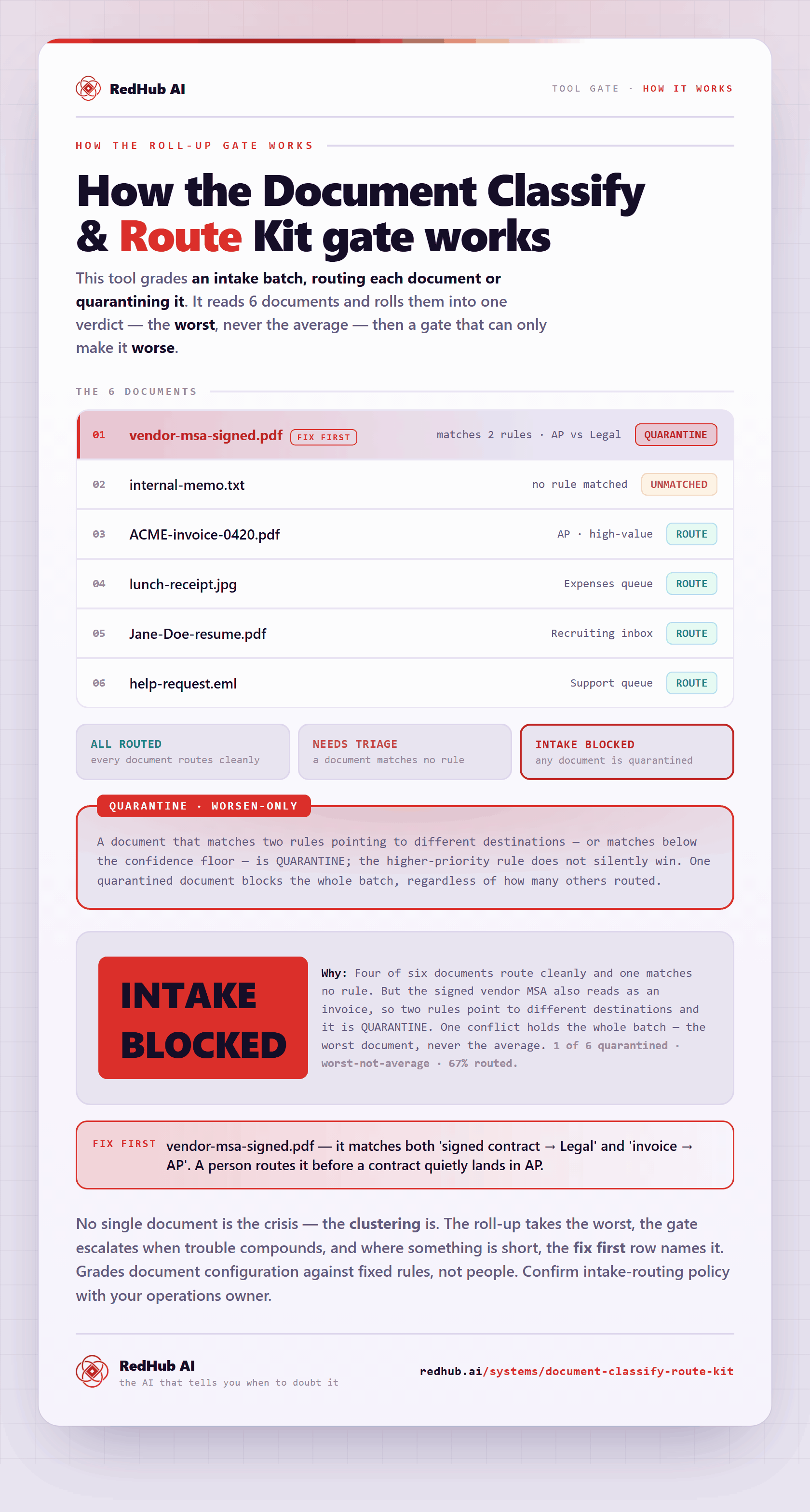
The gate this post refers to, drawn from the tool’s own logic. See the tool.