Sales Forecast Accuracy: Why Forecasts Lie
RedHub AI Editorialupdated September 7, 20264 min read

Jump to a section7
TL;DR
- What it is: sales forecast accuracy is how closely a predicted number matches what actually closes.
- Who it's for: founders forecasting off a pipeline without a dedicated RevOps team.
- How it works: forecasts break on happy ears and stage-based math that trusts an unverified stage.
- Bottom line: grade deals COMMIT / BEST CASE / AT RISK / NOT REAL and the forecast gets honest — see Pipeline Commander.
What is sales forecast accuracy?
Sales forecast accuracy is how closely the revenue number you predict for a period matches what actually closes. Most small-team forecasts miss because they're built on two things that aren't verified — the stage a rep set and their own optimism about a deal. Fixing accuracy means grading each deal on what's actually confirmed, not on what a rep hopes is true.
Best for: founders forecasting revenue without a dedicated RevOps analyst. Pipeline Commander grades every open deal so the forecast starts from reality.
Forecasts miss for the same reason every quarter: the number is built on top of deals nobody actually checked. A rep believes a deal will close, marks the stage accordingly, and the forecast trusts that belief without questioning it. Sales forecast accuracy comes from removing that trust and replacing it with a direct check on what's confirmed.
Two reasons forecasts go wrong
The first is happy ears — a rep hears interest and reports it as momentum, because believing in the deal is part of doing the job well. The second is stage-weighted math: multiplying a deal's dollar value by a percentage tied to its stage (say, 25% at "Discovery," 75% at "Proposal"). That math looks rigorous, but the stage underneath it was set by the same optimistic rep. Precise math on an unverified input just produces a wrong number with more decimal places.
Commit vs. best case: the honest distinction
The fix is grading each deal on what's actually confirmed, using four honest labels instead of a stage-derived percentage:
| Grade | Definition | Treat it as |
|---|---|---|
| COMMIT | Buyer and next step confirmed; nothing material is unresolved | Counted in the forecast |
| BEST CASE | Could close this period, but a real risk or open question remains | Upside, not counted yet |
| AT RISK | Missing a confirmed buyer or next step, whatever the stage says | Excluded until requalified |
| NOT REAL | No qualification signal behind the stage at all | Excluded and flagged for cleanup |
A forecast built only from COMMIT deals will run conservative — and it will also be right far more often than one built from every deal in "late stage." That's the trade sales forecast accuracy actually requires: a smaller, honest number beats a big, hopeful one.
How grading fixes the forecast
Grading works because it checks the same two signals every time — a confirmed economic buyer, a confirmed next step — instead of trusting a stage a rep can move for any reason. Once every open deal carries an honest grade, the forecast is just the sum of the COMMIT column. No separate forecasting exercise required; the grading did the work.
Key insight: a forecast is only as accurate as the least honest deal counted inside it. One AT RISK deal mislabeled as COMMIT can throw off a whole quarter's plan.
Forecast off graded deals, not hope
Pipeline Commander grades every open deal COMMIT / BEST CASE / AT RISK / NOT REAL and calls the whole pipeline HEALTHY / THIN / EXPOSED against quota — so the forecast starts from what's actually confirmed.
Get Pipeline Commander — $249 →A more accurate forecast still depends on enough deals entering the pipeline in the first place — see the Lead-to-Meeting Engine for that layer. For the full grading and review discipline, start with the sales pipeline management guide.
Decision Guide
Fix your forecasting method if: you consistently miss the number and the miss traces back to a handful of deals that "should have" closed.
Your forecast is probably fine if: it's built only from deals with a confirmed buyer and next step, and you track the miss rate over time.
Best first step: re-grade this period's forecasted deals using the four labels and compare the COMMIT total to what you originally reported.
FAQ
What is sales forecast accuracy?
How closely the revenue you predict for a period matches what actually closes. Low accuracy usually traces back to counting unverified deals as if they were confirmed.
Why do sales forecasts miss so often?
Two reasons: rep optimism reported as fact ("happy ears"), and stage-weighted math that trusts a stage nobody actually verified.
What's the difference between "commit" and "best case"?
Commit means the buyer and next step are confirmed with nothing material unresolved. Best case means it could close, but a real risk or open question remains — it's upside, not a promise.
Should I only forecast off "commit" deals?
For the number you report as the plan, yes. Best-case deals are worth tracking as upside, but counting them as certain is exactly how forecasts go wrong.
Can AI improve forecast accuracy?
It can grade every open deal against the same qualification signals every time, removing the inconsistency that comes from different reps reporting differently. The underlying facts still have to be confirmed with the buyer.
How do I measure my own forecast accuracy?
Compare what you forecasted for a closed period against what actually closed. Track the miss as a percentage over several periods — one bad quarter isn't a trend.
Does this replace the forecast field in my CRM?
No — it feeds it. Grade every deal honestly first, then let the CRM's forecast total reflect the graded reality instead of the raw stage math.
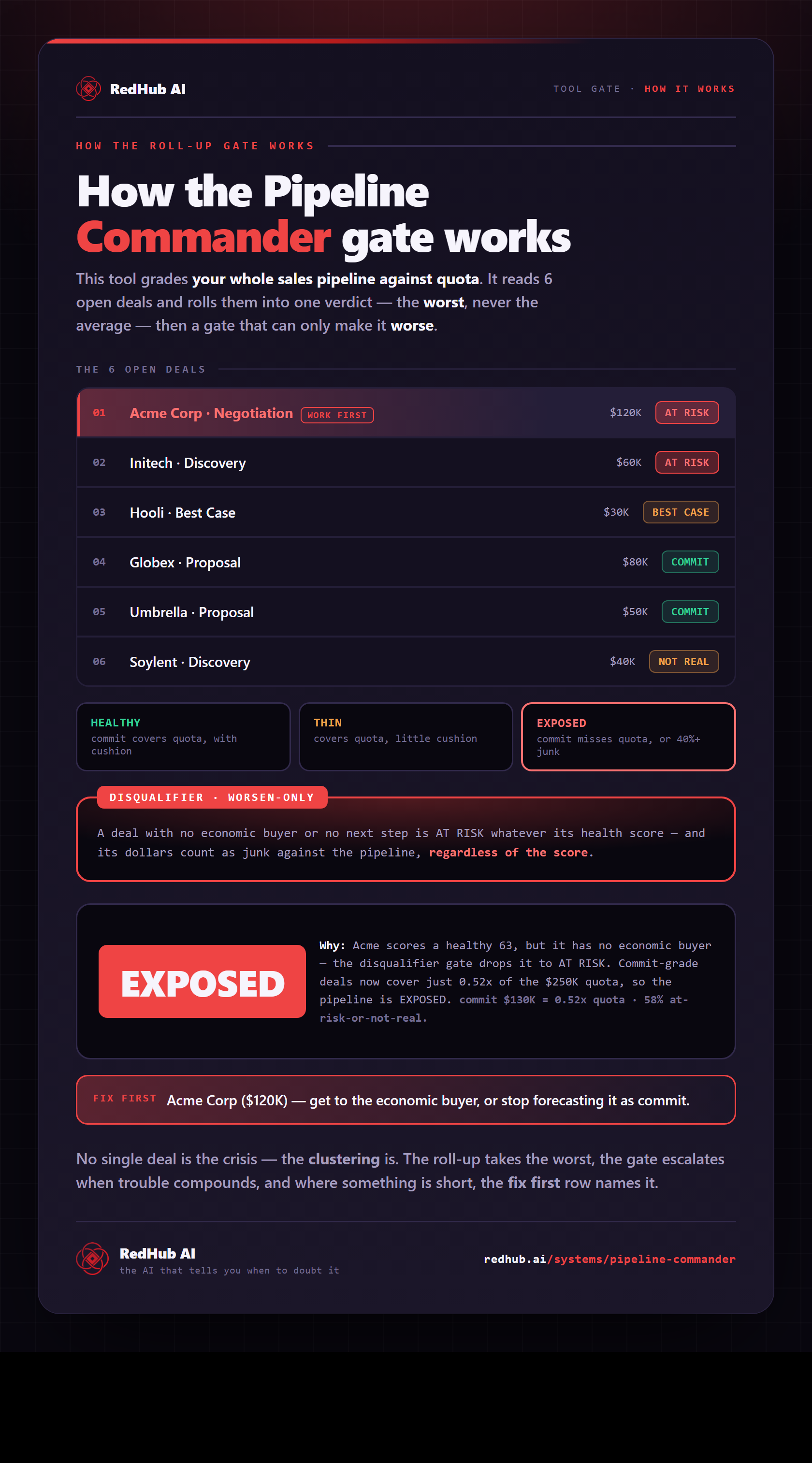
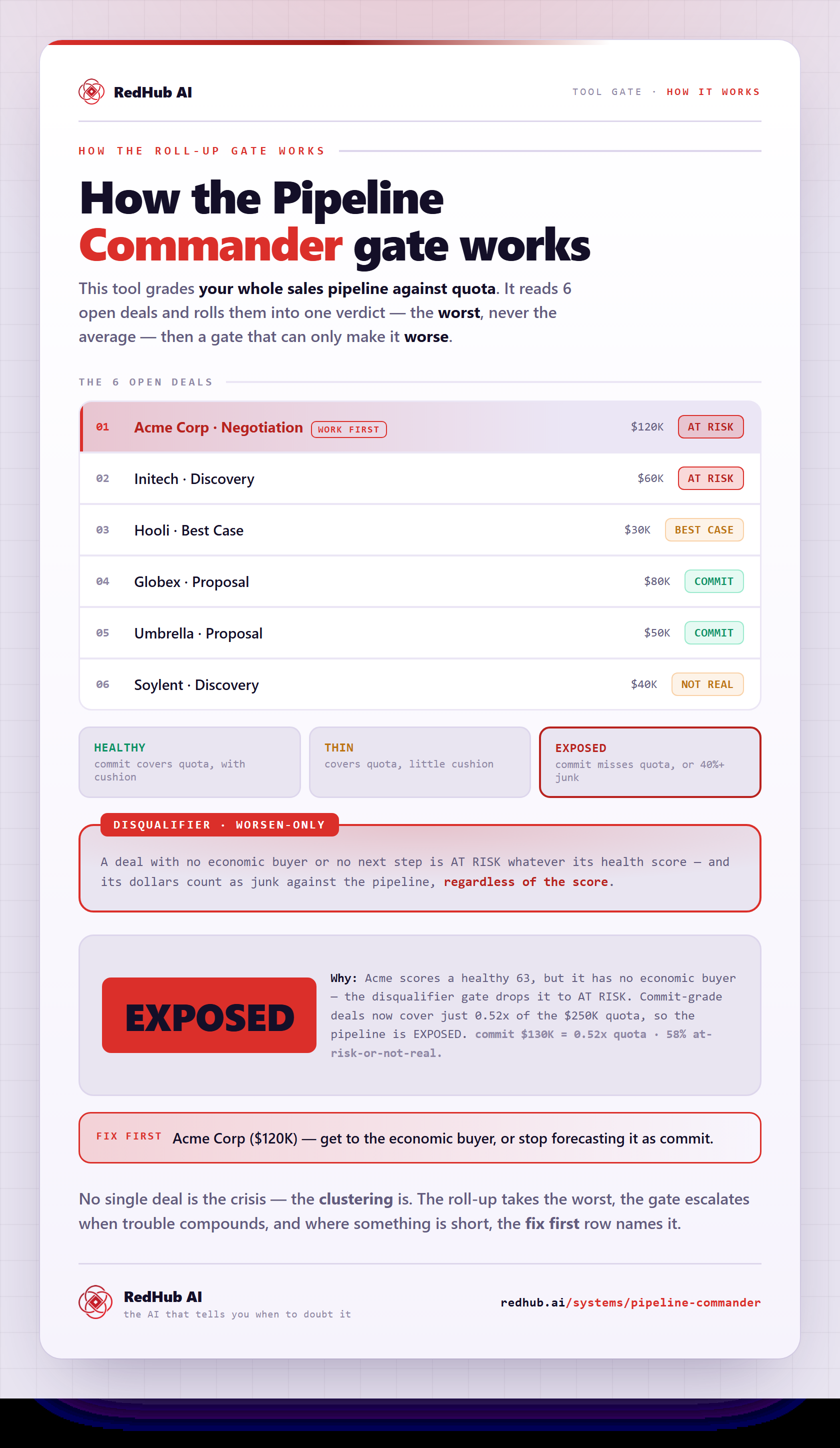
The gate this post refers to, drawn from the tool’s own logic. See the tool.