Sales Pipeline Management: Grade Deals, Not Hope
RedHub AI Editorialupdated September 7, 20265 min read

Jump to a section11
- TL;DR
- What is sales pipeline management?
- Why pipelines lie
- The four honest grades a deal can carry
- The disqualifier gate: what actually makes a deal at risk
- From deal grades to a pipeline verdict
- Why grading beats a stage-based forecast
- What sales pipeline management can't do
- Decision Guide
- More in this guide
- FAQ
TL;DR
- What it is: sales pipeline management is keeping an honest, current view of which open deals are real and what to do next.
- Who it's for: founders and sales-led operators running their own pipeline — see RedHub systems.
- How it works: grade every open deal on qualification — an economic buyer and a real next step — not the stage or dollar amount a rep typed in.
- Bottom line: a pipeline is only worth what's actually qualified inside it. Pipeline Commander grades every deal so you know what's real.
What is sales pipeline management?
Sales pipeline management is the ongoing work of tracking every open deal, checking whether it's actually qualified, and deciding what to work next. It is not the CRM software itself, and it is not the list of stages a rep drags a deal through. The discipline is qualification plus a real next step on every deal — a pipeline that looks big on a dashboard but is full of deals missing both is not healthy, no matter what the total says.
Best for: founders and sales-led operators who run their own pipeline review and don't have a VP of Sales to grade it for them. Pipeline Commander reads your CRM and grades every open deal automatically.
A pipeline report can say $2 million and still be worth almost nothing. The number on the dashboard comes from stages and dollar amounts a rep typed in — not from whether the deal is actually real. Sales pipeline management is the discipline that closes that gap: grading every open deal on what's actually true about it, not on what looks good in a meeting.
Why pipelines lie
Reps aren't dishonest on purpose. They're optimistic, and optimism is a job requirement. But that optimism means a deal gets marked "Proposal" because a call went well, not because a buyer confirmed anything. Multiply that across twenty or fifty open deals and the pipeline total becomes a story the team tells itself — not a forecast anyone should plan a hire or a spending decision around.
The four honest grades a deal can carry
Instead of trusting the stage a rep set, grade every deal on what's actually confirmed. Four grades cover it:
| Grade | What it means | What to do |
|---|---|---|
| COMMIT | Qualified and on track — the signals back up the close date | Protect it, don't over-manage it |
| BEST CASE | Could close, but a real risk or open question remains | Confirm the missing piece before you count on it |
| AT RISK | Missing an economic buyer or a real next step — whatever the stage says | Fix the gap or requalify before the next review |
| NOT REAL | No qualification signal at all — a stage a rep set with nothing behind it | Pull it from forecast; work it or drop it |
The disqualifier gate: what actually makes a deal at risk
Key insight: a deal missing an economic buyer or a real next step is AT RISK no matter its stage or dollar amount. A $50,000 deal sitting in "Proposal" for two months with no confirmed next step is not more real than a $5,000 deal at "Discovery" with a signed next step on the calendar. Stage and size describe hope. The gate describes reality.
From deal grades to a pipeline verdict
Once every open deal is graded, the whole pipeline gets one honest verdict against quota: HEALTHY, THIN, or EXPOSED. The verdict comes from how much of the pipeline is actually qualified, not from the raw total — and it should point to the one deal worth working first, not just a scoreboard.
Check your own pipeline's health
Put in your own numbers to see a rough read on your coverage. This is illustrative arithmetic on your inputs, not a promised verdict — it mirrors the shape of the check, not the full grading logic.
Why grading beats a stage-based forecast
Traditional forecasting multiplies a deal's dollar value by a percentage tied to its stage — 25% at "Discovery," 75% at "Proposal." That math looks precise, but it inherits the same lie the stage carries. If the stage itself was set on hope, the forecast built on top of it is hope with more decimal places. Grading the qualification signal directly — buyer confirmed, next step confirmed — catches what stage-weighted math never can.
What sales pipeline management can't do
Grading tells you what's real. It doesn't work the deal for you, and it won't fix a motion that's broken somewhere else. If the top of the funnel is thin to begin with, no amount of grading fills it — that's a job for a tool like the Lead-to-Meeting Engine. Once a deal is confirmed qualified, winning it against a competitor is a different skill — that's what the Sales Battlecard Builder is for. And a graded pipeline is one input into the founder's broader operating rhythm, which the Operating Cadence Engine covers end to end.
Know what's actually real in your pipeline
Pipeline Commander reads your CRM, grades every open deal COMMIT / BEST CASE / AT RISK / NOT REAL, calls the whole pipeline HEALTHY / THIN / EXPOSED against quota, and, where anything needs working, names the one deal to work first. Read-only — it grades and hands you the review; you work the deals.
Get Pipeline Commander — $249 →Decision Guide
Use it if: you run your own pipeline reviews and don't have a senior sales leader grading deals for you.
Skip it if: you track a small handful of deals from memory, or you already run a rigorous manual qualification check every week.
Best first step: pull your open pipeline and put a confirmed economic buyer and a real next step against every deal this week — or let Pipeline Commander do it automatically.
More in this guide
FAQ
What is sales pipeline management?
Keeping an honest, current view of which open deals are real and what to do next. The discipline is qualification and a next step on every deal, not the stage or dollar amount a rep typed in.
What does it mean for a pipeline to be "healthy"?
It means enough of the pipeline is actually qualified — confirmed buyer, confirmed next step — to cover quota, not that the raw total looks big on a dashboard.
Isn't the stage enough to track a deal?
No. A stage tells you where a deal sits in a process, not whether anything real is behind it. A deal can sit in "Proposal" for months on hope alone.
What is a disqualifier?
A missing signal that makes a deal AT RISK no matter its stage or size — most commonly no confirmed economic buyer, or no real next step on the calendar.
Does grading replace a sales manager?
No. It gives a founder or manager the honest read fast, so the review time goes into deciding what to do, not into deciding what's true.
How is this different from a normal CRM pipeline report?
A CRM report shows the stage and dollar amount a rep typed in. Grading checks the qualification signals underneath — whether a buyer and next step are actually confirmed.
Will this book meetings or send emails for me?
No. It's read-only — it reads your CRM, grades the deals, and hands you the review. You still work the deals yourself.
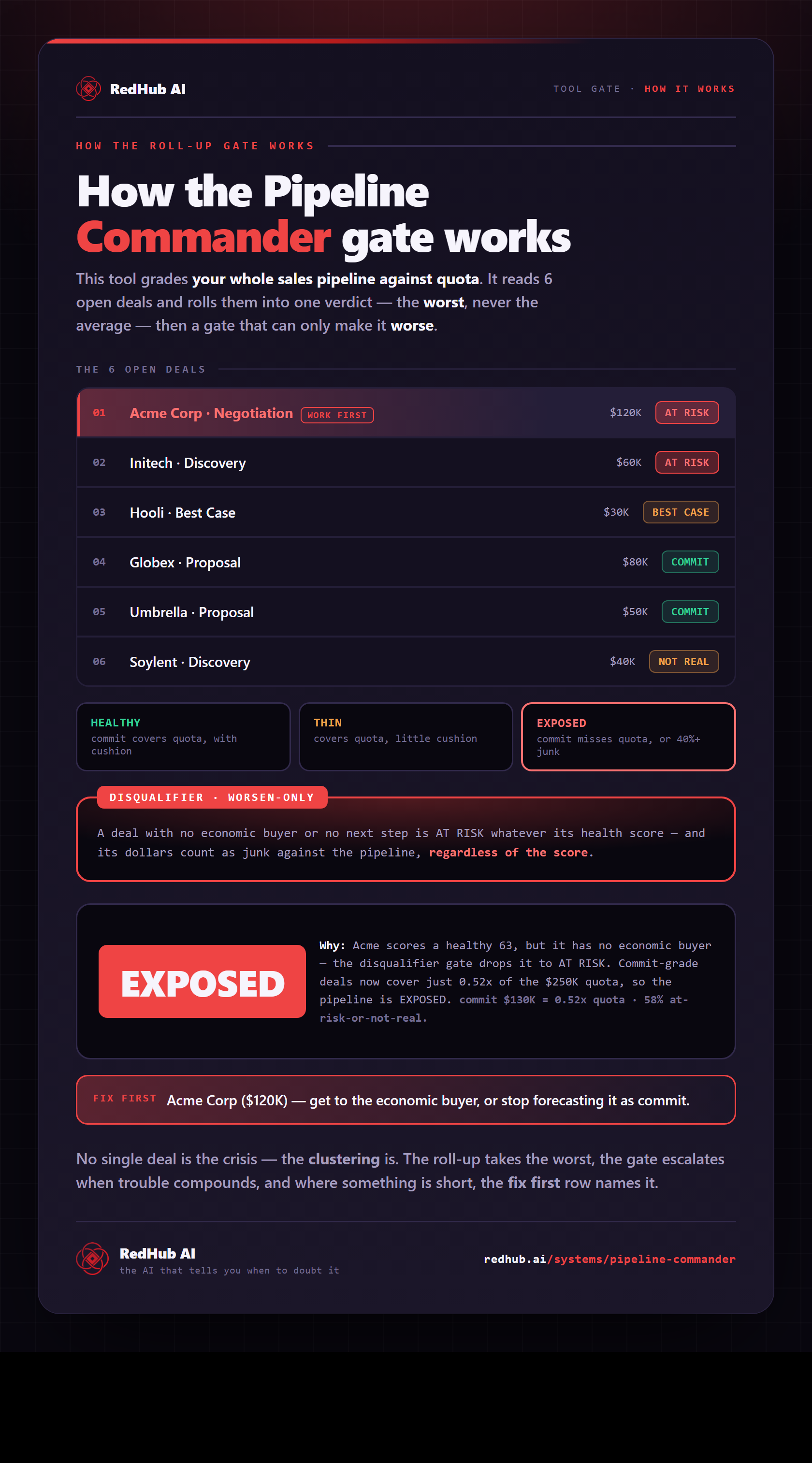
The gate this post refers to, drawn from the tool’s own logic. See the tool.