Sales Pipeline Qualification Grading, Explained
Todd Brooks, Founderupdated July 22, 20266 min read

Jump to a section10
- TL;DR
- What is sales pipeline qualification grading?
- Your Pipeline's Two Most-Trusted Numbers Are the Two Most Inflated
- Why Stage and Amount Are the Wrong Things to Trust
- Five Dimensions That Actually Predict a Close
- The Disqualifier That Catches the Deals That Were Never There
- What an Honest Pipeline Review Actually Names
- What This Doesn't Do
- Decision Guide
- FAQ
TL;DR
- What it is: Sales pipeline qualification grading scores each deal on five checkable signals — not on stage and amount, the two fields most prone to optimism.
- The problem: Stage and amount get rounded up deal by deal, until a pipeline built on hope looks genuinely healthy.
- The fix: Grade the qualification directly. Two missing signals — no economic buyer, or no next step — flag a deal at-risk no matter its stage or size.
- Bottom line: A modest, well-qualified deal beats a big late-stage one nobody's actually validated.
What is sales pipeline qualification grading?
Sales pipeline qualification grading is a way of scoring deals on how qualified they actually are — not on stage or amount. Instead of trusting the two fields most prone to optimism, it checks five specific, verifiable signals about each deal: a real economic buyer, a concrete next step, a champion, a stated pain, and a reason to act now. Deals roll up into an honest status — committed, best case, at risk, or not real — and two missing signals can override the whole score.
Best for: Founders forecasting off a CRM pipeline who suspect the total is more hopeful than real. This is the sales-honesty check inside a founder's AI executive system.
Your Pipeline's Two Most-Trusted Numbers Are the Two Most Inflated
Ask most founders how the pipeline is doing, and the answer comes from two fields: what stage the deals are in, and what they're worth. Those are also the two fields most likely to be optimistic rather than accurate. Not because reps are dishonest — because stage and amount are exactly what a hopeful read rounds up, deal by deal, until a pipeline that looks healthy is quietly built on hope instead of qualification. Sales pipeline qualification grading fixes that. It grades deals on what actually predicts a close, not on the two fields easiest to inflate.
Why Stage and Amount Are the Wrong Things to Trust
A deal doesn't reach "late stage" because it's truly further along in the buyer's decision. It often gets there because a rep had a good call, felt optimistic, and updated the field to match the feeling — not a verified fact about where the buyer stands. The amount field does the same thing. It reflects the best-case scope of a deal, not what's actually been discussed and agreed.
None of this is usually deliberate. It's optimism, compounding quietly across dozens of deals, until a report built from stage and amount paints a picture that's more hopeful than true. A founder planning around that picture is planning around hope.
Five Dimensions That Actually Predict a Close
A real qualification grade doesn't ask what stage a deal is in. It asks five specific, checkable questions about the deal itself.
| Signal | The question it forces |
|---|---|
| Economic buyer | Are you actually talking to someone with authority to approve this — or to someone who still has to go convince the real decision-maker? |
| Next step | Is there a concrete, scheduled next action — or has it drifted into "following up soon" with no plan? |
| Champion + multithread | Is there a genuine internal advocate, and is the relationship spread across more than one person — or does the deal live or die with a single contact? |
| Pain + value | Has the buyer named a real, specific problem this solves — in their words, not just your pitch? |
| Compelling event | Is there a real reason to act now — or is the timeline entirely soft, with no forcing function? |
Each deal gets scored honestly on these five. They roll up into a health score and a status — committed, best case, at risk, or simply not real — that reflects what's true about the deal, not what the stage field claims.
The Disqualifier That Catches the Deals That Were Never There
Two conditions override the entire score. A deal missing an engaged economic buyer, or missing a concrete next step, gets flagged at-risk — regardless of stage, regardless of dollar amount, regardless of how healthy every other signal looks.
A large, late-stage deal with no real access to the decision-maker and no scheduled next action isn't a large, late-stage deal. It's a deal that was never qualified, dressed up in a stage and amount field that made it look further along than it was. And it's exactly the kind of deal that inflates a pipeline the most — big numbers in late stages, carrying the total, closing nothing.
Grade a deal in five taps
Tap each signal that's genuinely confirmed for a deal. Missing an economic buyer or a next step triggers the disqualifier — no matter what the others say.
What an Honest Pipeline Review Actually Names
The output of a real grade isn't a single overall health number. It's a portfolio verdict — healthy, thin, or exposed against quota — paired with something more useful than a summary statistic: the single deal that most needs attention right now. Not a list of everything wrong at once. A clear, prioritized answer to "if I could only work one deal today, which one actually needs it?"
What This Doesn't Do
Be explicit about the limits. It reads the pipeline and delivers the review. It doesn't edit a deal, change a stage, send an outreach email, or update the CRM on its own. The read is delivered; the action stays with the founder or the sales team. And it doesn't invent a deal or a data point that isn't already in the CRM. It grades what's actually there, honestly — instead of filling optimistic gaps the way a hopeful stage field does.
Decision Guide
Use it if: You forecast off a CRM pipeline and you've been burned by "sure things" in late stages that quietly died — the classic sign that stage and amount are carrying more weight than qualification.
Skip it if: You already run a disciplined qualification framework on every deal and your late-stage forecast reliably closes.
Best first step: Take your three biggest open deals and check just two things on each — is there a confirmed economic buyer, and is there a scheduled next step. Any "no" is a deal you're counting on that isn't yet real.
FAQ
What is sales pipeline qualification grading, in plain terms?
It's scoring deals on how qualified they really are — five checkable signals like economic buyer and next step — instead of trusting stage and amount, the two fields most likely to be rounded up.
How is this different from a standard CRM pipeline report?
A standard report summarizes stage and amount — the two fields most prone to optimistic inflation. This grades qualification directly, using five separate signals that are harder to fudge than a stage dropdown.
What happens to a deal that gets flagged at-risk?
It's not necessarily dead. It's a signal that something specific is missing — usually economic-buyer access or a concrete next step — before you should count on it. The flag names exactly what's missing, which is the actionable part.
Can a small, early-stage deal score higher than a large, late-stage one?
Yes, and that's often the point. A modest deal with a real economic buyer, a real next step, and a genuine compelling event can be more reliable than a large deal sitting in a late stage with none of those confirmed.
Does this connect directly to my CRM?
It reads open deals from a connected CRM (HubSpot or GoHighLevel) to build the grade. It's read-only and doesn't modify anything in your live system.
Where does this fit with stress-testing decisions and my cash?
It's the sales check of three. Pair it with a Devil's-Advocate Board for strategic honesty and a Cash-Flow Sentinel for financial honesty. See how they fit together in the AI executive systems overview.
Grade your pipeline on what actually closes
Stop forecasting off the two fields reps inflate most. Score every open deal on real qualification — and surface the one deal that needs you today.
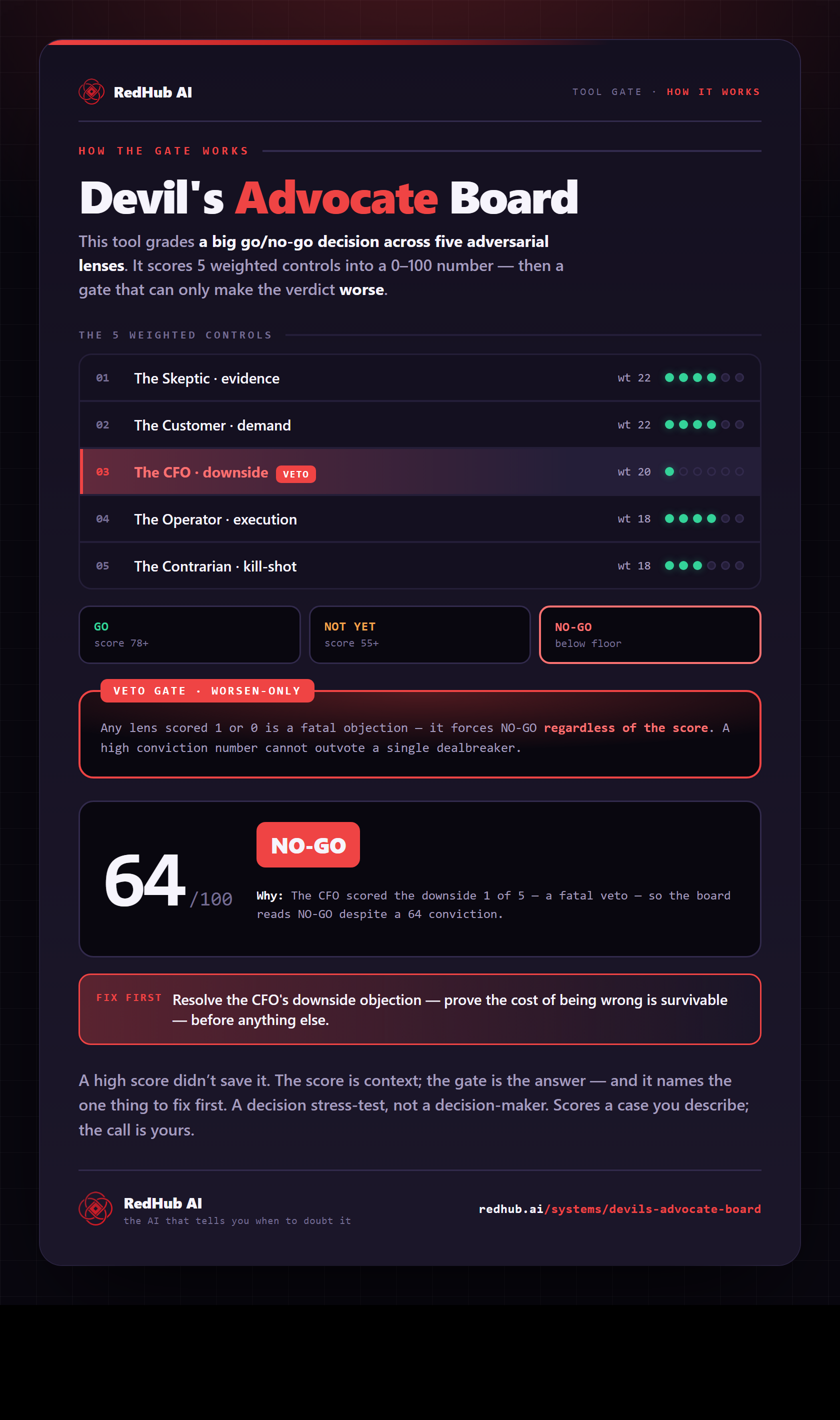
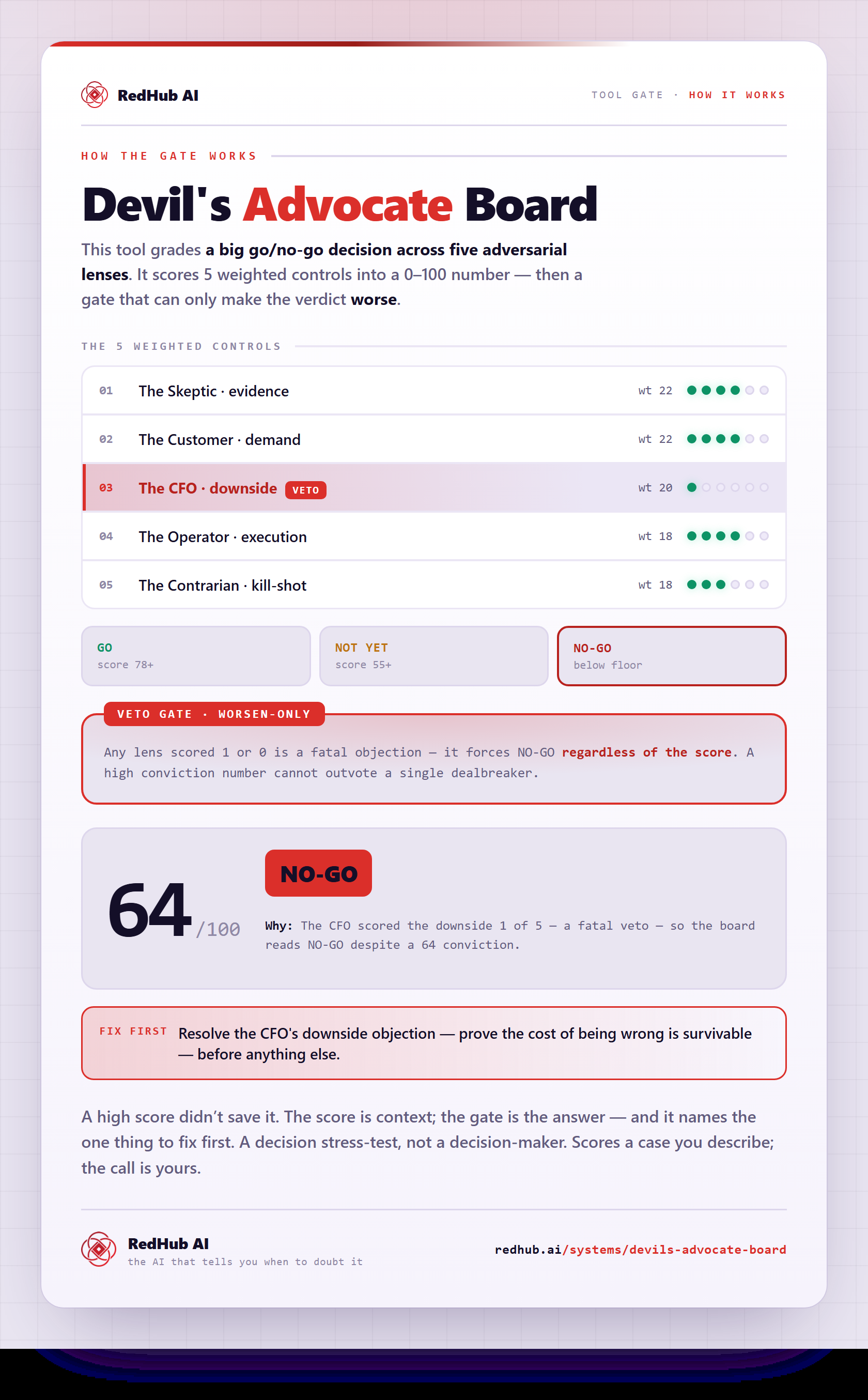
The gate this post refers to, drawn from the tool’s own logic. See the tool.