

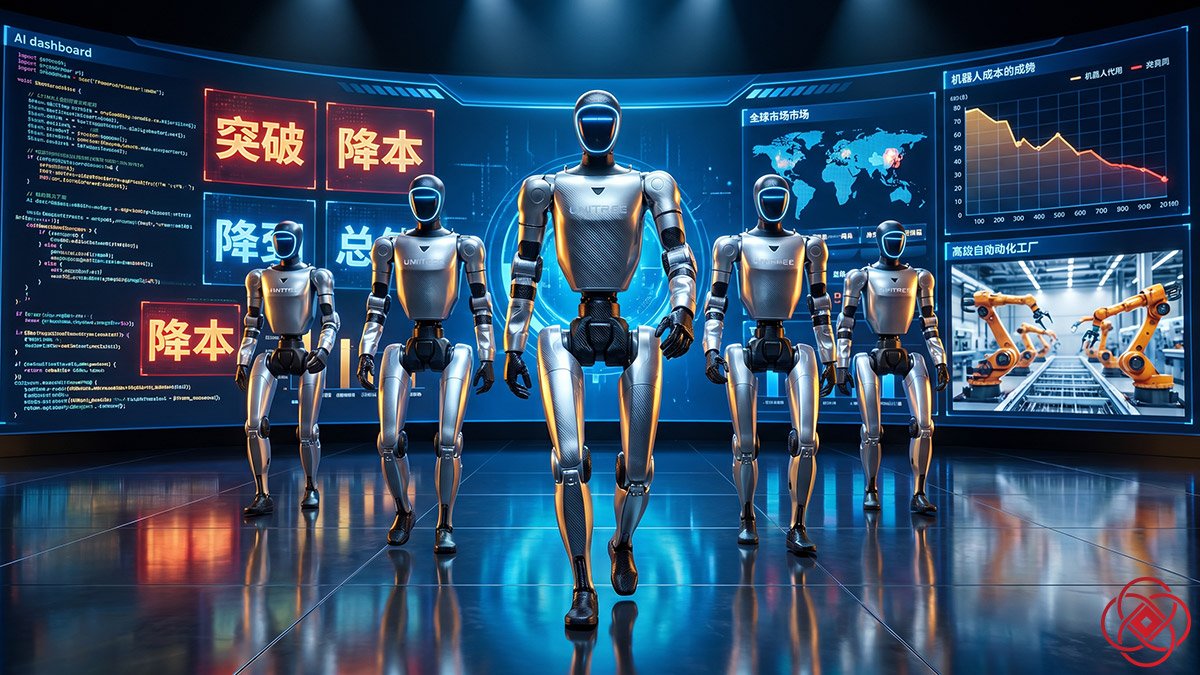
Unitree Robotics Humanoid Robots Explained
⏱️ 13 min read
TL;DR
- What it is: Unitree Robotics is the world's #1 seller of humanoid robots, shipping over 5,500 units in 2025 at prices starting at $13,500 — powered by embodied AI that learns from real-world factory environments.
- Who it's for: Businesses planning automation strategies, founders watching AI hardware trends, and anyone tracking how Chinese open-source AI ecosystems are disrupting physical robotics at scale.
- How it works: Unitree combines vertical integration, proprietary embodied AI (UnifoLM), open-source data sharing, and China's manufacturing supply chain to drop costs 40% annually while maintaining 60%+ gross margins.
- Bottom line: The same forces driving Chinese AI model cost advantages — efficiency, open ecosystems, state-backed scale — now apply to humanoid robots, and Unitree is leading the commercial breakthrough.
What Are Unitree Robotics Humanoid Robots?
Unitree Robotics humanoid robots are commercially available, AI-powered robotic platforms that combine hardware and embodied intelligence to perform real-world tasks in manufacturing, research, and commercial environments. Unitree shipped over 5,500 humanoid units in 2025 — representing roughly one-third of global humanoid robot output — at an average selling price of $25,000, with flagship models now available for $13,500.
Best for: Businesses evaluating automation ROI, robotics developers building on open-source AI ecosystems, and operators tracking Chinese AI hardware momentum.
Not ideal for: Companies expecting plug-and-play consumer robots or applications requiring fully autonomous decision-making without human oversight.
In February 2026, during China's Spring Festival Gala — the most watched television broadcast on earth — a fleet of humanoid robots performed a live kung fu routine on national television.
They moved in unison. They held their balance. They executed synchronized kicks and blocks with timing that would have been impossible for any robot on the planet five years earlier.
The company that built those robots was not Boston Dynamics. It was not Tesla. It was not a Silicon Valley startup burning through a billion-dollar Series C.
It was Unitree Robotics, a company headquartered in Hangzhou, China, founded less than a decade ago by a 25-year-old engineer named Wang Xingxing — and today recognized as the number one seller of humanoid robots anywhere in the world.
What Unitree has done — and is continuing to do in 2026 — is not just a robotics story. It is the clearest, most physical demonstration of what happens when AI stops living in a server rack and starts moving through the world. It is what the industry calls embodied intelligence. And Unitree is moving faster on it than almost anyone else.
Watch AGT- Unitree’s Robots Leave Simon Cowell SPEECHLESS!:
The Numbers That Define Unitree Right Now
Before we get into the technology, let us look at the business, because the numbers are the part most people have not seen yet.
In 2025, Unitree shipped more than 5,500 humanoid robots — officially confirmed in a company statement in January 2026 specifically issued to correct online misinformation. The company was explicit: that figure represents units actually sold and delivered to end customers, not order volume. Total mass production output exceeded 6,500 units.
For context, the global humanoid robot market shipped an estimated 16,580 units in total in 2025, according to Yano Research Institute's Global Humanoid Robot Market 2026 report. Unitree's 5,500+ units represent roughly one-third of the entire planet's humanoid robot output in a single year. Chinese companies collectively accounted for approximately 84.8% of all global humanoid robot shipments.
Revenue tells the same story. Unitree reported 1.708 billion yuan ($250 million) in 2025 revenue — a 335% year-over-year increase. Net profit hit 278 million yuan, a 194% improvement from 2024. The gross margin on its main business reached 60.27% for the full year — margins closer to a luxury spirits brand than to any hardware manufacturer most investors have ever seen.
And the price trajectory is moving in a direction that should terrify every American robotics company watching from the sidelines.
In 2023, Unitree's humanoid robots averaged 593,400 yuan per unit — roughly $85,000. By the first three quarters of 2025, the average selling price had dropped to 167,600 yuan — roughly $25,000. Today, the flagship G1 humanoid lists on Unitree's website at $13,500.
Margins going up while prices fall sharply. That is the signature of a company whose production costs are declining faster than its selling prices. It is the same dynamic that made solar panels and lithium batteries into commodities that reshaped global energy markets. And it is happening right now, in humanoid robotics, led by a company in Hangzhou.
What Unitree Robotics Humanoid Robots Actually Do
The G1 is Unitree's flagship humanoid. It stands 127 centimeters tall, weighs 35 kilograms, and moves on 23 to 43 high-precision joint motors depending on configuration. It is commercially available today, ships globally, and costs $13,500.
That price point matters because it breaks a psychological barrier. Comparable humanoid platforms from American companies — when available at all — are priced at $150,000 to $300,000. Tesla's Optimus is not yet independently purchasable. Figure AI's robots are deployed in limited commercial pilots. Unitree is shipping at scale, at a consumer-accessible price, right now.
But what makes the G1 worth discussing in a blog about AI is not the hardware. It is what is running on it.
Unitree's answer to the question of "how do you make a robot intelligent" is called UnifoLM — the Unitree Unified Large Model. It is Unitree's proprietary embodied AI system, designed to give the G1 the ability to understand its environment, plan actions, and execute tasks without explicit step-by-step programming for every scenario.
In February 2026, Unitree published a video showing its G1 humanoid robot assembling precision motor components on a live factory workbench — not in a demonstration environment, but on Unitree's own production floor. The system running the robot was UnifoLM-X1-0, the initial production version of the embodied AI model. Instead of relying entirely on simulated training data, Unitree uses its own manufacturing lines as a training environment — the robot collects behavioral data while performing real assembly tasks, which in turn trains the next generation of the model. Robots building data for robots. A closed-loop learning system.
Unitree's Vice General Manager Wang Qizhou described the direction plainly: the company is shifting from pre-trained systems — where behavior is baked in before deployment — to autonomous adaptive systems that continue learning from real-world experience after deployment. The long-term internal target is what CEO Wang Xingxing calls the "80/80 goal" — robots capable of handling 80% of tasks in 80% of environments. Most industry observers see that threshold as the genuine commercial breakthrough for humanoid robotics.
The AI Architecture Behind the Hardware
To understand what Unitree is building at the software layer, you have to understand the AI problem that humanoid robotics actually solves.
The challenge is not making a robot that can do one thing well. Industrial robots have done that for decades. The challenge is making a robot that can transfer learned behavior across new situations — picking up an object it has never seen before, navigating a space it has never mapped, responding to an unexpected event in real time.
This is the embodied intelligence problem. And solving it requires combining three types of AI capability:
Perception: Understanding what the robot's sensors are telling it about the physical world — position, force, visual data, spatial geometry.
Planning: Using that perception to model possible action sequences and choose the right one given a goal.
Execution: Converting planned actions into precise motor commands across 23 to 43 joints simultaneously, in real time, with continuous feedback loops.
Unitree’s UnifoLM architecture bridges these three layers. The model is trained on imitation learning — where the robot observes human demonstrations and learns to replicate them — combined with reinforcement learning, where the robot receives feedback on task success and adjusts its behavior accordingly. The open-sourced G1 manipulation dataset, which Unitree published on GitHub in late 2024, includes dexterous hand manipulation data, gripper manipulation data, and dual-arm operation sequences, adapted to mainstream imitation learning algorithms including Diffusion Policy and ACT.
This open-source strategy is deliberate. Unitree is doing what Qwen and DeepSeek did in the large language model space: releasing core data and tooling to the global developer community, seeding an ecosystem, and benefiting from external contributions back into the platform. The G1 robot page explicitly advertises that its ecosystem is "adapted to a variety of open source solutions" and "continuously updated."
The result of this approach showed up at the 2026 Spring Festival Gala. Compared to the 2025 Gala performance — already impressive by any prior standard — the 2026 robots showed measurably smoother joint motion, tighter formations, and better balance recovery. One year of real-world deployment data and model iteration had produced visible improvement. That is how embodied intelligence compounds.
The Cost Advantage Is Not Accidental
Unitree’s pricing power comes from a decision made early in the company's history: build everything in-house.
Where American robotics companies often rely on third-party suppliers for motors, reducers, sensors, and structural components, Unitree designs and manufactures its own core components. The company's IPO prospectus attributes the 60%+ gross margins directly to this vertical integration — self-designed motors, reducers, mechanical structures, and control systems that give Unitree procurement leverage as volumes scale.
The broader Chinese supply chain compounds this advantage. According to the Humanoid Robot Supply Chain report published by Robotics Center in April 2026, the localization rate of core components in China's humanoid robot ecosystem now exceeds 80%. Domestic joint module prices have fallen from over 1,000 yuan per module to the hundreds-of-yuan range. Complete machine costs have dropped from the million-yuan range to the hundreds-of-thousands.
Production costs are declining at roughly 40% annually — significantly faster than the 15-20% that analysts estimated just one year ago, according to Forbes' April 2026 analysis of the humanoid market.
This is the same dynamic that played out in electric vehicles, solar panels, and — as this blog has covered — AI model training and inference. When a country has the manufacturing depth, the supply chain integration, and the cost-reduction flywheel in motion, it is extraordinarily difficult for competitors to close the gap on price without matching the structural advantages underneath it.
The IPO Filing: What the Prospectus Reveals
On March 20, 2026, Unitree filed for an initial public offering on Shanghai's STAR Market — the exchange designed for high-technology companies, analogous to the Nasdaq in structure.
The filing seeks to raise approximately 4.2 billion yuan ($607 million). The company's founder Wang Xingxing holds a 23.8% direct equity stake and controls nearly 69% of voting rights. External backers include Meituan, HongShan China (formerly Sequoia China), Matrix Partners China, Tencent, Alibaba, Ant Group, Xiaomi, ByteDance, BYD, and Geely — alongside state-backed funds from Shanghai and Beijing.
The IPO was scheduled for regulatory review on June 1, 2026, according to Gasgoo reporting from May 27, 2026.
The prospectus paints an unambiguous financial picture. Revenue grew from 159 million yuan in 2023 to 392 million yuan in 2024 to 1.699 billion yuan in 2025. Net profit swung from a loss of 11 million yuan in 2023 to 278 million yuan in 2025. In Q1 2026, revenue reached 423 million yuan — up 68.5% year-over-year, showing growth continues even as the base gets larger.
The honest caveat in the prospectus: net profit after deducting non-recurring items fell 52.6% in Q1 2026 as R&D and selling expenses rose sharply. Unitree is reinvesting aggressively. The company's guidance for the first half of 2026 projects revenue of 1.05 to 1.13 billion yuan — strong top-line growth with compressed near-term margins as it scales the sales organization and model development in parallel.
Forbes called Unitree's IPO "a bellwether for China's emerging humanoid robotics industry." That is not hyperbole. It is the first company in the world to bring a fully commercial humanoid robot business to public markets with this level of unit volume, revenue, and margin transparency.
What Unitree Means for Builders and Businesses
Here is the practical implication for anyone reading this who is thinking about their own AI strategy.
Unitree is the most concrete proof yet that the Chinese open-source AI model — build at efficiency, release broadly, iterate fast, undercut on price — works beyond software. It works in hardware. It works in physical AI. It works in the kind of application that requires not just tokens and inference but motors, joints, sensors, and the ability to navigate a factory floor.
The Unitree G1 is to humanoid robotics what DeepSeek was to large language models: a product that crossed the quality threshold at a price point that no Western competitor had thought possible, built on engineering discipline rather than capital excess.
For businesses thinking about automation, the signal is clear. The cost of a capable robotic platform has already dropped from $150,000 to $13,500 in the span of a few product cycles. Yano Research projects global humanoid robot shipments to grow from 16,580 units in 2025 to 81,690 units in 2026 — a 492% increase in a single year. The 2035 forecast is 7.18 million units annually.
The adoption curve of humanoid robotics is now moving at AI model speed — which means fast enough that businesses which wait for the technology to feel mainstream before paying attention will spend years catching up to competitors who understood the trend early.
For the founders, operators, and builders reading this: you do not need to buy a $13,500 robot today. But you should understand that the same force driving DeepSeek's cost advantage in AI tokens — Chinese engineering efficiency, vertical integration, open-source ecosystems, and state-backed manufacturing scale — is now producing a similar disruption in physical robots.
The intelligence left the server rack. And it has learned how to do a backflip.
How It All Connects
Unitree is the fourth chapter in a story that this blog has been building.
The first chapter was the Chinese open-source AI model ecosystem — Qwen, DeepSeek, Kimi, MiniMax — dominating developer downloads and forcing a re-evaluation of what AI truly costs.
The second chapter was the economics: token pricing gaps of 87-98%, hybrid stack strategies, and the business case for owning versus renting intelligence.
The third chapter was capital: Hong Kong's IPO boom, MiniMax and Zhipu going public, Moonshot raising at $20 billion, the $16.2 billion Q1 2026 Chinese AI funding surge.
This fourth chapter is where all of it converges. Unitree is the company that takes cheap, efficient, open-source AI — the same ecosystem this blog has been covering — and puts it into a physical body that can assemble components on a factory floor, perform a kung fu routine in perfect formation, and walk through -47°C cold weather for 130,000 steps in a test of hardware resilience.
The AI race is no longer just about who writes the best code. It is about who builds the most efficient model, runs it at the lowest cost, raises capital through the most effective markets, and ultimately deploys it into the physical world at the fastest pace.
On every one of those dimensions, the Chinese ecosystem that this cluster of posts has been examining is moving faster than most Western observers have acknowledged.
The question is not whether this shift is happening. It already has happened. The question is whether your business understands it in time to act on it.
Decision Guide
Use it if: You're evaluating automation ROI for manufacturing or logistics, building on open-source robotics ecosystems, or tracking Chinese AI hardware trends for strategic planning.
Skip it if: You need fully autonomous consumer robots without oversight, expect plug-and-play deployment without technical integration, or operate in sectors with no near-term automation use case.
Best first step: Review Unitree's open-source G1 manipulation dataset on GitHub to assess technical compatibility with your stack, then model cost savings at $13,500/unit versus current labor or automation costs.
FAQ
What are Unitree Robotics humanoid robots in simple terms?
Unitree Robotics humanoid robots are commercially available, AI-powered machines that walk, manipulate objects, and perform tasks in real-world environments like factories and research labs. They're priced starting at $13,500 — drastically lower than competitors — and are powered by embodied AI that learns from real-world data rather than just simulations.
How does Unitree compare to Tesla's Optimus or Boston Dynamics robots?
Unitree shipped over 5,500 humanoid robots in 2025 at prices starting at $13,500, making it the world's #1 seller by volume. Tesla's Optimus is not yet commercially available for independent purchase, and Boston Dynamics' humanoid platforms are priced at $150,000 to $300,000 when available. Unitree is shipping at scale today, while most Western competitors are still in pilot or limited deployment phases.
How long does it take to see ROI from deploying Unitree humanoid robots?
ROI timelines vary by use case, but at $13,500 per unit, Unitree robots break even significantly faster than traditional industrial automation. For repetitive manufacturing tasks replacing human labor at $15-$25/hour, businesses can expect payback periods under 12-18 months depending on deployment scale and integration costs. The real advantage accelerates as the robots continue learning and improving task performance over time.
What makes Unitree's pricing so much lower than American robotics companies?
Unitree achieves 60%+ gross margins while selling at $13,500 through vertical integration — designing and manufacturing its own motors, reducers, and sensors in-house. Combined with China's deep supply chain ecosystem where component localization exceeds 80%, production costs are declining at 40% annually. This matches the same cost-reduction flywheel that disrupted solar panels, EVs, and AI model inference pricing.
Who benefits most from Unitree humanoid robots?
Manufacturers running high-volume assembly lines, logistics operators managing warehouse tasks, and robotics developers building on open-source AI ecosystems benefit most. Unitree's open-source strategy (similar to DeepSeek in LLMs) means developers can access manipulation datasets and integrate with mainstream imitation learning frameworks, accelerating custom application development.
Can small businesses afford Unitree robots, or are they only for enterprises?
At $13,500, Unitree robots are accessible to mid-sized manufacturers and even some small businesses with automation budgets. This is a 90% price reduction compared to traditional humanoid platforms. The bigger question is technical integration — businesses need basic robotics expertise or partner support to deploy effectively. But the capital barrier has dropped from enterprise-only ($150K+) to accessible for operations with moderate scale.
Is Unitree's embodied AI safe for factory environments with human workers?
Unitree's robots are designed for supervised deployment in structured environments, not autonomous operation in unpredictable spaces. The UnifoLM AI system uses real-time perception and planning, but current deployments involve human oversight and defined task boundaries. As with any industrial automation, proper safety protocols, workspace zoning, and training are required. The robots are not yet fully autonomous decision-makers — they're intelligent assistants that continue learning within defined operational parameters.