

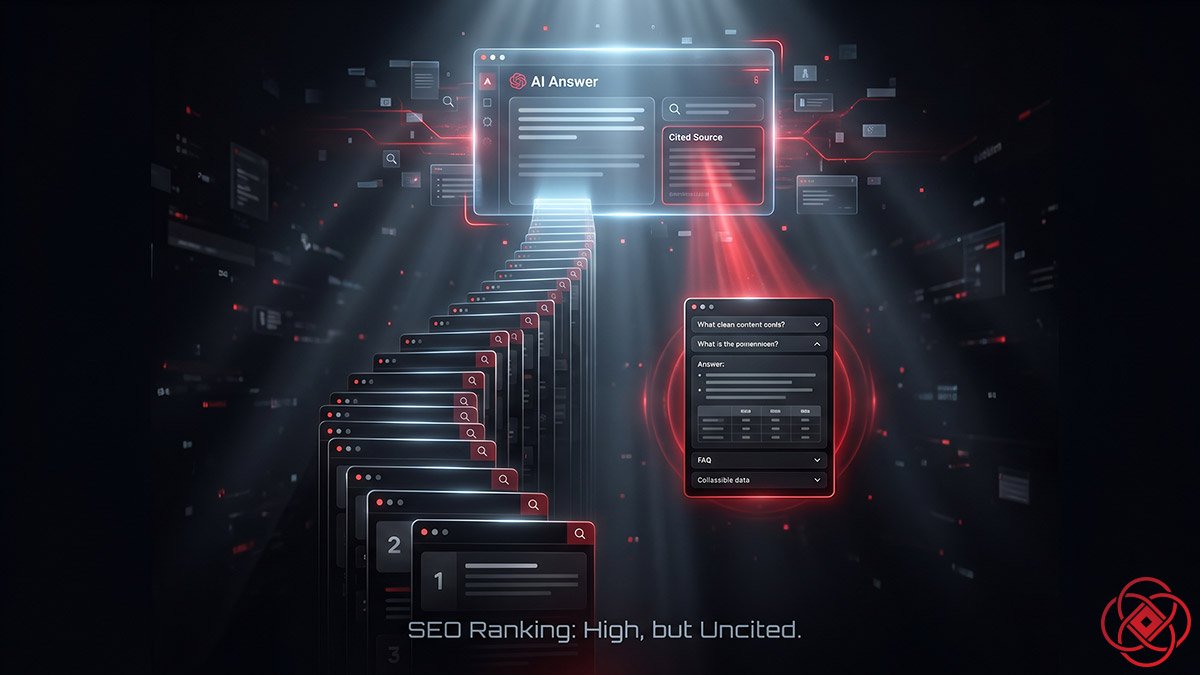
SEO vs GEO: Why Ranking on Google Doesn't Get You Cited by AI
⏱ 8 min read
TL;DR
- The wrong belief: "If I rank on Google, I'll show up in AI answers too." Industry research puts the overlap between top Google links and AI-cited sources below 20%. Rankings don't carry over automatically.
- Why: a search engine returns a list and lets the user choose. An answer engine does the choosing — it retrieves a handful of sources, writes one answer, and cites two to seven of them by name.
- What SEO still does: it helps you get retrieved and read. That matters. But being read isn't being cited.
- What GEO adds: crawlability for AI bots, answer-first structure, extractable schema, multi-source corroboration, and measurement of where you actually get named.
- The honest part: GEO improves your odds of citation. It does not guarantee one. AI answers vary by user, region, and day.
What's the difference between SEO and GEO?
SEO (search engine optimization) is the work of ranking a page in a list of links, where the user picks the winner. GEO (generative engine optimization) is the work of getting cited inside the single answer an AI writes, where the engine picks the winner. SEO gets you retrieved and read. GEO makes your content the easiest, most credible thing for the engine to quote and name. You need both, because they solve different halves of the same problem.
Context: this piece goes deep on one wrong belief. For the whole system — the CLEAR framework, engines, and the 30/60/90 plan — read the full GEO guide.
There's a belief holding up a lot of marketing plans right now: "We rank well on Google, so we'll show up in AI answers too." It sounds reasonable. It's also the most expensive assumption in the SEO vs GEO conversation, because it quietly tells you no new work is needed while your buyers move to a channel where you may not exist.
Here's the problem in one sentence. Google shows a list and lets your buyer choose. ChatGPT, Perplexity, and Google's own AI Overviews make the choice for them — they write one answer and name a few sources. If your page ranks first but never gets named, your buyer reads a conclusion you had no part in.
A search engine returns a list. An answer engine makes a choice.
This is the core difference, and everything else follows from it.
A search engine's job ends when it hands over ten links. The user does the reading, the comparing, and the choosing. Your job in SEO is to be high enough on that list to earn the click.
An answer engine's job ends when it hands over a conclusion. Behind the scenes, it retrieves a set of candidate pages, reads them, and writes one synthesized answer — crediting the two to seven sources that shaped it. The user never sees the list of candidates. They see the answer, and the short set of names inside it.
That changes what "winning" means. In search, ten links win something on page one. In an AI answer, a handful of sources win everything, and everyone else is invisible. There is no position eight in a synthesized answer.
Why the overlap is below 20%
If rankings decided citations, the top Google links and the AI-cited sources would mostly match. Industry research says they don't — the overlap runs below 20%. Why?
Because ranking and citing are two different tests, run at two different moments.
Ranking is a popularity-and-relevance test: keywords, links, and hundreds of signals that decide where a page sits in a list. Citing is a usability test: once the engine has retrieved a set of pages, which one hands it a clean, complete, credible answer it can lift and credit? A page can pass the first test and fail the second badly.
Think about what a typical high-ranking page looks like. A long intro before the point. The actual answer scattered across six paragraphs. No schema. A story-first structure written to hold a human reader, not to hand a machine a quotable block. That page ranks fine. But an engine reading it has to work hard to extract the answer — and there's usually another page in the retrieval set that did the work for it.
The blunt version: ranking gets you into the room. It doesn't get you quoted. What gets you quoted is whether your page hands the engine a liftable answer — and whether the rest of the web backs your claim up.
What SEO still does for you
None of this means SEO is dead. That claim is hype in the other direction, and it's just as wrong.
SEO still does real work in an AI-answer world:
- It gets you retrieved. Several answer engines — Google AI Overviews and Gemini most directly — sit on top of a search index. Pages that index and rank well are more likely to make the candidate set the engine reads from.
- It builds the link and mention footprint that engines treat as evidence you're a real, credible entity.
- It keeps the classic channel alive. Plenty of buyers still open Google and click links. That traffic doesn't vanish because a new channel showed up.
So keep your SEO. The mistake isn't doing SEO — it's assuming SEO finishes the job. It gets you read. It doesn't decide whether you get named.
What GEO adds that SEO doesn't
GEO picks up where SEO stops: after retrieval, at the moment the engine decides which sources to quote. Five additions do that work.
- Crawlability for AI bots. SEO checks that Googlebot can read you. GEO checks that GPTBot, OAI-SearchBot, PerplexityBot, ClaudeBot, and Google-Extended can too — and that your content is real HTML, not text that only appears after JavaScript runs. Plenty of sites block these bots without knowing it. Blocked means invisible, no matter how well you rank.
- Answer-first structure. Put a direct, complete answer right under a question-style heading — before the backstory. An engine assembling an answer under pressure quotes the page that already wrote it. This is the single highest-leverage on-page change, and it's the heart of how to get cited by ChatGPT and Perplexity.
- Extractable schema. FAQ and HowTo markup in JSON-LD, real tables, clean lists, plain definitions. Structure lets the engine pull your answer cleanly instead of guessing where it starts and stops.
- Multi-source corroboration. Answer engines cross-check. A claim that appears only on your site is your claim; a claim echoed by reviews, third-party mentions, and community threads is a fact the engine can safely repeat. SEO counts links. GEO cares whether the web agrees with you.
- Measurement of citations, not rankings. Your rank tracker can't see any of this. GEO tracks a different number: for your priority buyer questions, how often does each engine name you versus your competitors? That's citation rate and share of voice — covered step by step in how to measure AI visibility.
SEO vs GEO, side by side
| SEO (search engine optimization) | GEO (generative engine optimization) | |
|---|---|---|
| Goal | Rank a page in a list of links | Get cited inside a synthesized answer |
| Winner's prize | A click the user chose to make | A recommendation, in the answer, by name |
| How many win | Ten links on page one | Two to seven sources, often fewer |
| What matters most | Keywords, links, rankings | Crawlable to AI bots, answer-first structure, extractable schema, corroboration |
| How you check | Rank tracking | Citation rate and share of voice across engines |
Read the last row twice. Most teams that "do GEO" still check the wrong scoreboard. If your only dashboard is a rank tracker, you cannot see whether any of this is working.
Does your SEO carry over? A two-minute check
You don't have to take the overlap number on faith. Run the check yourself.
- Write down the exact question a buyer would ask to find you. Not your keyword — the question. "Best [what you sell] for [who you serve]" or "how do I fix [the problem you solve]."
- Ask it in ChatGPT (with search on) and Perplexity. Read the answer the way a buyer would. Who gets named? Who gets linked?
- Compare against your Google rank for the same query. If you rank on page one but the AI answer names competitors and not you, you've just measured the gap between SEO and GEO on your own brand.
One caution: a single answer is one sample, not a verdict. AI answers are non-deterministic — the same question can produce different source lists for different users, regions, or days. So treat the check as a starting line, not a scorecard. The real measurement is a pattern tracked over weeks, across engines.
The honest part: GEO improves odds, not certainties
Nothing in this piece — and nothing anyone sells you — guarantees a citation. The engines don't work that way. What GEO does is stack the deck: content the bots can read, answers they can lift, structure they can parse, claims the web corroborates, and a tracker that shows whether the trend is moving. That's a real, measurable edge. It is not a switch. Anyone promising "guaranteed AI citations" is selling certainty they don't have.
Close the gap between ranking and being cited
The GEO / AI Visibility Playbook is the treatment: the full CLEAR framework, paste-ready answer-first templates, schema patterns, a live-formula citation tracker, and a 30/60/90 plan — built to run without a technical background. Want the diagnosis first? The AEO Citation Audit Kit — $79 scores where your site stands today, page by page, before you change anything.
Get the GEO / AI Visibility Playbook — $149 →Where to go next
The answer-first version of this whole article: keep your SEO — it gets you retrieved. Add GEO — it gets you cited. Run the two-minute check today, and if a competitor is named where you aren't, start with crawlability and answer-first rewrites on your top pages. For the complete system, start with the full GEO guide, then go deep on getting cited by ChatGPT and Perplexity and measuring your AI visibility.
Decision Guide
Add GEO now if: you already rank for your buyer queries but the AI engines name competitors instead of you — your retrieval is working and your extraction is failing. That's the exact gap GEO closes.
Fix SEO first if: you don't rank and don't get cited. GEO structure on pages no engine retrieves is wasted work. Get indexed and relevant, then make it liftable.
Best first step either way: ask ChatGPT and Perplexity the exact question a buyer would ask to find you. What comes back tells you which problem you actually have.
FAQ
What is the difference between SEO and GEO?
SEO optimizes a page to rank in a list of links, where the user chooses what to click. GEO optimizes content to be cited inside the single answer an AI engine writes, where the engine chooses which two to seven sources to name. SEO wins clicks; GEO wins recommendations.
If I rank #1 on Google, will AI engines cite me?
Not automatically. Industry research puts the overlap between top Google links and AI-cited sources below 20%. Ranking helps you get retrieved into the engine's candidate set, but the citation goes to whichever page hands the engine the cleanest, most credible, most liftable answer — which is often not the top-ranked one.
Does GEO replace SEO?
No. SEO still gets you retrieved, builds credibility signals, and serves the buyers who still click links. GEO adds the layer SEO doesn't cover: AI-bot crawlability, answer-first structure, extractable schema, corroboration, and citation measurement. Keep SEO; add GEO on top.
Why do AI answers cite so few sources?
An answer engine writes one synthesized response instead of returning a list, and it credits only the sources that shaped that response — typically two to seven, often fewer. There's no page two and no position eight. You're either one of the named sources or you're absent from the answer entirely.
How do I check if my brand shows up in AI answers?
Ask ChatGPT (with search) and Perplexity the exact question a buyer would ask to find you, and see who gets named. Because answers vary by user, region, and day, treat one answer as a sample — real measurement means tracking your priority queries across engines over weeks. The method is in how to measure AI visibility.
Can anyone guarantee my site gets cited by AI?
No. AI answers are non-deterministic — the same question can return different sources on different days. Good GEO measurably improves your odds and lets you track the trend, but no tool, agency, or playbook can promise a specific citation. Distrust anyone who says otherwise.
What should I do first: an audit or the full playbook?
If you don't know where you stand, start with the diagnosis: the AEO Citation Audit Kit scores your current pages for citation-readiness. If you already know the gap and want the system to close it, the GEO / AI Visibility Playbook is the treatment — templates, tracker, and the 30/60/90 plan.