AI Cost Per Task vs. Per Seat: Which Pricing Model Wins?
RedHub AI Editorialupdated September 20, 20265 min read

Jump to a section9
Neither pricing model wins outright — per-task pricing tends to suit bursty or variable-volume work, and per-seat pricing tends to suit steady daily use by a fixed group of people. The right answer depends on your actual task volume and how many people touch the workflow, not on which model sounds cheaper in a sales pitch.
TL;DR: Per-task (usage-based) pricing scales with how much you actually use the tool — good for variable or low-volume work, risky for high-volume work without a spend cap. Per-seat pricing is a flat cost per person regardless of usage — good for steady daily users, wasteful for occasional ones. Model both against your real volume using the method in how to calculate your AI cost per task before you commit to either.
The two models, plainly
- Per-task (usage-based) pricing. You pay for what you actually use — per call, per unit of output, per task run. Cost scales directly with volume. Low usage means low cost; high usage means the bill grows right alongside it.
- Per-seat pricing. You pay a flat amount per licensed user per month, regardless of how much or little that person actually uses the tool. Cost scales with headcount, not usage.
Some vendors offer only one model; some offer both and let you choose; some blend them (a seat that includes a usage allotment, with overage billed per-task). Whichever you're looking at, the decision comes down to matching the pricing shape to your actual usage pattern.
When per-task pricing tends to win
- Low or variable volume. If a task only runs occasionally, or volume swings a lot month to month, you're not paying for capacity you don't use.
- Few people touch the task. If only one or two people ever trigger the workflow, per-seat pricing for a whole team would waste money on unused licenses.
- You want costs to scale down as easily as they scale up. A slow month means a smaller bill automatically — no need to remove seats or renegotiate.
When per-seat pricing tends to win
- Steady, predictable daily use. If a person uses the tool constantly, all day, a flat seat cost is often cheaper than paying per use once volume crosses a certain point.
- Budget predictability matters more than optimizing to the dollar. A flat monthly cost per person is easier to forecast than a usage bill that can spike with a busy week.
- Many people need access, and most will actually use it. Per-seat makes sense when the team genuinely relies on the tool daily — the trap is paying for seats that sit idle (see the hidden-costs guide on per-seat creep).
The volume crossover point
Somewhere between "barely uses it" and "uses it constantly," a usage-based cost crosses over and becomes more expensive than a flat seat would have been. Below that crossover, per-task wins. Above it, per-seat wins. The crossover point is different for every tool and every team, because it depends on the vendor's specific usage rate and seat price — there's no universal volume threshold you can memorize. You have to model it with your own numbers.
How to model it for your own team
- Estimate monthly task volume per person using real usage data if you have it, or a careful estimate if you don't.
- Calculate the usage-based cost at that volume, using the vendor's current per-task or per-unit rate — verify it on their pricing page, since usage rates and tiers shift.
- Compare it to the flat seat price for that same person.
- Repeat per person or per role if usage varies a lot across your team — the answer can be "per-seat for the power users, per-task for everyone else," especially if the vendor allows mixing.
- Re-run the comparison whenever usage or pricing shifts — a team that grows into heavier daily use might flip from "per-task made sense" to "per-seat is now cheaper."
A blended reality: many tools mix both
Plenty of AI vendors don't force a binary choice — a seat might include a monthly usage allotment, with additional usage billed per-task past that point. If you're evaluating a blended plan, model both halves: the flat seat cost against your baseline usage, and the marginal per-task rate against any usage above the included allotment. Treat the "included" amount as a real limit worth tracking, not an unlimited buffer.
The task-level example: support-ticket summarizer
A team where three agents summarize tickets constantly all day might do better on a per-seat plan for those three people — predictable, and likely cheaper than metering every single ticket. A team where ticket volume is unpredictable and spread thin across a dozen occasional users might do better on usage-based pricing, paying only for the tickets that actually get summarized rather than licensing everyone "just in case." Same task, different answer, because the volume and usage pattern are different.
Pairs well with
For the deeper token-level math behind a usage-based rate — useful once you're modeling the crossover point precisely — see the Token Economics Workbook. And if you land on usage-based pricing, the AI Spend Runaway & Billing-Safeguard Gate protects against the bill growing past what your crossover analysis assumed.
More in this guide
Is per-task or per-seat pricing cheaper?
Neither is cheaper in general — it depends on your usage volume per person. Low or variable volume tends to favor per-task; steady heavy daily use tends to favor per-seat.
What is the "crossover point" between the two models?
The volume level at which usage-based cost becomes more expensive than a flat seat would have been. It's specific to each vendor's rates and has to be modeled with your own numbers, not memorized as a rule of thumb.
Can I mix both pricing models on one team?
Often, yes — some vendors let you license power users on seats and leave occasional users on usage-based billing. Model each group separately.
What's the biggest risk with per-seat pricing?
Paying for seats that sit mostly idle. Audit actual usage per seat periodically rather than assuming everyone who has access is using it.
What's the biggest risk with per-task pricing?
Usage quietly scaling past what you budgeted for, especially if adoption spreads faster than expected. A spend guardrail helps catch this early.
How do blended plans (seat plus usage allotment) fit in?
Model both halves separately — the flat seat cost against baseline usage, and the marginal usage-based rate against anything past the included allotment.
How do I start modeling this for my own team?
Start with the cost-per-task pillar guide to get your real per-task cost, then compare it against the vendor's seat price at your team's actual volume.
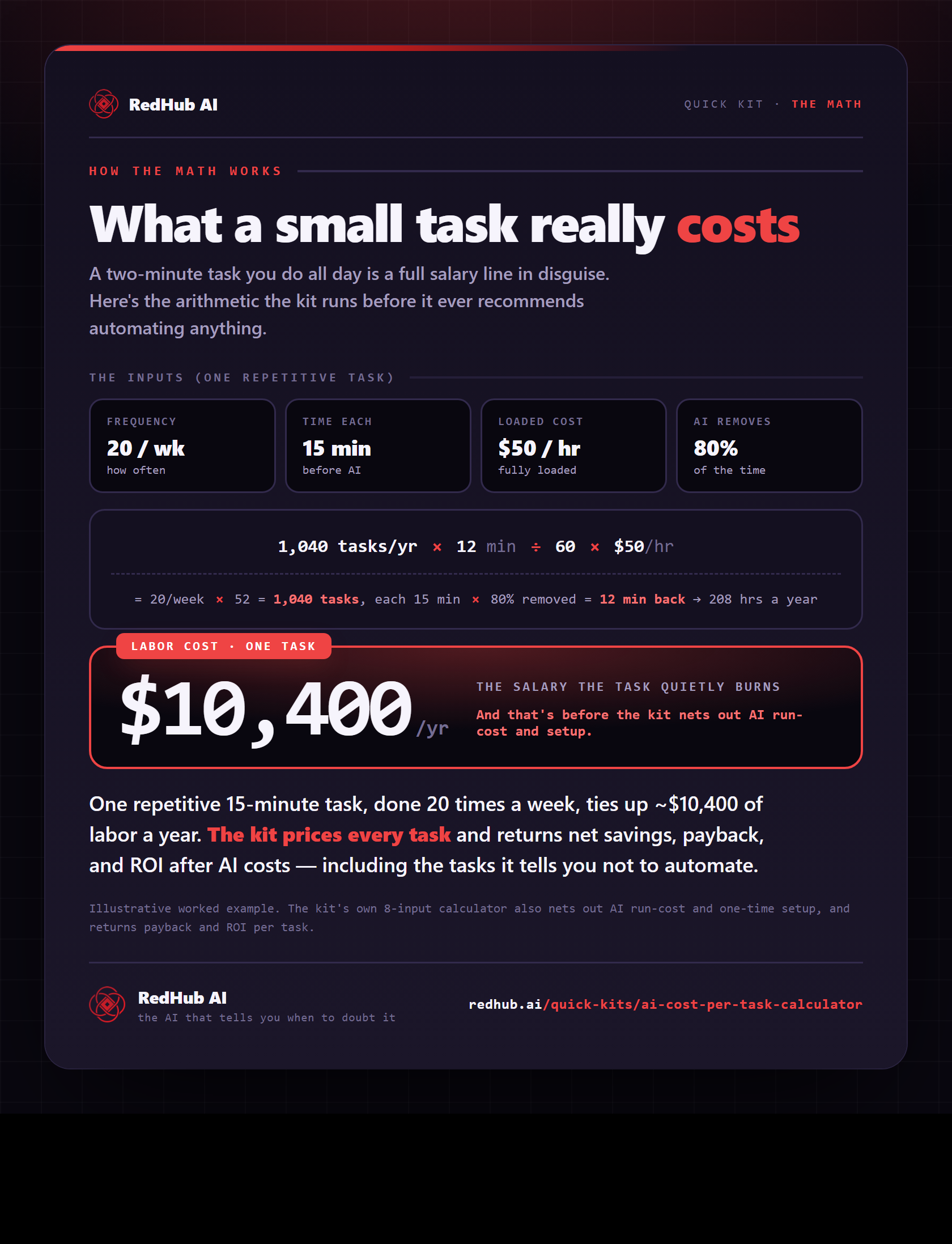
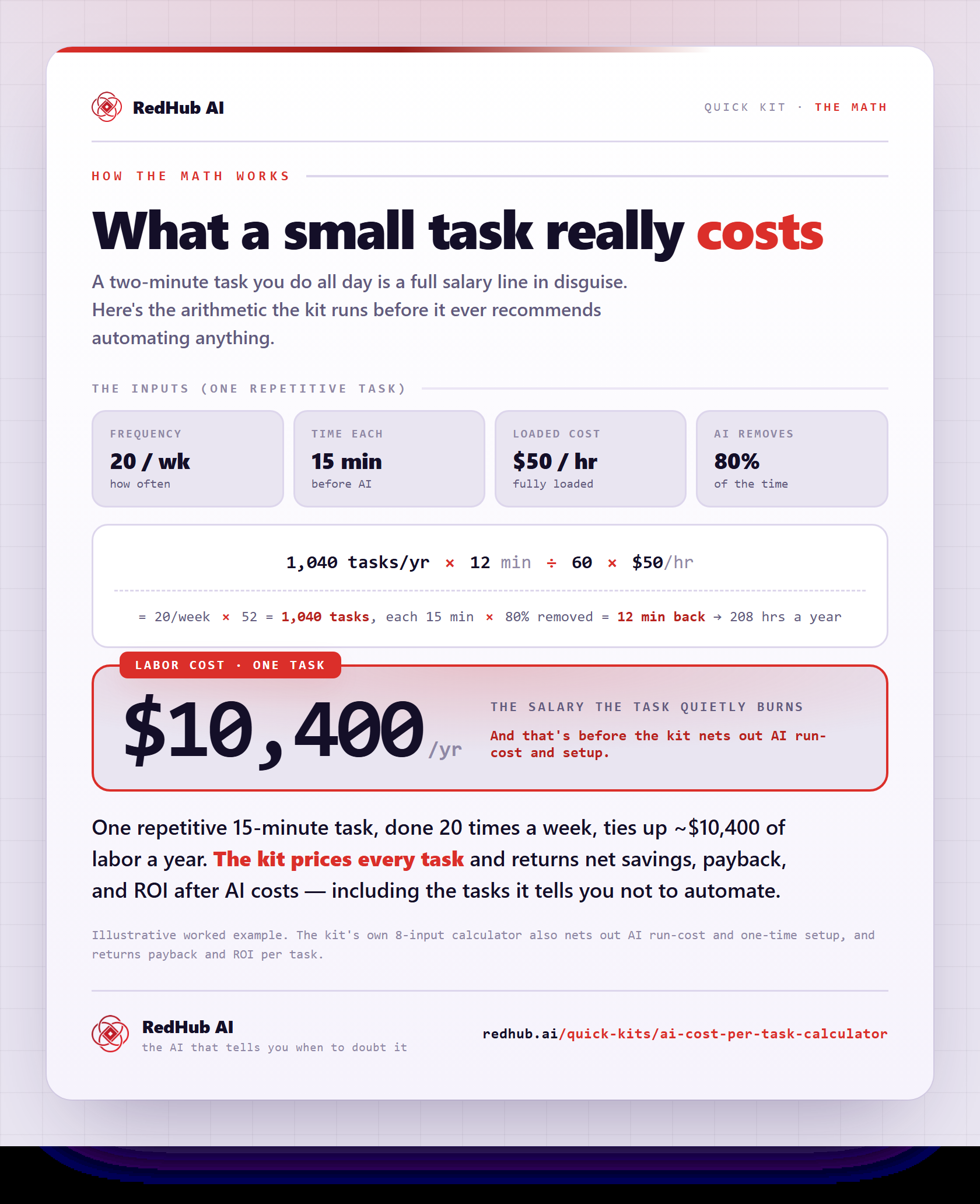
The gate this post refers to, drawn from the tool’s own logic. See the tool.