Meeting Cost: How to Calculate What Your Meetings Actually Cost
RedHub AI Editorialupdated September 20, 20266 min read

Jump to a section9
- Why meeting cost is invisible by default
- The formula, spelled out
- What "fully-loaded" means, and why it's not your gross salary
- The four questions meeting cost actually answers
- Cost is a decision input, not a verdict
- Where the reclaimed time and money actually go
- How this differs from fixing your meeting culture
- Pairs well with
- More in this guide
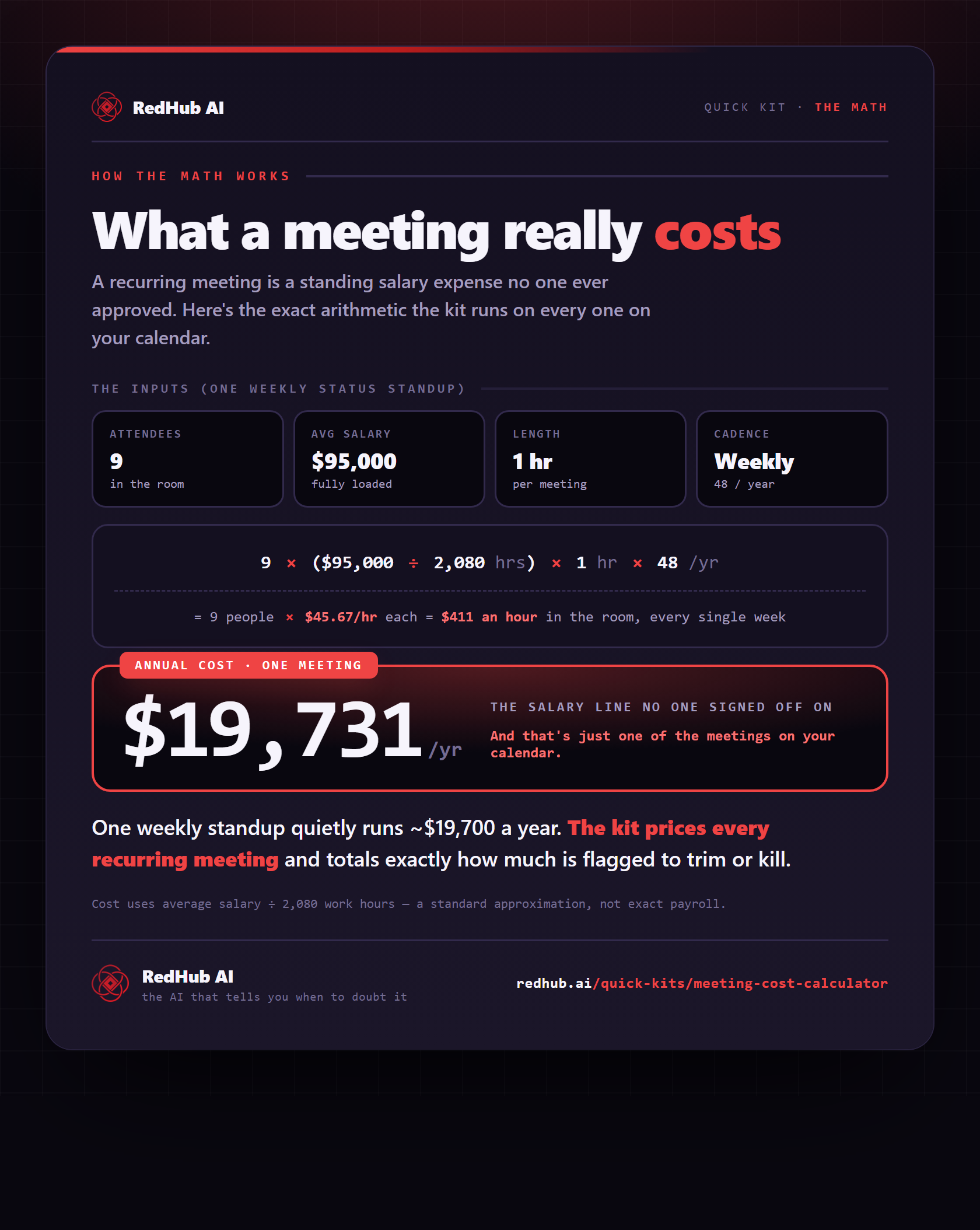
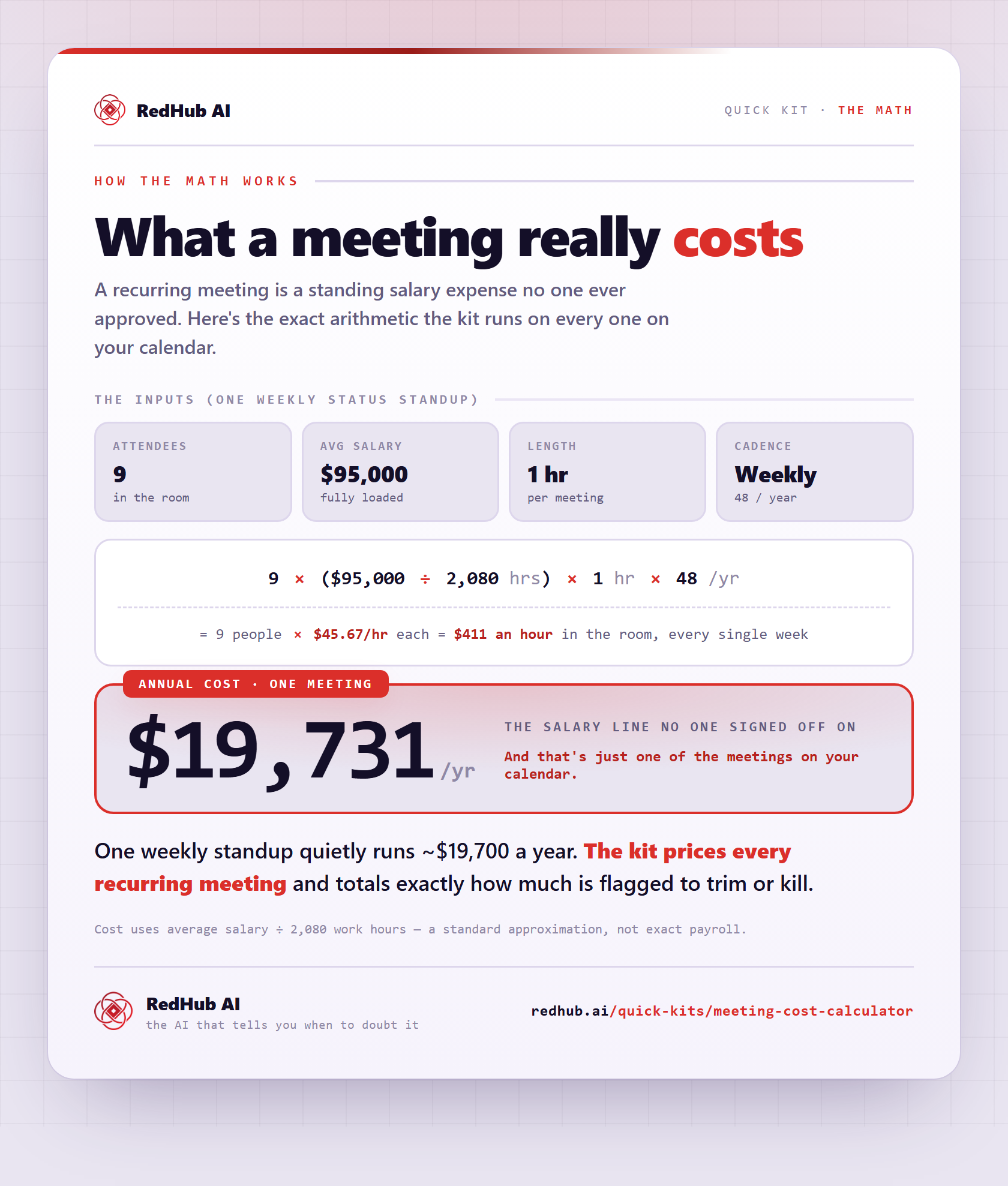
A meeting has no line item on your P&L, so it feels free. It isn't. Every meeting you run is a purchase — you're buying a block of your team's fully-loaded time and spending it on that meeting instead of on the work it was hired to do. The formula for what that purchase costs is simple: attendees × fully-loaded hourly rate × duration in hours, multiplied by how often it recurs. The hard part isn't the math. It's making yourself do the math before you hit "send recurring invite."
TL;DR: Meeting cost = attendees × average fully-loaded hourly cost × meeting length in hours × how often it recurs. A 6-person, 60-minute weekly meeting at a $60/hr average blended rate runs about $1,440/month — and that's before you count the context-switching cost around it. The goal isn't zero meetings; it's making cost visible so you keep the ones earning their price and cut the ones that aren't. This cluster covers the formula, the too-many-meetings math, how to audit a calendar, and how to score whether a meeting was worth what it cost — all anchored to the Meeting Cost Calculator ($29).
Why meeting cost is invisible by default
Salary is a budget line. A conference room, if you still rent one, is a budget line. But the 30 minutes six people spend in a status meeting doesn't show up anywhere as a dollar figure — it just shows up as "Tuesday." That invisibility is exactly why meeting load creeps upward and almost never gets pruned. Nobody has to defend a recurring invite in front of a finance person the way they'd defend a software subscription. Meeting cost stays invisible right up until you calculate it, and once you calculate it, it's very hard to un-see.
The formula, spelled out
The math behind meeting cost isn't complicated, but each input deserves its own honest number:
- Attendees — count everyone on the invite who actually shows up, not just the "required" list. Optional attendees who always join still cost money.
- Fully-loaded hourly cost per person — base salary plus payroll tax, benefits, and overhead, divided by working hours in a year. This number is meaningfully higher than "salary ÷ 2,080" — treat it as an estimate, not exact accounting.
- Duration in hours — the scheduled length, not the useful length. A 60-minute meeting that regularly runs 75 minutes costs what it actually runs, not what the calendar invite says.
- Frequency — how many times per month it happens. A weekly meeting recurs roughly 4.3 times a month; a biweekly recurs about 2.2.
Multiply the four together and you have a monthly cost. Multiply by 12 and you have an annual one — which is usually the number that changes minds in a leadership meeting about, well, meetings.
Worked example: 6 attendees × $60/hr average fully-loaded rate × 1 hour × 4 times/month ≈ $1,440/month, or roughly $17,280/year — for one recurring status meeting. That's the size of number that turns "let's just keep it, it's only an hour" into an actual decision instead of a default.
What "fully-loaded" means, and why it's not your gross salary
If you calculate meeting cost off base salary alone, you'll underestimate it — often significantly. Fully-loaded cost typically adds payroll taxes, benefits, and a share of overhead on top of salary. Exact multipliers vary by company and geography, so RedHub's tools ask you to enter your own average blended rate rather than assuming a fixed markup. Use whatever number your finance function already treats as "true cost of an hour of this person's time." If you don't have one, a conservative placeholder is fine — the point of the calculation is comparative (is this meeting worth roughly this much?), not audit-grade precision.
The four questions meeting cost actually answers
- Is this specific meeting worth what it costs? The subject of Meeting ROI — cost is only half the equation; the other half is what the meeting produced.
- How much does the whole meeting load cost, in aggregate? Covered in The True Cost of Too Many Meetings, where individually-cheap meetings stack into an expensive week.
- Which specific meetings should I keep, shrink, or kill? That's a structured audit, not a vibe check — see How to Run a Meeting Audit.
- What's the exact formula and how do I run it fast? Start with How Much Does a Meeting Cost?, which includes a live calculator.
Cost is a decision input, not a verdict
Where the reclaimed time and money actually go
Cutting or shrinking a meeting doesn't create value by itself — it creates capacity. What happens to that capacity is the real payoff, and it's worth planning for before you touch a single invite. Two follow-on moves matter most: redirecting freed hours into planned capacity (rather than letting them silently refill with more meetings) and giving people an async alternative for the status updates that don't need a live room. RedHub's Capacity & Utilization Planner ($49) helps you decide where reclaimed hours should go, and the Inbox-to-Done Engine ($129) is built for the async-alternative half of that equation — turning status-update meetings into a written flow that doesn't require six people in a room at the same time.
How this differs from fixing your meeting culture
This cluster is deliberately narrow: it's about the dollar cost of meetings and the keep/shrink/kill decision that cost math supports. It is not a guide to running better meetings — better agendas, better facilitation, better follow-through. If what you actually need is a system for your team's whole operating rhythm (which meetings exist, in what cadence, reporting into what decisions), that's a different and larger problem — see the Operating Cadence Engine ($299), which designs the rhythm itself rather than pricing the meetings inside it.
Start here: the Meeting Cost Calculator is a $29 spreadsheet — enter attendees, fully-loaded rate, duration, and frequency for each recurring meeting on your calendar, and it returns the real monthly and annual cost per meeting plus a total across your whole meeting load. It's the tool every post in this cluster points back to.
Pairs well with
Once you know what a meeting costs, the next moves are usually redesigning your team's meeting rhythm with the Operating Cadence Engine ($299), and deciding where the reclaimed hours go with the Capacity & Utilization Planner ($49).
More in this guide
How do you calculate the cost of a meeting?
Multiply the number of attendees by the average fully-loaded hourly cost per person, by the meeting length in hours, then by how often it recurs per month. That gives you a monthly cost; multiply by 12 for an annual figure.
What's a "fully-loaded" hourly rate?
It's base salary plus payroll taxes, benefits, and a share of overhead, expressed as an hourly figure — higher than salary divided by working hours alone. Use your own company's average blended rate; it's an estimate for decision-making, not exact accounting.
Is every expensive meeting a bad meeting?
No. Cost is an input to the decision, not the decision itself. A high-cost meeting that drives a real decision or unblocks real work can be worth every dollar — the goal is visibility, not automatic cuts.
What should I do after I know a meeting's real cost?
Decide to keep, shrink, or kill it based on what it actually produces relative to what it costs — see the meeting audit and meeting ROI posts in this cluster for the decision framework.
Does the Meeting Cost Calculator replace a full operating-rhythm redesign?
No. It prices individual meetings so you can make keep/cut decisions. If you need to redesign your team's whole meeting rhythm and cadence, that's the Operating Cadence Engine's job.
What do I get in the Meeting Cost Calculator?
A $29 spreadsheet that takes attendees, fully-loaded rate, duration, and frequency for each recurring meeting and returns per-meeting and total monthly/annual cost, so you can rank meetings by real dollar impact.
The gate this post refers to, drawn from the tool’s own logic. See the tool.