How Executives Can Use AI for Better Decisions (Without Outsourcing Judgment)
RedHub AI Editorialupdated November 5, 20267 min read

Jump to a section7
AI for decision making works when executives use it as an analyst and keep the decision for themselves. It is good at widening the options, arguing the other side and drafting the first pass of an analysis. It is unreliable as the final word, because it can be confidently wrong and the wrong answer reads as smoothly as the right one. The discipline is simple to state: treat every AI output as an input to question, verify the facts the decision rests on, and make sure you could defend the call without pointing at the tool. This post covers that discipline, and where it meets the leadership-team briefing the rest of this guide is about.
TL;DR: Use AI to widen options, argue against your preferred choice and draft analysis. Then verify the numbers and claims the decision rests on, and make the call yourself. If "the analysis said so" is your real reason, you have handed over the decision. The Exec AI Briefing & Decision Course ($99) does not coach AI-assisted decisions. It grades whether your leadership team is ready to make decisions about AI. Part of the guide on AI for executives.
What AI is good at in a decision
The upside is real. Facing a decision, an executive can get several things from AI faster than from a busy team:
- A wider option set. Ask for five approaches you have not considered. Most decisions get stuck choosing between the first two ideas anyone had.
- The case against you. Ask it to argue against your preferred option. A direct report may soften that case. A model has no career to protect.
- A first draft of the analysis. A pros-and-cons memo, a first-pass model, a summary of a long contract. This is the grunt work that usually delays a decision.
- The questions an analyst would ask. Second-order effects, what would have to be true, what could break. You react to a list instead of starting from a blank page.
One caution on the second item. A chat assistant asked for its view can lean toward the framing you gave it. If you describe your plan warmly, you may get warmth back. Ask it explicitly to build the strongest case against the decision, and judge the case on its evidence, not its tone.
Where judgment has to stay human
The line is easy to state and easy to blur under time pressure. AI produces the material, and you make the decision. A model can invent a fact, misread your context or optimize for a goal you never set. None of that shows on the surface. So the executive's job is to interrogate the output. Is this claim true? Does the reasoning hold? Does the recommendation account for the thing only you know about your customers, your people or your cash? The accountability for the decision never transfers to the tool, so the judgment cannot either.
Verify what the decision rests on
Not every AI output needs an audit. The parts a decision actually rests on do. Before a number, a claim or a recommendation drives a real choice, check it against a source you trust. A single invented figure, delivered with total confidence, can steer a large decision wrong. It is the same standard you would apply to a new analyst's first model: check the numbers that carry the conclusion, and skim the rest.
Here is a concrete case from the leadership briefing. Its competitive awareness lesson ends with a task: list what two named competitors have shipped with AI in the last quarter. Asking an AI assistant for that list is a reasonable start. It will return a tidy answer. Some of it may be wrong, out of date, or a launch that was announced and never shipped. Check each item against the competitor's own announcement or product page before it counts. If the team then marks its competitive awareness a 3 on the strength of an unchecked list, the mark rests on something nobody verified.
Spend works the same way. AI can total a quarter of AI line items from an exported ledger in seconds. Before that total goes in front of the leadership team, reconcile it to the invoices. A total that is off because two vendors were merged, or a renewal was missed, will survive every meeting it is quoted in.
Deciding with AI versus deciding about AI
These are two different skills, and it helps to keep them apart. Deciding with AI is the analyst discipline above. Deciding about AI is the leadership team's job: what AI is for in the business, what to spend, what exposure to accept, whether people can execute, and how to respond to competitors.
The Exec AI Briefing & Decision Course is built for the second. In a 60-minute session the team marks each of those five dimensions from 0 to 5, and the marks are weighted into a 0 to 100 total and one verdict: LEADING, CATCHING UP or BLINDSIDED. It does not teach prompting, and it does not grade how well anyone uses AI in their own decisions. Its five-lesson course ends each lesson with a decision about AI, such as writing a one-paragraph AI thesis tied to a business metric, or naming your largest AI regulatory exposure and who owns it.
The two skills do meet. Every one of those decisions is a place where an executive might reach for an AI assistant to draft the thesis or summarize the exposure. The verification standard above is what keeps the briefing's marks honest. How the team agrees on those marks is covered in aligning your leadership team on AI.
Make the standard shared
One executive using AI carefully is good. A leadership team that agrees on the standard is better, because a decision then means the same thing whoever made it. The standard can be three sentences long. AI widens options and drafts, and people make the calls. The numbers a decision rests on get checked against a source. "The model said so" is never a reason. Write it down, and say it out loud the first time someone brings an AI-drafted analysis to the leadership meeting.
Grade how ready your leadership team is to decide about AI
Five dimensions, marked 0 to 5 in a facilitated 60-minute session: strategy, spend and ROI visibility, risk and regulatory exposure, team capability, and competitive awareness. A weighted total, one verdict, and the dimension to fix first. It grades the team as a group, never a person.
Get the Exec AI Briefing & Decision Course — $99Pairs well with
To pressure-test one specific decision, the Devil's-Advocate Board ($199) runs it past five skeptical lenses, each building the strongest case against it, and returns GO, GO WITH CONDITIONS, NOT YET or NO-GO. It runs on your own AI tool, and it is a stress-test, not a decision-maker: the call stays yours. To build the underlying skill across your people, the AI Literacy & Workforce Training Kit ($199) is a role-based training program with a deck, participant workbook and facilitator guide.
More in this guide
How should executives use AI in decisions?
As an analyst. Use it to widen the options, argue against your preferred choice, draft the first pass of the analysis and list the questions an analyst would ask. Then verify the facts the decision rests on and make the call yourself. The accountability stays with you.
Can I let AI make the recommendation?
You can read its recommendation, but do not accept it as the decision. AI can invent a fact or misread your context, and a wrong answer reads as smoothly as a right one. Question the reasoning and check the numbers before you act on it.
How do I know if I have handed over too much judgment?
Ask whether you could defend the decision without quoting the AI's output, and whether you would still back it if the model had recommended the opposite. If "the analysis said so" is your real reason, the tool made the call.
Do I need to verify everything AI produces?
No. Verify the parts the decision rests on: the numbers, the factual claims and the recommendation itself. Check them against a source you trust, the way you would check a new analyst's first model. Skim the rest.
Does the Exec AI Briefing teach AI-assisted decision making?
No. The Exec AI Briefing grades whether a leadership team is prepared to make decisions about AI, across strategy, spend, risk, capability and competitive awareness. It does not teach prompting or grade how anyone uses AI in their own decisions, and it scores no individual.
Should this be a personal or a team practice?
A team practice. When the leadership team agrees that AI drafts and people decide, that the numbers a decision rests on get checked, and that "the model said so" is never a reason, decisions mean the same thing whoever made them.
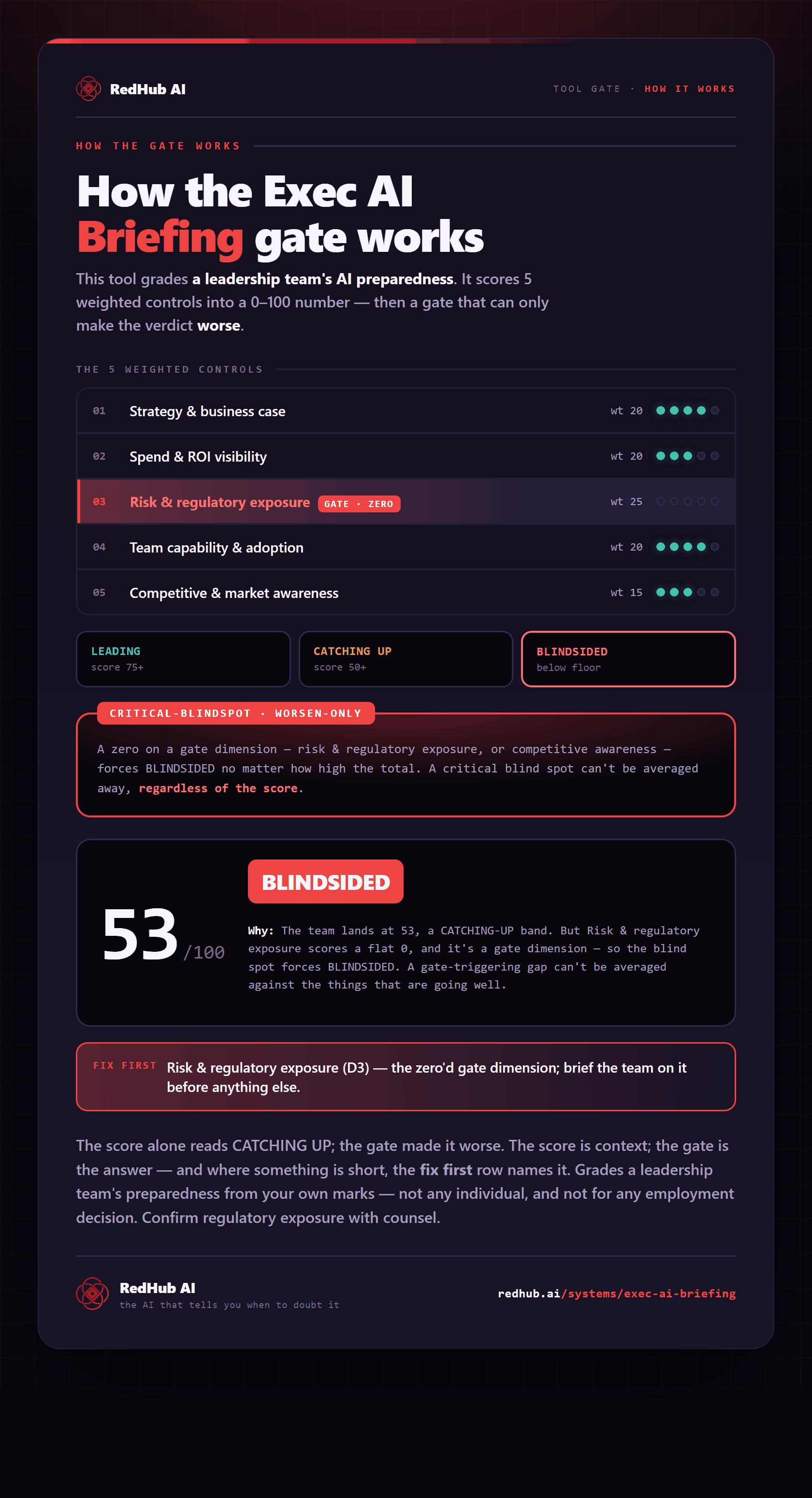
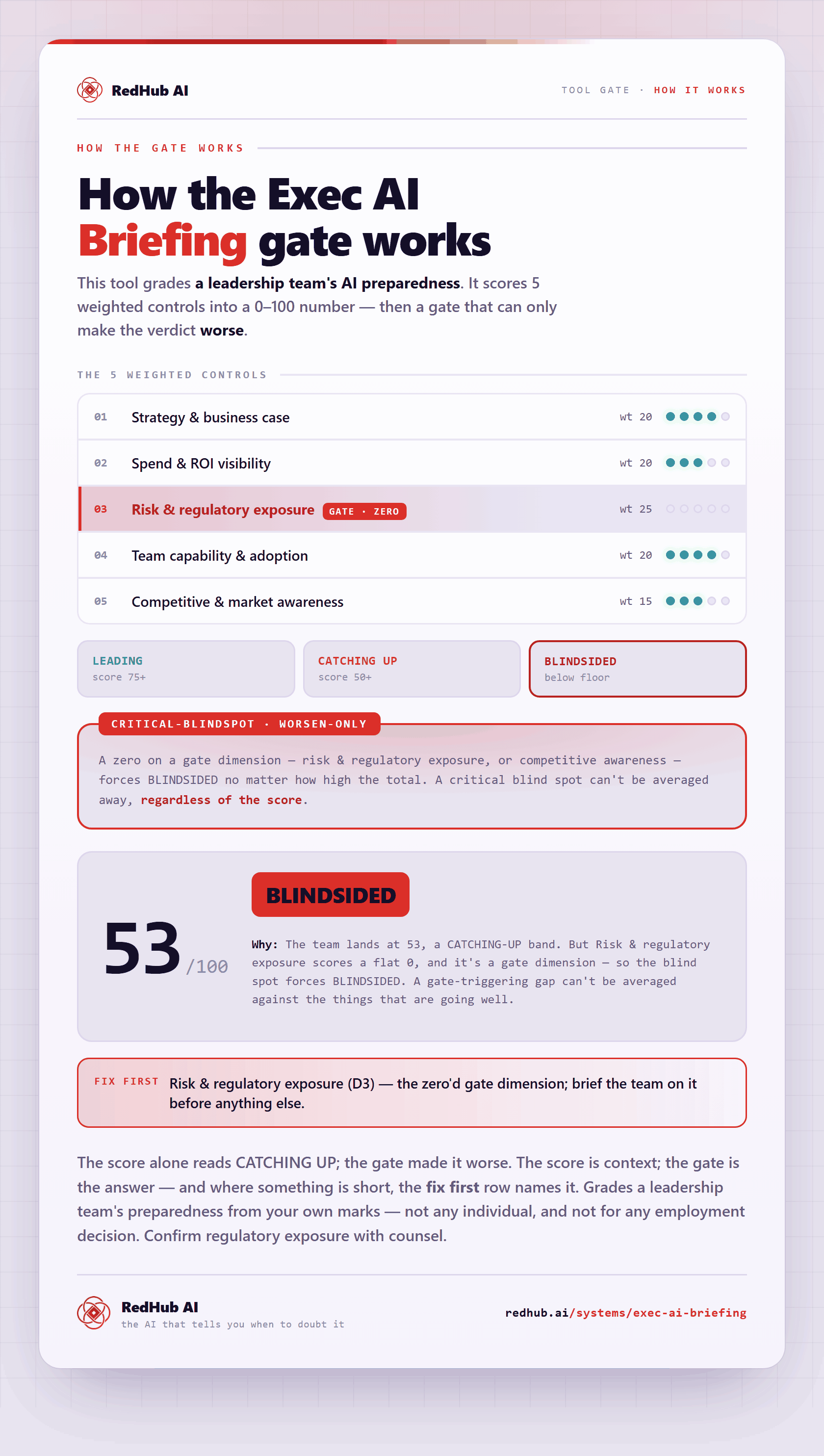
The gate this post refers to, drawn from the tool’s own logic. See the tool.