The AI Questions Your Board Will Ask (and How to Answer Them)
RedHub AI Editorialupdated November 5, 20267 min read

Jump to a section7
Board level AI questions come down to five: what is our AI strategy, what are we spending and getting back, what could go wrong and who owns it, can our people actually use this, and what are competitors doing. A good answer is not a polished deck. It is a specific answer tied to a decision the leadership team has already made, plus a plain statement of what you do not know yet and how you will find out. Boards can tell a team that has thought this through from a team performing confidence, and the second one reads as the bigger risk.
TL;DR: Expect five board questions on AI: strategy, spend and return, risk and accountability, capability, and competitive position. Answer each with a decision and a number where you have one, and name what you do not know with a date to find out. The answers have to be the whole team's, or the board learns the strategy is not settled. The Exec AI Briefing & Decision Course ($99) scores your leadership team on the same five areas before the meeting. Part of the guide on AI for executives.
The five questions, and what a credible answer contains
The wording changes from board to board. The themes do not. Prepare one honest answer to each.
| What the board asks | A credible answer contains |
|---|---|
| "What is our AI strategy?" | A short written thesis tied to a business metric, the few uses that serve it, and what you have decided not to do |
| "What are we spending, and what are we getting?" | This quarter's actual AI spend, what is proven, and what is still a bet with a date to judge it |
| "What could go wrong, and who owns it?" | Your largest AI exposure, the person who owns it, and the guardrail in place or planned |
| "Can our people actually use this?" | An honest read of real use versus shadow use and guesswork, and what good use looks like in one role |
| "Are competitors ahead of us?" | What two named competitors have shipped with AI recently, checked against their own announcements |
The governance question usually arrives inside the risk question. "Who is accountable?" is answered by naming the owner of your largest exposure and the ground rules your people work under. The readiness side of that is covered in is your company ready for AI.
How to answer without hand-waving
A board is reassured by a team that speaks specifically and admits the edges of what it knows. It is unsettled by vague optimism. So tie every answer to a decision. "We are investing here because it moves this number. We are holding off there until we see this result. The risk we watch most closely is this one, and here is the guardrail." That is a credible answer even when the AI program is young. "We are very excited about AI and exploring many opportunities" is not. It tells the board nothing has been decided.
The risk answer needs the most care
Of the five, the risk answer is the one where a confident guess does the most damage. If the honest position is that leadership has not looked at its AI obligations and exposure, say that, and say who will look and by when. Do not describe your regulatory position to a board on the strength of an internal guess. Confirm the exposure with qualified counsel first. Whether a particular use creates a legal obligation is a separate legal question, and a readiness exercise does not answer it.
Score yourself on the same five areas first
The Exec AI Briefing & Decision Course grades a leadership team on five dimensions that line up with these questions: strategy and business case, spend and ROI visibility, risk and regulatory exposure, team capability and adoption, and competitive and market awareness. The team marks each from 0 to 5 in a 60-minute session. The facilitator playbook defines a 5 as "we could brief the board on this today." Any dimension below 5 is, by that definition, a question where your board answer still has a gap.
The marks are weighted 20, 20, 25, 20 and 15 into a 0 to 100 total. LEADING is 75 or more, CATCHING UP is 50 to 74, and BLINDSIDED is below 50. A 0 on risk or on competitive awareness forces BLINDSIDED whatever the total.
Here is what that looks like before a board meeting. The sample read that ships with the product marks strategy 4, spend 3, risk 0, capability 4 and competitors 3. The total is 53, which on its own would read CATCHING UP. The 0 on risk forces BLINDSIDED, and risk is named as the dimension to fix first. Translated into the board meeting, that team has a decent strategy answer and no answer at all to "what could go wrong." That is the question to work on before the meeting, not the strategy slide.
Two limits matter here. The marks are the team's own, and nothing checks them against evidence. The briefing also does not write your board answers. It tells you which of the five questions you are least ready for. It grades the leadership team as a group, scores no individual, and is not legal, financial, investment or compliance advice.
The answers have to be the team's
A board question aimed at one executive is often a test of whether the whole team agrees. If the CEO gives a confident AI answer and the CFO visibly does not share it, the board learns the strategy is not settled. Consistent answers come from a team that already had the hard conversation and agreed one position on each question. That work is covered in aligning your leadership team on AI. The board meeting only shows whether it happened.
Find the board question you are least ready for
The Exec AI Briefing & Decision Course scores your leadership team on strategy, spend and ROI visibility, risk and regulatory exposure, team capability, and competitive awareness. You get a weighted total, LEADING, CATCHING UP or BLINDSIDED, and the dimension to fix first. A five-lesson course turns each dimension into a decision you can make that week.
Get the Exec AI Briefing & Decision Course — $99Pairs well with
For the accountability part of the risk answer, the AI Governance & Acceptable Use Starter Kit ($39) gives you editable starting templates, including an acceptable use policy, a vendor evaluation rubric and an incident response playbook. They are templates, not legal advice. For the capability answer, the AI Literacy & Workforce Training Kit ($199) is a role-based training program for your people.
More in this guide
What AI questions will my board ask?
Expect five themes: what is our AI strategy, what are we spending and getting back, what could go wrong and who owns it, can our people use it, and what are competitors doing. Prepare a specific answer to each, tied to a decision your leadership team has made.
How do I answer board AI questions credibly?
Tie each answer to a decision: why you are investing in one place, what you are holding off on, the risk you watch most and the guardrail for it. Give the number where you have one. Specific and honest beats polished and vague.
Is it OK to tell the board "we don't know yet"?
Yes, when it is specific. Say what you cannot yet show, the test you are running and when you will have a result. A board expects a team that knows the limits of what it knows and has a plan, more than it expects certainty.
How should I answer the board's AI risk question?
Name your largest AI exposure, who owns it and the guardrail in place or planned. If leadership has not yet looked at its obligations, say so and say who will look and by when. Confirm any regulatory exposure with qualified counsel before describing it to a board.
Why do board answers depend on team alignment?
A question to one executive tests whether the whole team agrees. If the CEO's confident answer is visibly not shared by the CFO, the board learns the strategy is not settled. Consistent answers come from a team that agreed one position on each question first.
How can a leadership team prepare for board AI questions?
Score the team on the same five areas before the meeting. The Exec AI Briefing marks strategy, spend, risk, capability and competitive awareness 0 to 5 and names the weakest area to fix first. It grades the team as a group and is not legal or financial advice.
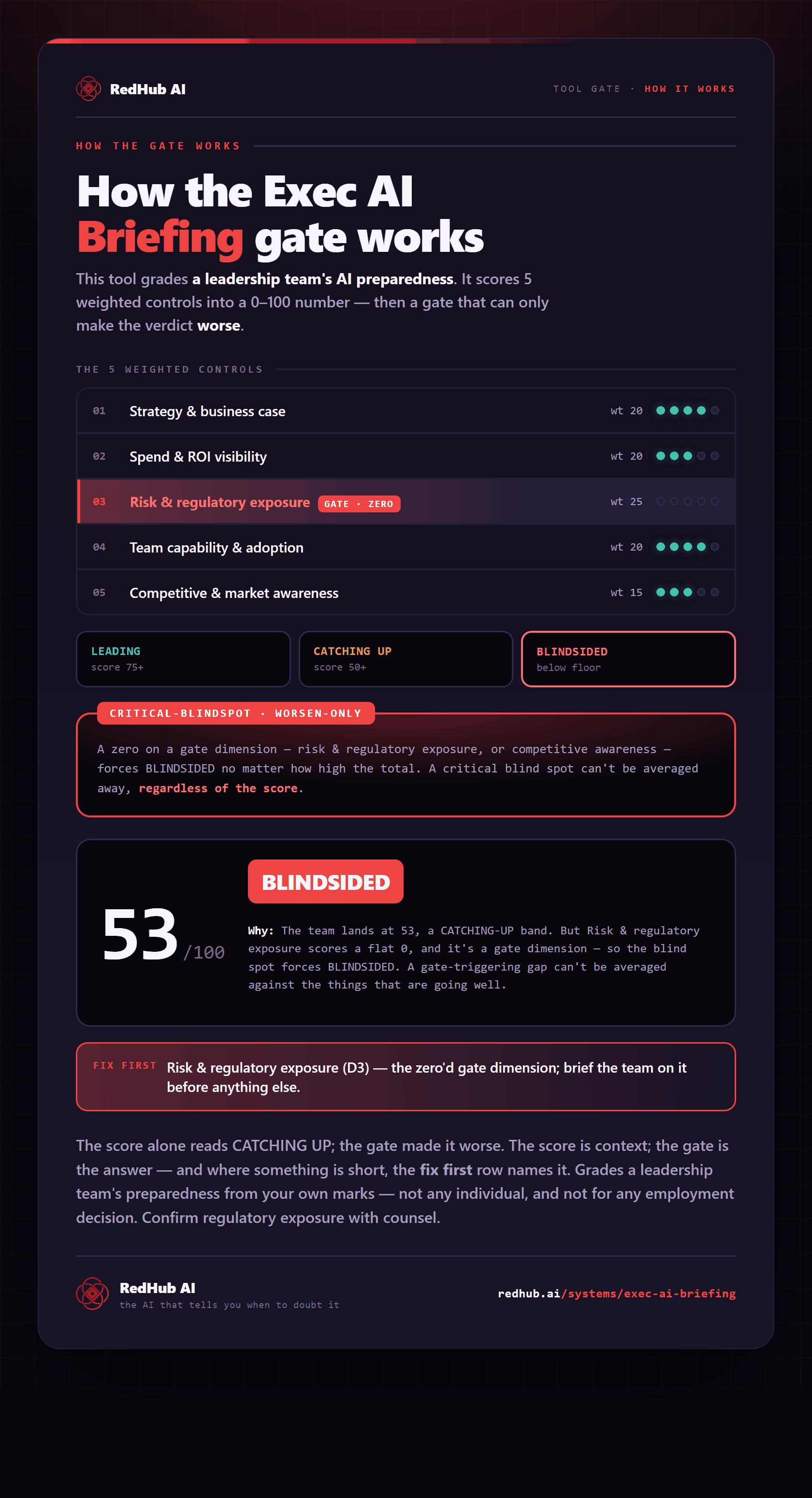
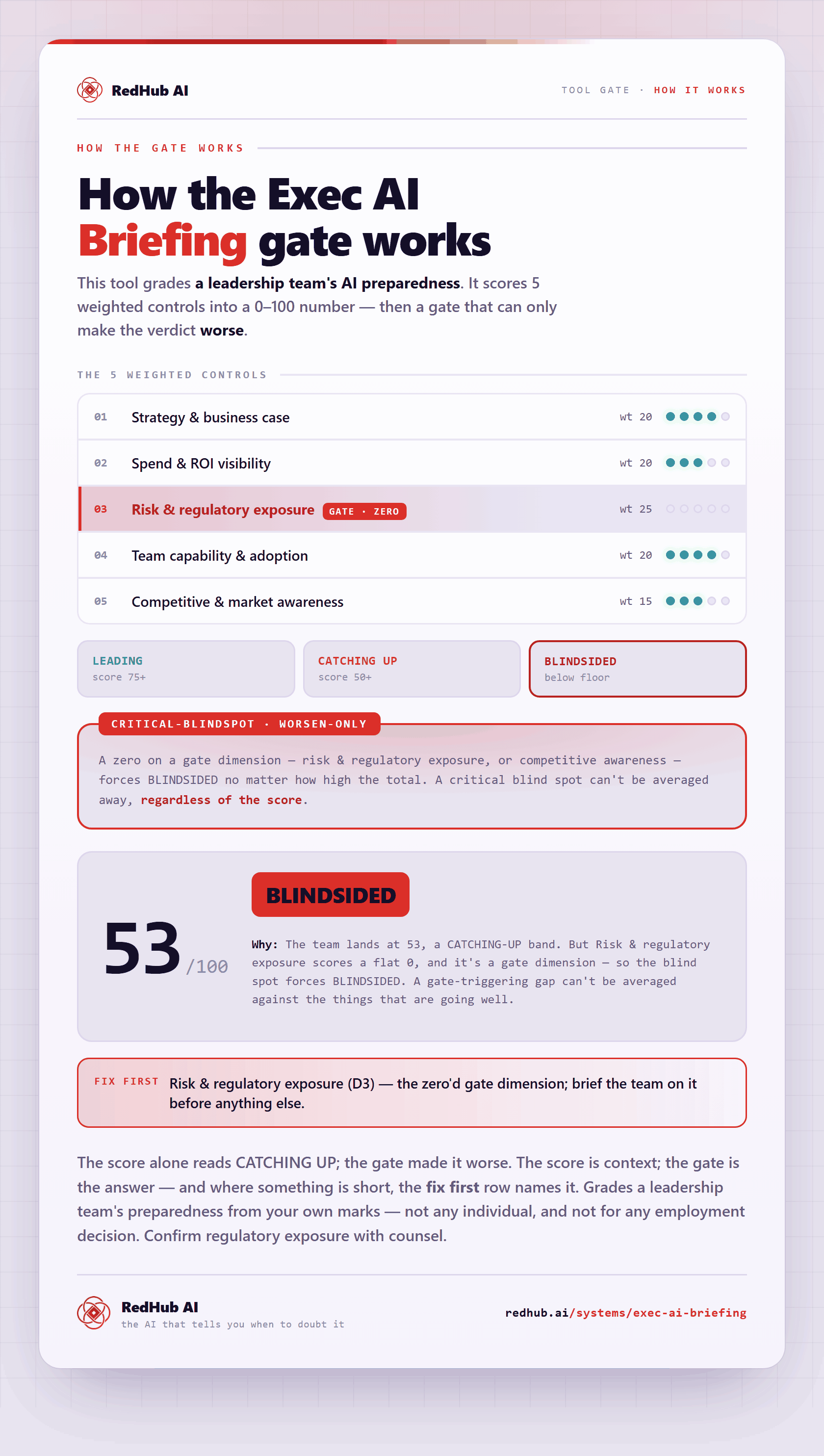
The gate this post refers to, drawn from the tool’s own logic. See the tool.