Is Your Company Ready for AI? A Leadership Readout
RedHub AI Editorialupdated November 5, 20267 min read

Jump to a section8
"Is my company ready for AI?" has a more useful answer than yes or no. A company is ready when its leadership team can honestly answer five things: what AI is for in the business, what it spends and gets back, what exposure it carries, whether its people can execute, and what competitors are shipping. Most companies are uneven across the five, strong on one and thin on another. So the useful readout names the thin spot and the next thing to fix. This post walks through scoring the five yourself, with the arithmetic shown, using the model inside the Exec AI Briefing & Decision Course ($99).
TL;DR: Score five areas 0 to 5 as a leadership team: strategy, spend and ROI visibility, risk and regulatory exposure, team capability, and competitive awareness. Weighted 20, 20, 25, 20 and 15, they make a 0 to 100 total. LEADING is 75 or more, CATCHING UP is 50 to 74, and BLINDSIDED is below 50. A 0 on risk or on competitors forces BLINDSIDED whatever the total. The lowest mark is the one to fix first. Part of the guide on AI for executives.
The five questions, and what a 0 and a 5 look like
Score these as a leadership team, about the organization, in one sitting. The facilitator playbook that ships with the briefing sets one rule for the room: score honestly, not aspirationally. It defines a 5 as "we could brief the board on this today," not "we mean to."
- Strategy and business case. Is there a written AI thesis tied to the business, or only enthusiasm? A 5 is a thesis you could present today.
- Spend and ROI visibility. Can anyone state what the company spends on AI this quarter and what it returns? A 5 means someone can, with the numbers.
- Risk and regulatory exposure. Does leadership know its AI obligations and exposure? If the honest answer is "we have not looked," the playbook scores it 0.
- Team capability and adoption. Can the organization use AI well, or is it shadow use and confusion? This is one mark for the organization, not a rating of anyone.
- Competitive and market awareness. Does leadership know what rivals are shipping with AI? "No idea" is a 0.
Marks 1 through 4 have no written definitions in the playbook. That is a real limit. Two teams can put different marks on the same reality, so compare your score with your own next score, not with anyone else's.
Turn the marks into a verdict
Divide each mark by 5 and multiply by its weight, then add the five and round. In practice, each point of strategy, spend or capability is worth 4 points of the total, each point of risk is worth 5, and each point of competitive awareness is worth 3. Then apply the bands: LEADING at 75 or more, CATCHING UP from 50 to 74, BLINDSIDED below 50. One rule overrides the bands. A 0 on risk or on competitive awareness forces BLINDSIDED, however high the total.
Here are four reads, each run through the briefing's engine:
| Marks (strategy, spend, risk, capability, competitors) | Total | Verdict | Fix first |
|---|---|---|---|
| 4, 4, 4, 4, 3 | 77 | LEADING | Competitors |
| 4, 3, 0, 4, 3 (the shipped sample) | 53 | BLINDSIDED (gate) | Risk |
| 5, 5, 0, 5, 5 | 75 | BLINDSIDED (gate) | Risk |
| 3, 3, 1, 3, 2 | 47 | BLINDSIDED (band) | Risk |
The third row is the one to study. A total of 75 sits on the LEADING line, and the verdict is still BLINDSIDED, because the team has not looked at its exposure. The fourth row reaches the same verdict a different way: no zero anywhere, just thin on everything. The first row reads LEADING and still names a dimension to fix, because competitors at 3 is short of 5. The briefing names nothing to fix only when every mark is 5.
Read the gate line, not only the fix-first line
The dimension to fix first is the lowest mark. When two marks tie, the earlier dimension in the list wins, strategy before spend before risk and so on. That tie-break has a side effect worth knowing. Mark strategy 0, spend 4, risk 4, capability 4 and competitors 0, and the total is 52. The gate fires on competitors, so the verdict is BLINDSIDED, but strategy is named first because it comes earlier in the list. Fixing strategy alone would leave you BLINDSIDED. The engine prints which dimension fired the gate on its own line. When the gate has fired, clear that dimension off zero first.
Readiness is a baseline, not a grade
The point of scoring readiness is to know what to improve. It is not a label to earn or a ranking of anyone. A useful readout sounds like this: "Our strategy is written, our spend is invisible, and we have not looked at our exposure." That is a to-do list. Treating it as pass or fail tempts the room to inflate marks, and an inflated 3 hides the gap the exercise exists to find. The briefing grades the leadership team's preparedness as a group. It scores no individual, and it is not for any hiring, performance or other employment decision.
From the readout to the next fix
Once you know the weakest dimension, the next move is specific. The briefing's five-lesson Decision Course ends each lesson with a decision you can make that week:
- Strategy: write a one-paragraph AI thesis tied to a specific business metric. Aligning the team on it is covered in aligning your leadership team on AI.
- Spend: pull this quarter's actual AI line items. If there is no view of them, assign someone to build one.
- Risk: name your single largest AI regulatory exposure and who owns it. The AI Governance & Acceptable Use Starter Kit ($39) has editable starting templates for the ground rules.
- Capability: pick one role and define what good AI use looks like for it this quarter. The AI Literacy & Workforce Training Kit ($199) is a role-based training program.
- Competitors: list what two named competitors have shipped with AI in the last quarter, and check each item against their own announcements.
The playbook gives the fix-first dimension an owner and a 30-day checkpoint, and re-runs the briefing a quarter later. The course makes the point plainly: moving from BLINDSIDED to CATCHING UP usually comes from clearing a gate dimension off 0, not from polishing a dimension that was already strong. In the shipped sample, raising risk from 0 to 1 takes the total from 53 to 58 and the verdict to CATCHING UP.
What this readout cannot tell you
The marks are your own, and nothing checks them against evidence. A team that marks generously gets a generous verdict. Risk and regulatory exposure asks whether leadership knows its exposure. It does not say what any law requires, and it is not legal, financial, investment or compliance advice, so confirm any exposure with qualified counsel. The weights and the gate are the product's opinion about what matters, written where you can read them. You may weigh things differently.
Get the readout, the agenda and the course
The Exec AI Briefing & Decision Course is a runnable Python engine and a workbook that give the same verdict, a facilitator playbook for a 60-minute session, a five-lesson Decision Course, and the sample read above. Nothing is uploaded, and there is no AI inside the scoring.
Get the Exec AI Briefing & Decision Course — $99Pairs well with
For a capability gap, the AI Literacy & Workforce Training Kit ($199) trains your people, and the AI Fluency Diagnostic ($79) measures individual AI working practices for development. For the ground rules behind the risk answer, the AI Governance & Acceptable Use Starter Kit ($39) gives you editable templates, not legal advice.
More in this guide
Is my company ready for AI?
Score five areas as a leadership team: strategy, spend and ROI visibility, risk and regulatory exposure, team capability, and competitive awareness. Most companies are uneven across them, so the useful answer is the weakest area and the next fix, not a yes or no.
How is an AI readiness score calculated?
In the Exec AI Briefing, each of five areas is marked 0 to 5 and weighted 20, 20, 25, 20 and 15 into a 0 to 100 total. LEADING is 75 or more, CATCHING UP is 50 to 74, and BLINDSIDED is below 50. A 0 on risk or on competitive awareness forces BLINDSIDED.
Can a company score 75 and still not be ready?
Yes, in the Exec AI Briefing's model. Marking 5 on every area except a 0 on risk and regulatory exposure totals 75, and the verdict is BLINDSIDED, because a 0 on risk or on competitive awareness forces it whatever the total.
Is a readiness score a grade of our people?
No. It is a baseline for the leadership team to improve against. The Exec AI Briefing records one mark per area for the organization, scores no individual, and is not for any hiring, performance or other employment decision.
How is this different from measuring AI skills?
Readiness asks what the leadership team knows and has decided, with capability as one mark for the whole organization. Measuring how well individual people use AI is a separate question, answered for development purposes by a tool such as the AI Fluency Diagnostic.
What do I do once I know our weakest area?
Make one specific decision on it this week, such as writing an AI thesis tied to a metric or naming your largest AI exposure and its owner. Give it an owner and a 30-day checkpoint, then score all five again a quarter later.
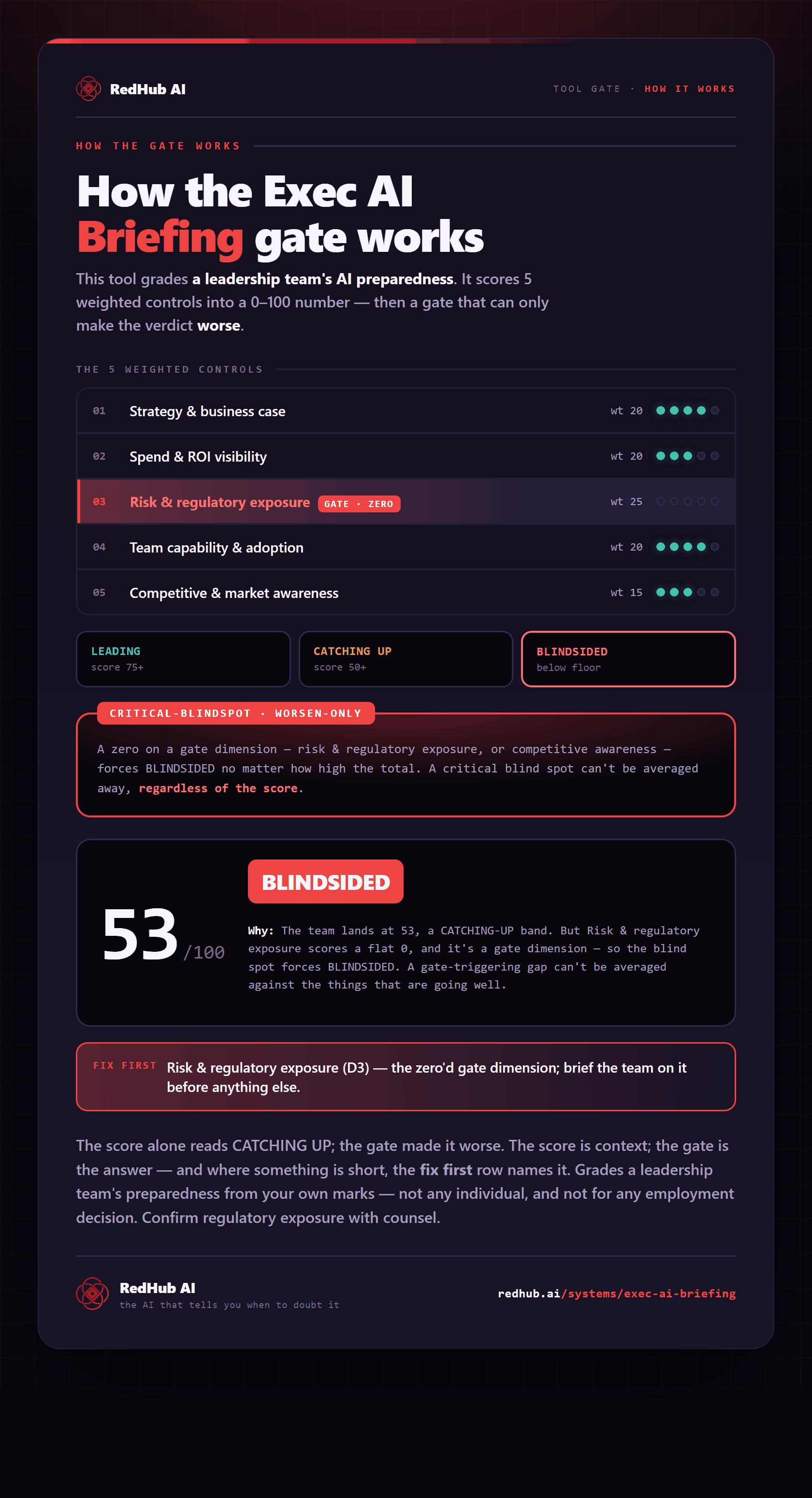
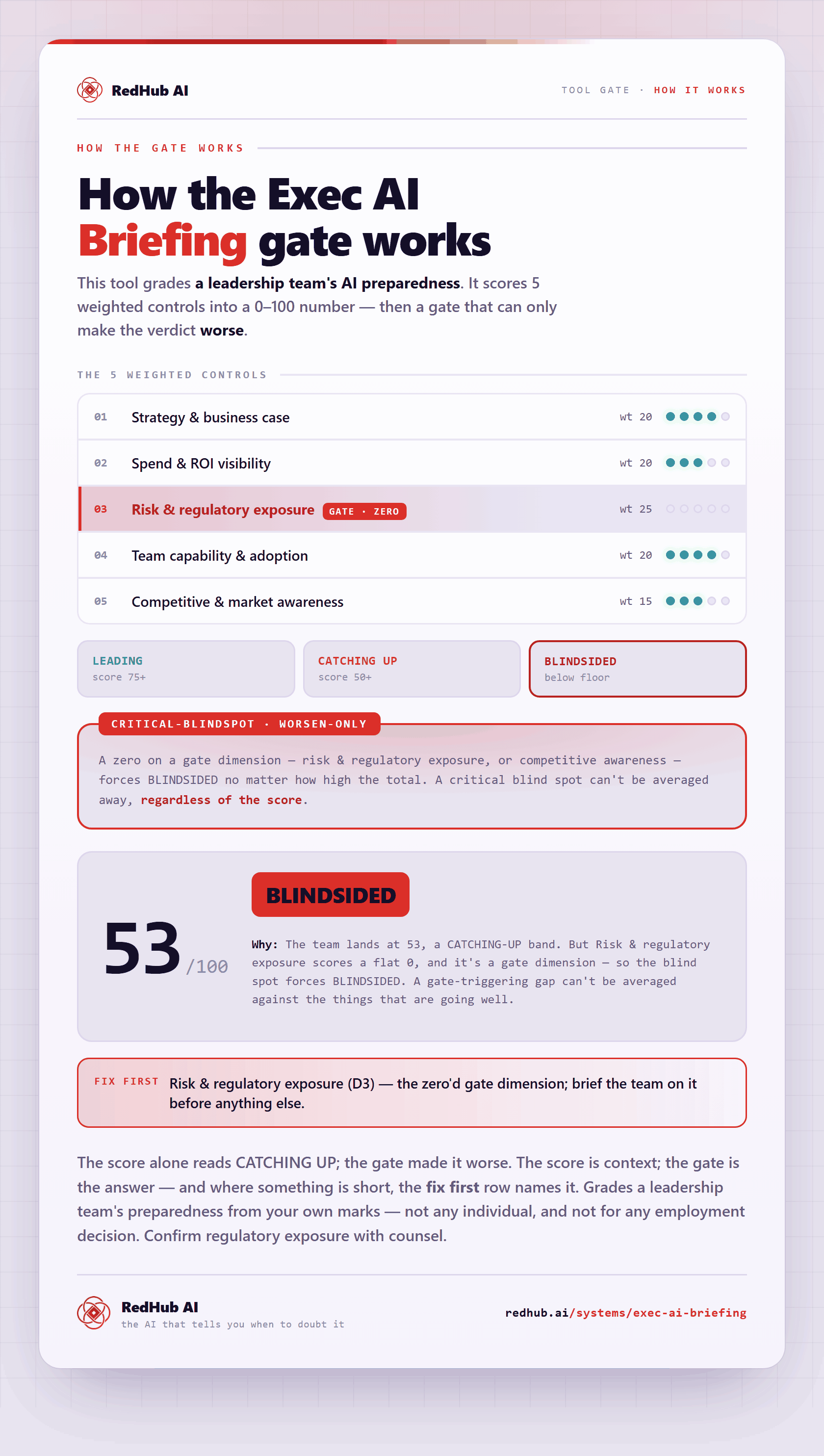
The gate this post refers to, drawn from the tool’s own logic. See the tool.