How to Align Your Leadership Team on AI
RedHub AI Editorialupdated November 5, 20267 min read

Jump to a section8
An AI strategy for leadership teams starts with the disagreement nobody has said out loud. The CEO, the CFO and the heads of function usually hold different positions on AI, and each position is reasonable from where that person sits. Left unspoken, the split gets argued again in every meeting and nothing builds on the last decision. You align a team by getting each person's real view on the table, settling the disputes that can be settled, agreeing one honest position, and committing to the next decision. Alignment is not everyone nodding. It is a recorded decision the skeptic can live with.
TL;DR: Leadership teams split on AI because it lands on each function differently, and the split stays quiet. Have every leader mark the same five questions privately, reveal the marks together, and spend the time where they differ most. Separate disputes of fact from disputes of judgment, agree one mark per question, and write down the next decision with an owner. The Exec AI Briefing & Decision Course ($99) gives the five questions, the scoring and a 60-minute agenda. Part of the guide on AI for executives.
Why leadership teams quietly disagree on AI
AI lands on every function differently. The CEO sees competitive upside and wants to move. The CFO sees spend with no clear return and wants proof. The head of operations sees disruption to processes that work and is wary. Whoever owns risk sees exposure. None of these views is wrong, and few of them get said plainly. So the debate never happens once. It happens in fragments, in every meeting, and an AI initiative stalls one small hesitation at a time.
Get the split onto paper first
The fastest way to surface a disagreement is to stop people from hearing each other's answer before they give their own. The method below is ours, not a feature of any tool. It works with any shared set of questions. We use the five dimensions from the leadership briefing because they cover the ground a leadership team has to decide on.
- Mark privately. Before any discussion, each leader writes a mark from 0 to 5 for each question: strategy and business case, spend and ROI visibility, risk and regulatory exposure, team capability and adoption, and competitive awareness. Every mark is about the organization, never about a colleague.
- Reveal together. Put all the marks up at once. Where everyone wrote the same number, move on quickly.
- Talk where the spread is widest. A gap of two or more points on one question is where the real disagreement lives. Spend the session there.
- Separate fact from judgment. "Nobody can state what we spend on AI this quarter" is a fact you can check before the meeting ends. "That spend isn't worth it" is a judgment the team has to make. Arguments loop when the two get mixed.
- Agree one mark and the next decision. Each question ends with a single agreed mark, and the weakest one ends with an owner and a date.
A worked example: one question, a three-point gap
Take spend and ROI visibility. The CEO writes 4: "We know what we spend." The CFO writes 1: "I cannot tie a single AI line item to a result." The facilitator playbook gives the room a test for this question. Can anyone state what the company spends on AI this quarter and what it returns? It also defines a 5 as "we could brief the board on this today." Asked that way, the dispute stops being about optimism. Either someone can state the number or nobody can. Here, the spend can be pulled together from invoices but the return cannot be stated, and the room agrees on 2.
The gap matters more than it looks, because the marks are weighted. In the briefing, spend carries a weight of 20, so each point is worth 4 points of the 0 to 100 total. Suppose the team agrees strategy 4, risk 3, capability 4 and competitors 4. With the CEO's 4 on spend, the total is 75, which reads LEADING. With the CFO's 1, it is 63, which reads CATCHING UP. With the agreed 2, it is 67, still CATCHING UP, and spend becomes the dimension to fix first. The team's verdict depends on whose mark it was going to accept, and the private round made that visible.
What the briefing records, and what it does not
The Exec AI Briefing & Decision Course is a 60-minute facilitated session in which the room scores its own organization on those five dimensions. The workbook and the engine take one mark per dimension, the mark the room agrees. They weight the marks into a total, return LEADING, CATCHING UP or BLINDSIDED, and name the dimension to fix first where one is short. A 0 on risk or on competitive awareness forces BLINDSIDED whatever the total.
That design has a limit you should plan around. The tool does not record who disagreed, and it cannot tell a mark the room argued its way to from a mark the most senior person announced. The private round above is how you protect against the second. Keep the private marks only as long as the discussion needs them, and keep them unattributed. They are a way to find the disagreement, not a record of anyone.
Alignment ends in a decision
The trap is mistaking a pleasant meeting for alignment. Everyone nods, nobody commits, and the disagreement goes back underground. A session that worked leaves things you can point to: five agreed marks, a verdict, the dimension to fix first with a named owner and a 30-day checkpoint, and the conditions that would change the team's mind. The briefing's playbook ends the session that way and calls for a re-run one quarter later.
A re-run tells you whether the agreed marks moved. It does not prove the team is aligned. If you want to know that, run the private round again and compare the spread with last quarter's. A narrower spread on the same questions is the evidence. A consistent team also needs each member using the same standard on AI-drafted analysis, which is the subject of using AI for better decisions.
Who should run the session
The playbook is written for someone in the room to facilitate while the room does the scoring. That works when the facilitator is not the person with the strongest stake in the answer. If the CEO is the loudest enthusiast, have someone else run it, or bring in an outside facilitator. The rule of the room is the same either way: score honestly, not aspirationally.
Run the session with a structure the whole team can see
The Exec AI Briefing & Decision Course includes a facilitator playbook timed for 60 minutes, a workbook and Python engine that give the same verdict, a five-lesson Decision Course, and a worked sample read. It grades the leadership team as a group and is not for any employment decision.
Get the Exec AI Briefing & Decision Course — $99Pairs well with
Once the team has agreed where it stands, the AI Literacy & Workforce Training Kit ($199) builds capability with a role-based deck, participant workbook and facilitator guide. The AI Governance & Acceptable Use Starter Kit ($39) gives you editable starting templates for the ground rules, including an acceptable use policy and employee usage guidelines. They are templates, not legal advice.
More in this guide
How do I get my leadership team aligned on AI?
Have each leader mark the same questions privately, reveal the marks together, and spend the discussion where they differ most. Separate disputes of fact from disputes of judgment, agree one position on each question, and end with a written decision that has an owner and a date.
Why do leadership teams disagree about AI?
Because AI lands on each function differently. The CEO tends to see upside, finance sees uncertain spend, operations sees disruption and risk sees exposure. Each view is reasonable and often unspoken, so the same debate repeats in fragments until the initiative stalls.
Should I override the skeptics to move faster?
No. The skeptic is often holding a real risk the enthusiasts are skipping past. Build that caution into the plan as guardrails, a staged rollout or a check to run first. A team that silences its skeptic meets the unnamed risk later.
Does the Exec AI Briefing record each executive's view?
No. The Exec AI Briefing records one agreed mark per dimension for the organization and grades the leadership team as a group. It does not record who disagreed or score any individual. To surface disagreement, have each leader mark privately before the room agrees.
Do we need an outside facilitator?
Not necessarily. The Exec AI Briefing's playbook is written for someone in the room to facilitate. What matters is that the facilitator is not the person with the strongest stake in the answer. If that is the CEO, have someone else run it.
How do we know if we actually aligned?
A re-score shows whether the agreed marks moved, not whether the team agrees. Repeat the private round a quarter later and compare the spread on each question with last time. A narrower spread on the same questions is the evidence that alignment held.
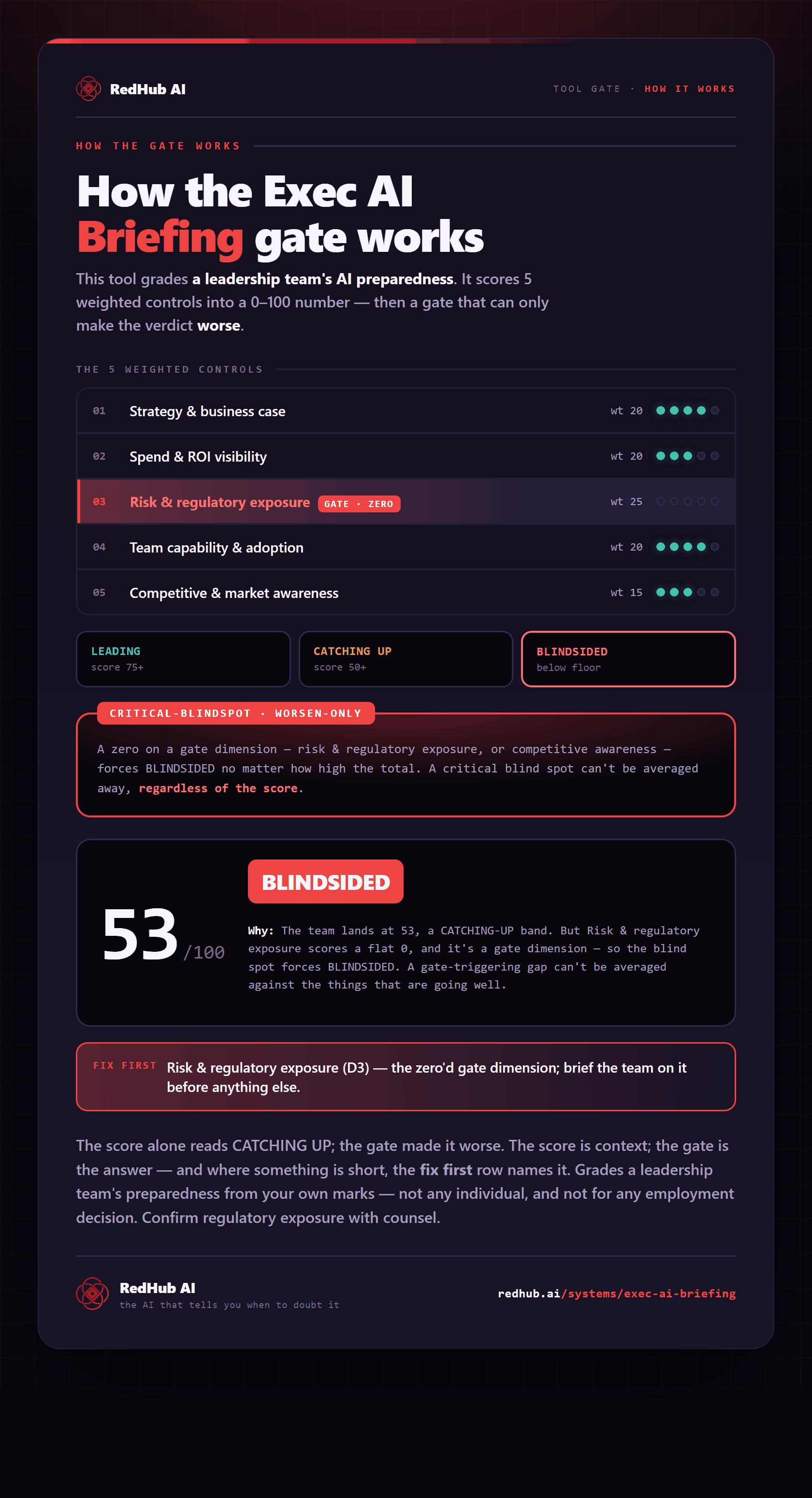
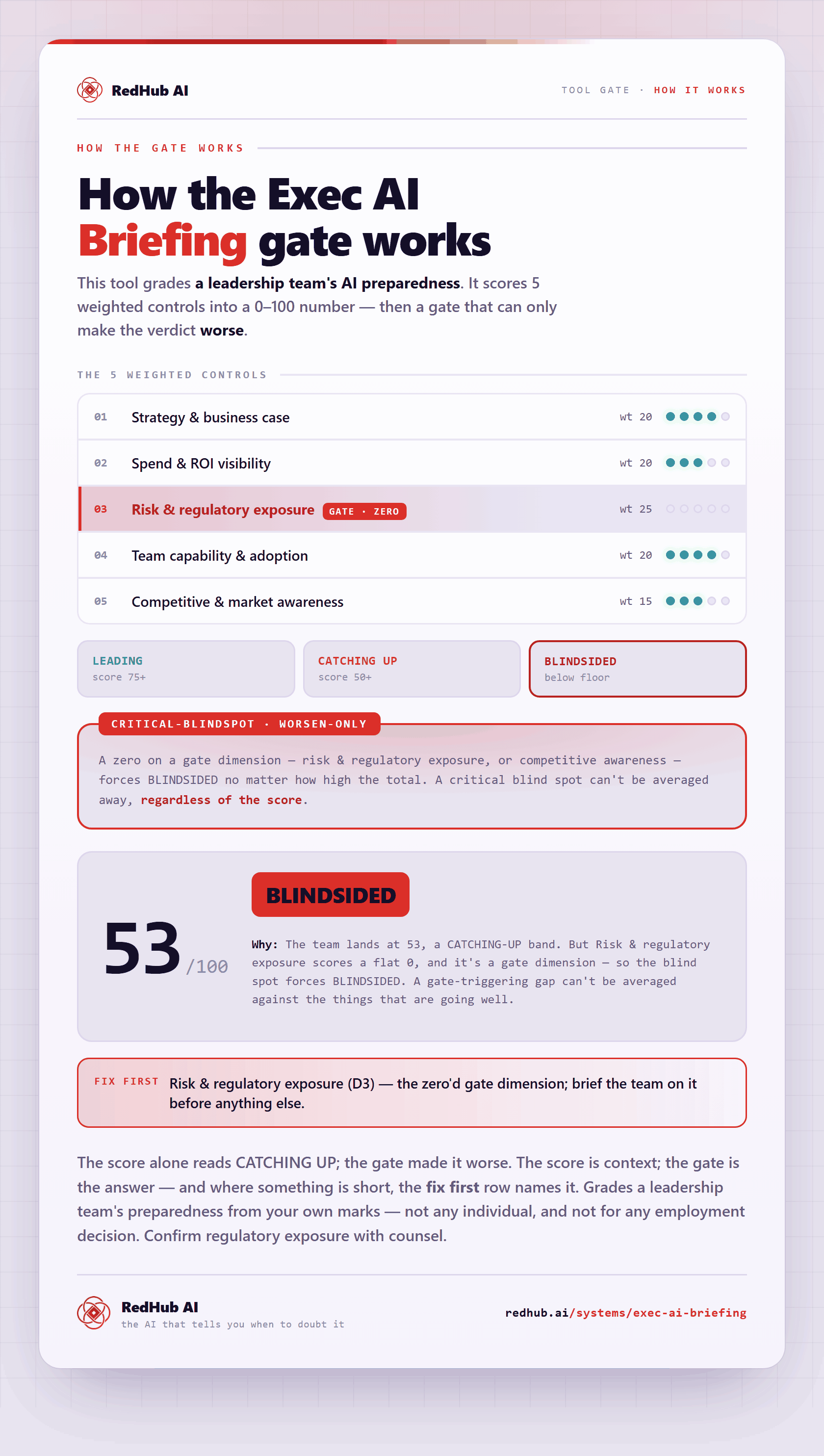
The gate this post refers to, drawn from the tool’s own logic. See the tool.