AI Generated Resumes: Verify Claims, Don't Play Detector
RedHub AI Editorial6 min read

Jump to a section8
TL;DR
- What it is: AI-generated resumes are now normal. The problem was never the tool — it's claims nobody verified.
- Who it's for: Hiring teams tempted by AI-detection tools, and anyone building a verification-first alternative with the Hiring Verification Bundle.
- How it works: Stop asking "did AI write this?" (unanswerable) and start asking "can these claims be verified?" (answerable, fair, and consistent).
- Bottom line: Detection guesses about authorship. Verification checks facts. Only one of those holds up when the decision gets questioned.
Should employers screen out AI-generated resumes?
No. Using AI to write a resume isn't dishonesty — a truthful history written by a tool is still truthful, and an invented one typed by hand is still fraud. There's also no reliable way to detect AI-generated text, so rejecting suspected AI resumes means acting on a guess, inconsistently, against candidates who did nothing wrong. The workable response is verification: confirm the material claims — degree, dates, title, headline result — against reachable sources, the same way for every candidate, regardless of who or what typed the document.
Best for: teams replacing detection theater with a checkable process. The Hiring Verification Bundle ($99) scores what's verifiable — never who wrote it.
Every hiring team has felt it: applications that read eerily alike, cover letters with the same confident cadence, resumes polished to a uniform shine. AI-generated resumes are everywhere, and the reflex is understandable — find a detector, filter them out, get back to "real" applications. That reflex is wrong three ways: the detection doesn't work, the rejection isn't fair, and the filter aims at the wrong problem. Here's what actually changed when AI started writing applications — and the response that holds up.
Using AI to write a resume isn't lying
Start with the uncomfortable symmetry. A candidate with a genuine decade of experience who asks an AI assistant to write it up has produced a truthful resume. A candidate who types an invented degree with their own two hands has produced a fraudulent one. The tool tells you nothing about the truth of the claims — and the claims are the only thing that matters.
Resume-writing help has always existed: career coaches, template services, professional writers. AI just made it free. Penalizing candidates for using the same class of help your own team uses daily isn't a standard — it's a mood.
Detection doesn't work — and acting on it is worse
AI-text detectors produce confident-sounding guesses. Polished human writing trips them; lightly edited AI text slips them. No vendor can honestly promise otherwise, because there is no reliable signal in the text itself to find.
Now put that unreliability in a hiring pipeline and it compounds:
- You'll be wrong invisibly. A false positive rejects an honest candidate with no way for anyone to notice, ever.
- You'll be inconsistent. Detector scores wobble. Two identical-quality candidates get different treatment based on noise — the exact opposite of the same-checks-for-everyone discipline that keeps hiring fair and defensible.
- You'll build a decision on a claim you can't support. "We rejected them because a tool guessed AI wrote their resume" is not a sentence anyone wants to defend — to a candidate, a regulator, or a court. This is the same reason automated screening of people draws EEOC scrutiny: consequential decisions built on unaccountable signals.
Key insight: detection asks a question you can't answer (who wrote this?) to justify a decision you shouldn't automate (reject this person). Verification asks a question you can answer (is this claim confirmed?) and leaves the decision with people. Not legal advice — but one of these processes is explainable and one isn't.
What AI actually changed: fabrication got cheap and clean
The real shift isn't that candidates use writing tools. It's that a fabricated application now costs nothing to produce and arrives specific, internally consistent, and beautifully written. The tells that used to leak — vagueness, sloppy inconsistencies, generic filler — are gone. Surface reading is dead as a screening method, in both directions: you can't spot fabrication by roughness, and you can't trust truth by polish.
Which means the only durable signal left is the one that was always the point: can the claims be independently verified? A real degree sits in a registrar's records. A real title survives a reference call. A real headline result has a confirmable shape. Fabrications, however beautifully written, have none of that behind them — and no writing tool can conjure a registrar record into existence.
The verification-first response
Practically, handling AI-generated resumes looks like this:
- Drop authorship from your criteria entirely. Don't ask, don't guess, don't buy a detector. It's unanswerable and irrelevant.
- Triage every application for verifiability. How much of this document can be checked at all? Are core claims corroborable? Are references reachable? The Application Fabrication-Risk & Verification Triage scores six such signals; heavy AI-generation tells are one of them, weighted lightest — and even a zero there only routes to a conversation, never a rejection.
- Verify finalists claim by claim. Degrees to registrars and issuers, work claims to confirmed references, each claim tracked to a verified / verify-first / unverifiable verdict.
- Let the candidate speak to their experience. The honest response to a resume that reads machine-written isn't suspicion — it's a conversation. Someone who lived the work can talk about it fluently in their own words. That conversation, plus verified claims, tells you everything a detector pretends to.
This is why the tools in the Hiring Verification Bundle are explicitly not AI detectors — they never assert "this was written by AI," and they never score or reject a person. They score what's verifiable in the document and point your checking. That's the honest version of the job, and it's the version that treats a candidate who used a writing tool exactly like one who didn't: verify the same claims, the same way. The red flags that still matter are all verifiability signals for the same reason.
Skip the detector. Check the claims.
Triage how verifiable every application is, then verify finalists claim by claim — the artifact, never the candidate, every verdict routing to a check. Two tools, $99, save $29 vs. separate. 30-day guarantee.
Get the Hiring Verification Bundle — $99 →Decision Guide
Use this approach if: AI-polished applications have made your old screening instincts useless and you want a process that's fair, consistent, and explainable.
Skip it if: you're shopping for a tool that promises to catch AI resumes. That promise can't be kept, and acting on it creates the risk you're trying to avoid.
Best first step: take one suspiciously perfect application and, instead of guessing about authorship, check its single load-bearing claim against a real source. The answer will be more useful than any detector score.
FAQ
Can you detect an AI-generated resume?
Not reliably. AI-text detectors misfire in both directions — flagging polished human writing and missing edited AI text — and no vendor can honestly promise otherwise. Any process built on detection is built on guesses.
Is it lying to use AI to write your resume?
No. The truth of a resume lives in its claims, not its authorship. A truthful history written by AI is truthful; an invented one typed by hand is fraud. Verify claims, ignore the typing.
Should I reject resumes that look AI-written?
No. You'd be acting on an unreliable guess, applied inconsistently, against candidates who did nothing wrong — a fairness problem and a legal-risk problem at once. Run the same verification on every application instead.
What actually changed now that AI writes resumes?
Fabrication became cheap and clean. Invented applications now arrive specific, consistent, and polished, so surface reading stopped working. The claims themselves — checkable against registrars, issuers, and references — are the only signal left.
How do I hire safely when every resume looks perfect?
Two passes: triage every application for overall verifiability, then verify finalists claim by claim against reachable sources — the same checks for everyone. The full process is in our guide to verifying resume claims.
Is the Hiring Verification Bundle an AI detector?
No, deliberately. One of its six signals notes heavy AI-generation tells, but it's the lightest-weighted signal and only ever routes to a conversation — the tools never assert AI authorship, never score a person, and never output a reject. They score the document's verifiability and point your checking.
Not legal advice: rejecting or screening candidates based on AI-authorship guesses touches anti-discrimination and AI-hiring law (Title VII, plus state and local rules). This article describes a verification process, not the law of your jurisdiction — confirm your process with HR and qualified counsel.
Verification beats detection
The Hiring Verification Bundle: a whole-application verifiability triage plus a per-claim checklist gate. Not an AI detector, a screening tool, a background check, or legal advice — an honest working aid for the checking that actually protects you.
Get the Hiring Verification Bundle — $99 →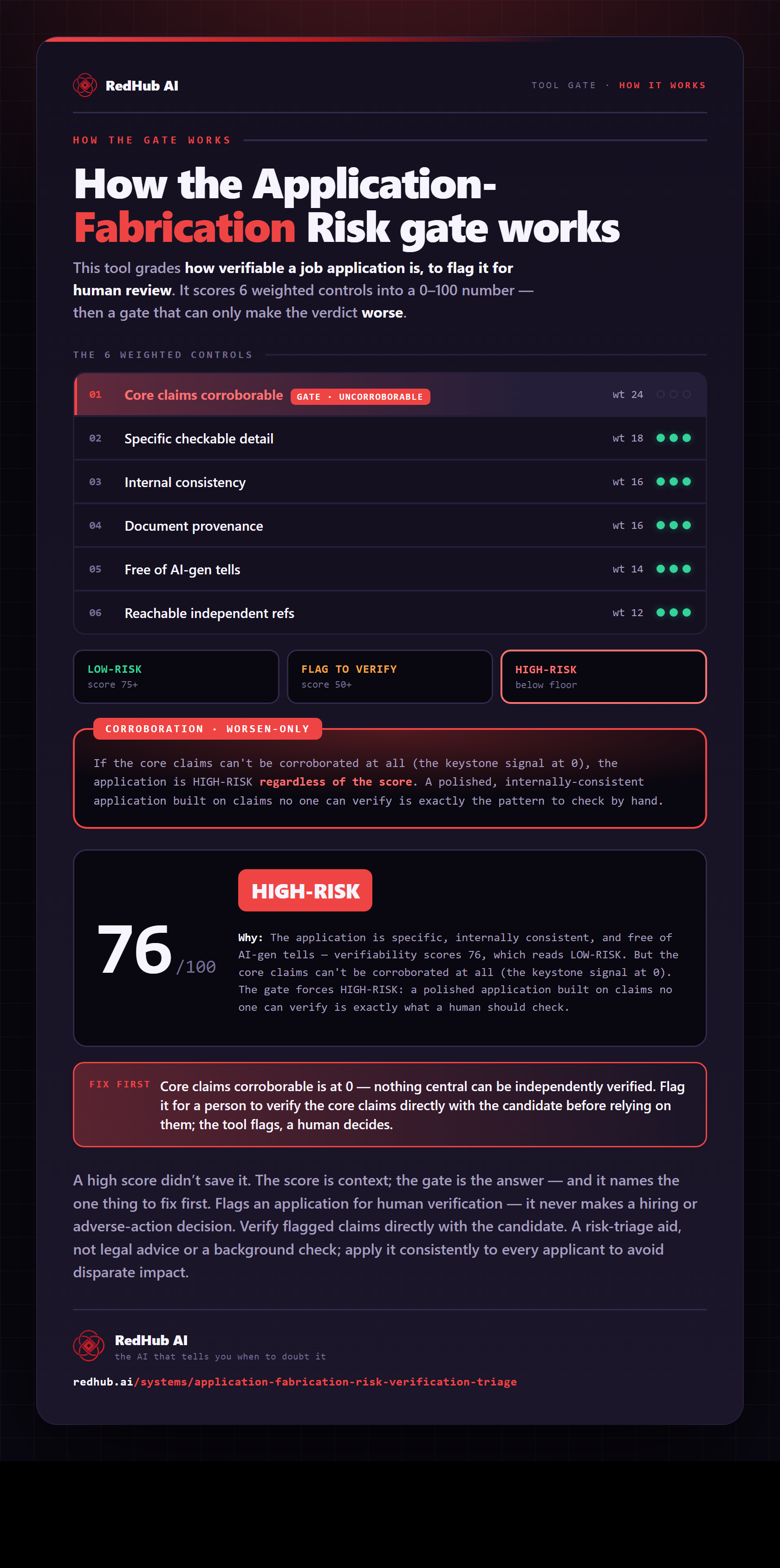
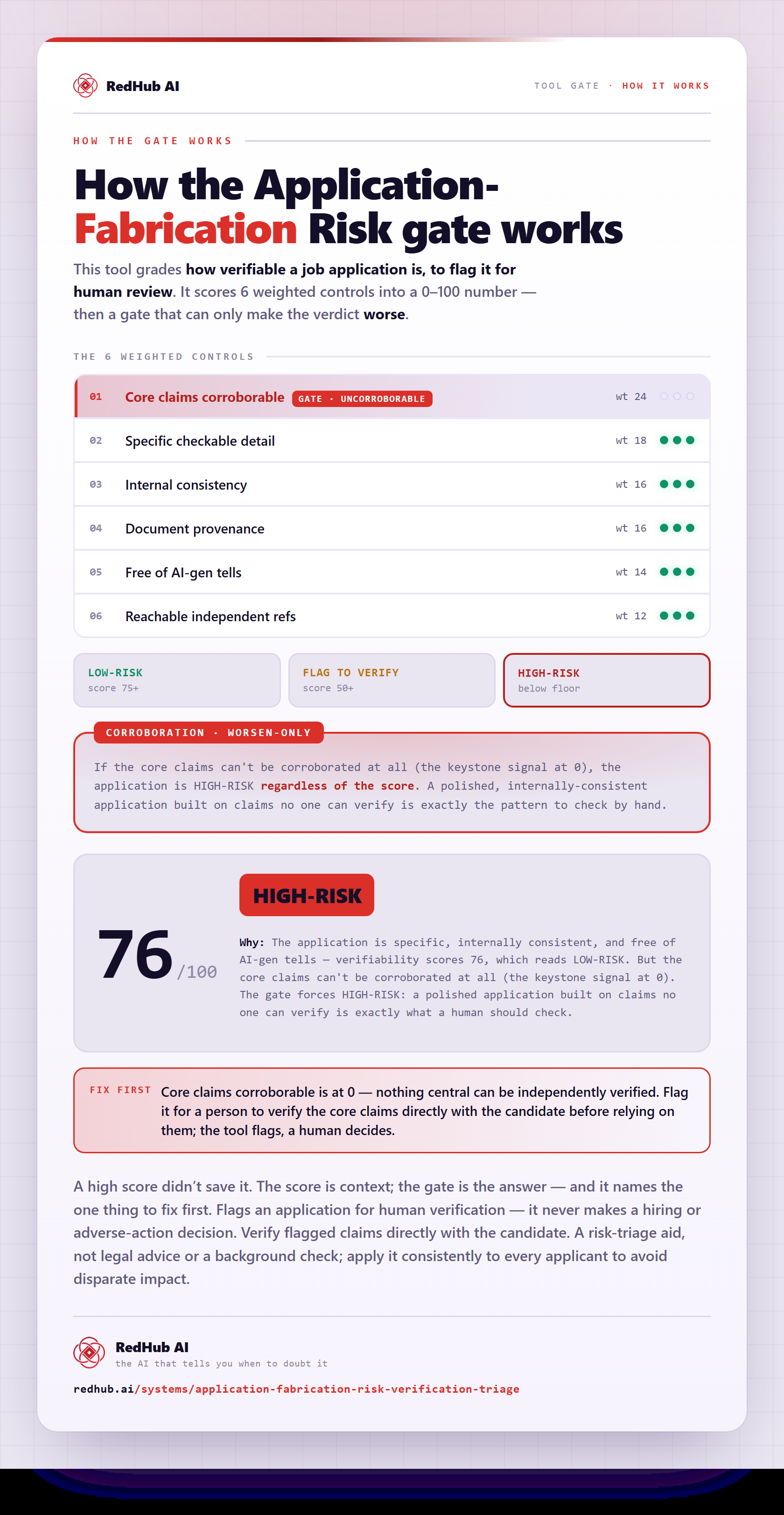
The gate this post refers to, drawn from the tool’s own logic. See the tool.