How to Verify References — and the Claims Behind Them
RedHub AI Editorial6 min read

Jump to a section8
TL;DR
- What it is: Verifying references is two jobs: confirm each reference is a real, independent person first — then use the conversation to verify the resume's material claims.
- Who it's for: Hiring managers and founders making finalist decisions, especially those running the Hiring Verification Bundle's per-claim checklist.
- How it works: Reach the reference through an independent channel, cross-check their role, then ask the same claim-focused questions for every candidate.
- Bottom line: A reference is only evidence if the reference itself is verified. An unreachable or unverifiable reference means ask for another — not reject the candidate.
How do you verify references?
To verify references, confirm the person is real and independent before you trust anything they say: reach them through a channel you found yourself (a company main line or verified work email, not just the cell number on the application), and cross-check that they actually held the role and overlap they're described as having. Then use the call to verify specific material claims from the resume — dates, title, scope, the headline result — with the same question set for every candidate. A reference you can't independently confirm is a lead, not evidence.
Best for: verifying the claims no registrar can settle — what the candidate actually did. The Resume-Claim Verification Checklist Gate ($49) tracks whether each claim's source is genuinely reachable.
Reference checks have a bad reputation because most of them deserve it. A ten-minute call with a hand-picked cheerleader, three vague questions, "yeah, they were great," done. That ritual verifies nothing. Worse: in the same StandOut CV study that found 64.2% admitted lying on their resume at least once (opens in a new tab), references themselves show up as one of the most common things people lie about. Friends posing as former managers is a real pattern, and paid fake-reference services openly advertise. So learning how to verify references properly means doing two jobs in order — verify the verifier, then verify the claims.
Job one: confirm the reference is real
Before a word of the conversation counts as evidence, the person on the other end has to be independently confirmed. Three checks, a few minutes each:
- Reach them through a channel you found. Call the company's main line and ask for the person, or use a work email at the company's real domain. The cell number on the application connects you to whoever the candidate chose — which is exactly the hole fake-reference services drive through.
- Cross-check the role and overlap. Does this person's public professional footprint (a company directory, a profile) match "engineering manager at that company during those years"? A reference whose own story can't be confirmed can't confirm anyone else's.
- Confirm independence. A former manager or direct colleague is evidence. A friend, a relative, or a peer who never worked with the candidate is a character witness — fine as far as it goes, but they can't corroborate work claims, and they shouldn't be counted as if they could.
Key insight: in the verification checklist's terms, a reference is a source, and sources have to be reachable and real before the claims they support count as anything more than claimed. Verify the verifier first.
Job two: verify claims, not vibes
Once the reference is confirmed, most people waste the call. "What's it like working with them?" invites a rehearsed answer and verifies nothing. The call is your one chance to check the claims no database can settle — so bring the resume's material claims and work through them:
- Dates and title: "Our records question is simple — what was their title, and roughly when did they work with you?" Let the reference answer first; don't feed the resume's version.
- Scope: "The resume describes leading a team of eight. How would you describe what they owned?" Real scope survives an open question; inflated scope wobbles.
- The headline result: "They cite cutting onboarding time roughly in half. Were you close to that work? What was their part in it?" You're checking the claim's shape — did it happen, and was this person central — not auditing decimals.
- The disconfirming question: "What would you have wanted them to be stronger at?" An honest reference has an answer. A scripted one doesn't.
Ask the same core set for every candidate at the same stage, and write down who confirmed what. Consistency is what makes the answers comparable — and what keeps the process fair and defensible.
When references are unreachable
It happens constantly, and it isn't damning: companies fold, managers move, people go quiet. The honest status for an unconfirmed material claim is unverifiable — for now. The right next step is to go back to the candidate: "We couldn't reach this reference — can you connect us, or offer someone else who was close to this work?" Honest candidates fix this fast, and often gladly. What you don't do is silently downgrade the candidate because a phone number went dead.
This is exactly the logic the Resume-Claim Verification Checklist Gate enforces: each claim gets an evidence level and a source-reachability mark, an unreachable source on a material claim holds the whole checklist at HOLD TO VERIFY, and the hold routes to "get a source from the candidate" — never to a reject. Three verified claims can't clear one unverifiable material one, and no stack of warm reference vibes can either.
Not legal advice: reference conversations touch legal territory — keep questions job-related, apply the same process to every candidate, and know that using a third-party checking service can trigger FCRA consent and notice duties. Some employers only confirm dates and title, and state rules on what references can say vary. Confirm your reference process with HR and qualified counsel.
Where references fit in the verification stack
References are the reachable source for the claims that matter most and verify hardest: what someone actually did and how well. Registrars settle degrees and certifications; issuers settle licenses; but "led the migration," "grew the territory," "ran a team" — those live or die on a confirmed human who was there. That's why "reachable independent references" is one of the six signals in the red-flag triage, and why the full resume-claim verification guide treats the reference call as a verification instrument, not a formality.
Make every reference call count as evidence
The Hiring Verification Bundle pairs a whole-application verifiability triage with a per-claim checklist — including source-reachability on every material claim, so a dead-end reference is a named, visible hold instead of a shrug. Two tools, $99, save $29. 30-day guarantee.
Get the Hiring Verification Bundle — $99 →Decision Guide
Use this process if: a hiring decision rests on claims only a human can confirm — scope, results, how someone actually operated.
Skip it if: you want references to rubber-stamp a decision you've already made. That's theater, and it's not worth anyone's twenty minutes.
Best first step: for your current finalist, reach one reference through a channel you found yourself — not the number on the application — and ask one open question about the resume's headline result.
FAQ
How do I know if a reference is real?
Reach them through an independent channel — the company's main line or a verified work-domain email — and cross-check that their role and dates match who they're described as being. If you can only reach them through the contact info the candidate supplied, they're not independently confirmed yet.
Are fake references actually common?
Common enough to check for. Survey data (StandOut CV) finds references among the things candidates admit lying about, and paid fake-reference services exist openly. The fix costs minutes: verify the person before you weigh their words.
What should a reference check actually verify?
The material claims from the resume: dates, title, scope, and the headline result — asked as open questions so the reference answers from memory, not from the script. "Were they great?" verifies nothing.
How many references should I check?
Enough confirmed-independent people to cover the material claims — usually two or three, including at least one former manager. One warm voice covering everything is thin evidence for a decision this size.
What if a candidate's references can't be reached?
Treat the affected claims as unverifiable for now, tell the candidate, and ask them to reconnect you or offer an alternative who was close to the work. Unreachable is a status to resolve — not a reason to reject.
What questions am I allowed to ask a reference?
Keep every question job-related and ask the same core set for every candidate. Questions that touch protected characteristics are off the table, same as in interviews. This isn't legal advice — have HR or counsel review your standard question set once, then reuse it.
Verify the verifier, then the claims
A consistent per-claim checklist with source-reachability built in — the artifact, never the candidate, and every verdict routing to a check. Read the full guide to verifying resume claims, or start with the tools.
Get the Hiring Verification Bundle — $99 →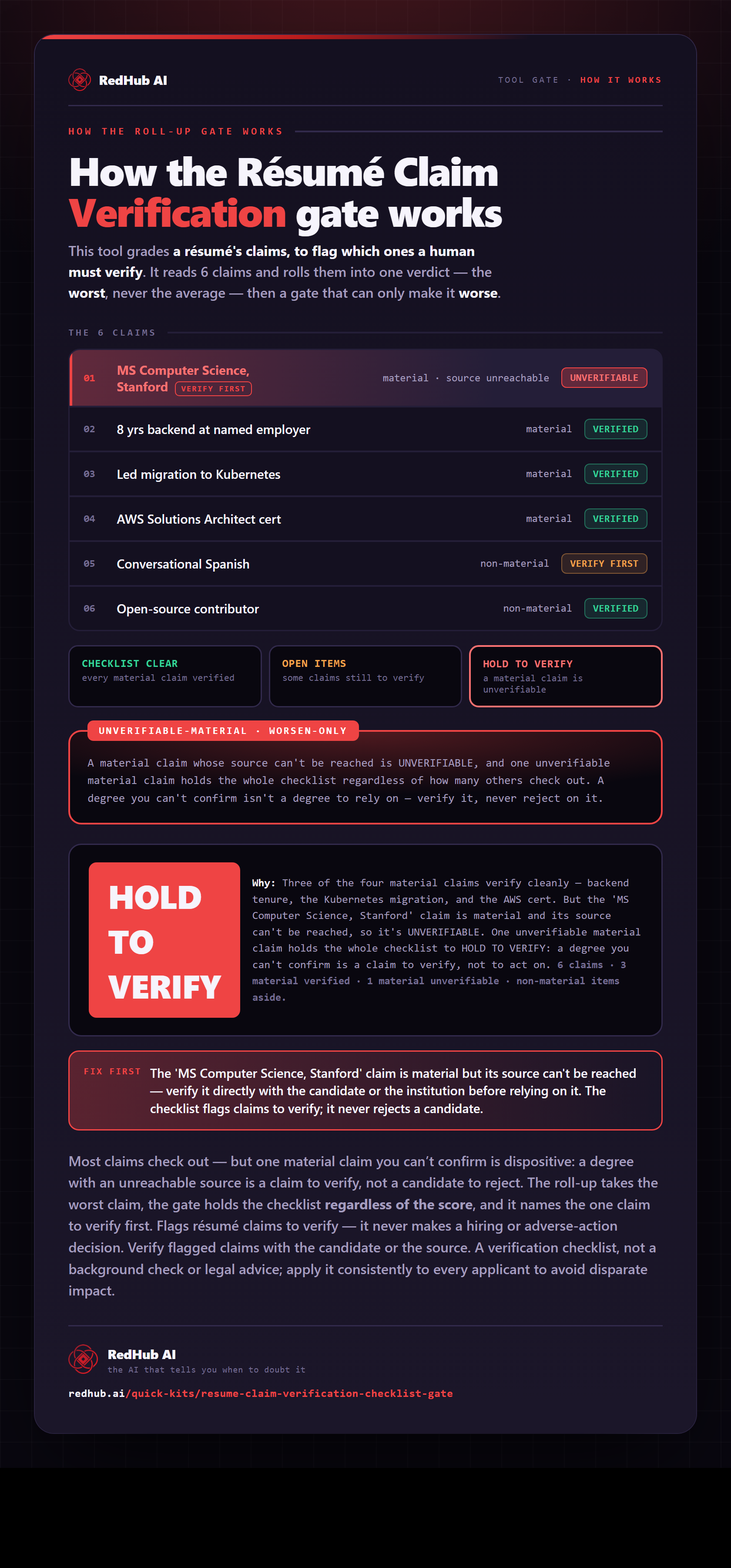
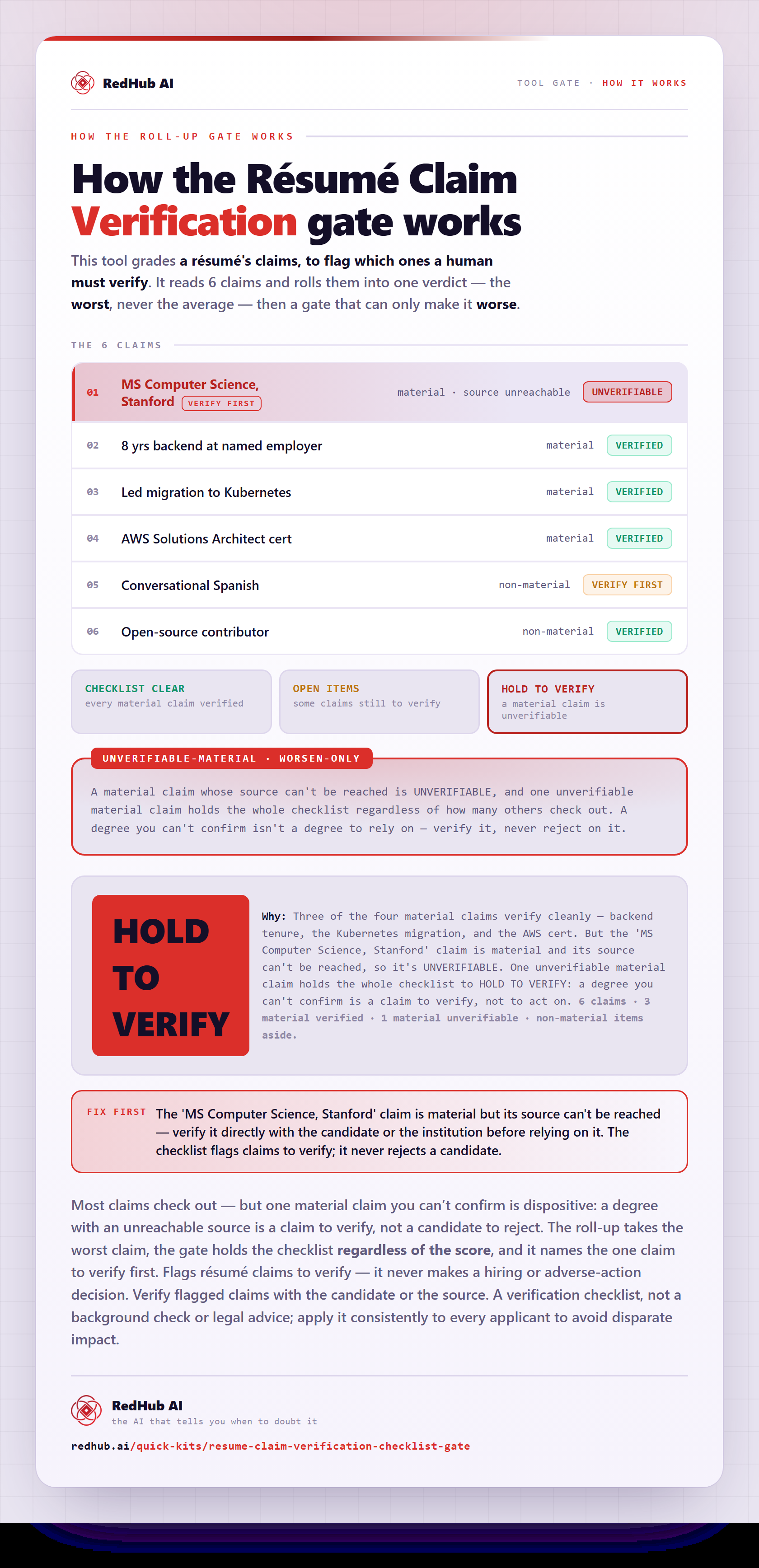
The gate this post refers to, drawn from the tool’s own logic. See the tool.