How to Verify Education Credentials on a Resume
RedHub AI Editorial6 min read

Jump to a section9
TL;DR
- What it is: Verifying education credentials means confirming a degree, diploma, or certification with the institution or issuer itself — not with the resume that claims it.
- Who it's for: Anyone hiring for a role where the credential is load-bearing, including teams running the Hiring Verification Bundle's per-claim checklist.
- How it works: Identify the material credentials, get the candidate's consent and details, check the registrar or issuer's verification channel, and confirm the institution is real and accredited.
- Bottom line: A degree that can't be confirmed isn't fake — it's unverified. Hold the checklist, ask for a source, and let the candidate resolve it.
How do you verify education credentials?
To verify education credentials, go to the source that issued them: the school's registrar or its enrollment-verification service for degrees, the certifying body's public lookup page for professional certifications, and an accreditation database to confirm the institution itself is legitimate. Get the candidate's consent and exact details first (institution name at the time of attendance, dates, credential name). Never accept the resume, a scanned certificate, or a profile page as final proof — those are the claims being checked, not the evidence.
Best for: roles where the credential is a requirement, not decoration. The Resume-Claim Verification Checklist Gate ($49) tracks each credential to a VERIFIED / VERIFY FIRST / UNVERIFIABLE verdict.
The degree is the classic keystone claim. It's specific, it's binary — the person either earned it or didn't — and whole hiring decisions rest on it. It's also one of the more commonly embellished sections on a resume, from "attended" quietly becoming "graduated" to entirely invented credentials from schools that exist only as websites. The good news: education is the easiest claim type to verify properly, because real institutions keep records and real certifiers publish lookup tools. Here's the process.
Why education claims deserve the check
Three reasons this claim type earns first place in your verification order:
- It's usually material. If the posting requires the degree or the license, the claim is load-bearing by definition. A wrong title inflates; a wrong license can put you out of compliance.
- It's cheap to fake and cheap to check. Diploma mills sell realistic paper, and AI writes convincing education sections. But a registrar or an issuer lookup settles the question in minutes to days.
- It's binary. Unlike "led a team of 12," a credential claim has a clean true/false answer waiting at a reachable source. There's no excuse for relying on it unchecked.
The five-step verification path
- List the material education claims. Not every line matters. The MBA on a role that requires one is material; a decades-old minor is not. Verify what the decision rests on — the same set, for every finalist.
- Get consent and exact details. Tell the candidate you verify credentials for all finalists (consistency is the fairness), and collect what the check needs: the institution's name at the time, campus, dates, credential name, and any name the candidate studied under. Many registrars require the candidate's authorization — that's normal, not an obstacle.
- Check the issuer's own channel. For U.S. degrees, many institutions verify through the National Student Clearinghouse (opens in a new tab); otherwise, contact the registrar directly. For certifications (cloud, security, accounting, project management), use the certifying body's public verification page and the credential ID. Ask the candidate for that ID — a real credential holder has it.
- Confirm the institution is real and accredited. A verified degree from a fake school is still a fake credential. Check the U.S. Department of Education's accreditation database (DAPIP) (opens in a new tab) or CHEA (opens in a new tab). Diploma mills often mimic real university names — verify the institution, not just the name.
- Record the evidence and give the claim a verdict. Write down who confirmed what, when, and through which channel. Each claim lands as verified, verify-first, or unverifiable — and an unverifiable material credential holds the decision until it's resolved, with the candidate given a fair chance to supply a source.
Key insight: "the school can't confirm it" is not the same as "the candidate lied." Schools merge, records offices lag, names change, and international records take longer. Unverifiable means hold and ask — never silently reject. Most honest claims resolve the moment the candidate hears there's a question.
What education verification costs you in time
The usual objection is time. Run your own numbers — this is plain arithmetic on your inputs, not a promise:
Your monthly verification time budget
For most teams that's a few hours a month — for finalists only, because the two-grain motion triages the wider pool first and saves deep checking for the people you're serious about. Compare that with the cost of one hire whose required credential turns out not to exist.
Where the legal lines are
Two boundaries to respect, briefly and honestly:
- FCRA. If a third-party service verifies education for you, that's typically a consumer report under the federal Fair Credit Reporting Act — written consent first, and specific adverse-action steps if the result affects the decision. The FTC's employer guide (opens in a new tab) covers the basics. Checking directly with a registrar yourself is a different path, but consent is still the norm and state rules vary.
- Consistency. Verify the same credentials at the same stage for every candidate. Checking only the candidates who "seem off" is where discrimination risk enters.
Not legal advice: this article describes a verification process, not the rules of your jurisdiction. Confirm your education-verification and background-check process with HR and qualified counsel.
Where this fits in the bigger checklist
Education is one claim type on a longer list. The Resume-Claim Verification Checklist Gate gives every material claim its own row — evidence level, source reachability, per-claim verdict — and holds the whole checklist at HOLD TO VERIFY when one material claim (a degree is the textbook case) has no reachable source. Three confirmed claims can't clear one unconfirmed material one; that's the gate doing its job. For claims a registrar can't settle — titles, scope, headline results — the reachable source is a human being: here's how to verify references. And for spotting which applications need this depth at all, start with the six red flags that still matter.
Give every credential a verdict, not a vibe
The Hiring Verification Bundle pairs the whole-application triage with the per-claim checklist — VERIFIED / VERIFY FIRST / UNVERIFIABLE on every material claim, and a hold that names the one claim blocking the checklist. $99, save $29 vs. separate. 30-day guarantee.
Get the Hiring Verification Bundle — $99 →Decision Guide
Use this process if: the role requires a degree, license, or certification — or a candidate's credential is a core reason you're hiring them.
Skip the deep check if: the credential is genuinely immaterial to the role. Verify what the decision rests on; don't audit someone's life.
Best first step: for your current finalist, ask the certifying body's lookup page for one certification ID. It takes five minutes and sets the habit.
FAQ
How do I verify a candidate's degree?
With the candidate's consent, check the institution's registrar or its enrollment-verification service — many U.S. schools verify through the National Student Clearinghouse. You'll need the institution's name at the time, dates of attendance, and the exact credential name.
What is a diploma mill?
An operation that sells credentials without real accredited instruction — often with a university-sounding name and a convincing website. That's why you verify the institution too: check it in the Department of Education's DAPIP database or CHEA before trusting any degree it issued.
Do I need the candidate's permission to verify their education?
Practically, yes — many registrars require the candidate's authorization, and if a third-party service does the check, FCRA requires written consent. Telling every finalist "we verify credentials at this stage" is also the fair, consistent way to do it. Not legal advice; confirm with counsel.
How do I verify professional certifications?
Use the issuing body's own public verification page with the credential ID the candidate provides. Most major certifiers — cloud platforms, security bodies, accounting and PM institutes — publish a lookup tool. No ID and no lookup result is a verify-first flag, not a rejection.
What if the school no longer exists or can't be reached?
Closed schools usually have a records custodian — often the state's higher-education agency. Until a source is reached, the claim is unverifiable: hold it, tell the candidate, and let them help locate the records. Unreachable is a status, not a verdict on the person.
How long does education verification take?
Certification lookups take minutes. Clearinghouse and registrar checks typically run from same-day to a few business days; closed schools and international records take longer. Build the wait into your finalist stage instead of skipping the check.
Check the claim before you trust it
Per-claim verdicts, a material-claim gate, and a consistent habit you apply to every finalist. Not a background check, a screening tool, or legal advice — a working aid that points your checking. Read the full guide to verifying resume claims, or get the tools.
Get the Hiring Verification Bundle — $99 →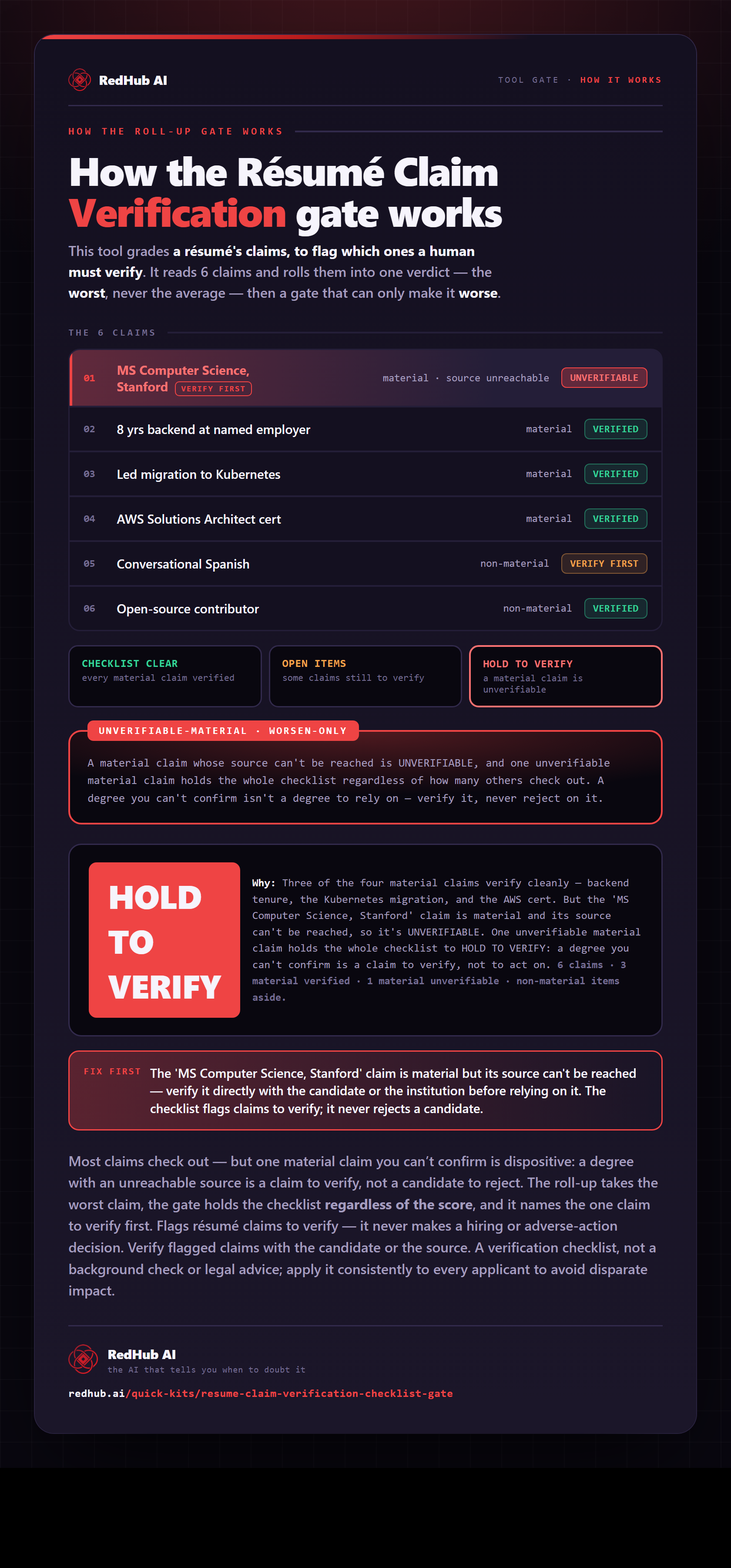
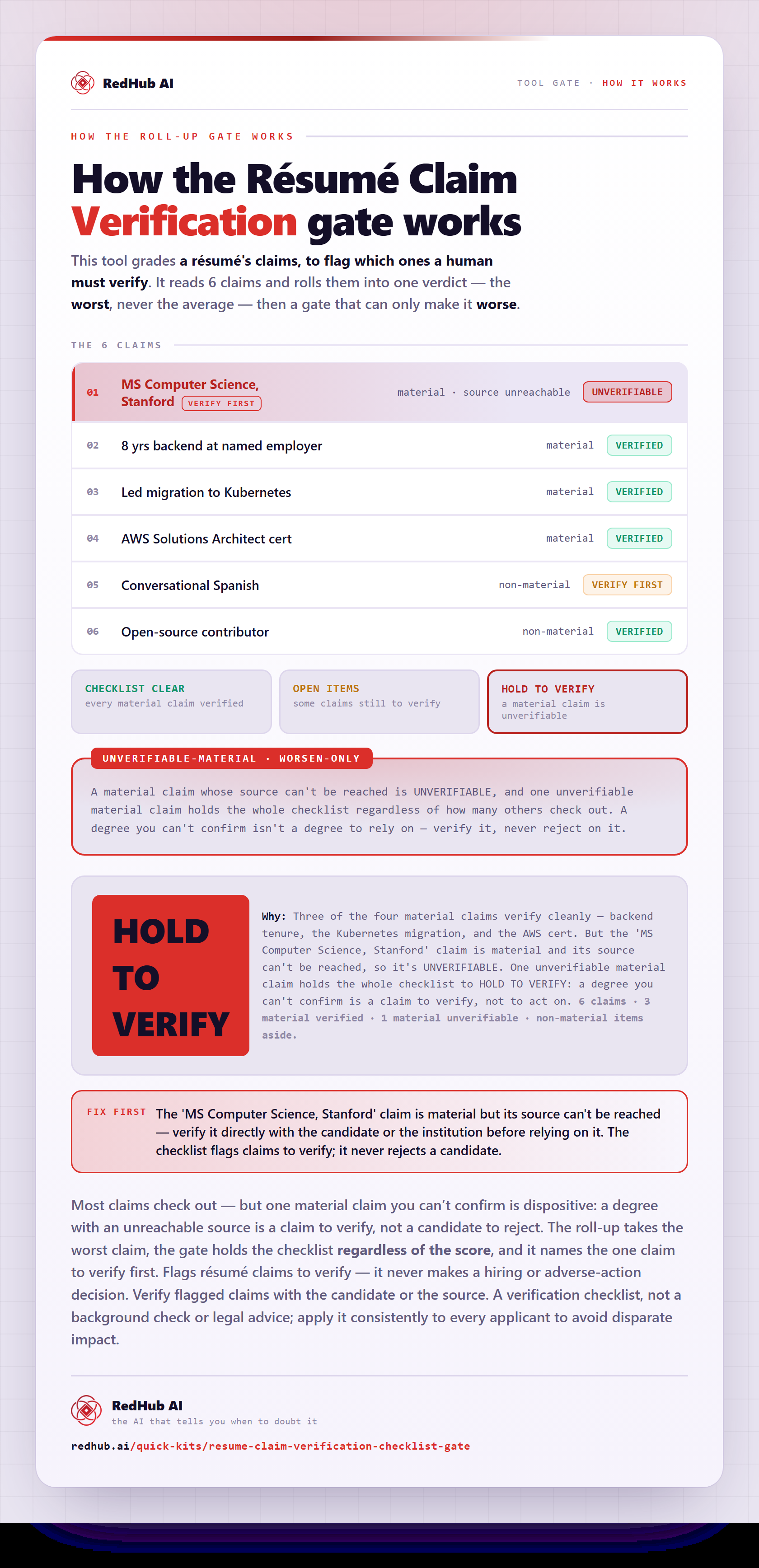
The gate this post refers to, drawn from the tool’s own logic. See the tool.