Resume Red Flags: Verify Them, Don't Reject Them
RedHub AI Editorial7 min read

Jump to a section9
TL;DR
- What it is: A resume red flag is a signal that a claim needs verification — not a reason to reject anyone.
- Who it's for: Recruiters and hiring managers tired of gut-feel screening, and anyone building a consistent process with the Hiring Verification Bundle.
- How it works: Drop the folklore flags (gaps, formatting, job-hopping). Watch six verifiability signals instead, with one that outranks the rest: a load-bearing claim nobody can corroborate.
- Bottom line: Every red flag should trigger the same next step — go check the claim — applied to every candidate the same way.
What are resume red flags?
Resume red flags are signals that something on an application needs verification before you rely on it — a core claim with no way to corroborate it, vague detail where specifics should be, internal contradictions, or references nobody can reach. In the AI era, a red flag is honestly defined by one question: can this claim be checked? A red flag is never, by itself, evidence of lying — and it should route you to a verification step, not a rejection.
Best for: teams replacing gut-feel screening with a repeatable check. The Hiring Verification Bundle ($99) scores these signals consistently across a whole applicant pool.
Search for resume red flags and you'll find the same folklore list every time: employment gaps, job-hopping, typos, "weird" formatting. That list was always shaky. Now it's actively harmful — because AI erased the surface signals it depends on, and because acting on folklore inconsistently is how hiring gets unfair fast. Here's the honest version: which flags still mean something, what each one actually tells you, and why the right response to every single one is a verification step, never a reject.
The old red-flag list is dead
Most traditional red flags were proxies for effort and continuity. Typos meant carelessness. Gaps meant something to hide. Polish meant diligence. Those proxies broke twice over:
- AI killed the surface signals in both directions. A fabricated history now arrives with perfect formatting, confident phrasing, and zero typos. Meanwhile an excellent, truthful candidate who didn't use a writing tool may look "rougher" than the invented one. Judging the surface now selects for tool use, not truth.
- The life-story flags were always noise. Gaps are caregiving, illness, layoffs, sabbaticals, visas. Job changes are startups folding and industries convulsing. Treating those as marks against a person punishes circumstances, not dishonesty — and applying such judgments unevenly across candidates is where discrimination risk lives.
Key insight: a useful red flag is a property of the claims, not the person or the paper. The only question that survives the AI era is: can what this document says be verified?
The six red flags that still matter
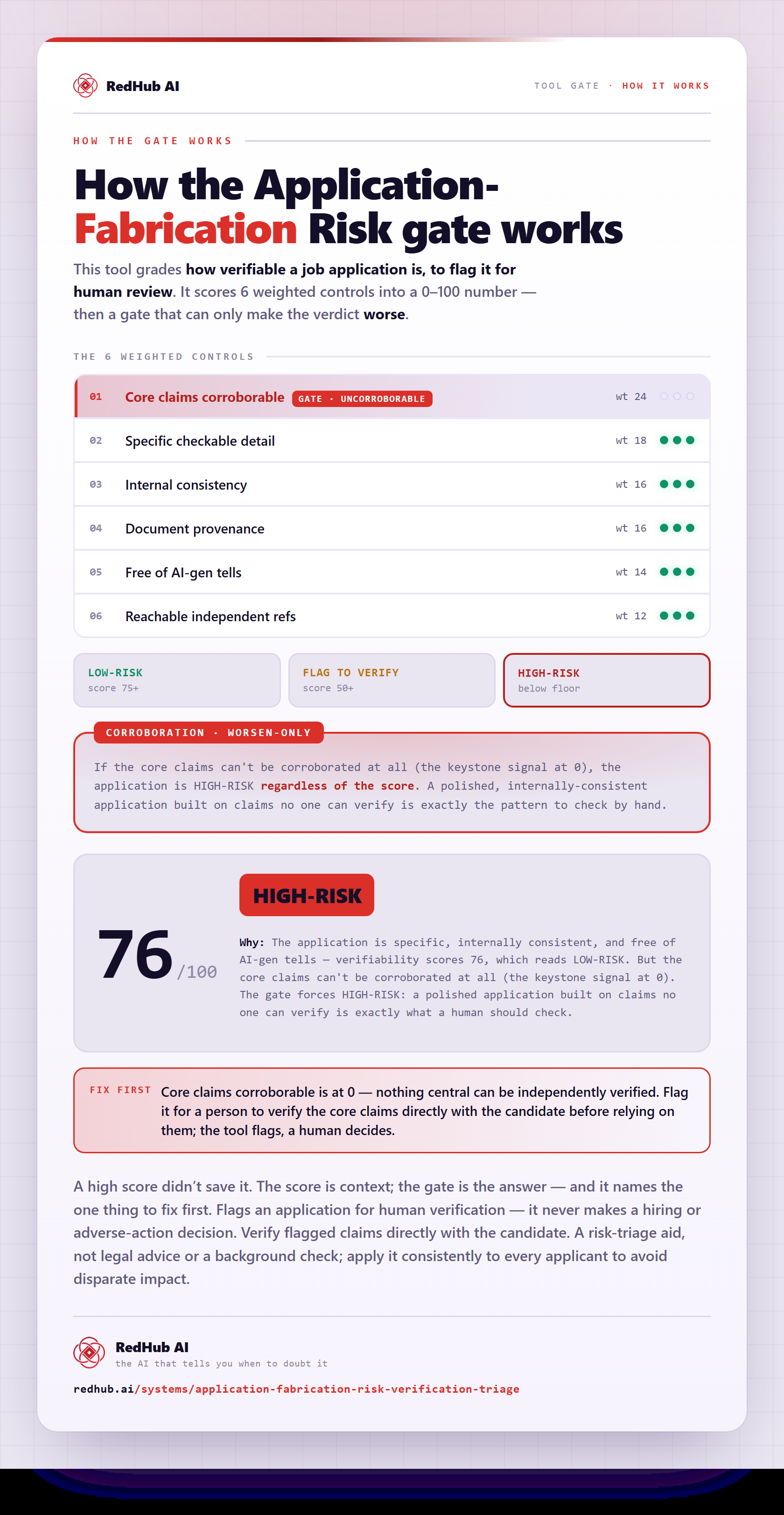
These are the six verifiability signals the Application Fabrication-Risk & Verification Triage scores on every application (the weights are the tool's shipped configuration). Notice that every one is about checkability — none is about the candidate's life choices.
| Red flag | What it actually tells you | The verification step |
|---|---|---|
| A core claim nobody can corroborate (the keystone) | The claim the candidacy rests on — degree, title, headline result — has no independent source confirming it. This is the fabrication pattern. | Verify that one claim first. Ask the candidate directly for a source; most honest claims resolve in one exchange. |
| Vague where it should be specific | "Improved performance significantly" gives you nothing to check. Uncheckable phrasing may be padding — or just weak writing. | Ask for the specifics: which project, what metric, measured how. True experience has details. |
| Internal inconsistencies | Dates that overlap impossibly, titles that don't match the timeline, a skills list the history can't explain. | Ask the candidate to walk the timeline. Confusion differs from evasion — and you'll hear the difference. |
| Odd provenance | The document's origin story doesn't hang together — details that shift between the resume, the profile, and the cover letter. | Compare versions, then ask about the discrepancy directly. There's often a boring explanation. |
| Heavy AI-generation tells | Only that a writing tool was involved — which is not fraud and not disqualifying. | Have the candidate speak to the experience in their own words. The claims still verify or they don't. More on why detection is a trap. |
| No reachable references | Every named source is unreachable, generic, or unverifiable — so nothing in the document can be independently confirmed yet. | Request current, reachable references — and verify the references themselves before you lean on them. |
One flag outranks the other five
The six signals aren't equals. In the triage tool, "core claims corroborable" is a keystone: if the load-bearing claim scores zero — no independent way to confirm it — the whole application gates to HIGH-RISK, no matter how clean everything else is. In the tool's shipped example, an application scores 76 out of 100 overall and still gates, because its one central claim can't be corroborated.
That's deliberate, and it's the part most screening habits miss. Fabricated applications are usually clean everywhere except the one claim that matters. If you average your impressions, the clean filler buries the problem. A gate can't be buried.
Why "verify, never reject" is the whole game
Here's the discipline that separates a defensible process from a lawsuit generator: a red flag's only legitimate output is a verification step.
- Same signals, every candidate. Check the same six things at the same stage for everyone. Hunting flags harder on some candidates than others — for any reason — is where adverse-impact problems start.
- Flag → check, not flag → bin. An unverifiable claim means "not yet confirmed," not "false." Ask for a source. A registrar name changed; a company got acquired; a reference moved. Most flags die on contact with one polite email.
- People decide, with the results in hand. When verification completes, a human weighs what came back and makes the call. No score, gate, or checklist decides — because tools that decide about people are exactly what EEOC guidance warns about.
Not legal advice: AI in hiring and acting on background findings are regulated territory (EEOC guidance, FCRA duties, state law). This article describes a verification process; confirm yours with HR and qualified counsel. For the full legal context, see the complete guide to verifying resume claims.
Running this at real volume
Six signals per application is manageable at ten applications and impossible at two hundred — unless you make it mechanical. That's the job of the Hiring Verification Bundle: the triage scores the six signals into LOW-RISK / FLAG TO VERIFY / HIGH-RISK across the pool (with the keystone gate built in), and the per-claim checklist takes each flagged finalist the rest of the way — evidence and source-reachability on every material claim, with a hold that names the one claim blocking things. Both tools score the document only, and every verdict routes to a check, never a reject.
Stop screening on folklore
Score the six red flags that survive the AI era — consistently, for every application — and get a to-verify list instead of a gut feeling. Two tools, $99, save $29 vs. separate. 30-day guarantee.
Get the Hiring Verification Bundle — $99 →Decision Guide
Use this approach if: you want red-flag review to be consistent, explainable, and safe — the same checks on every application, every finding routed to verification.
Skip it if: you're looking for justification to reject faster. That's the opposite of this system, and it's the risky version.
Best first step: take three recent applications and score just the keystone question on each: can the central claim be corroborated by any independent source you could actually reach?
FAQ
What are the biggest resume red flags?
The biggest is a load-bearing claim — the degree, the title, the headline result — that no independent source can corroborate. After that: vagueness where specifics belong, internal contradictions, and references nobody can reach. All of them are verification prompts, not verdicts.
Are employment gaps a red flag?
Mostly no. Gaps are usually life — caregiving, layoffs, health, study. A gap isn't a claim, so there's nothing to verify. If the timeline genuinely contradicts itself, ask the candidate to walk you through it.
Should I reject a resume that has red flags?
No. A red flag means "check this claim before relying on it." Ask the candidate for a source; most flags resolve in one exchange. Rejecting on unverified flags is unfair and raises legal risk — hold the decision until the check completes.
Are typos and formatting still red flags?
Not anymore, in either direction. AI makes any resume flawless, so polish no longer signals diligence and roughness no longer signals carelessness. Judge what can be verified, not how the document looks.
Is an AI-written resume a red flag?
By itself, no — using a writing tool isn't dishonesty. Heavy AI generation just means the surface tells you nothing, so verification matters more. Here's the full argument for verifying claims instead of playing detector.
Which tool scores these red flags?
The Application Fabrication-Risk & Verification Triage ($79) scores all six signals with the keystone gate; it's bundled with the per-claim checklist in the Hiring Verification Bundle ($99). Both score the document, never the person — no ranking, no reject output.
Six honest signals. One consistent motion.
Triage every application the same way, verify finalists claim by claim, and let people make the decisions. Not a screening tool, a background check, or legal advice — a working aid that points your checking.
Get the Hiring Verification Bundle — $99 →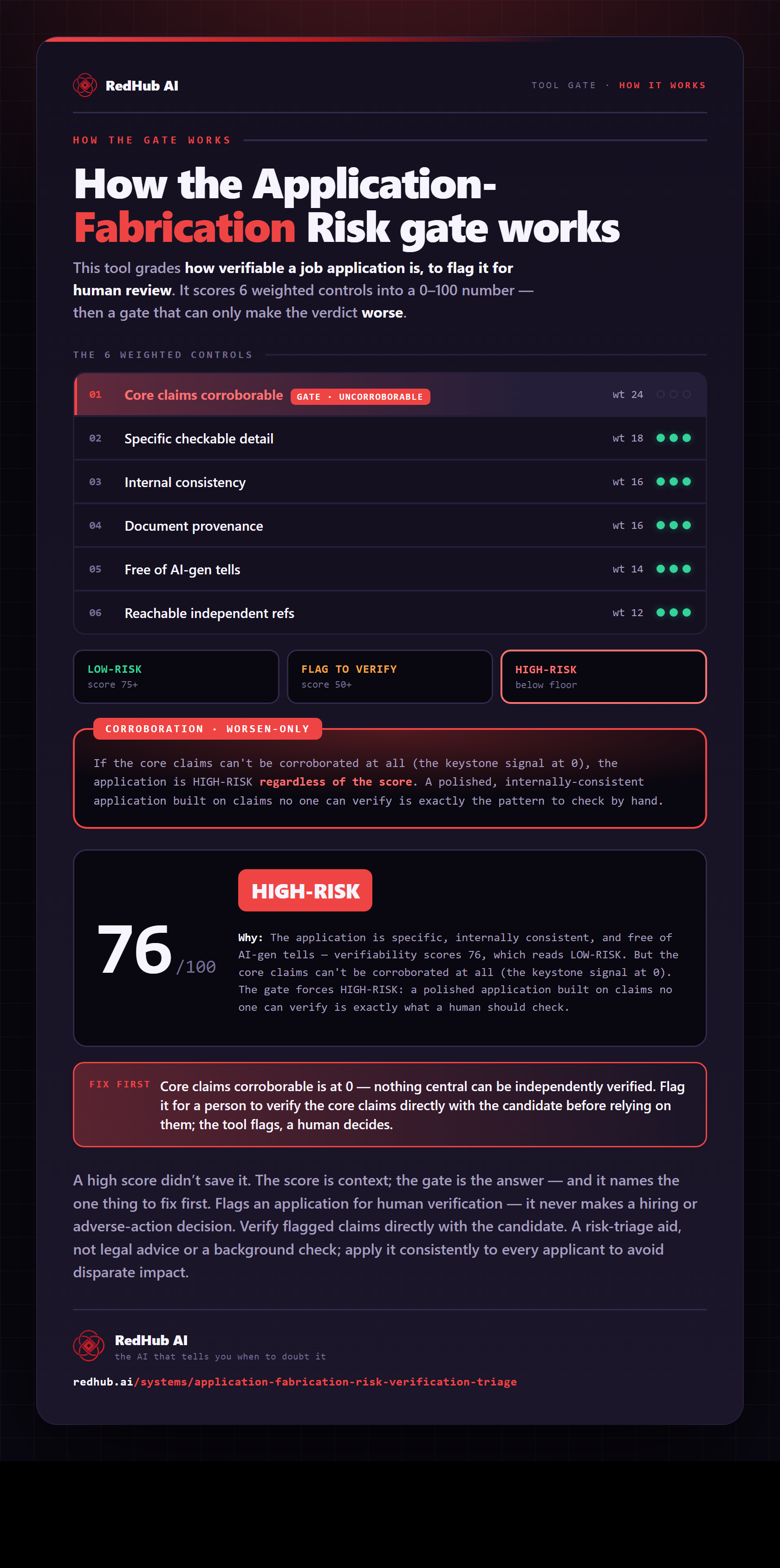
The gate this post refers to, drawn from the tool’s own logic. See the tool.