How to Verify Resume Claims Before You Hire
RedHub AI Editorial10 min read

Jump to a section11
- TL;DR
- What does it mean to verify resume claims?
- Why "looks legit" stopped meaning anything
- The two-grain verification motion
- What "verified" actually means
- The keystone rule: one unverifiable claim outweighs ten verified ones
- The five claim types worth verifying
- Keep it fair — and on the right side of the law
- What resume verification is not
- Decision Guide
- FAQ
TL;DR
- What it is: Verifying resume claims means confirming each material claim — the degree, the title, the headline result — against a reachable, independent source before you rely on it.
- Who it's for: Recruiters, hiring managers, and founders making high-trust hires — anyone using tools like the Hiring Verification Bundle to make checking consistent.
- How it works: Two passes. First triage the whole application to see how verifiable it is. Then work the finalists claim by claim, the same way for every candidate.
- Bottom line: AI made polish worthless as evidence. The only thing a resume can still prove is what you actually verify — and every finding should trigger a check, never a rejection.
What does it mean to verify resume claims?
Verifying resume claims means confirming that what an application says is true — with evidence from a reachable, independent source — before you make a decision that depends on it. It has two grains: a whole-application read (how much of this document can be checked at all?) and a per-claim check (is this specific degree, title, or result confirmed?). Done right, it judges the document, never the person, and every unverified claim leads to a verification step — not a rejection.
Best for: teams that want one consistent verification motion from inbox to offer. The Hiring Verification Bundle ($99) packages both grains — a whole-application triage plus a per-claim checklist.
Here is the uncomfortable truth about hiring in 2026: you cannot tell a true resume from a fabricated one by reading it. Not anymore. AI writing tools produce applications that are specific, consistent, and clean — whether the facts behind them are real or invented. So the question is no longer "does this resume look credible?" It's "how to verify resume claims before I rely on them?" This guide walks through the full answer: what to verify, in what order, and how to do it without being unfair to candidates or careless with the law.
Why "looks legit" stopped meaning anything
Resume embellishment was never rare. In a 2023 survey of about 1,900 U.S. workers by ResumeLab, roughly 7 in 10 admitted they had lied on a resume (opens in a new tab). A separate StandOut CV study (~2,100 respondents, 2023) found 64.2% admitted lying on their resume at least once (opens in a new tab) — with skills, experience, and references each among the most common lies. These are self-reported surveys, so treat the exact numbers loosely — but the direction is consistent across years and studies: misrepresentation is common, not exceptional.
What changed recently isn't the lying. It's the packaging. For decades, hiring managers leaned on soft signals: clean formatting, confident phrasing, specific detail, internal consistency. Those signals used to correlate with effort and truth. Now any AI assistant produces all of them on demand, for a real career history or an invented one. The polish that used to mean something now means nothing.
Key insight: when a signal becomes free to fake, it stops being a signal. The only signal left in a resume is verifiability — whether a real, reachable source can confirm what it says.
The two-grain verification motion
Verifying everything on every resume is impossible at real volume. Verifying nothing is how bad hires happen. The workable answer is a two-pass motion:
- Triage the whole document. Before you spend an hour on calls, spend two minutes asking: how verifiable is this application overall? Are the core claims corroborable? Are there reachable references? Is the detail specific enough to check? This pass sorts the pool into applications that are ready to rely on, applications that need a closer look, and applications resting on claims nobody can confirm.
- Verify finalists claim by claim. For the small set of candidates you're serious about, list each material claim — the degree, the employment dates, the title, the headline result — and mark two things for each: what evidence supports it, and whether the source of that evidence is actually reachable. Each claim gets its own verdict: verified, verify first, or unverifiable.
- Let people decide. Verification produces a to-check list, not a hiring decision. A human reviews what came back, gives the candidate a fair chance to supply a source for anything open, and makes the call. No tool, checklist, or score should ever reject anyone.
This is exactly the shape of the Hiring Verification Bundle: the Application Fabrication-Risk & Verification Triage does pass one (a 0–100 verifiability read on the document), and the Resume-Claim Verification Checklist Gate does pass two (a per-claim verdict with a next step on each). Both score the document — never the candidate.
What "verified" actually means
A claim is not verified because it sounds right, because the candidate seems trustworthy, or because it appears in three places on the same resume. A claim is verified when three tests pass:
- Material. Does the claim actually carry weight in your decision? A hobby line doesn't need checking. The degree the role requires does. Verify material claims for everyone; skip the trivia for everyone.
- Evidence. Is there something concrete supporting the claim — a document, a record, a named project, a person who was there? "It's on the resume" is not evidence; the resume is the thing being checked.
- Reachable source. Can you actually contact the source of that evidence — a registrar, a certification issuer's lookup page, a reference at a real company number? Evidence with no reachable source is not yet verification. It's a lead.
The keystone rule: one unverifiable claim outweighs ten verified ones
Most fabricated applications don't lie everywhere. They lie once, in the load-bearing spot — the degree, the title, or the headline result the whole candidacy rests on — and surround that one claim with true, checkable filler. If you average your confidence across the document, the filler buries the problem.
That's why verification needs a gate, not an average. In the triage tool's shipped six-application example, one application scores 76 out of 100 on overall verifiability — comfortably clean-looking — and still lands HIGH-RISK, because its single core claim can't be corroborated by any independent source. The verdict isn't a judgment of the applicant. It's an instruction: verify that claim before you rely on it.
For the curious, here is how the triage weights its six document signals (these are the tool's shipped configuration values, not industry statistics):
Notice the keystone. Only "core claims corroborable" can gate the whole verdict on its own. A stack of good scores on the other five can never lift an application whose central claim nobody can confirm — because that pattern, clean everywhere except the one claim that matters, is exactly what fabrication looks like.
The five claim types worth verifying
| Claim type | Reachable source | Deep dive |
|---|---|---|
| Employment history & dates | Former employer's HR line, payroll records the candidate supplies | Covered below and in the red-flags guide |
| Degrees & education | Registrar, National Student Clearinghouse, accreditation databases | How to verify education credentials |
| Certifications & licenses | The issuer's own public verification page or registry | Same guide — certifications section |
| Titles, scope & headline results | A confirmed-real reference who was actually there | How to verify references |
| The references themselves | Company main lines, role cross-checks — verify the verifier first | Same guide — fake references |
And one claim type deliberately missing from that table: "was this resume written by AI?" That's not a claim about the candidate's history, and chasing it is a trap — here's why AI-detection is the wrong move and what to check instead.
Keep it fair — and on the right side of the law
Candidate verification touches regulated ground, so three habits matter as much as the checking itself:
Verify, never reject. An unverifiable claim means "ask the candidate for a source," not "decline the candidate." Many open claims resolve in one email — the registrar had a name change, the reference switched jobs, the certificate number was mistyped. Treating a verification flag as a rejection punishes people for your incomplete information, and it's where legal exposure starts.
Same checks, same stage, every candidate. Verifying some candidates harder than others — because of a gut feeling, a name, a school, or anything else — is how fairness problems and discrimination claims are born. Decide which material claims get verified at which stage, then apply that identically to everyone. Automated tools that score or screen people carry adverse-impact risk under Title VII of the Civil Rights Act — the long-standing federal bar on selection procedures that disproportionately exclude protected groups (opens in a new tab). (The EEOC's dedicated AI guidance was withdrawn in 2025, but the underlying disparate-impact law it described is unchanged.) Scoring the document's verifiability and routing every verdict to a human verification step is how this whole motion is designed to stay clear of that line.
Know where the FCRA line is. If you hire a third-party company — a consumer reporting agency — to run background checks or verify records for you, the federal Fair Credit Reporting Act applies: written consent first, and specific notice steps before and after acting on the results. The FTC publishes a plain-English employer guide to using consumer reports (opens in a new tab). Checking a claim yourself, directly with the source, is a different path — but state and local rules vary, and acting on what verification turns up can still trigger duties.
Not legal advice: this article describes a verification process, not the law of your jurisdiction. Background checks, AI in hiring, and adverse action are regulated at the federal, state, and local level. Confirm your process with HR and qualified counsel before you rely on it.
Verification is one piece of a larger hiring motion. For the rest of the funnel — fair job posts, structured screening, interview kits, scorecards — see our companion guide to AI for recruiting and hiring.
What resume verification is not
Three things this motion deliberately isn't, because each one fails in practice:
- It's not a background check. A formal background check through an FCRA-compliant provider covers criminal records, credit, and other regulated territory. Claim verification is the layer before that: confirming what the application itself asserts. You may still need both.
- It's not AI detection. No tool can reliably tell you a resume was AI-written, and using AI to write a truthful resume isn't fraud. Verify the claims; ignore the authorship. Full argument here.
- It's not red-flag gut feel. Gaps, job changes, and formatting quirks are mostly noise, and hunting them inconsistently is unfair. The red flags that still matter are verifiability signals — here's the honest list.
Make verification a system, not a vibe
The Hiring Verification Bundle is both grains in one purchase: the Application Fabrication-Risk Triage (score the whole document's verifiability) plus the Resume-Claim Verification Checklist Gate (verify finalists claim by claim). $99 — $29 less than the two tools separately. They score the artifact, never the person, and every verdict routes to a verification step.
Get the Hiring Verification Bundle — $99 →Decision Guide
Use this approach if: you make hires where a wrong claim is expensive — technical roles, leadership, finance, anything client-facing — and you want a consistent, defensible checking motion instead of gut feel.
Skip it if: you're looking for a tool to screen, rank, or auto-reject candidates. That's not verification, and it's the fastest way into EEOC adverse-impact territory.
Best first step: take your current finalist, list their five most material claims, and honestly mark which ones you have actually confirmed with a reachable source. Most teams find the answer is zero or one.
FAQ
What is resume claim verification?
Confirming each material claim on an application — degree, dates, title, headline results — against evidence from a reachable, independent source before you rely on it. It judges the document, never the person, and every finding leads to a check, not a rejection.
How do I verify resume claims without slowing hiring down?
Two passes. Triage every application quickly for overall verifiability (minutes), then do full claim-by-claim verification only on finalists (an hour or so each). You spend deep effort on three candidates, not three hundred.
Which claims should I verify first?
The material ones — the claims your decision actually rests on. Usually that's the degree or certification the role requires, the most recent title and dates, and the headline result the candidate leads with. One unverifiable material claim matters more than ten verified minor ones.
Is it legal to verify a candidate's resume claims?
Verifying claims is a normal, lawful part of hiring when done consistently for every candidate at the same stage. Using a third-party agency triggers FCRA consent and notice duties, and some state and local laws add rules. This isn't legal advice — confirm your process with counsel.
Should I reject a candidate if I can't verify a claim?
No. "Unverifiable" means "not yet confirmed," not "false." Ask the candidate for a source — most open claims resolve in one exchange. Rejecting on an unverified flag is both unfair and legally risky; hold the decision until the check completes.
Can software detect a fake resume?
Not reliably, and tools that claim to are guessing. What software can honestly do is score how verifiable a document is and track per-claim verification status — which is exactly what the Hiring Verification Bundle does, without ever scoring or rejecting a person.
What's in the Hiring Verification Bundle?
Two full RedHub tools: the Application Fabrication-Risk & Verification Triage ($79 alone) and the Resume-Claim Verification Checklist Gate ($49 alone). The bundle is $99 — $29 off the $128 separate total — with a 30-day no-questions refund. Both are offline workbooks; nothing about your candidates is uploaded anywhere.
Verify the claim, not the polish
Triage the whole application, then check it claim by claim — the same way for every candidate. One purchase, both tools, lifetime access, 30-day guarantee. Not a hiring tool, a background check, or legal advice — a working aid that points your checking.
Get the Hiring Verification Bundle — $99 →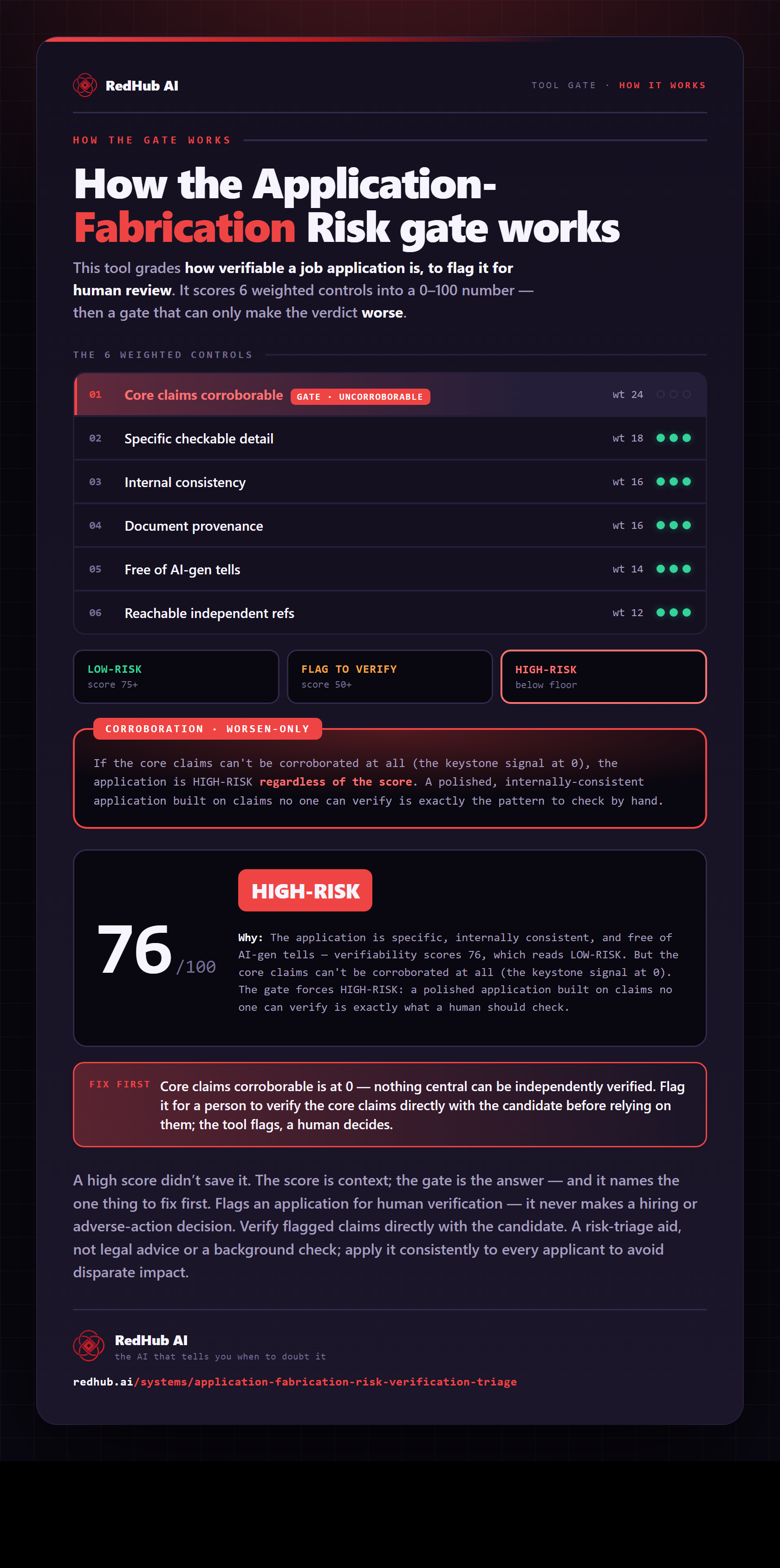
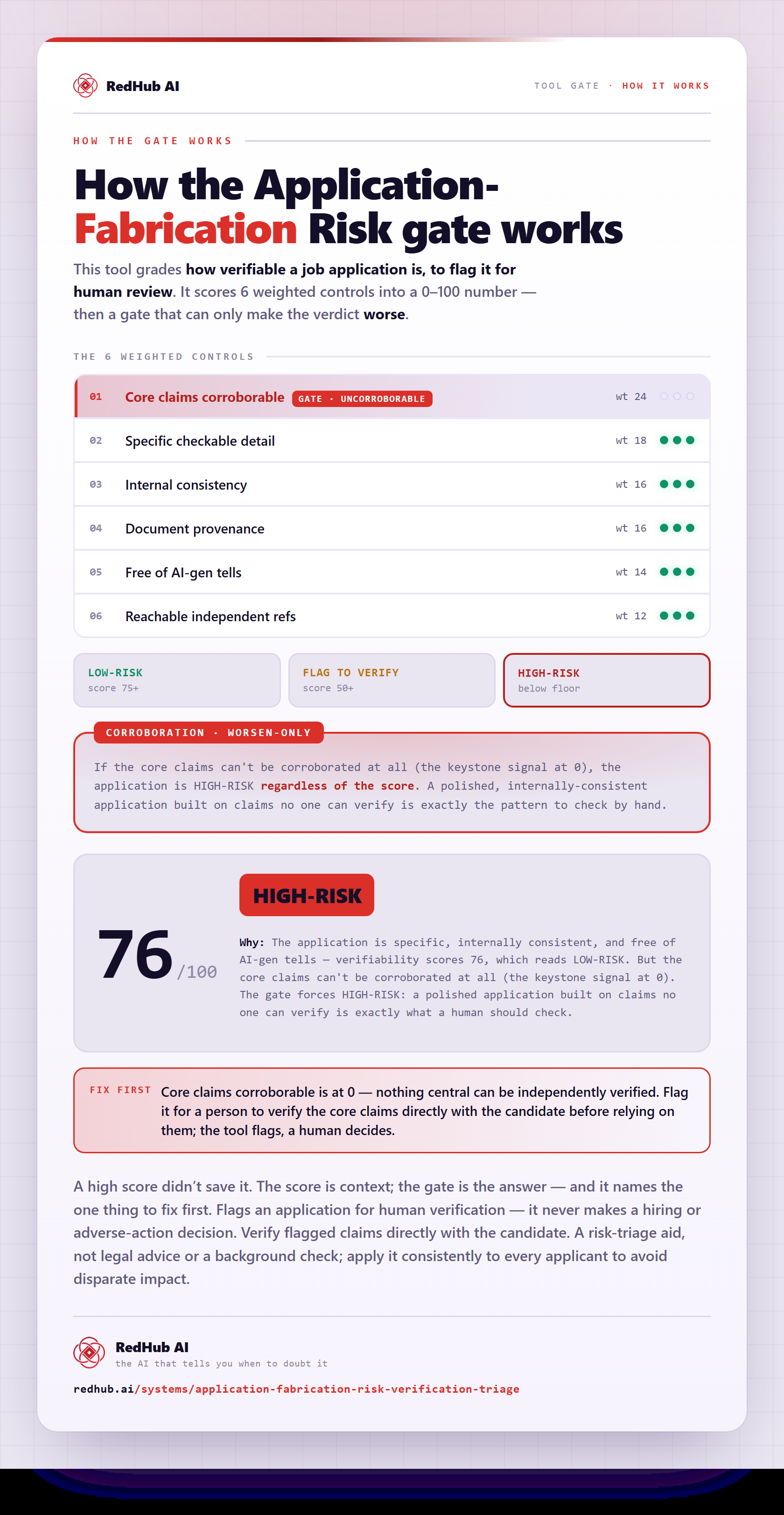
The gate this post refers to, drawn from the tool’s own logic. See the tool.