The AI Verification Tax: Why Checking AI Output Costs More Than You Think
RedHub AI Editorialupdated October 7, 20266 min read

Jump to a section6
Every AI draft arrives with a second job attached: someone has to decide whether it can be trusted. The time that takes is the AI verification tax. It gets paid after the tool has logged its fast draft, in a reviewer's afternoon, and no budget line carries it. A report produced in seconds has saved nothing yet. The saving exists once someone has checked the report and found it sound. How large the tax is depends far less on the length of the output than on what a missed error would cost.
TL;DR: The tax is paid at three points: a first read, a spot-check, and a correction cycle when the check fails. The first two are the price of using AI with care. The third is the one to cut. In an illustrative ten-person team, adding half an hour to each incident moves the monthly cost from $1,440 to $1,800 and the verdict from LEAKING to EPIDEMIC. The Workslop Cost & Verification-Tax Calculator ($49) runs that arithmetic on your teams. For the wider picture, read the hidden cost of AI slop at work.
Where the tax gets paid
It is charged at three separate points, and each one grows for a different reason.
- The first read. Someone reads the output closely enough to judge it. This takes attention even when nothing is wrong, and every piece of AI output owes it.
- The spot-check. For anything with numbers, claims or code, someone verifies the specific fact, runs the specific test or traces the specific logic. This step grows with how technical the content is.
- The correction cycle. When the check turns something up, someone goes back to the tool with corrected instructions, generates again and checks the new version. This loop can repeat.
The third point is where the hours go. The researchers who named workslop reported in a September 2025 Harvard Business Review article (opens in a new tab) that employees spent an average of one hour and 56 minutes dealing with each instance. That is a survey average of self-reported time, not a benchmark for your team.
Why the tax follows stakes, not length
A two-paragraph internal note about next week's schedule and a two-paragraph answer to a customer asking about a refund take about the same time to generate. They do not take the same time to verify. The note gets a glance. The refund answer gets checked against the written policy, the customer's order and whatever was promised in the last email, because a wrong answer there costs money and a customer.
A team that counts "AI time saved" by drafts produced is counting both of those as one unit each. The count is most wrong on the work that matters most, since that is the work with the longest check.
A worked example, with made-up numbers
Take a ten-person team. In a typical month, 40% of them (four people) receive hollow AI-assisted work from a colleague. Each of those four deals with three incidents a month, and each incident takes two hours to verify and redo. The loaded hourly rate is $60.
That is 10 x 0.40 x 3 x 2 = 24 hours a month, or $1,440. Over a year it is $17,280. Divided across all ten people it is $144 per head per month. Against the workbook's default lines (CONTAINED under $50 per head, LEAKING under $150, EPIDEMIC at $150 or more), this team reads LEAKING, six dollars short of the top band.
Now change one input. Each incident takes two and a half hours, not two. The month becomes 30 hours and $1,800, the per-head figure becomes $180, and the same team reads EPIDEMIC. Half an hour per incident moved the verdict.
The part you should keep paying
Some of this tax buys something. A first read and a spot-check on anything that matters is ordinary care, with or without AI, and a team that drives those to zero has stopped checking. The part to attack is the correction cycle: output that fails the check, gets regenerated and fails again. That points at what is being generated, and how to reduce AI rework covers the fixes.
The two parts are harder to separate than that makes it sound. An hour of checking that finds nothing looks like waste afterward. It was the same hour as the one that caught a wrong figure last month, and the reviewer had no way to know in advance which kind it would be. You can match the depth of a check to the stakes. You cannot tell beforehand which careful read will come up empty, so a measured tax will always include hours that were worth spending.
Run the arithmetic on your own teams
The Workslop Cost & Verification-Tax Calculator uses the same five inputs as the example: headcount, the share of people receiving workslop, incidents per receiver per month, rework hours per incident, and a loaded hourly rate. It returns monthly and annual cost and a CONTAINED, LEAKING or EPIDEMIC verdict per team, then totals the org. One .xlsx, and both threshold lines are editable.
Get the Workslop Cost & Verification-Tax Calculator — $49Pairs well with
The Internal AI Handoff QA Gate ($79) turns the spot-check into six signals marked 0, 1 or 2 before an AI-assisted memo, analysis or summary goes to a colleague. The verdict is the weakest signal: HAND OFF, REWORK or DO NOT HAND OFF. For the high-stakes end, the Customer-Facing AI Output Risk Triage ($79) grades each customer-facing AI surface, such as a support bot or a chat widget, on six controls and returns LOW, REVIEW or HIGH RISK per surface. The Anti-Slop Content System ($79) is for written drafts: a heuristic slop scanner and a scorecard that returns Publish, Revise or Rework.
More in this guide
What is the AI verification tax?
It is the time cost of checking AI output before you trust it: the first read, the spot-check on specific claims, and any correction cycle when the check finds a problem. It is paid after the tool has produced its fast draft.
Should I try to eliminate the verification tax?
No. A first read and a spot-check on anything that matters is ordinary care. The part worth reducing is the repeated correction cycle, which points at the quality of what is being generated.
Why does the tax follow stakes and not word count?
Because how carefully something must be checked depends on what a missed error would cost. A short answer to a customer about a refund can take longer to verify than a long internal note.
Is the $1,440-a-month example a typical number?
No. It is an invented example to show the arithmetic: 10 people, 40% receiving workslop, 3 incidents each, 2 hours per incident, at $60 an hour. Your number depends on your own inputs.
How do I lower the tax without skipping checks?
Improve what the model is given so drafts need fewer correction cycles, and put one defined check before work is handed off so problems are caught in one pass. Both are covered in how to reduce AI rework.
How is the verification tax different from the cost of AI slop?
The verification tax applies to all AI output, good or bad, because all of it has to be read and judged. The cost of AI slop is the narrower share caused by hollow output: the extra verifying and the redoing.
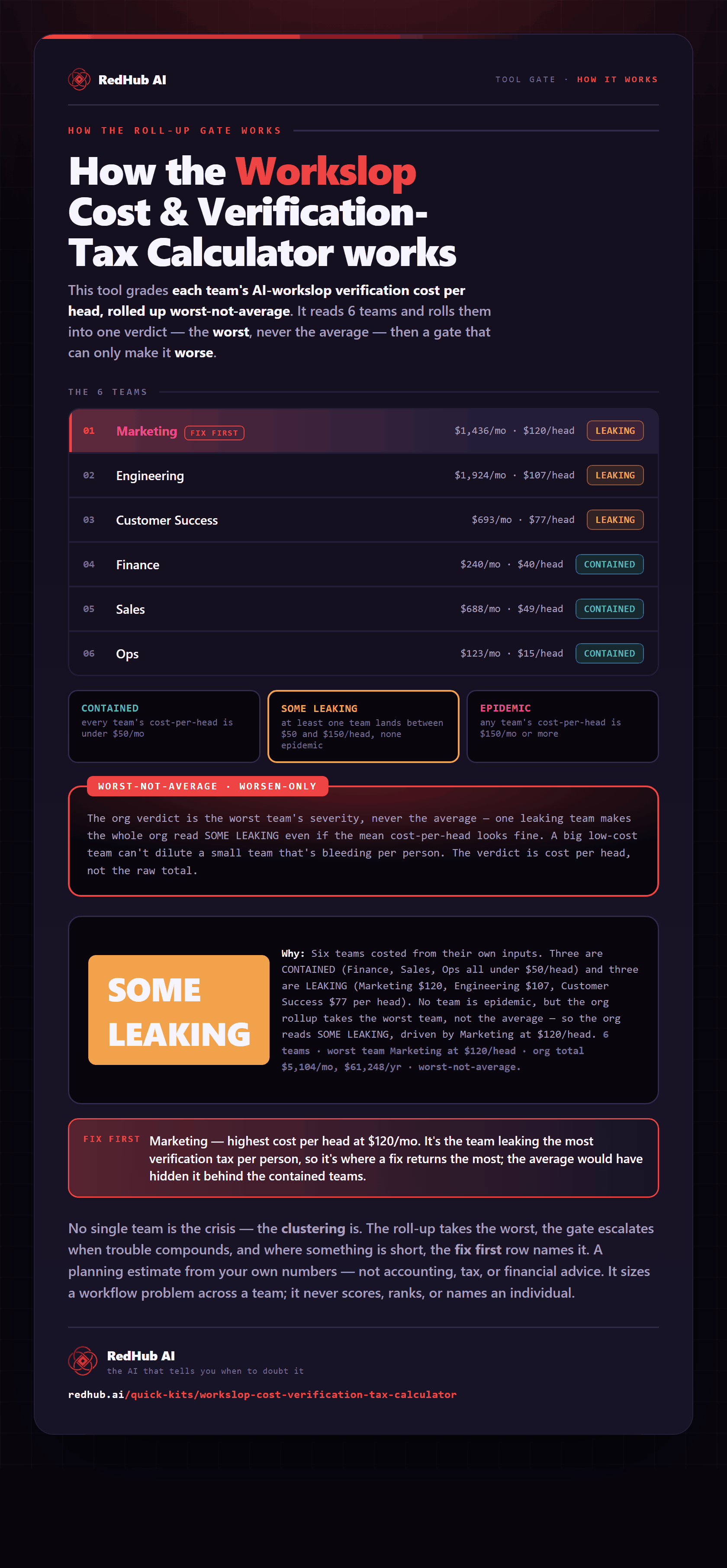
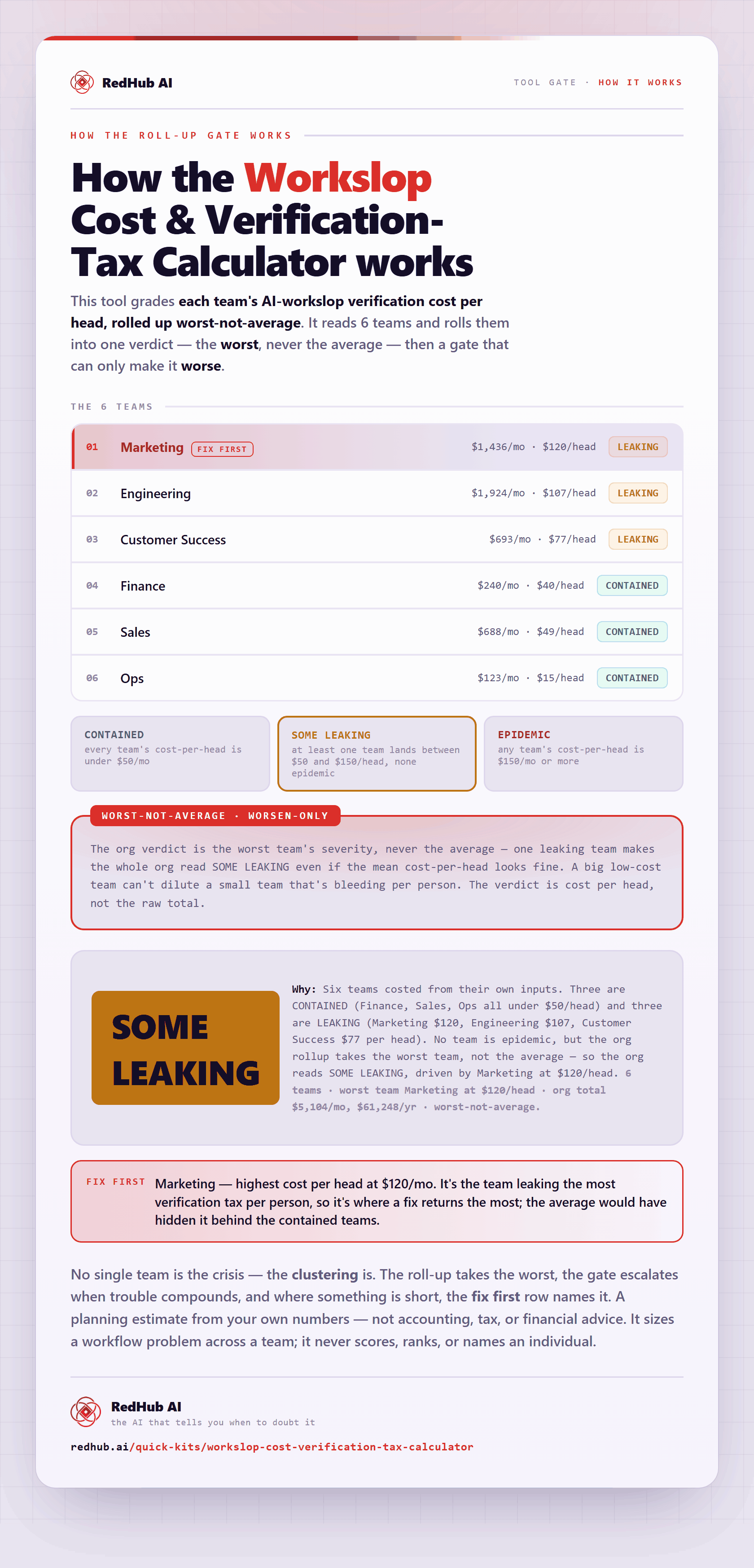
The gate this post refers to, drawn from the tool’s own logic. See the tool.