The Hidden Cost of AI Slop at Work (And How to Measure It)
RedHub AI Editorialupdated October 7, 20267 min read

Jump to a section8
- Where the word came from, and what the $186 figure means
- See your number: what is workslop costing your team?
- What the number on this page cannot tell you
- The verification tax never reaches an invoice
- Is the AI saving time, net?
- What the paid calculator does, and what it leaves to other tools
- Pairs well with
- More in this guide
Nobody sends you an invoice for the cost of AI slop. You pay it in hours: the time your team spends checking, fixing and redoing AI output that looked finished, multiplied by what those hours cost. The subscription shows up on a card statement and the draft shows up in seconds. The twenty minutes a manager spent finding the wrong number in that draft shows up nowhere. Three inputs are enough to put a dollar figure on it, and the calculator on this page does the multiplication. The figure has one limit you should know before you use it: it cannot tell a wasted hour from a necessary one.
TL;DR: Workslop is AI output that looks done and leaves the checking, fixing and redoing to whoever receives it. Its cost is hours times a loaded hourly rate, and most teams have never written it down. A 2025 study reported in Harvard Business Review put it at $186 a month for each affected employee; your number will differ. The calculator on this page gives a rough monthly figure from three inputs. The Workslop Cost & Verification-Tax Calculator ($49) works it out per team from five inputs and bands each team CONTAINED, LEAKING or EPIDEMIC.
Where the word came from, and what the $186 figure means
"Workslop" is a 2025 term, and it is not ours. Researchers at BetterUp Labs and the Stanford Social Media Lab introduced it in a Harvard Business Review article (opens in a new tab) published on September 22, 2025. It names AI-generated work that looks polished and lacks the substance to move the task forward, so the effort lands on the person who has to read it, check it or redo it. A report with confident numbers nobody traced is workslop. So is a function that runs and mishandles the one edge case the feature exists for.
The same article reported that employees spent an average of one hour and 56 minutes dealing with each instance, and that these incidents "carry an invisible tax of $186 per month." That number gets repeated as $186 for every employee. The article's own arithmetic is narrower. For an organization of 10,000 workers it applies the $186 to the 41% of workers the study found had encountered workslop, and arrives at "over $9 million per year" (10,000 x 0.41 x $186 x 12 = $9,151,200). Spread across all 10,000 people, that works out to about $76 per head per month.
Both figures come from a survey of self-reported time and self-reported salary, and neither one is your team. We are not going to tell you that you lose $186 a person, or $76. A number from someone else's survey says nothing true about your payroll. The calculator below runs on your hours and your rates.
See your number: what is workslop costing your team?
Enter how many people on your team use AI, how many hours a week each spends fixing or verifying its output, and a fully loaded hourly cost. The calculator multiplies people by hours by 4.33 weeks by the rate. At its starting values (8 people, 4 hours a week, $55 an hour) that comes to about $7,621 a month, or $91,450 a year.
What is AI slop costing your team each month?
What the number on this page cannot tell you
Divide the starting result by its eight people and you get about $953 each per month. Now hold that against the paid workbook, which by default reads a team as EPIDEMIC at $150 per head per month. At $55 an hour, $150 buys under three hours a month. Four hours a week is more than six times past that line.
The two tools disagree because they count different things. The calculator above counts every hour spent checking AI output. Some of those hours are the job: reading an AI-drafted client summary before it goes out is time you would want spent. The workbook counts something narrower, which is incidents of hollow work that a person received and then had to verify or redo.
So the number on this page is a ceiling on your workslop cost. The waste sits somewhere under it, and three inputs can't say how far. Use the figure to decide whether the problem is worth an afternoon of measuring. Run it again after you change something, and the difference between the two runs is the result of that change.
The verification tax never reaches an invoice
Every piece of AI output carries a second cost: the time someone spends deciding whether to trust it. A draft that takes seconds to produce can take a manager twenty minutes to check line by line. Those twenty minutes are in no tool subscription, no project tracker and no adoption dashboard. A team that tracks time-to-first-draft is measuring the fast half of the transaction. The slow half is covered in the AI verification tax, including why it grows with the stakes of the work and not with its length.
Is the AI saving time, net?
Time saved drafting, minus time spent verifying and redoing, is your net. It can land on either side. On a weekly report that used to take three hours, a 50-minute review and an occasional redo can still leave you ahead. Make the review longer and the redo more frequent, and the same workflow loses time while drafting stays fast. Is AI saving your team time? runs that ledger with the arithmetic shown.
What the paid calculator does, and what it leaves to other tools
The Workslop Cost & Verification-Tax Calculator is one .xlsx. For each team you enter headcount, the share of people receiving workslop, incidents per receiver per month, rework hours per incident, and a loaded hourly rate. It multiplies the first four into monthly hours lost, prices them, and divides by headcount. The verdict reads cost per head, not the total: CONTAINED under $50, LEAKING under $150, EPIDEMIC at $150 or more, with both lines editable.
The six-team example that ships in the workbook totals about $5,100 a month. Its Marketing team of 12 costs $119.70 per head and reads LEAKING, the highest of the six, so the Dashboard names it. Its Sales team comes in at $49.14 per head and reads CONTAINED, 86 cents under the line. That is how close a band can be, and why the lines are yours to move.
It measures and it stops there. It does not check a single deliverable before it is handed off, it does not judge a draft's writing, and it does not know how much time AI saved you. It scores teams, never individual people. If the number tells you the problem is real, how to reduce AI rework covers the two fixes, and what workslop is covers how to recognize it.
Put your own dollar figure on workslop
The Workslop Cost & Verification-Tax Calculator turns five inputs per team into monthly and annual cost, cost per head, and a CONTAINED, LEAKING or EPIDEMIC verdict, then totals the org and names the team with the highest cost per head when at least one team reads LEAKING or EPIDEMIC. One .xlsx with live formulas. No per-employee figure is built in.
Get the Workslop Cost & Verification-Tax Calculator — $49Pairs well with
The Internal AI Handoff QA Gate ($79) checks one AI-assisted memo, analysis or summary before it goes to a colleague. You mark six signals 0, 1 or 2, and the verdict is the weakest of them: HAND OFF, REWORK or DO NOT HAND OFF. The Anti-Slop Content System ($79) is for written content: a heuristic slop scanner and the SPARK scorecard, which returns Publish, Revise or Rework. It is a quality guardrail, not an AI detector. The AI Over-Reliance & Critical-Thinking Check ($69) has a person review AI text seeded with six planted problems and mark which they caught, then returns INDEPENDENT, ASSISTED or RELIANT. It is for individual development and training only.
More in this guide
What is the cost of AI slop, in plain terms?
It is the hours your team spends verifying, fixing or redoing AI-generated work that looked done, multiplied by what those hours cost you. It is a labor cost, and it appears on no invoice or subscription bill.
Is the $186 figure accurate for my team?
No one can say from the outside. It comes from one 2025 survey reported in Harvard Business Review, built on self-reported time and salary, and the article applies it to the 41% of workers who had encountered workslop. Your cost depends on your own headcount, hours and rates.
Does the calculator fix the slop, or only measure it?
It measures. The paid workbook turns your inputs into a monthly and annual cost per team and a verdict per head. Checking a deliverable before handoff and improving written drafts are separate jobs with separate tools.
Is this a way to track how much work each employee is doing?
No. The workbook totals a category of rework across a team and scores the team. It does not score, rank or name an individual, and it is not a performance review tool.
Why is the free calculator's number so much higher than the workbook's bands?
They count different things. The calculator on this page counts every hour spent checking AI output, including checks worth doing. The workbook counts incidents of hollow work that someone received and had to verify or redo, which is a smaller number.
What is the difference between workslop cost and the verification tax?
Workslop is the flawed output. The verification tax is the checking work any AI output creates for the person who receives it, flawed or not. Workslop cost is the part of that tax, plus the redoing, that hollow output causes.
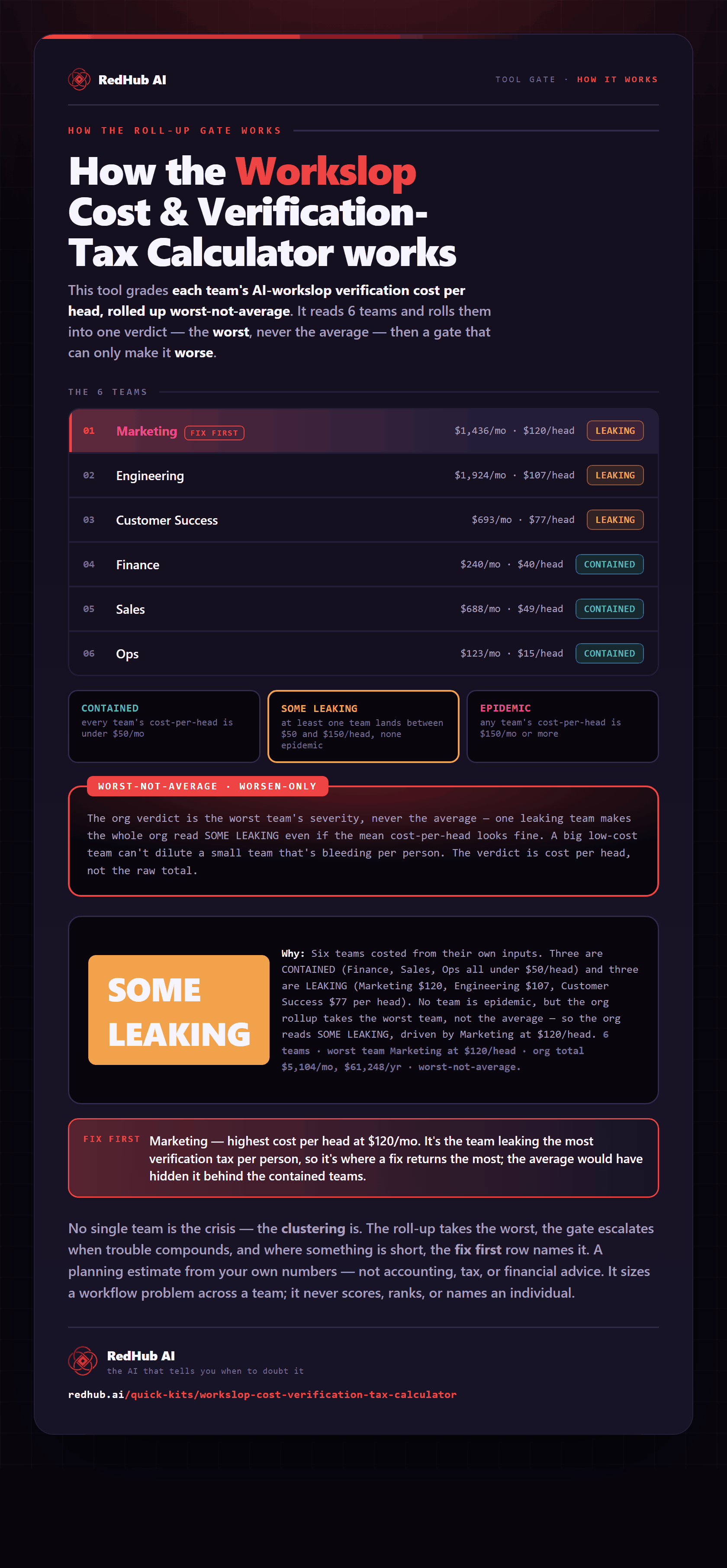
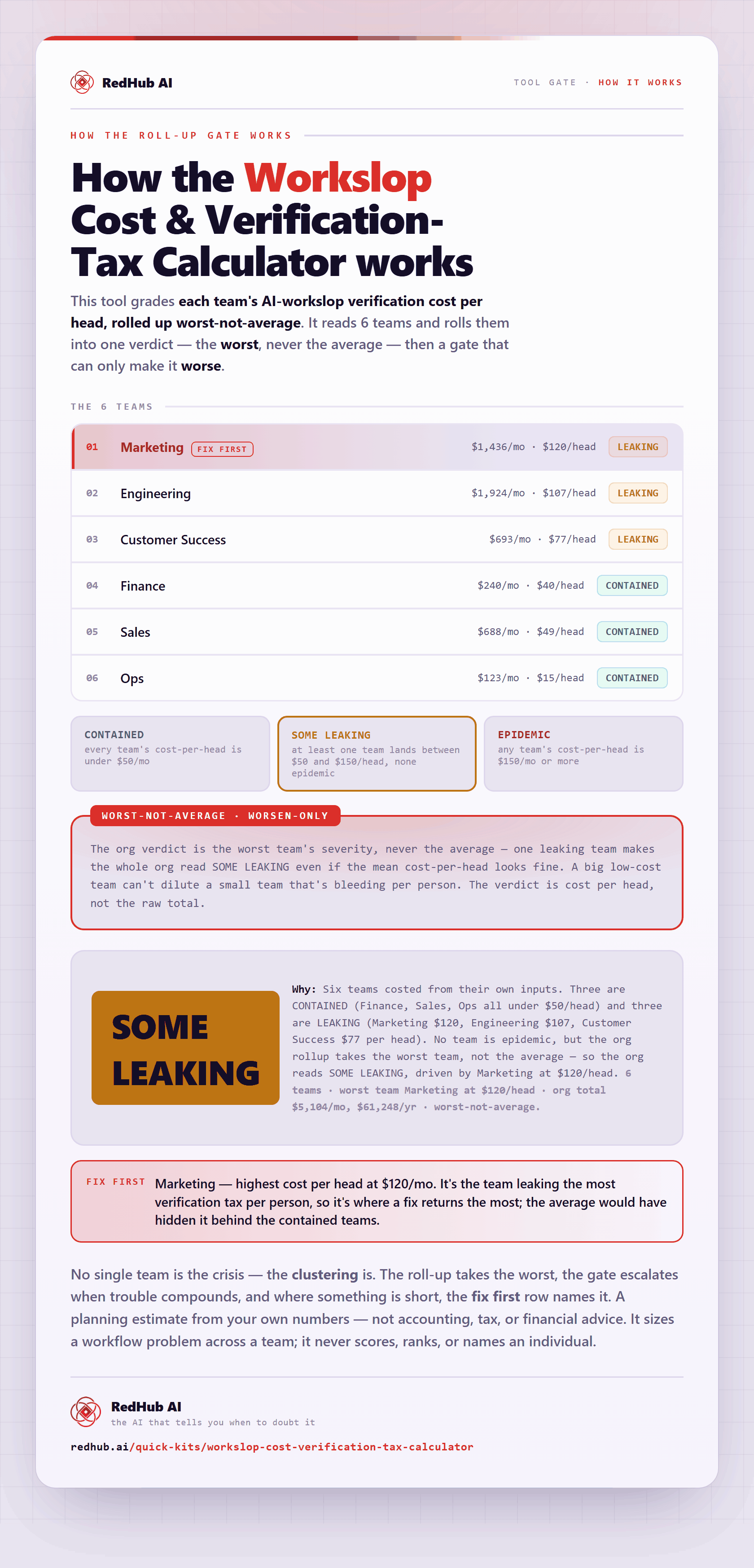
The gate this post refers to, drawn from the tool’s own logic. See the tool.