How to Reduce AI Rework (Without Banning AI)
RedHub AI Editorialupdated October 7, 20265 min read

Jump to a section7
To reduce AI rework, look in two places before you consider a ban: what the model was given to work from, and whether anyone checked the output before it moved on. A ban removes the drafting speed and leaves the deadline in place, so the pressure that made the tool attractive is still there the next morning. Fix the inputs, then fix the handoff. There is a third case, where checking the output costs as much as doing the work by hand, and for that one the narrow answer is to stop using AI on that task.
TL;DR: Give the model your standard: an approved example, the facts that must appear, and what to leave out. Put one defined check before any AI-assisted work goes to a colleague, with depth matched to the stakes. Feed every caught problem back into the prompt. Where tracing the output takes as long as writing it, stop using AI for that task and keep it elsewhere. To see which team carries the highest rework cost per head, the Workslop Cost & Verification-Tax Calculator ($49) prices it. Start with the hidden cost of AI slop at work if you have not measured yet.
Two places rework starts
When an AI-assisted piece of work comes back for a redo, ask two questions. Was the output good enough to use? Did anyone with judgment check it before it went further? A missed deadline, an awkward client call and an afternoon spent tracing a bug to a generated snippet are all downstream of one of those. Chasing each symptom separately costs more than fixing the two sources.
Fix one: give the model your standard
Compare two prompts for the same job. The first says "write the weekly client update." The second supplies last month's approved update, lists the three numbers that must appear, and adds a rule that every figure names where it came from. The first returns something responsive and generic. The second returns a draft with fewer things to correct, because the standard was in the request.
For written content, the Anti-Slop Content System ($79) covers this ground with brand-voice prompts, a heuristic slop scanner and the SPARK scorecard, which returns Publish, Revise or Rework. It is a guardrail for writing, not for code or figures. Our post on AI slop in writing explains what the scorecard looks for.
Fix two: one defined check before handoff
"I checked it" means different things to different people at 5:40 on a deadline day. An informal review culture depends on each person's private definition, and workslop gets through the gaps between them. A written check with the same questions every time closes those gaps.
The Internal AI Handoff QA Gate ($79) is one such check for work passed between colleagues. It marks six signals 0, 1 or 2: sources reachable, figures traced, task advanced, owner edits present, claims scoped to support, and next action clear. The verdict is the weakest of the six, not the average: HAND OFF, REWORK or DO NOT HAND OFF. If sources or figures are short of full marks, it reads DO NOT HAND OFF whatever the rest say.
Three habits that cost little
- Match review depth to stakes. A client deliverable earns a thorough check. An internal note about room bookings does not. A checkpoint that treats both the same becomes a bottleneck, and people route around bottlenecks.
- Feed corrections back in. When a check catches a problem, change the prompt or the example that produced it. Fixing only the one output leaves the same gap for next week.
- Name the gap, specifically. "This figure has no source" gets fixed faster than "the quality is off." It also stays about the work.
When stopping is the right call
A checkpoint is itself a cost. Every figure traced and every source opened is verification tax, and on some tasks it eats the whole saving. Take a quarterly figures summary where each number has to be traced to the ledger. If tracing takes as long as typing the numbers in by hand, AI has moved the work, not removed it.
For that task, stop. That is a decision about one workflow and it leaves AI in place for meeting agendas, first-draft outlines and everything else where the check is short. Where the line falls is a judgment about stakes, and two careful managers will draw it in different places. The ledger in is AI saving your team time? gives you the two numbers to argue over.
See which team costs the most per head
The Workslop Cost & Verification-Tax Calculator prices rework per team from five inputs and returns CONTAINED, LEAKING or EPIDEMIC on cost per head. Its Dashboard totals the org and names the team with the highest cost per head when at least one team reads LEAKING or EPIDEMIC. Run it before a fix and again after, and the difference is what the fix was worth. One .xlsx; it scores teams, never individual people.
Get the Workslop Cost & Verification-Tax Calculator — $49Pairs well with
The Anti-Slop Content System ($79) is fix one for written content, and the Internal AI Handoff QA Gate ($79) is fix two for work passed between colleagues. If reviewers are the weak point, the AI Over-Reliance & Critical-Thinking Check ($69) has a person review AI text seeded with six planted problems, including a fabricated statistic, and returns INDEPENDENT, ASSISTED or RELIANT. It is for individual development and training only.
More in this guide
How do I reduce AI rework without giving up AI tools?
Fix the two sources. Give the model an approved example and explicit constraints so drafts need fewer corrections, and put one defined check before AI-assisted work is handed to a colleague.
Why not ban AI after a bad experience?
A ban removes the drafting speed and leaves the deadlines that made the tool attractive. A narrower move is to fix the inputs and the handoff, and to stop using AI only on the tasks where checking costs as much as the work.
What is the fastest way to lower rework this week?
Pick one workflow and give the model a real example of an approved piece of that work, plus the facts that must appear. A prompt that never stated the standard cannot meet it.
Should every piece of AI output get the same review?
No. Match review depth to stakes. A client deliverable earns a thorough check and a low-stakes internal note does not. Reviewing everything at the highest level turns the checkpoint into a bottleneck people skip.
How do I know the fix is working?
Rework on that workflow falls over successive weeks, and errors reaching colleagues or clients do not rise. If rework falls and errors rise, people are checking less, not producing better work.
Do I need to measure the cost before fixing it?
It helps you choose where to start. The Workslop Cost & Verification-Tax Calculator ($49) shows which team carries the highest rework cost per head, and a second run after the fix shows what changed.
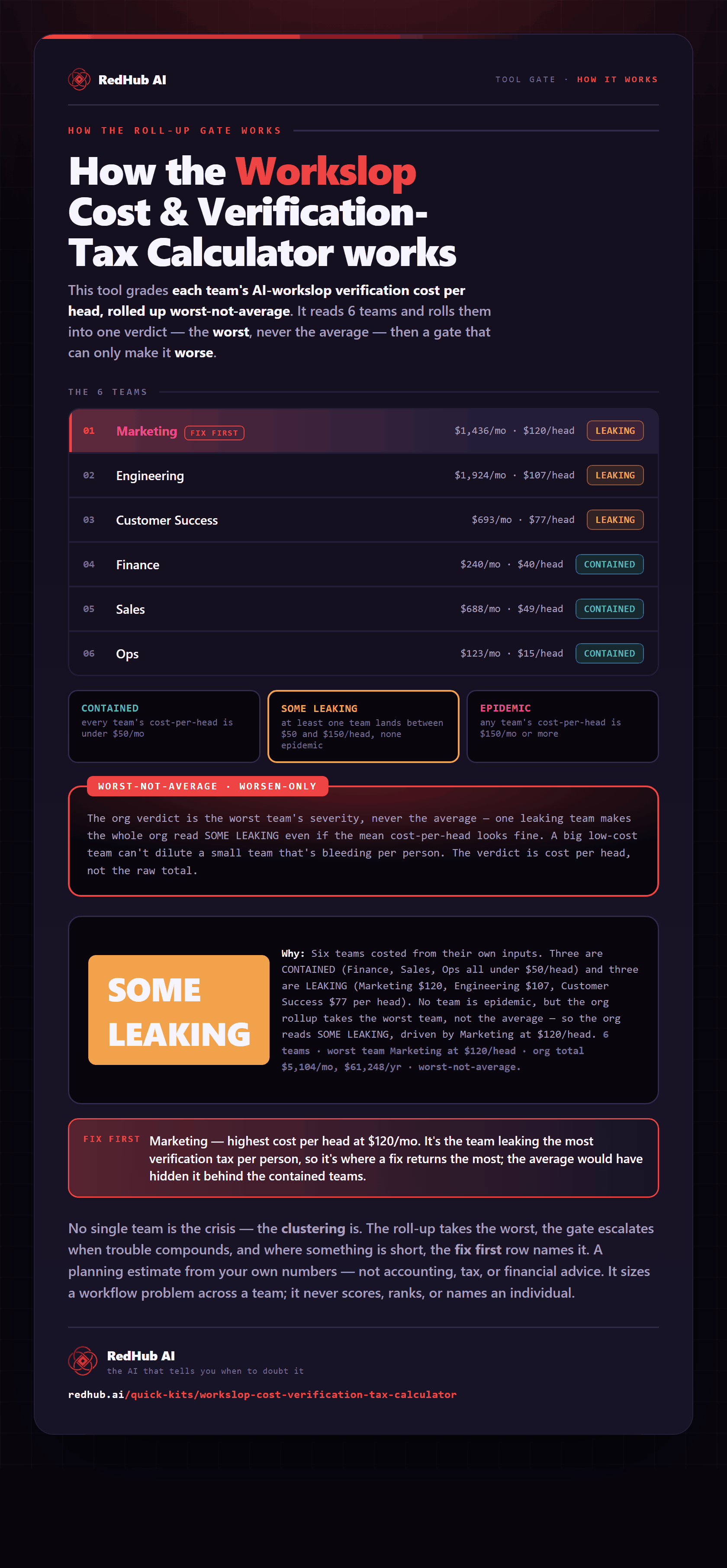
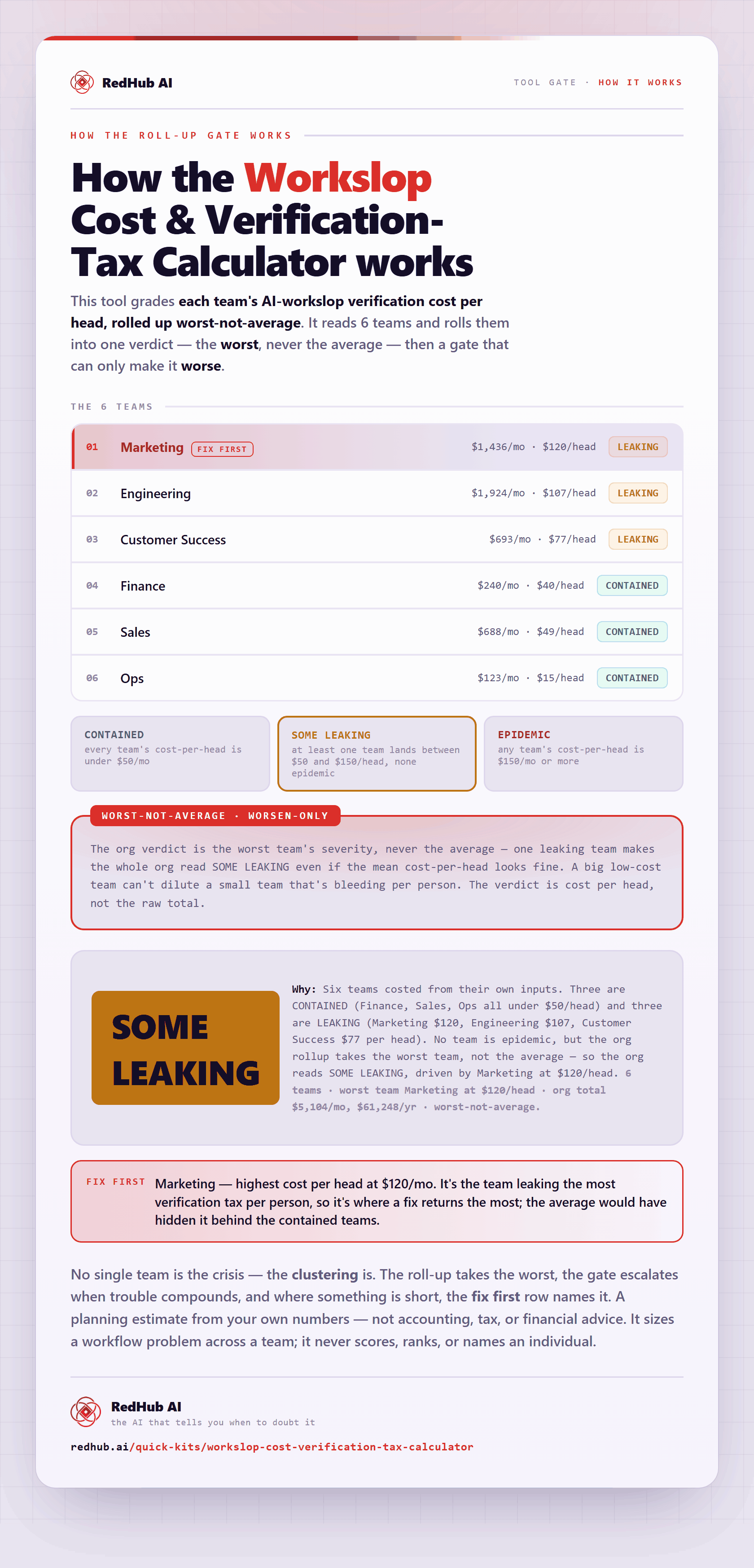
The gate this post refers to, drawn from the tool’s own logic. See the tool.