What Is Workslop? The AI Output That Makes More Work
RedHub AI Editorialupdated October 7, 20266 min read

Jump to a section7
Workslop is AI-generated work that looks finished and lacks the substance to move the task forward, so the job of finishing it falls on whoever receives it. The word dates from 2025 and came from researchers, not from us. It does not mean typos or clumsy sentences. It means output that passes the glance test and fails the first real use: a report whose numbers nobody traced, a summary that is accurate and tells you nothing, code that runs and skips the case you needed. You find the gap after you have started relying on it.
TL;DR: Workslop is a mismatch between how finished a piece of work looks and how finished it is. The polish is what makes it expensive, because polish is what gets a reader to skip the check. The term describes the work, never the person, and you often cannot know whether AI made it. If you want to know what it costs your team in dollars, the Workslop Cost & Verification-Tax Calculator ($49) prices it per team. The pillar, the hidden cost of AI slop at work, has a free version on the page.
Where the term comes from
Researchers at BetterUp Labs and the Stanford Social Media Lab introduced "workslop" in a Harvard Business Review article (opens in a new tab) published on September 22, 2025. Their summary describes it as content that appears polished but lacks real substance, offloading the thinking onto coworkers. The same article reported that employees spent an average of one hour and 56 minutes dealing with each instance they received. That is a survey average of self-reported time, and it is a fair picture of the scale: one piece of workslop costs its reader most of a morning.
The shape it takes
Workslop looks complete, sounds confident and is formatted like finished work. Something the recipient needed is missing, and they discover it late. A rough draft marked as rough gets handled with care. Workslop gets treated as real work until someone finds the gap, and by then it may have been forwarded, quoted or built on.
| Work type | What workslop looks like |
|---|---|
| Written reports | Clean structure and confident numbers, with a figure that was invented, mislabeled or lifted out of context |
| Client emails | Polished tone and correct grammar, answering a different question than the one asked |
| Code | Runs and passes the obvious test, and mishandles the edge case the feature exists for |
| Meeting summaries | Reads as thorough, and drops the one decision or disagreement that mattered |
| Research pulls | Cites sources that look credible and either say something else or cannot be found |
Why bad writing is cheaper than workslop
Bad writing announces itself. You catch the typo or the paragraph that makes no sense on the first read, and you fix it or send it back. That costs a minute. Workslop reads well and uses the right vocabulary for the field, so the reader skips the check they would have run on a messier draft. Take a meeting summary with five tidy bullets. The reader accepts it in thirty seconds. The decision it left out resurfaces two weeks later as a second meeting.
Writing that only sounds generic is a different problem with a different fix. Our post on AI slop in writing covers that one. Workslop can be well written. Its defect is in what it fails to carry.
Why a team misses it
The cost lands on someone other than the person who produced the work. The sender gets a fast result and moves on. The manager who reviews it, or the teammate who builds on it, pays for finding what is missing. Nobody logs "25 minutes locating the gap in a document that took seconds to generate." No dashboard has a field for it, so it turns into a general feeling that everyone is busier.
The word describes the work, not the sender
A name helps. "The team feels busier since we started using AI" gives nobody anything to act on. "The weekly pipeline summary keeps arriving without the numbers traced" does.
The name also has an edge. Calling a colleague's document workslop is close to an accusation about how they made it, and you usually cannot know. A person in a hurry produces the same hollow report with no AI involved. So does a careful person who used AI and trusted it once too often. If the label gets attached to people, they stop saying when they used AI, and then the team has the same output and less information about it.
The safer habit is to name the gap in the work: this figure has no source, this summary skips the pricing decision. Whether that is enough to keep the word from turning into an insult depends on the team, and some teams will do better without the word at all.
Find out what the hollow work costs
The Workslop Cost & Verification-Tax Calculator takes five inputs per team: headcount, the share of people receiving workslop, incidents per receiver per month, rework hours per incident, and a loaded hourly rate. It returns monthly and annual cost, cost per head, and CONTAINED, LEAKING or EPIDEMIC per team. It scores teams, never individual people.
Get the Workslop Cost & Verification-Tax Calculator — $49Pairs well with
The Internal AI Handoff QA Gate ($79) is the quick test above, made repeatable. Before an AI-assisted memo, analysis or summary goes to a colleague, you mark six signals 0, 1 or 2, including whether sources are reachable and figures are traced, and it returns HAND OFF, REWORK or DO NOT HAND OFF. The AI Over-Reliance & Critical-Thinking Check ($69) tests the receiving side: a person reviews AI text seeded with six planted problems, marks which they caught, and gets INDEPENDENT, ASSISTED or RELIANT. It is for individual development and training only. The Anti-Slop Content System ($79) handles the other problem, writing that sounds generic, with a heuristic slop scanner and a scorecard that returns Publish, Revise or Rework.
More in this guide
What is workslop?
AI-generated work that looks finished and professional but lacks the substance the recipient needed. The effort of finding the gap and fixing it shifts to the person who receives it.
Is workslop the same thing as an AI hallucination?
No. A hallucination is a specific fabricated fact or citation, and it is one way workslop shows up. A missing edge case in code or a dropped decision in a meeting summary is workslop too, with nothing fabricated.
Who came up with the term?
Researchers at BetterUp Labs and the Stanford Social Media Lab, in a Harvard Business Review article published in September 2025. It is not a RedHub term.
How is workslop different from sloppy writing?
Sloppy writing gets caught on the first read. Workslop is polished and well formatted, so readers skip the check and find the missing substance later, after the work has been used.
Can a person produce workslop without AI?
Yes. The word was coined for AI-generated work, but a rushed person can produce the same hollow report by hand. That is one reason to name the gap in the work and leave the question of how it was made alone.
How do I find out what workslop costs my team?
Estimate how many people receive it, how often, how long each incident takes to sort out, and what those hours cost. The Workslop Cost & Verification-Tax Calculator ($49) does that multiplication per team.
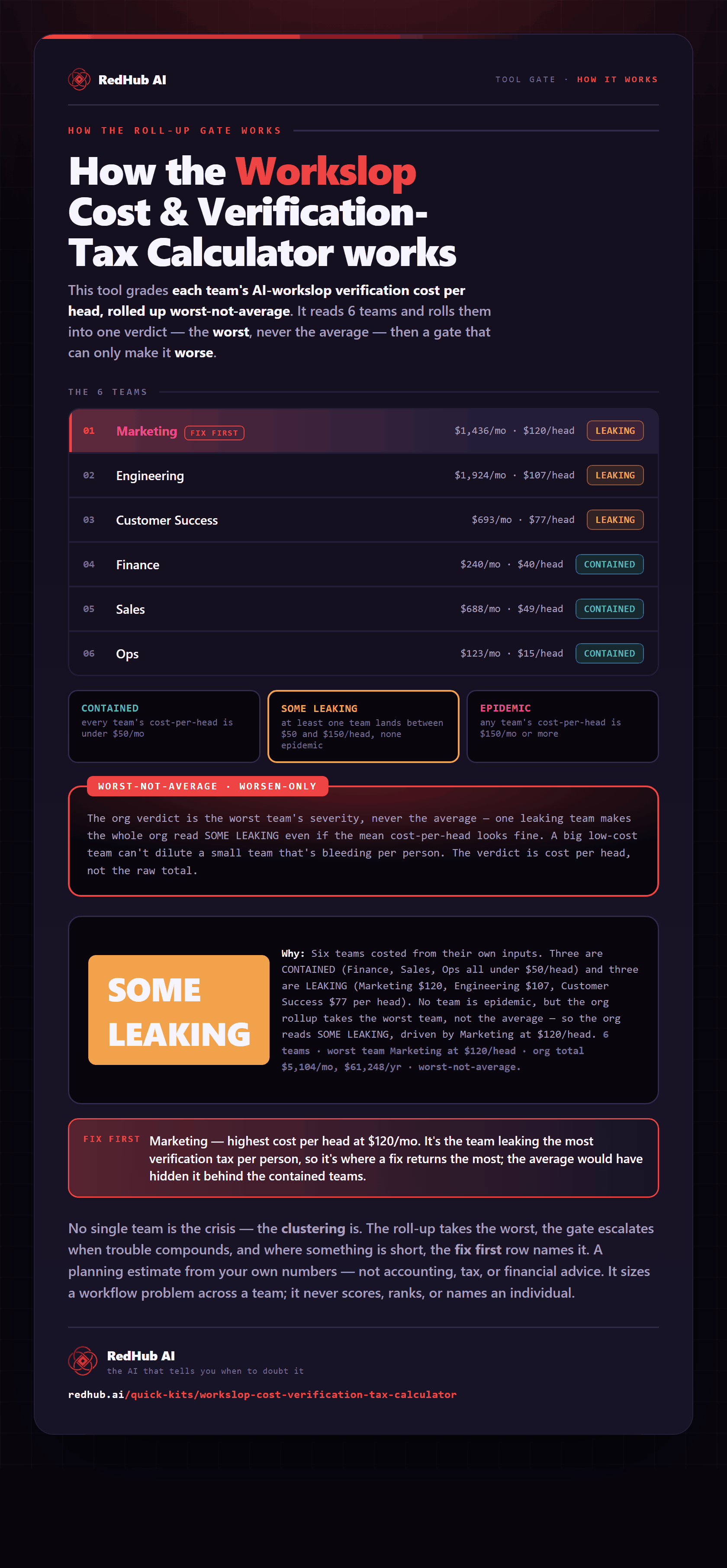
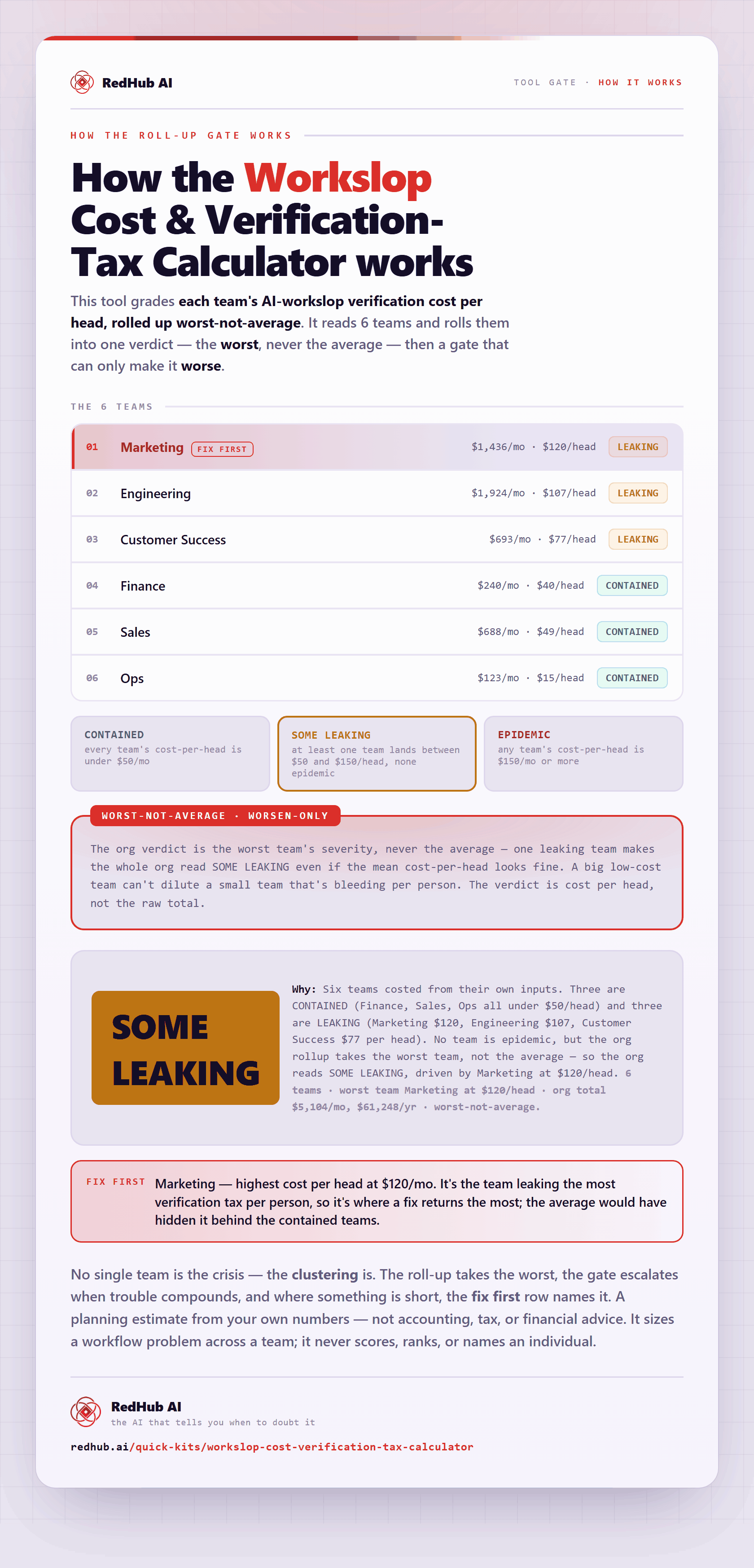
The gate this post refers to, drawn from the tool’s own logic. See the tool.