Why Netflix Paid $587M for AI Workflow Leverage
Todd Brooks, Founderupdated July 22, 20268 min read
Jump to a section7
TL;DR
- What happened: Netflix paid a reported $587M in cash for InterPositive, the AI film-tech startup co-founded by Ben Affleck.
- Why it matters: Netflix didn't buy a flashy demo. It bought AI planted inside the exact workflow where its content value is created.
- The lesson: The AI that wins isn't AI that makes content. It's AI that becomes part of a painful, high-value workflow — and gets hard to remove.
- Your move: You don't need $587M. You need the same idea one size down — an AI system that lives inside your own content workflow, like the Authority Video Engine.
What is AI workflow leverage?
AI workflow leverage is what you own when AI is embedded inside a high-value process — not sitting beside it as a tool you open and forget. It sits at the moment value is created, speeds the work up, and keeps the human expert at the center. That embedded position is what makes it valuable and hard to remove, which is exactly what buyers and customers pay for.
Best for: founders, creators, and experts who want AI to compound their own work — start with the Authority Video Engine, an AI system that lives inside your video workflow.
Here is the founder lesson behind Netflix's big AI deal, up front: the winners in AI are not the tools that make content. They are the systems that live inside a painful, expensive workflow, move from novelty to necessity, and become hard to rip out. That is AI workflow leverage. Netflix just paid a reported $587 million for it.
You do not need $587 million to use the same idea. You need it one size down — an AI system that sits inside your own content workflow instead of a clever gadget you try once and abandon. Let's break down what actually happened, why it matters, and how to apply it at your scale this week.
What Netflix actually bought
According to reporting from TechCrunch (opens in a new tab), Variety (opens in a new tab), and TheWrap (opens in a new tab), Netflix acquired InterPositive, an AI film post-production startup co-founded by Ben Affleck, for a reported $587 million in cash. The deal closed in March 2026 and surfaced in a federal filing months later.
InterPositive's tools build an AI model from a production's own dailies — the raw footage shot each day — then use it to speed up post-production: relighting shots, mixing, adding visual effects. The stated design goal was to keep "the artist at the center," not replace them. Affleck founded the company in 2022 and ran it quietly with a small team of around 16 people before joining Netflix as a senior adviser. Netflix has said around 300 of its titles already used generative AI in some form.
Figures above are from published reporting on the deal, not RedHub estimates.
Notice what is missing from that story. Netflix did not pay nine figures for a text-to-video toy or a slick demo reel. It paid for AI that plugs into the exact step where a film's value is made — the edit, the finish, the moment raw footage becomes a watchable title.
The real lesson: embed AI in the workflow, not beside it
Most AI products live as a sidecar. You open a tab, type a prompt, copy the output, and close it. It helps for a minute, then it is forgotten. There is no leverage there, because there is nothing to remove. It was never part of how the work actually gets done.
Workflow leverage is the opposite. The AI sits at the point where value is created. It does not ask you to change your process — it becomes your process. That is what makes it valuable, and that is what makes it hard to remove. Netflix bought a system that lives inside the content pipeline, keeps the creator at the center, and collapses the timeline between idea and finished asset.
Key insight: A demo shows what AI can do. A system changes what your workflow is. Buyers and customers pay for the second one, because the first one is easy to walk away from.
| Sidecar tool | Embedded system |
|---|---|
| You open it, use it, forget it | It lives inside the work you already do |
| Helps once, no compounding | Speeds every cycle, compounds over time |
| Easy to drop — nothing breaks | Hard to remove — it is the process |
| Novelty | Necessity |
To be clear about the honest line here: RedHub does not build Hollywood post-production or film VFX. Nothing we make competes with InterPositive's technology, and we are not claiming parity. The takeaway that transfers is the principle, not the tech — embed AI inside your content workflow, keep yourself at the center, and collapse the time between idea and finished piece.
How to apply this at founder scale
You are not acquiring a studio. You are trying to show up as the expert in your niche without losing a full day to every video. Same principle, one size down. Here is how to put AI workflow leverage to work in your own content:
- Pick an expensive problem. Not "make more content" — the costly, repeating one. For most experts that is turning what they know into video that actually earns authority.
- Put AI inside the workflow, not beside it. Instead of a prompt you paste into once, use a system that runs the whole loop: research, outline, build, record.
- Keep yourself at the center. The uncopyable layer is your point of view. The AI should interview it out of you, not replace it with generic filler.
- Make it repeatable so it becomes necessity. A one-time trick is novelty. A system you run every week is how a quiet channel becomes a steady authority engine.
That is exactly the shape of RedHub's Authority Video Engine ($199). It is a Workflow-tier system, not a demo — an MCP-driven pipeline that sits inside content production. It scouts your topic on real vidIQ search data, interviews you into an opinionated outline, fills only the gaps in scope, and builds an animated Claude Design deck with a built-in teleprompter, all behind an authority gate that refuses topics you can't speak to first-hand. Four Claude Skills, real data, your voice on top — the goal is a recorded, point-of-view video in about 70 minutes once you're set up.
The honest line: The Authority Video Engine improves your odds of recording the right thing. It does not guarantee views, subscribers, or clients, and it doesn't touch film-grade post-production. You bring your own vidIQ Max plan and you go on camera. It's a repeatable system, not a growth hack.
Own the leverage at your scale
The Authority Video Engine is AI embedded inside your video workflow — creator at the center, timeline collapsed. Research the right topic on live vidIQ data, get interviewed into a point-of-view outline, and build a recordable deck with a teleprompter. One purchase, lifetime access, 12 months of updates.
Get the Authority Video Engine — $199 →Not ready for the full engine? Start smaller.
Workflow leverage does not have to start at $199. If you want the same "novelty to necessity" idea in a lighter form, two systems get you moving:
- Organic Social & Short-Form Video System ($79) — a repeatable content system that turns a one-off idea into a series you actually keep making. This is how a content habit becomes a necessity instead of a novelty.
- AEO-Aware Content Repurposing System ($79) — the "make content faster, cheaper, more scalable" move: take one recorded asset and turn it into many channel-ready pieces, optimized to get found by AI answers.
Pick the one that matches where you are. The point is the same at every price: stop reaching for tools you open and forget, and start building AI into the workflow where your value is actually made.
Decision Guide
Use this thinking if: you have real expertise, a repeating content problem, and you want AI to compound your own work instead of replacing it.
Skip it if: you want a faceless, fully-automated channel with no point of view — embedded leverage is built around a human at the center.
Best first step: pick your one expensive, repeating content problem, then put a system inside that workflow. If it's video, the Authority Video Engine is the direct fit; if you want a lighter start, the Short-Form Video System ($79) is the on-ramp.
FAQ
What is AI workflow leverage in plain terms?
It's the value you get when AI is built into a high-value process instead of sitting beside it. The AI does the work where the work happens, so it speeds things up and becomes hard to remove. A sidecar tool you open and forget has no leverage — an embedded system does.
How much did Netflix pay for Ben Affleck's AI startup?
Netflix paid a reported $587 million in cash for InterPositive, per reporting from TechCrunch, Variety, and TheWrap. The deal closed in March 2026 and later appeared in a federal filing. Those figures come from published reporting, not from RedHub.
Why did Netflix buy it instead of building its own?
Because InterPositive's tools were already embedded in the exact step where a film's value is made — post-production. Netflix bought workflow leverage, not a demo: AI planted at the moment value is created, with the artist kept at the center.
Does RedHub build film post-production or VFX like InterPositive?
No. RedHub does not do Hollywood-grade post-production, relighting, or VFX, and nothing we make competes with InterPositive's technology. The lesson that transfers is the principle — embed AI inside your content workflow — applied to a founder's or creator's own video, not to film production.
What is the Authority Video Engine?
It's a $199 Workflow-tier system from RedHub that sits inside your video-production workflow. It scouts topics on real vidIQ search data, interviews you into an opinionated outline, fills gaps in scope, and builds an animated Claude Design deck with a built-in teleprompter — aiming for a recorded, point-of-view video in about 70 minutes once you're set up.
Do I need anything else to use the Authority Video Engine?
Yes. You bring your own vidIQ Max plan with the vidIQ MCP connected to Claude, and you record the video yourself. The Engine is the orchestration layer on top — the Skills, scoring, templates, and playbooks — not a vidIQ subscription or a source of YouTube data.
Does it guarantee more views or clients?
No, and it won't pretend to. It improves your odds of recording the right thing on the right topic, but it doesn't control the algorithm or the market. It's a repeatable system that keeps your point of view on top, not a growth hack.
What if $199 is too much to start?
Start smaller with the same principle. The Organic Social & Short-Form Video System ($79) builds a repeatable content habit, and the AEO-Aware Content Repurposing System ($79) turns one asset into many. Both put AI inside your workflow at a lighter price.
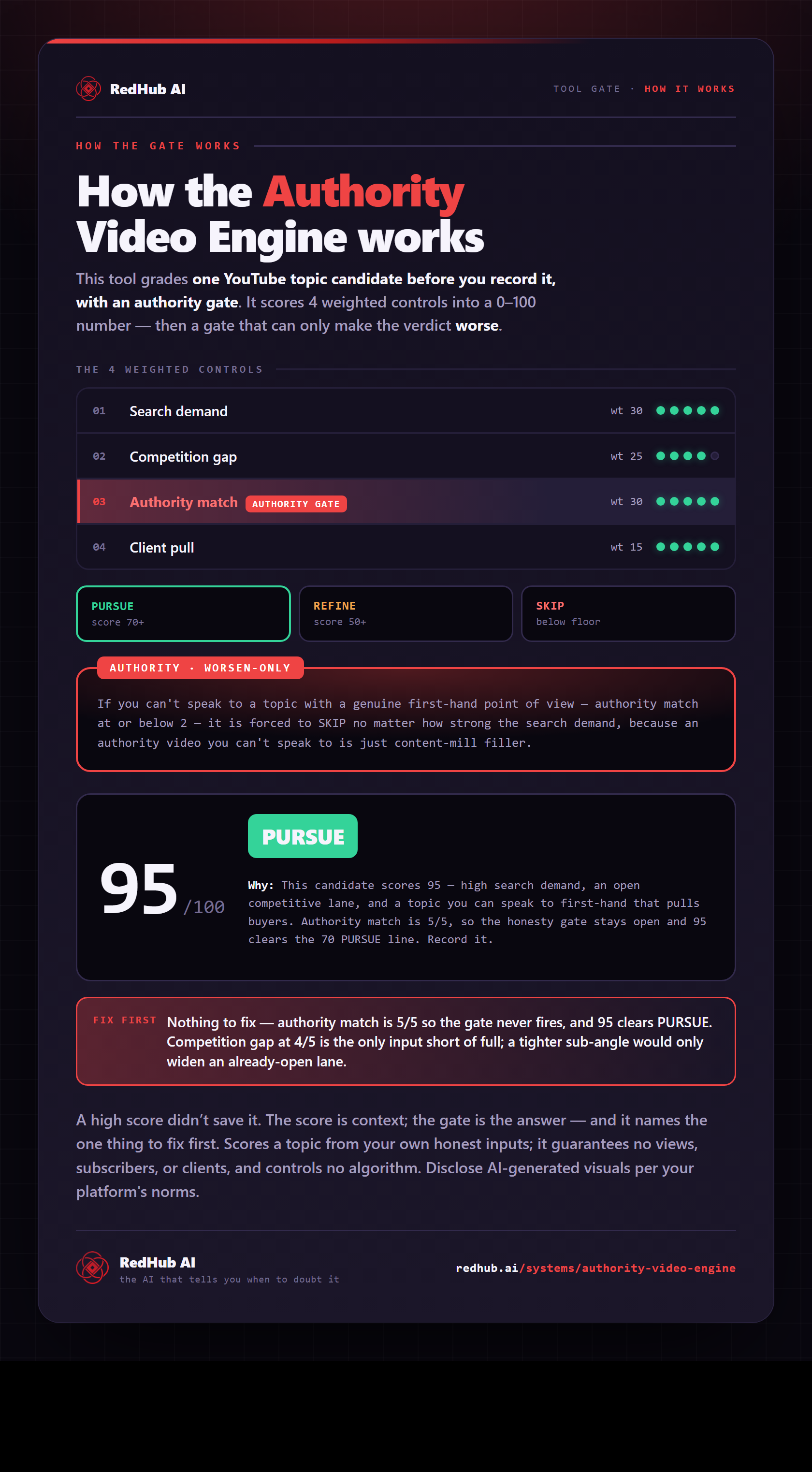
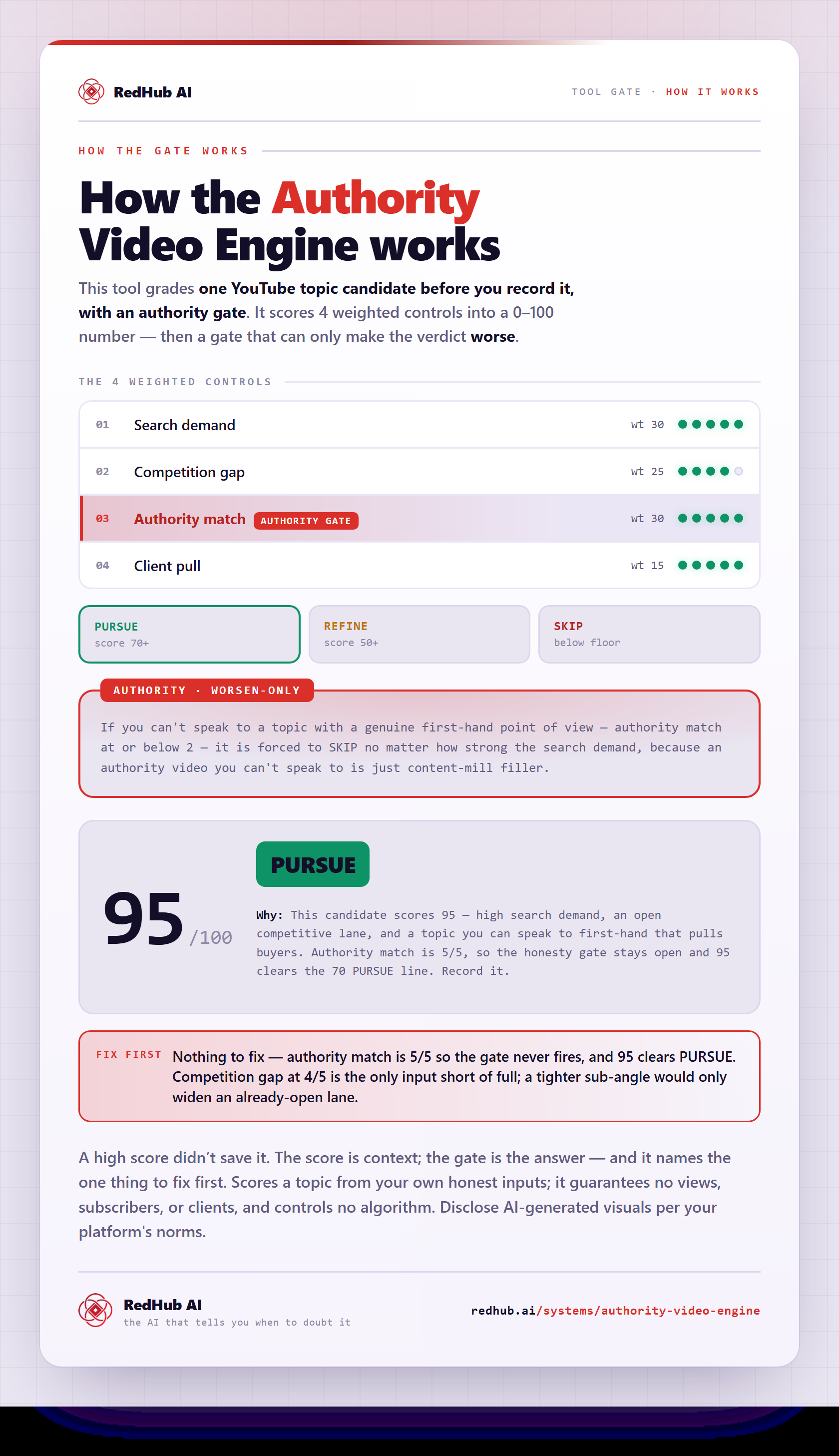
The gate this post refers to, drawn from the tool’s own logic. See the tool.