Am I Ready to Hire? The Real Readiness Signals
RedHub AI Editorialupdated September 7, 20267 min read

Jump to a section8
TL;DR
- What it is: Being ready to hire means the role is affordable at its fully-loaded cost, documented enough to hand off, and backed by demand likely to last — not that you're too busy to keep up.
- Who it's for: Founders about to make their first hire — see The First-Hire Go/No-Go.
- How it works: Six signals, marked from what you actually know about the role. Two are gates — weak on either one forces a NOT YET, no matter how busy you are.
- Bottom line: Feeling overwhelmed is the signal owners trust most and the one that predicts the least.
Am I ready to hire?
You're ready to hire when you can answer yes to three things about a specific role: you can cover its fully-loaded cost — salary plus payroll taxes, benefits, and tools, commonly 1.25 to 1.4 times the base number — without straining your runway; the work is documented well enough that someone else could actually pick it up; and the demand behind the role is likely to hold for months, not just this week. Feeling constantly behind is a real signal that something in the business needs to change, but it doesn't answer any of those three questions on its own — which is why it's the signal most owners lean on and the one that predicts a good hire the least.
Best for: owners staring down their first hire — score the real readiness signals with The First-Hire Go/No-Go.
"Am I ready to hire?" almost always gets answered with a feeling: exhausted, behind, drowning in a good way. That feeling is real — but it's not a readiness signal. It's a demand signal. Readiness is a different, more boring question, and it's answered with facts you can check today, not a mood you're in this week. This post walks through the signals that actually matter and the one everyone reaches for instead. It's part of the larger picture in when to make your first hire.
The false signal: feeling overwhelmed
Being busy is the easiest signal to notice and the least useful one to act on. It tells you demand exists somewhere in the business. It tells you nothing about whether that demand will still be there in six months, whether you can afford to pay for help with it, or whether the work is even something you could hand to someone else yet. Owners who hire the moment they hit their limit are solving for this week — and the hire that solves this week is often the same one that causes next quarter's cash crunch.
Key insight: busy and ready answer different questions. Busy tells you something needs to change. Ready tells you whether a full-time hire is the change that fixes it — versus a contractor, a price increase, or simply saying no to more work.
The signals that actually matter
Six things determine whether a specific hire is ready, and two of them are gates — weak on either one is enough to force a NOT YET regardless of the rest.
| Signal | What it's really asking | Gate? |
|---|---|---|
| Fully-loaded cost coverage | Can you cover salary + taxes + benefits (≈1.25–1.4×) for a couple of months without stress? | Yes |
| Runway survives the hire | After that cost lands, does your cash runway still clear the danger zone? | No |
| The role's revenue / throughput case | Can you name what the role returns, not just how busy it keeps you? | No |
| Work documented enough to hand off | Is the work written down and repeatable, or still only in your head? | Yes |
| Founder time freed | Does the reclaimed time go somewhere worth more than the hire costs? | No |
| Fits W-2 vs 1099 intent | Does how you plan to engage them match the real working relationship? | No |
Notice what isn't on that list: how tired you are, how many nights you've worked late, or how many times you've said "I just need help." Those experiences are the reason you're looking at this list in the first place. They're not on it.
A readiness checklist you can run today
You don't need a tool to do a first honest pass. Walk through these before you write a job post:
- Write the fully-loaded cost, not the salary. Take the base salary you're considering and multiply by roughly 1.25 to 1.4 to estimate taxes, benefits, and tools. Can you cover that number, comfortably, for two to three months even in a slow stretch?
- Check runway after the hire, not before it. Run your cash-out-date math again with the new payroll line included. If runway drops into the danger zone, the timing is wrong even if the role itself is right.
- Write the role in one paragraph. What would this person own, and how would you know they're doing it well? If you can't write that paragraph, the work isn't documented enough to hand off yet — write it down before you hire for it.
- Name the return, not the relief. "It would take pressure off me" is not a revenue case. "It would let us take on two more clients a month" is. If you can only describe relief, the case isn't there yet.
- Ask where the freed time actually goes. If the honest answer is "more of the same thing I'm already doing," the hire isn't freeing anything worth more than it costs.
If every one of those checks passes, you're likely looking at a real HIRE NOW. If the cost or the documentation check fails, the honest answer is NOT YET — and the better next move is usually to bridge with a contractor instead of committing to full-time payroll.
Two inputs worth checking before you self-assess
Two of the readiness signals above depend on numbers most owners haven't actually pulled recently. It's worth checking both before you trust your gut on either.
- Where your time actually goes. "Founder time freed" assumes you know what you're spending your hours on today — and most owners overestimate the high-value share and underestimate the busywork. The Founder Time-Leverage Audit ($79) reads your actual calendar and task mix and tells you where the leverage really is, which is the honest input to this signal instead of a guess.
- Whether you can really afford it. "Fully-loaded cost coverage" and "runway survives the hire" are both cash questions, and cash questions deserve a real read rather than a gut feel. Cash-Flow Sentinel ($249) computes your actual burn, trajectory, and runway and returns an honest verdict before you commit payroll to it.
Score the actual role, not the feeling
The First-Hire Go/No-Go ($129, one-time) scores all six signals from your own marks and returns HIRE NOW, BRIDGE WITH A CONTRACTOR, or NOT YET — with a gate that won't let being busy pass for being ready.
Get The First-Hire Go/No-Go — $129 →Decision Guide
You're ready if: you can cover the fully-loaded cost without stress, the work is documented enough to hand off, and the demand behind it is likely to last.
You're not ready if: the only signal you have is exhaustion, or you can't yet write the role in one clear paragraph.
Best first step: write the fully-loaded cost and the one-paragraph role description today. Those two checks alone rule out most premature hires.
FAQ
Am I ready to hire my first employee?
You're ready when you can cover the role's fully-loaded cost without straining runway, the work is documented enough for someone else to run, and the demand behind it is likely to hold for months. Feeling overwhelmed doesn't answer any of those on its own.
Why doesn't "I'm too busy" count as a readiness signal?
Because it tells you demand exists, not whether you can afford to pay for help with it or whether the work is ready to hand off. Plenty of businesses are busy and still not ready to hire — the fix there is often a contractor, a price change, or turning down work, not payroll.
What if I'm confident but the numbers are tight?
Trust the numbers over the confidence. Owners consistently underestimate the fully-loaded cost of a hire and overestimate how quickly a new hire becomes fully productive. If coverage or runway is tight, that's the honest gate — bridge with a contractor until it isn't.
How do I know if the work is "documented enough"?
If you can write the role in one clear paragraph — what they'd own, and how you'd know they're doing it well — it's documented enough. If the honest answer is "it's all in my head," write it down before you hire, or the new person will spend months learning by osmosis while you keep doing the job.
What should I check before trusting my own readiness read?
Where your time actually goes — most owners guess wrong — and what your cash runway really looks like after the hire lands. Both are worth a real read rather than a gut feel before you commit.
What if I'm ready on some signals but not others?
That's common, and it's exactly what the BRIDGE WITH A CONTRACTOR verdict is for — real signal, but not a full commitment yet. More on that trade-off in hire vs contractor.
Where do I score this properly?
The First-Hire Go/No-Go ($129, one-time) scores all six signals from your own marks, applies the two gates, and returns one verdict — plus a runnable engine and workbook if you're weighing more than one role.
Trade the feeling for the facts
Six signals, two gates, one honest verdict on the role you're actually considering — not on how tired you are this week.
Get The First-Hire Go/No-Go — $129 →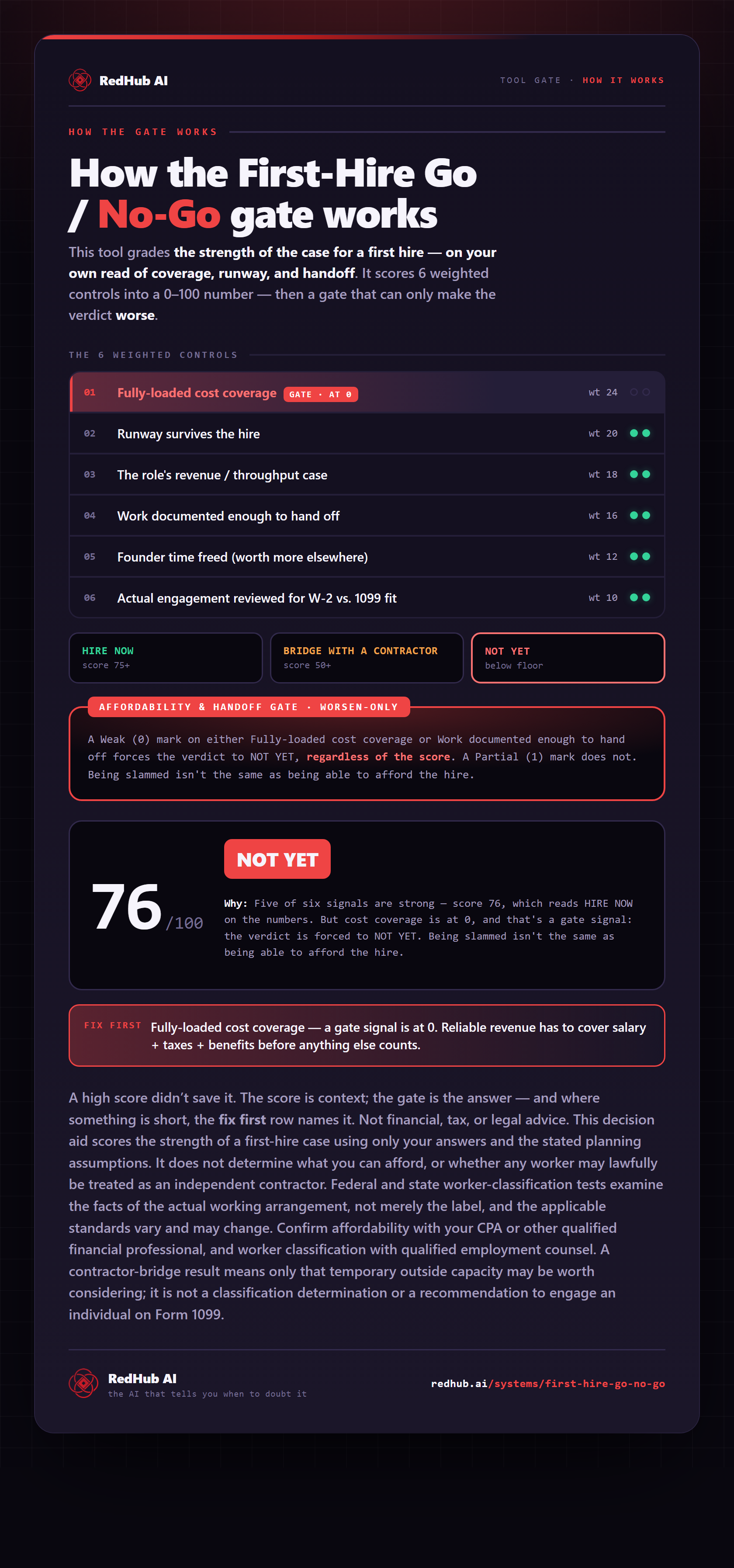
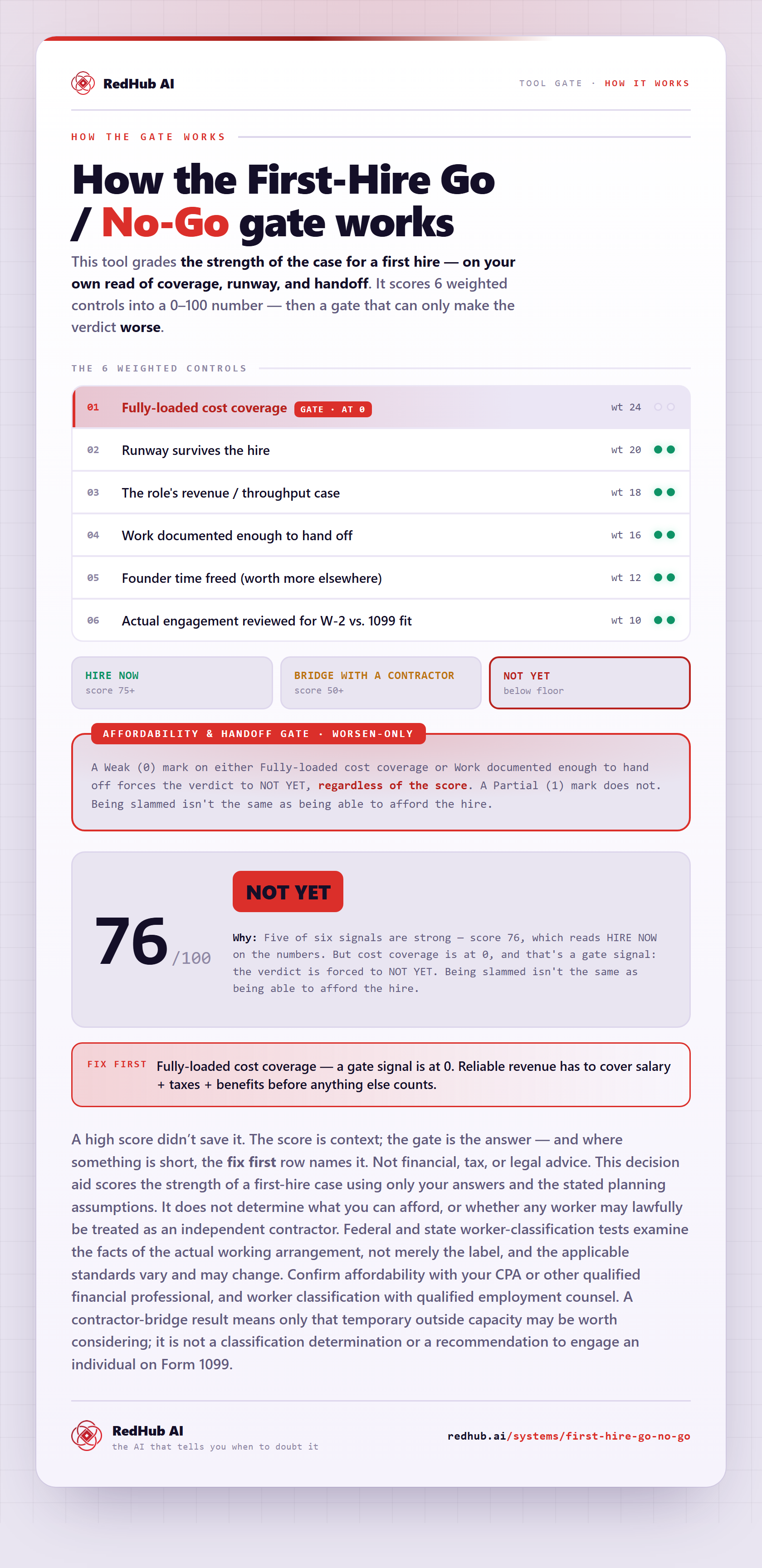
The gate this post refers to, drawn from the tool’s own logic. See the tool.