First Hire Mistakes That Sink New Businesses
RedHub AI Editorialupdated September 7, 20266 min read

Jump to a section10
- TL;DR
- What are the most common first hire mistakes?
- Mistake 1: Hiring on exhaustion, not affordability
- Mistake 2: Hiring before the work is documented
- Mistake 3: Budgeting the salary, not the real cost
- Mistake 4: Hiring for relief instead of a named return
- Mistake 5: Letting runway thin out right after the hire lands
- Mistake 6: Hiring a mini-you with no clear success measure
- Decision Guide
- FAQ
TL;DR
- What it is: The most common first hire mistakes are hiring on exhaustion instead of affordability, hiring before the work is documented, and skipping the fully-loaded cost math.
- Who it's for: Founders about to make their first hire — see The First-Hire Go/No-Go.
- How it works: Each mistake below maps to one weak signal in a first-hire decision — fixing the signal fixes the mistake.
- Bottom line: Almost every first-hire mistake is a version of the same error: treating urgency as readiness.
What are the most common first hire mistakes?
The most common first hire mistakes are hiring the moment you feel overwhelmed instead of when you can actually afford it, hiring before the work is written down anywhere but your own head, budgeting the headline salary instead of the fully-loaded cost, hiring for relief instead of a named business return, and letting cash runway thin out right after the hire lands. Each one is really the same mistake wearing a different hat: mistaking urgency for readiness.
Best for: founders about to sign their first offer letter — pressure-test the decision with The First-Hire Go/No-Go first.
Most first-hire mistakes don't look like mistakes in the moment. They look like relief. You've been slammed for weeks, you finally hire, and the pressure lifts — for about a month. Then payroll gets tight, or the new hire is still asking you what to do, or the workload that justified the hire quietly dries up. This is a tour of the specific ways that happens, and it's part of the broader question of when to make your first hire.
Mistake 1: Hiring on exhaustion, not affordability
The single most common first-hire mistake is timing the decision to your stress level instead of your bank account. Being slammed tells you demand exists. It says nothing about whether you can reliably cover the role's fully-loaded cost — salary plus payroll taxes, benefits, tools, and space, commonly 1.25 to 1.4 times the base salary — for the months it takes to see whether the hire pays for itself. Owners who skip that check are the ones most likely to be blindsided a quarter later when payroll gets tight.
Key insight: a role can look great on every other measure and still be the wrong hire right now if you can't comfortably cover its real cost. Coverage isn't one factor among many — it's a gate. Weak coverage should force the verdict to NOT YET regardless of how busy you are.
Mistake 2: Hiring before the work is documented
The second-most expensive mistake is hiring for work that only exists in your head. If you can't write the role in one clear paragraph — what they'd own, and how you'd know they're doing it well — a new hire can't either, and they'll spend months learning by osmosis while you keep doing the job yourself and paying a salary for the privilege. This is why "work documented enough to hand off" is the second gate in a first-hire decision, not just a nice-to-have.
Mistake 3: Budgeting the salary, not the real cost
Owners routinely price a hire at the number on the offer letter and get surprised by everything stacked on top of it — payroll taxes, benefits, tools, onboarding time, space. The realistic multiplier is commonly cited around 1.25 to 1.4 times the base salary. Budget the lower number, and a hire that looked affordable on paper turns into a cash squeeze in month two.
Mistake 4: Hiring for relief instead of a named return
"This would take pressure off me" is not a business case — it's a feeling. A real case names what the role returns: more clients served, faster turnaround, revenue the role directly drives or clearly frees you to pursue. If the honest answer to "what does this role return" is only "it would help," the role's revenue case isn't there yet, and the hire is premature even if you can technically afford it.
Mistake 5: Letting runway thin out right after the hire lands
Coverage and runway are two different checks, and owners often only run one. You can cover a hire's fully-loaded cost for this month and still watch your cash-out date creep dangerously close once that new payroll line runs for a year. Always re-run your runway math with the new hire's cost already included — not your current runway, the runway after the hire.
Mistake 6: Hiring a mini-you with no clear success measure
A less obvious mistake: hiring someone to "help with everything" instead of a defined role with a way to measure whether it's working. Vague roles are the hardest to hand off and the hardest to know are succeeding — which loops back to the documentation gate above. Define the role narrowly enough that you'd know, within 90 days, whether it's a HIRE NOW that's paying off or a mistake to unwind.
| Mistake | The signal it breaks |
|---|---|
| Hiring on exhaustion | Fully-loaded cost coverage (gate) |
| Hiring before the work is written down | Work documented enough to hand off (gate) |
| Budgeting salary, not real cost | Fully-loaded cost coverage (gate) |
| Hiring for relief, not a return | The role's revenue / throughput case |
| Ignoring post-hire runway | Runway survives the hire |
| Hiring a mini-you, no success measure | Work documented enough to hand off (gate) |
Notice how many of these mistakes trace back to the same two gate signals. That's not a coincidence — coverage and documentation are the two checks that are easiest to skip under pressure, and skipping either one is what turns a hopeful hire into an expensive one. It's also worth checking your real numbers before you decide, rather than trusting the gut feel that led to these mistakes in the first place: Cash-Flow Sentinel ($249) grades your actual runway and burn before payroll adds a new line, and the Founder Time-Leverage Audit ($79) shows you where your hours really go, so "this would free up my time" is a measured claim instead of a guess.
Catch the mistake before you sign
The First-Hire Go/No-Go ($129, one-time) scores your role on the six signals above, applies the two gates, and tells you the one thing to fix first if the verdict isn't HIRE NOW.
Get The First-Hire Go/No-Go — $129 →Decision Guide
You're at risk of a mistake if: your reason for hiring is "I'm too busy," you haven't written the fully-loaded cost, or you can't describe the role in one clear paragraph.
You're likely clear if: you can name what the role returns, you've re-run runway with the new cost included, and the work is documented enough for someone else to run.
Best first step: write down the fully-loaded cost and the one-paragraph role description before you do anything else. Those two checks catch most of the mistakes above.
FAQ
What's the most common first hire mistake?
Timing the hire to your stress level instead of your bank account — hiring the moment you're overwhelmed, without checking whether you can reliably cover the fully-loaded cost for the months it takes to see the hire pay off.
Why is hiring before the work is documented a mistake?
Because a new hire can't run work that only exists in your head. They'll spend months learning by trial and error while you keep doing the job — meaning you're paying a salary and getting no relief.
How much does the fully-loaded cost really add to a salary?
Commonly cited around 1.25 to 1.4 times the base salary once payroll taxes, benefits, tools, and space are included. Budgeting the headline number alone is one of the fastest ways to get blindsided by payroll.
Is "I'm too busy" ever a good enough reason to hire?
It's a good enough reason to look at hiring — it's not a good enough reason to actually do it. Check affordability and documentation first; if either is weak, bridge with a contractor instead.
What's a cheap way to avoid these mistakes?
Write two things down before you do anything else: the fully-loaded cost of the role, and a one-paragraph description of what the person would own. Those two checks alone catch most premature hires.
Do these mistakes apply to a contractor too?
Some do — budgeting real cost and naming a return matter either way. Documentation matters less for a short-term contractor engagement, which is one reason a contractor is often the safer bridge when the work isn't fully defined yet.
How do I check my own hire against these mistakes?
The First-Hire Go/No-Go ($129, one-time) scores the same six signals these mistakes map to and names the one thing to fix first if the verdict isn't a clean HIRE NOW.
Don't repeat the mistake. Score it first.
Six signals, two gates, one honest verdict — catch the premature hire before it catches you.
Get The First-Hire Go/No-Go — $129 →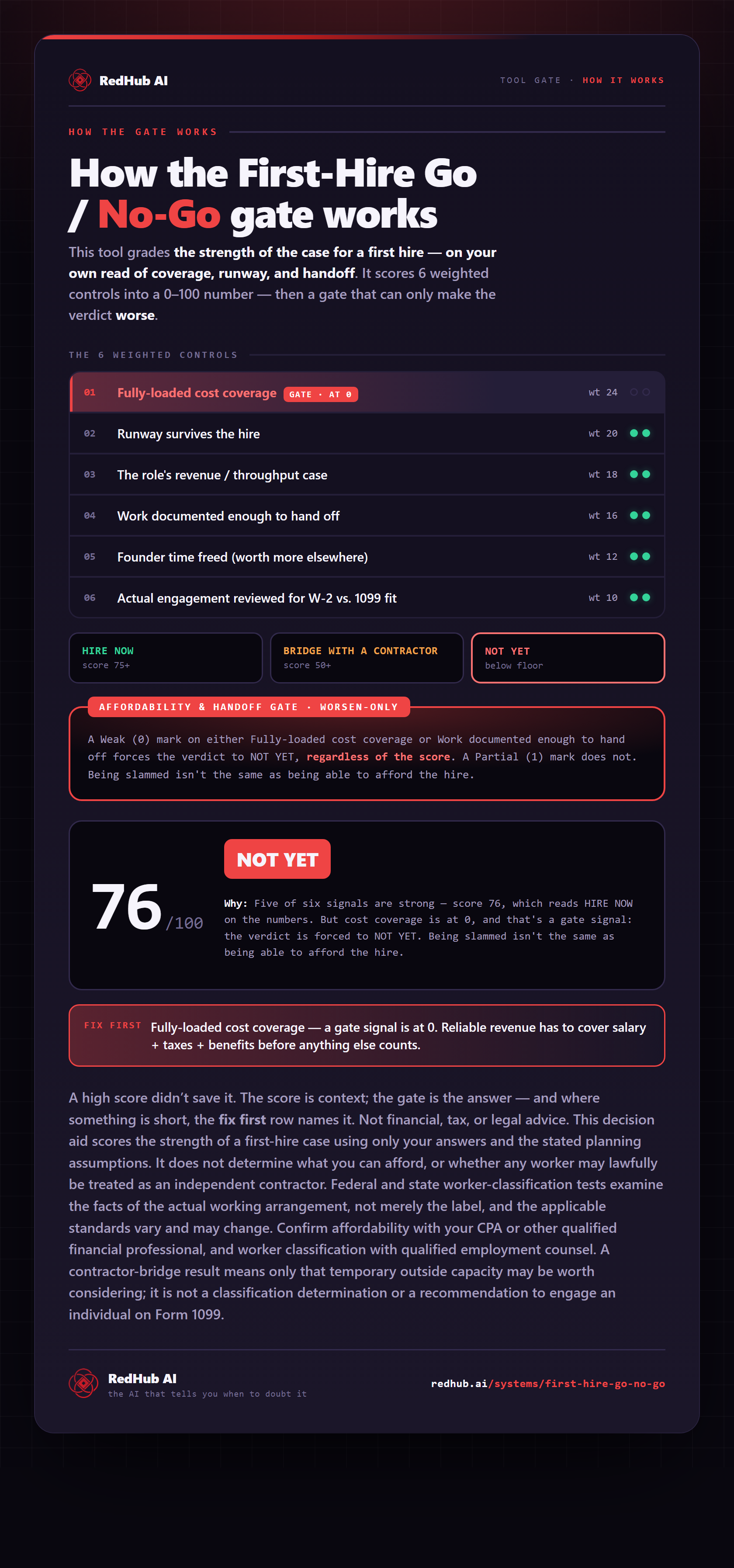
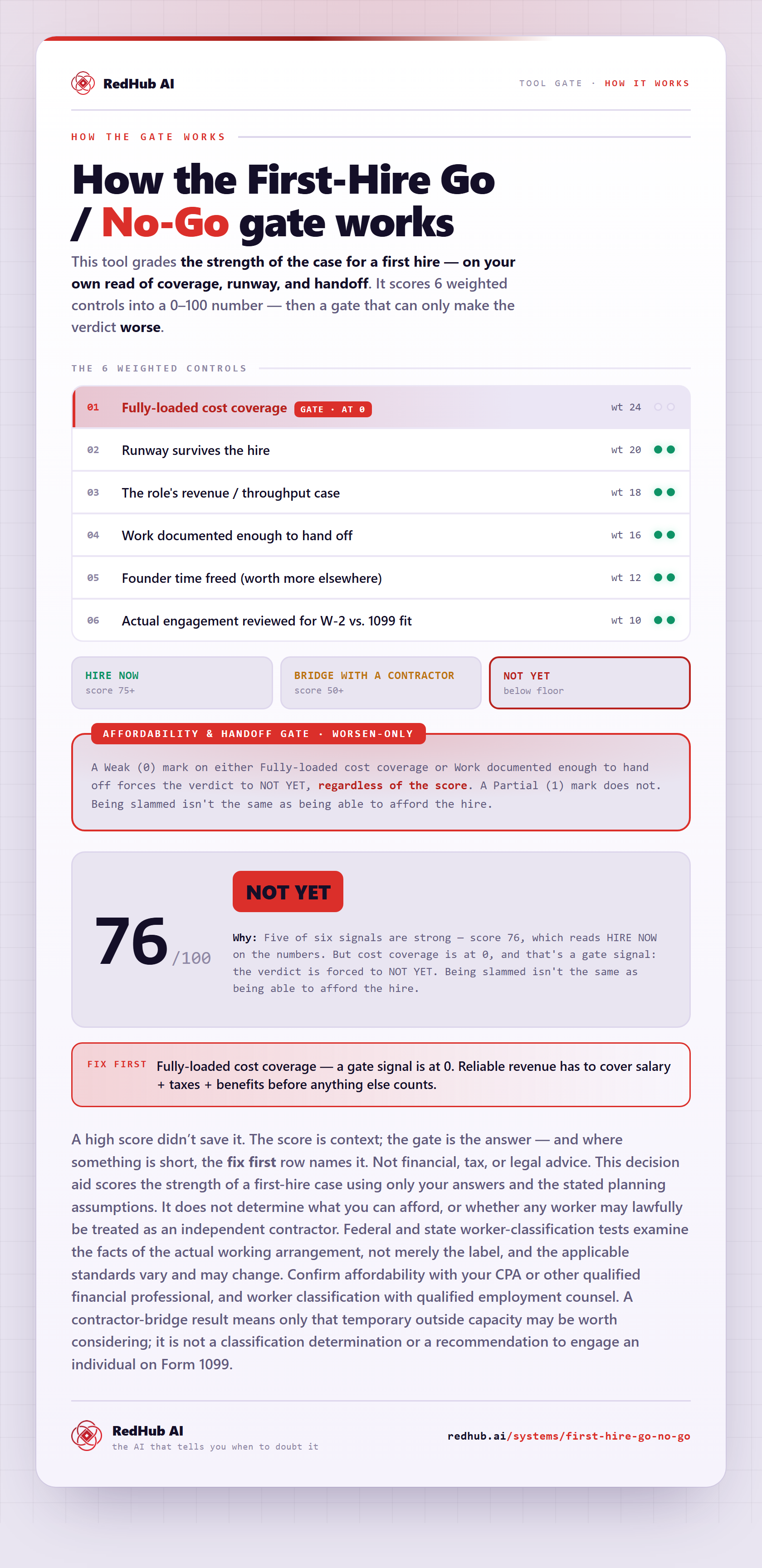
The gate this post refers to, drawn from the tool’s own logic. See the tool.