Hire vs Contractor: How to Make Your First Call
RedHub AI Editorialupdated September 7, 20266 min read

Jump to a section8
TL;DR
- What it is: Hire vs contractor comes down to cost, commitment, and control — a contractor costs more per hour but nothing when there's no work; an employee costs less per hour but commits you to payroll either way.
- Who it's for: Founders whose first-hire case is real but the timing or coverage isn't fully there yet — see The First-Hire Go/No-Go.
- How it works: When two signals — fully-loaded cost coverage and documented work — aren't both strong, bridging with a contractor is the honest middle step, not a consolation prize.
- Bottom line: Worker classification is a legal and tax question, not a preference — this article is not legal or tax advice.
Hire vs contractor: which is right for your first hire?
Choose a contractor when the work is real but you're not ready to commit to full-time payroll — cash coverage is tight, the work isn't fully documented yet, or the need might not last. Choose an employee when the fully-loaded cost is comfortably covered, the role is documented enough to hand off, and the demand behind it is durable. The honest signal isn't which option feels more "official" — it's whether your two gate checks, affordability and documentation, are both genuinely strong yet.
Best for: founders deciding between a contractor and a first employee — score the actual decision with The First-Hire Go/No-Go.
The hire vs contractor question usually gets framed as a personality choice — some founders "believe in" full-time teams, others swear by contractors. That framing hides the real decision, which is mechanical: cost per hour versus cost of commitment, and how much control you need over how the work gets done. This sits inside the bigger question of when to make your first hire — this post is about which structure fits when the timing is close but not obviously a yes.
What actually changes between the two
| Factor | Employee (W-2) | Contractor / fractional (1099) |
|---|---|---|
| Cost when there's no work | You still pay — payroll runs regardless of workload | You pay only for work delivered |
| Fully-loaded cost | Salary plus taxes, benefits, tools — commonly 1.25–1.4× the base | Higher hourly rate, but no taxes/benefits stack on top |
| Commitment | Ongoing — ending it is a real event, not a contract expiring | Bounded by the engagement — easier to scale down |
| Control over how work is done | You can direct the day-to-day process | Legally limited — control is a key factor in classification |
| Best fit | Documented, durable, recurring work you can afford outright | Real but uncertain work, or work you can't yet fully define |
Where each option wins
An employee wins when
- The fully-loaded cost is comfortably covered, not just this month's cash
- The work is documented enough that training is realistic
- The demand is likely to hold for the long term, not a single busy season
- You need someone directing day-to-day, integrated into the team
A contractor wins when
- You're not sure the demand lasts past a few months
- Coverage is tight and full-time payroll would strain runway
- The role isn't documented enough yet — you're still figuring out what "good" looks like
- You want to test a working relationship before committing further
Why bridging is the honest middle, not a compromise
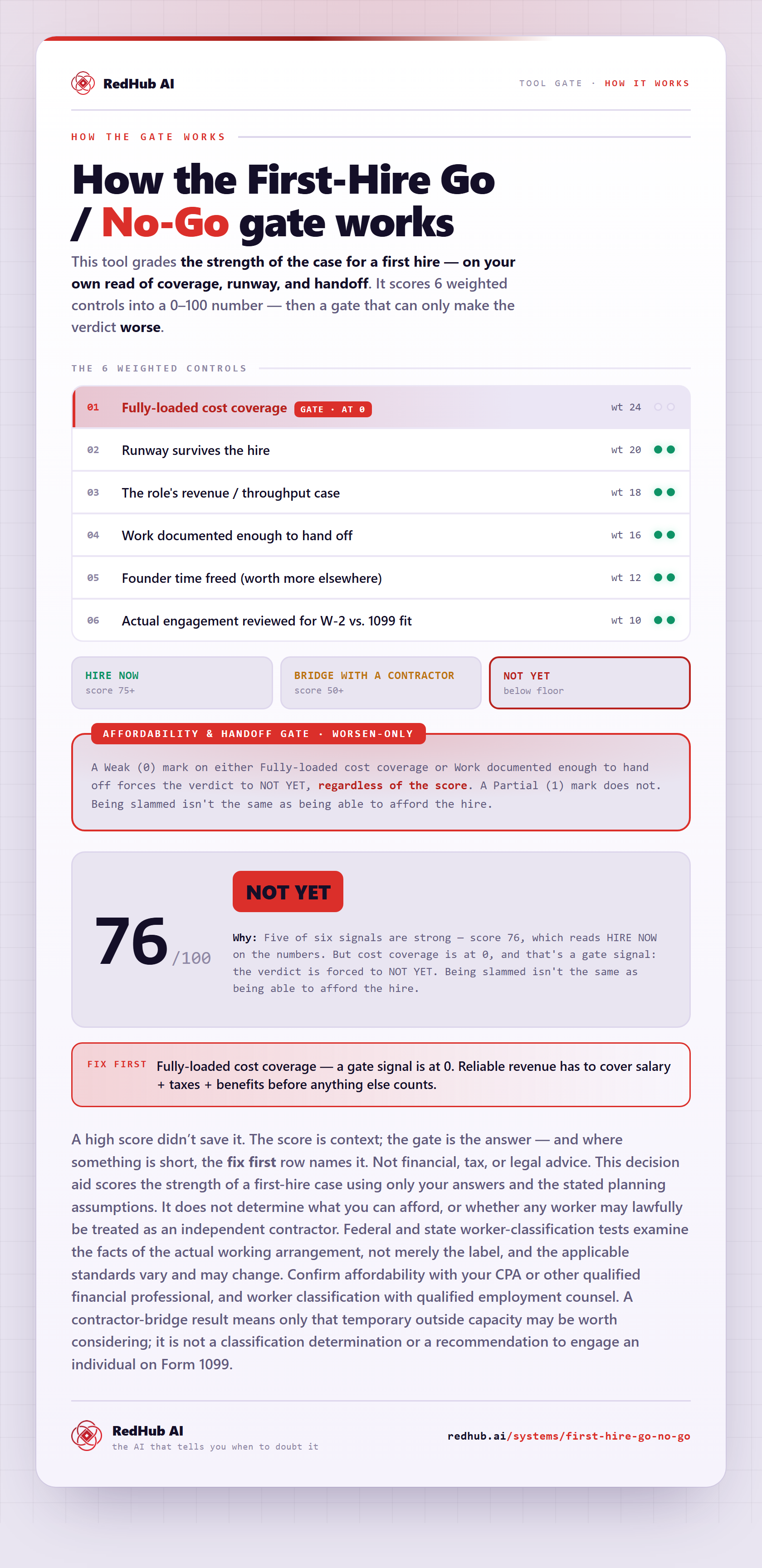
Founders often treat a contractor as the fallback when they can't "really" hire yet — a lesser option. That framing gets it backwards. When two specific signals are weak — you can't comfortably cover the fully-loaded cost, or the work isn't documented enough to hand off — those are exactly the two gates that force a NOT YET verdict in a first-hire decision, no matter how strong everything else looks. Bridging with a contractor in that situation isn't settling. It's the correct move given the facts in front of you.
Key insight: a contractor lets you buy the help without buying the commitment. You get the work done, you learn what the role actually needs, and you convert to a full hire later once coverage is solid and the role is genuinely documented — which is usually a stronger hire than the one you'd have made under pressure.
This is the same territory fractional executives and consultants operate in on the other side of the table — seasoned operators who work part-time across several companies precisely because full-time isn't the right structure for every need. If what you actually need is senior judgment a few hours a week rather than a full-time hand, a fractional arrangement may fit better than either a full employee or an hourly contractor.
The one thing that isn't your call to make alone
Whether someone should be paid as a W-2 employee or a 1099 contractor is not a matter of preference — it's governed by the actual working relationship: how much control you exert over how the work gets done, whether the work is core and ongoing to the business, and whether the person is genuinely in business for themselves. A signed 1099 agreement does not, by itself, make someone a contractor. Classification rules differ by state and agency, and the federal standard has been in flux.
Not legal or tax advice. This article explains the trade-offs between hiring an employee and engaging a contractor — it does not determine how a specific worker should be classified. Confirm the actual classification with your CPA or qualified employment counsel before you decide.
Score which structure fits, not just the vibe
The First-Hire Go/No-Go ($129, one-time) scores your specific role on six weighted signals and tells you honestly whether it's HIRE NOW, BRIDGE WITH A CONTRACTOR, or NOT YET — including a signal on whether your W-2 vs 1099 intent actually fits the work.
Get The First-Hire Go/No-Go — $129 →Once the verdict genuinely reads HIRE NOW, running the hire well — a fair job post, a structured screen, a lawful interview, an evidence-based scorecard — is a different job, and it's exactly what the Recruiting & Hiring Skills Pack is built for.
Decision Guide
Choose a contractor if: coverage is tight, the work isn't fully documented, or you're not sure the demand lasts.
Choose an employee if: the fully-loaded cost is comfortably covered, the work is documented, and the demand is durable.
Best first step: run your candidate role through both gate checks — cost coverage and documentation — before you write a single job description or contractor scope.
FAQ
Should my first hire be an employee or a contractor?
Choose a contractor if cash coverage is tight, the work isn't documented enough yet, or you're not sure the demand lasts. Choose an employee once the fully-loaded cost is comfortably covered and the role is durable and definable.
Is a contractor cheaper than an employee?
Per hour, usually not — contractor rates are typically higher than an equivalent salary. But you only pay for work delivered, with no payroll taxes, benefits, or ongoing commitment stacked on top. Which is cheaper depends on how steady the workload actually is.
What's the real risk of choosing wrong?
Hiring an employee too early risks a cash crunch or a role nobody can hand off. Choosing a contractor when the work is truly recurring and durable can mean paying a premium for something that would have been cheaper as a hire. Both risks are why the decision deserves a real check, not a gut call.
Can I just start someone as a contractor and convert them later?
Often, yes — and it's a common bridging pattern. Just make sure the actual working relationship matches the label at every stage; a contractor who's directed like an employee is a classification risk regardless of what the paperwork says. Confirm with counsel if you're unsure.
Is contractor vs employee a legal decision?
Yes — worker classification is governed by the actual working relationship (control, how core and ongoing the work is, whether the person is genuinely in business for themselves), not by preference or by what the contract is titled. This article isn't legal or tax advice; confirm your specific case with a CPA or employment counsel.
What if I need senior judgment, not just extra hands?
That's a different shape of engagement — a fractional executive or consultant, not an hourly contractor or a full-time junior hire. See the Fractional Executive & Consultant Skills Pack for that side of the decision.
How do I score my specific hire-vs-contractor decision?
The First-Hire Go/No-Go ($129, one-time) scores your role on six weighted signals, including cost coverage and classification fit, and returns HIRE NOW, BRIDGE WITH A CONTRACTOR, or NOT YET.
Don't guess the structure. Score it.
Six weighted signals tell you honestly whether this role is ready for a full hire, a contractor bridge, or neither yet.
Get The First-Hire Go/No-Go — $129 →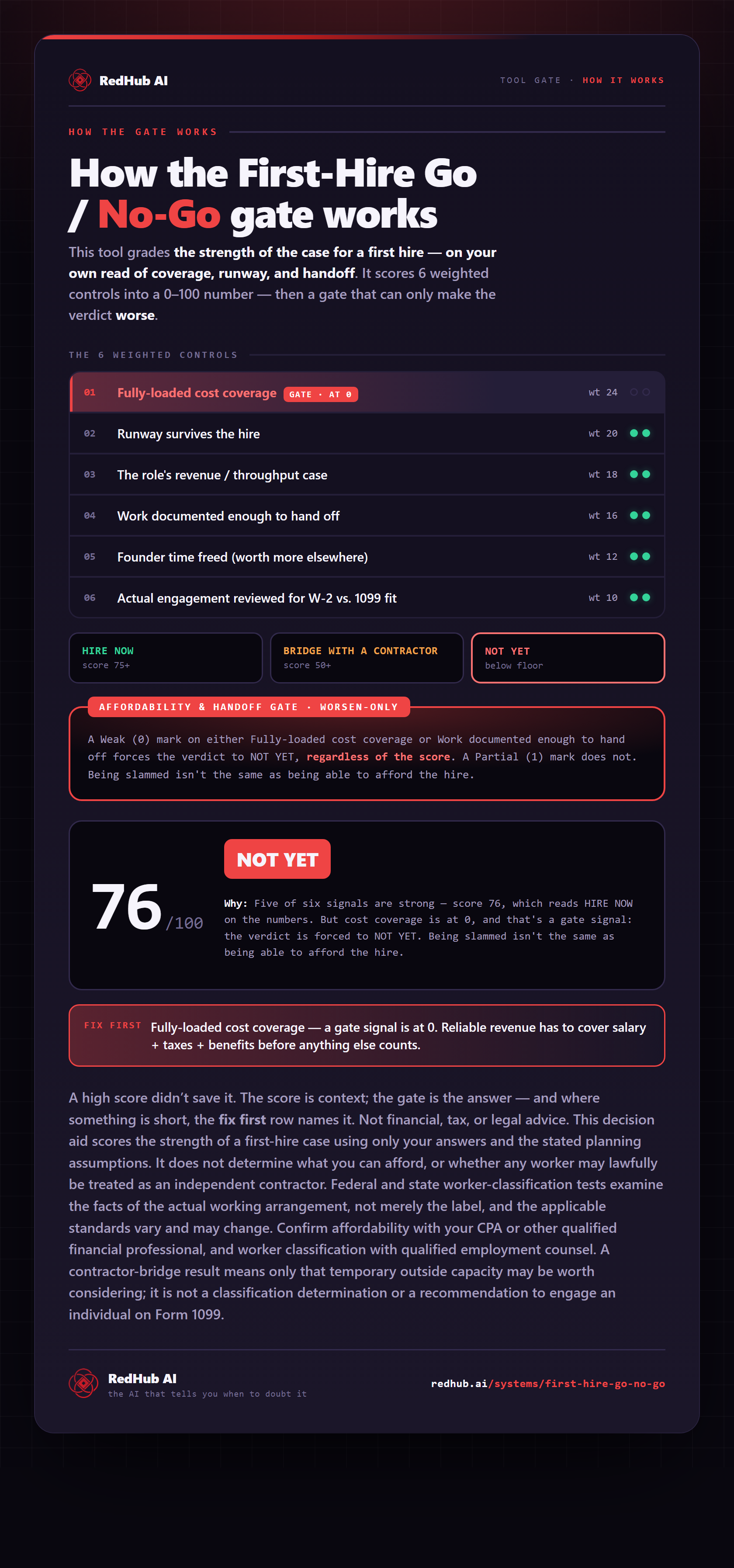
The gate this post refers to, drawn from the tool’s own logic. See the tool.