What Role to Hire First (and How to Pick It)
RedHub AI Editorialupdated September 7, 20266 min read

Jump to a section8
TL;DR
- What it is: The right first hire is the recurring work costing you the most leverage — not the task you'd most enjoy handing off.
- Who it's for: Founders who've decided a hire is coming and need to pick which role — see The First-Hire Go/No-Go.
- How it works: Define the role in one paragraph before you hire for it — undefined roles are the hardest to hand off and the hardest to know are working.
- Bottom line: Pick the role by what it frees you to do, not by what's easiest to write a job post for.
What role should you hire for first?
Hire first for the recurring work that costs you the most leverage — the task that's eating hours you could spend on the highest-value part of the business, and that someone else could genuinely learn to do well. That's usually not the task you'd most enjoy offloading, and it's rarely the most exciting title to hire for. It's whatever repeatable, definable chunk of work is quietly capping how much the business can do, once you can name it clearly enough that someone else could actually own it.
Best for: founders who've decided to hire and now need to pick the role — score the specific role with The First-Hire Go/No-Go.
Deciding to hire and deciding what to hire for are two different questions, and founders often answer the second one badly even after getting the first one right. The instinct is to hire for whatever feels most urgent this week, or whatever role sounds most legitimate to have. Neither of those is the right filter. This post is the second half of when to make your first hire — once the timing is right, here's how to pick the role.
The wrong way to pick: most fun to offload
Ask most founders what they'd hire for first and you'll hear the task they personally like least — the bookkeeping, the scheduling, the inbox. That's an understandable instinct, but it optimizes for your mood, not the business. A task you dislike but that takes fifteen minutes a week is a bad first hire. A task you don't mind that's quietly eating twelve hours a week is a great one.
The right way to pick: highest recurring leverage
The role worth hiring for first is the one where three things line up: it happens often enough to be worth a dedicated role, it's currently done by you (or nobody, which is worse), and handing it off frees time that goes toward something worth meaningfully more than the hire costs. That's the actual leverage calculation — not how annoying the task is, but how much it's capping the business by staying on your plate.
Key insight: the highest-leverage role to hire for is rarely the one you notice first. It's usually the recurring task you've stopped noticing because you've been doing it so long — which is exactly why it's worth a deliberate look instead of a gut pick.
Define the role before you hire for it
Once you've identified the candidate role, the next step isn't writing a job post — it's writing the role itself. Can you describe, in one paragraph, what this person would own and how you'd know they're doing it well? If the honest answer is "I'm not totally sure," the role isn't ready to hire for yet, no matter how much time it's costing you. Hiring for an undefined role is one of the most common ways a first hire fails: you end up training by osmosis for months, still doing the job yourself, now with a salary attached.
- List every recurring task you touch weekly. Not one-off projects — the things that repeat, week after week, regardless of what else is going on.
- Estimate the hours each one costs you. Be honest, not aspirational. Most founders underestimate how much time the boring, recurring stuff actually takes.
- Rank by what the freed time is worth elsewhere. The highest-leverage candidate is the task whose hours, if freed, would go toward the thing that grows the business the most.
- Write the top candidate as a one-paragraph role. What they'd own, how you'd measure it working. If you can't write it clearly, that's your answer — it's not ready yet.
- Check it against the other signals. A well-defined, high-leverage role still needs the fully-loaded cost covered and a durable case behind it before it's a real HIRE NOW.
Most founders skip step 1 and 2 entirely and jump straight to "I need a marketing person" or "I need an assistant" — titles, not roles. The title comes after you've identified the actual recurring, definable, high-leverage work. Get that step right and the title picks itself.
Where to find the real numbers, not the guess
Steps 1 and 2 above depend on knowing where your time actually goes — and most founders are wrong about their own time mix, usually overestimating the high-value share. The Founder Time-Leverage Audit ($79) reads your actual calendar and task mix and tells you where the leverage really sits, instead of relying on which task you happen to resent most this week.
Once the role is defined, score it
The First-Hire Go/No-Go ($129, one-time) takes the role you've defined and scores it on six weighted signals — fully-loaded cost coverage, runway, the revenue case, documentation, freed time, and classification fit — and returns one verdict.
Get The First-Hire Go/No-Go — $129 →Once the verdict reads a clean HIRE NOW, running the actual hire — a fair job post, a structured screen, a lawful interview, a real scorecard — is a different skill set, and it's what the Recruiting & Hiring Skills Pack is built for.
Decision Guide
Hire for this role if: it's recurring, you can describe it in one clear paragraph, and freeing it up sends your time somewhere worth more than the hire costs.
Don't hire for this role yet if: you can't yet describe what "done well" looks like, or the task is a one-off rather than a recurring pattern.
Best first step: list every task you touch weekly, estimate the hours honestly, and pick the highest-leverage one — not the one you personally dislike most.
FAQ
What role should a founder hire for first?
The recurring task costing the most leverage — the one eating hours that could go toward the highest-value part of the business — not the task you personally enjoy least or the title that sounds most official.
How do I know if a role is "high leverage"?
Ask what the freed time would go toward if this role were handled by someone else. If the answer is meaningfully more valuable than what the hire costs, it's high leverage. If the honest answer is "more of the same," it isn't.
Should I write a job description before defining the role?
No — define the role first. Write one clear paragraph on what the person would own and how you'd measure them doing it well. A job description written before that tends to describe a task list, not a real role.
What if the role I want to hire for isn't fully recurring yet?
That's a documentation and durability problem, not a titles problem. Consider bridging with a contractor until the pattern is clear enough to define and the demand looks likely to hold — see hire vs contractor.
How do I find out where my time actually goes?
Most founders guess wrong, usually overestimating their high-value hours. The Founder Time-Leverage Audit ($79) reads your actual calendar and task mix instead of your impression of it.
What comes after I've picked the role?
Score it. A well-defined role still needs its fully-loaded cost covered and a durable case behind it — The First-Hire Go/No-Go ($129, one-time) checks all six signals before you commit.
What happens once the role scores as a real HIRE NOW?
Then it's a hiring-process question — a fair job post, a structured screen, a lawful interview, a real scorecard — which is exactly what the Recruiting & Hiring Skills Pack ($79) is built to run.
Pick the role by leverage, not by feel
Define it, then score it — six weighted signals, one honest verdict on the exact role you're considering.
Get The First-Hire Go/No-Go — $129 →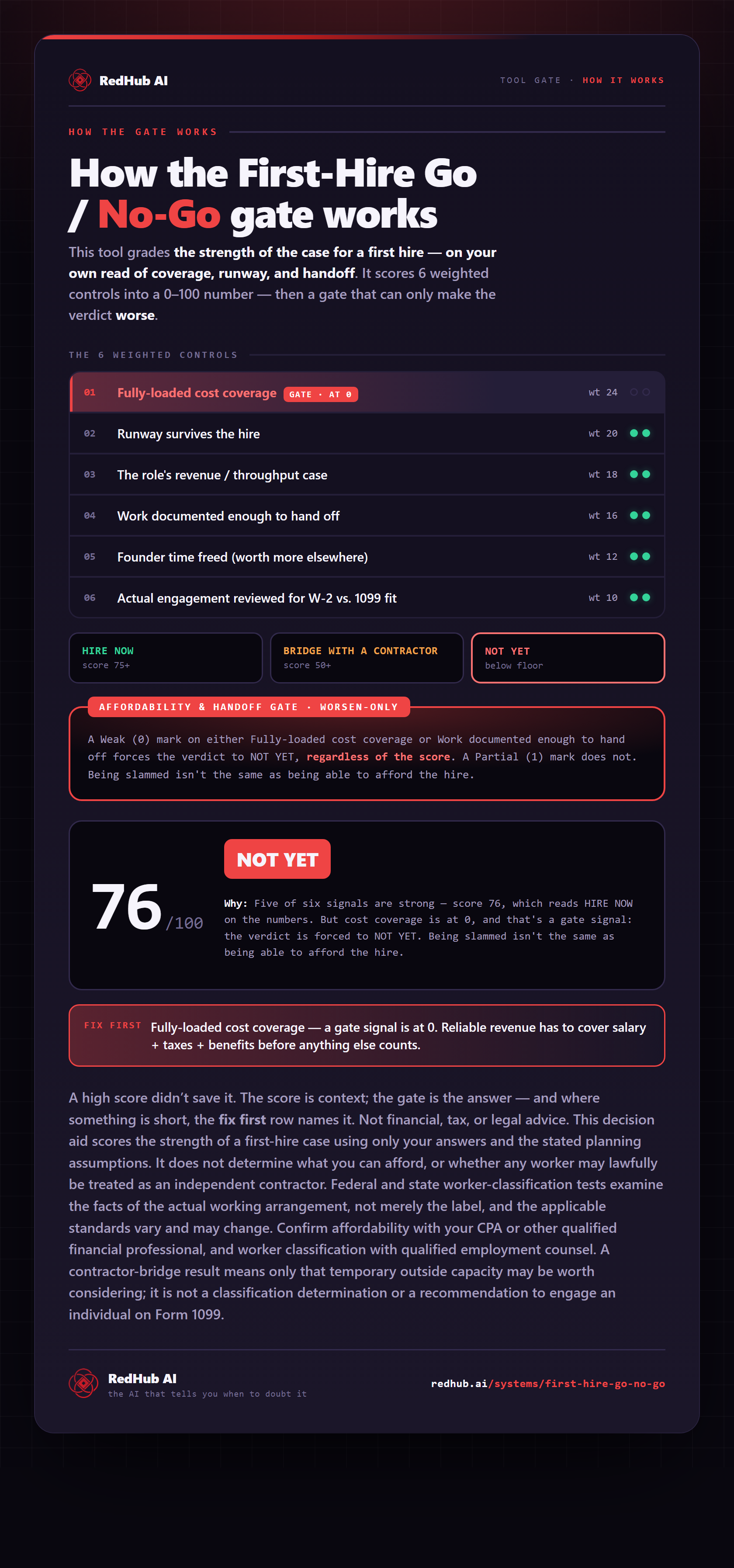
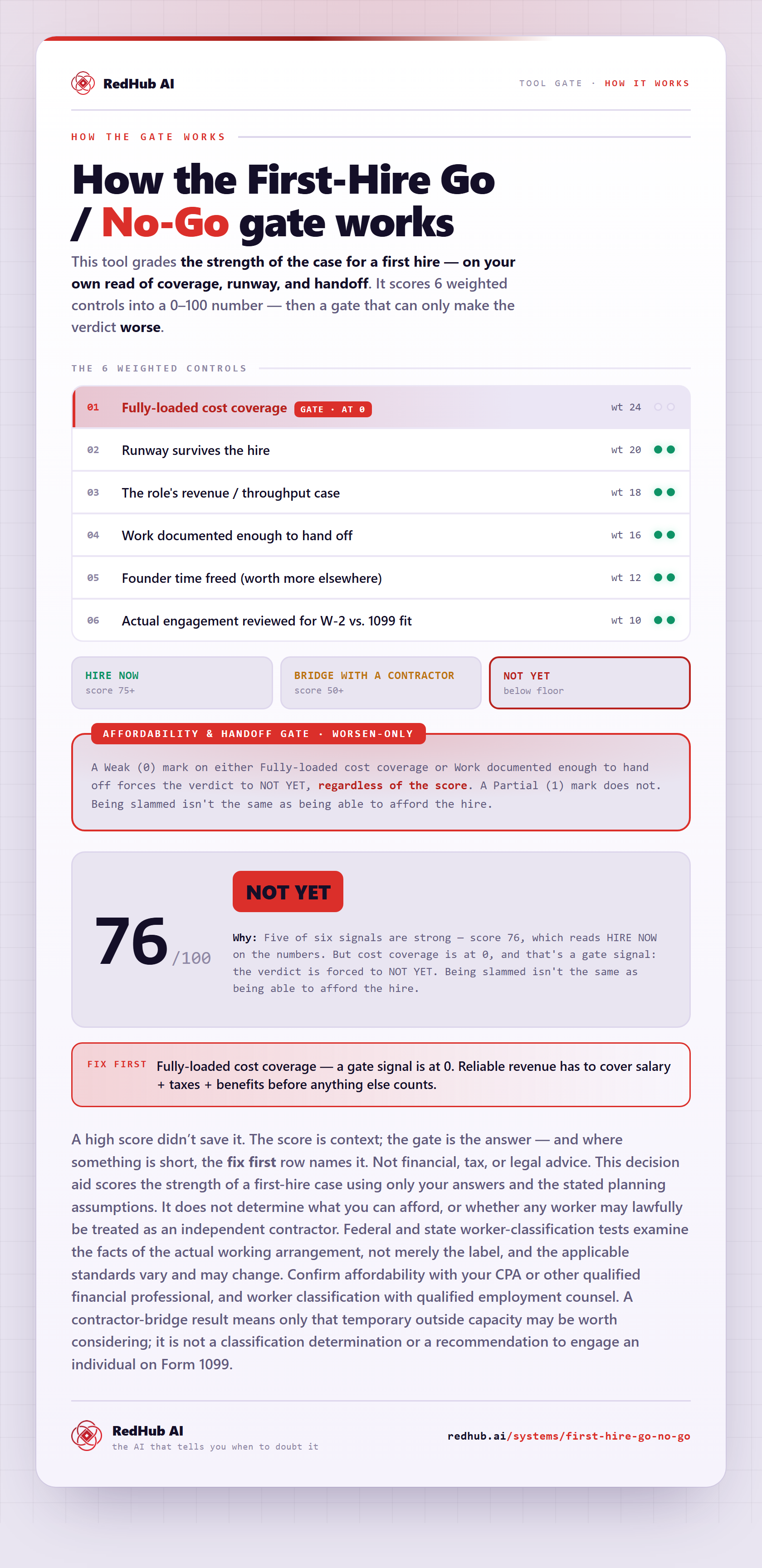
The gate this post refers to, drawn from the tool’s own logic. See the tool.