When to Make Your First Hire (and When to Wait)
RedHub AI Editorialupdated September 7, 20268 min read

Jump to a section10
TL;DR
- What it is: Knowing when to make your first hire comes down to three things being true at once — the role is definable, fundable for months (not weeks), and durable — not just that you're too busy to keep up.
- Who it's for: Founders and owners weighing their first employee — see The First-Hire Go/No-Go.
- How it works: Score six weighted signals from your own marks. Two of them are gates — being busy can't pass for being able to afford the hire or having the work documented enough to hand off.
- Bottom line: The verdict is HIRE NOW, BRIDGE WITH A CONTRACTOR, or NOT YET. If it's not yet, bridge — don't hire on exhaustion.
When should you make your first hire?
The right time to make your first hire is when a specific role is recurring and documented enough for someone else to run it, you can cover its fully-loaded cost — roughly 1.25 to 1.4 times the base salary once taxes, benefits, and tools are added — without straining your runway, and the revenue or throughput backing it is likely to hold up for months, not just this week. Feeling overwhelmed is real, but it is not on that list. If any of the load-bearing pieces aren't there yet, the honest move is to bridge the gap with a contractor or fractional hire, not to sign an offer letter on exhaustion.
Best for: founders and owners staring at their first hire decision — score it directly with The First-Hire Go/No-Go.
Most owners decide to make their first hire the same way: they get busy enough, long enough, that hiring starts to feel inevitable. That feeling is worth listening to — it usually means something real is happening in the business. But it is a terrible way to time the decision, because being slammed and being ready to hire are two different questions, and only one of them determines whether the hire helps you or sinks you.
This guide walks through what actually determines when to make your first hire: the signals that matter, the one most owners skip, and the honest middle option — bridging with a contractor — for when the case is real but the timing isn't.
Why "I'm slammed" isn't a hiring signal
Being overwhelmed tells you that demand exists. It tells you nothing about whether you can pay for the hire six months from now, whether the role is clear enough for someone else to actually do it, or whether the workload will still be there once it's handled. A founder who hires the moment they hit their limit is optimizing for this week's stress, not for the business's next year.
The real cost of a hire also runs higher than most owners budget for. Base salary is only part of it — payroll taxes, benefits, tools, and space commonly push the fully-loaded cost to roughly 1.25 to 1.4 times the headline number. Owners who price the hire at the salary alone, then hire the moment they're drowning, are the ones most likely to be blindsided a few months later when payroll gets tight. And a hire that doesn't work out is expensive twice — a commonly cited estimate holds that a large share of employee turnover traces back to a hire that shouldn't have happened yet, which means the cost isn't just the bad month, it's the cleanup after.
The three things that have to be true at once
Strip away the noise and a first-hire decision comes down to three questions, each backed by concrete signals:
Can you afford it?
Not "can you afford this month" — can you cover the fully-loaded cost for a couple of months without stress, and does your cash runway still clear the danger zone after you add the new payroll line? These are two separate checks. A role can be affordable on paper and still sink you if runway was already thin.
Is the work real and definable?
Two things matter here. First, is there an actual revenue or throughput case for the role — can you name what it returns, not just how busy it keeps you? Second, is the work documented well enough that someone else could pick it up, or is it still entirely in your head? Hiring for work nobody can hand off just means paying a salary and still doing the job yourself.
Will it last?
Is the demand behind this role likely to still be here in six months, and once it's off your plate, does your freed-up time go somewhere that's actually worth more than the hire costs? A hire that only solves this month's spike, or that frees time you'll spend the same way you already were, isn't durable — it's a temporary patch with a permanent price tag.
The two-trigger gate: busy is not the same as ready
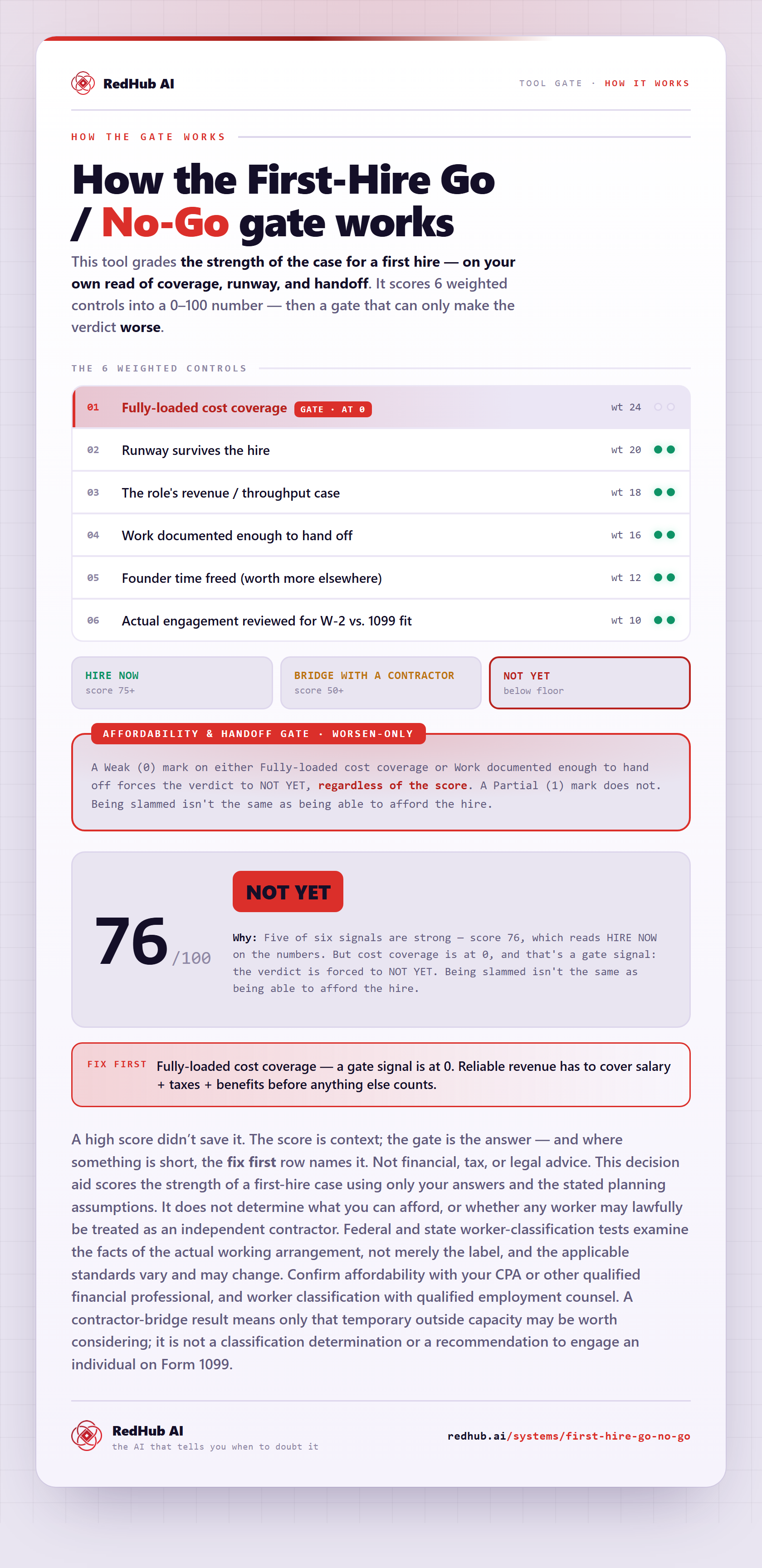
Here's the part most owners skip, and it's the part that actually protects them. Two of the signals above — fully-loaded cost coverage and documented, hand-off-ready work — aren't just inputs to a score. They're gates. If either one is weak, the honest verdict is NOT YET, no matter how strong everything else looks and no matter how busy you are.
The bright line: A role can score well everywhere else — real revenue case, freed time worth more elsewhere, a role that fits your W-2 vs 1099 intent — and still read NOT YET if you can't reliably cover the fully-loaded cost, or if the work is still undocumented. Being slammed doesn't clear either gate. It just makes the gate easier to ignore.
This is the anti-self-deception core of The First-Hire Go/No-Go: you mark six signals 0/1/2 from your own knowledge of the role, it computes a weighted score, and then it checks the two gates before it hands back a verdict. A role can score 76 out of 100 — strong on paper — and still land on NOT YET because coverage is weak. That's not a bug. That's the tool refusing to let urgency pass for readiness.
Score the role you're considering
Try it on the actual role in front of you. Mark each signal honestly — this mirrors the weighted math behind the full tool, simplified for a quick gut-check. It's illustrative, not a substitute for scoring it properly with your real numbers.
Should you make this hire?
Every load-bearing signal is strong. This reads like a real go.
Change "Fully-loaded cost coverage" to Weak and watch the verdict flip to NOT YET no matter what else you mark — that's the gate doing its job. This gut-check is illustrative; The First-Hire Go/No-Go runs the same math against your real numbers and ships a runnable engine, a workbook, and a worked six-role sample so you can sequence more than one role at once.
The three verdicts, plainly
| Verdict | What it means | What to do |
|---|---|---|
| HIRE NOW | The role is definable, fundable, and durable — no gates are tripped | Write the role clearly and start the hire |
| BRIDGE WITH A CONTRACTOR | Real signal, but not enough to commit to full-time payroll yet | Bring in a contractor or fractional hire, revisit later |
| NOT YET | A gate is weak — coverage or documentation — regardless of urgency | Fix the weak signal first, then re-score |
Score it with your real numbers
The First-Hire Go/No-Go ($129, one-time) scores a role on six weighted signals from your own marks and returns one verdict — with a gate that won't let being busy pass for being ready. Includes a runnable engine, a workbook, two playbooks, and a six-role worked sample.
Get The First-Hire Go/No-Go — $129 →Where to go deeper
This pillar is the map. Each piece of the decision gets its own guide:
- Am I ready to hire? — the real readiness signals versus the false one everyone leans on.
- Hire vs contractor — the trade-offs, and when to bridge instead of commit.
- First hire mistakes — the ones that sink new businesses, and how each maps to a signal above.
- What role to hire first — picking the highest-leverage recurring work, not the most fun to offload.
And once the verdict is genuinely HIRE NOW, the next question is how to run the hire well — fair job post, structured screen, lawful interview, evidence-based scorecard — which is exactly what the Recruiting & Hiring Skills Pack is built for.
Decision Guide
Hire now if: the role is recurring, documented enough to hand off, you can cover its fully-loaded cost without straining runway, and the demand behind it is likely to hold for months.
Bridge with a contractor if: the case is real but coverage is tight, runway is thin, or you're not ready to commit to full-time payroll yet.
Wait if: you can't yet cover the fully-loaded cost or the work is still entirely in your head — no amount of "I'm slammed" changes either of those.
FAQ
When should I make my first hire?
When the role is recurring, documented enough for someone else to run, affordable at its fully-loaded cost without straining runway, and likely to still matter in six months. Feeling too busy to keep up is common, but it isn't one of those signals on its own.
What if I'm too busy to wait?
Busy tells you demand is real — it doesn't tell you whether you can pay for the hire or whether the work is ready to hand off. If either of those is weak, bridge the gap with a contractor instead of committing to full-time payroll on exhaustion alone.
Should I hire a contractor before a full employee?
Often, yes. When the case for the role is real but coverage is tight or the work isn't fully documented yet, a contractor or fractional hire is the honest middle step — you get the help without the full commitment, and you can convert later. More in hire vs contractor.
What does "documented enough to hand off" actually mean?
It means the work exists somewhere other than your head — written steps, a repeatable process, or clear criteria for what "done well" looks like — so a new person could actually pick it up. If you can't describe it in a paragraph, it's not ready to hire for yet.
What if my revenue looks fine right now but isn't guaranteed?
That's a durability problem, not an affordability problem. A hire funded by a one-time spike or an uncertain contract is riskier than one funded by recurring, likely-to-continue revenue — weigh that honestly before committing to payroll.
Is this legal or tax advice?
No. Nothing here — or in The First-Hire Go/No-Go — is financial, tax, or legal advice, and it doesn't certify a worker classification. Confirm affordability with your CPA and W-2 vs 1099 classification with qualified counsel; the working relationship, not the label, is what governs that call.
What does The First-Hire Go/No-Go cost and what do I get?
$129, one-time. You get a runnable scoring engine, a workbook that reproduces the same math, a readiness playbook, a get-to-go runbook, and a six-role worked sample — enough to score one role or sequence several.
Stop guessing. Score the hire.
Six weighted signals, a gate that won't let busy pass for ready, and one honest verdict — HIRE NOW, BRIDGE WITH A CONTRACTOR, or NOT YET.
Get The First-Hire Go/No-Go — $129 →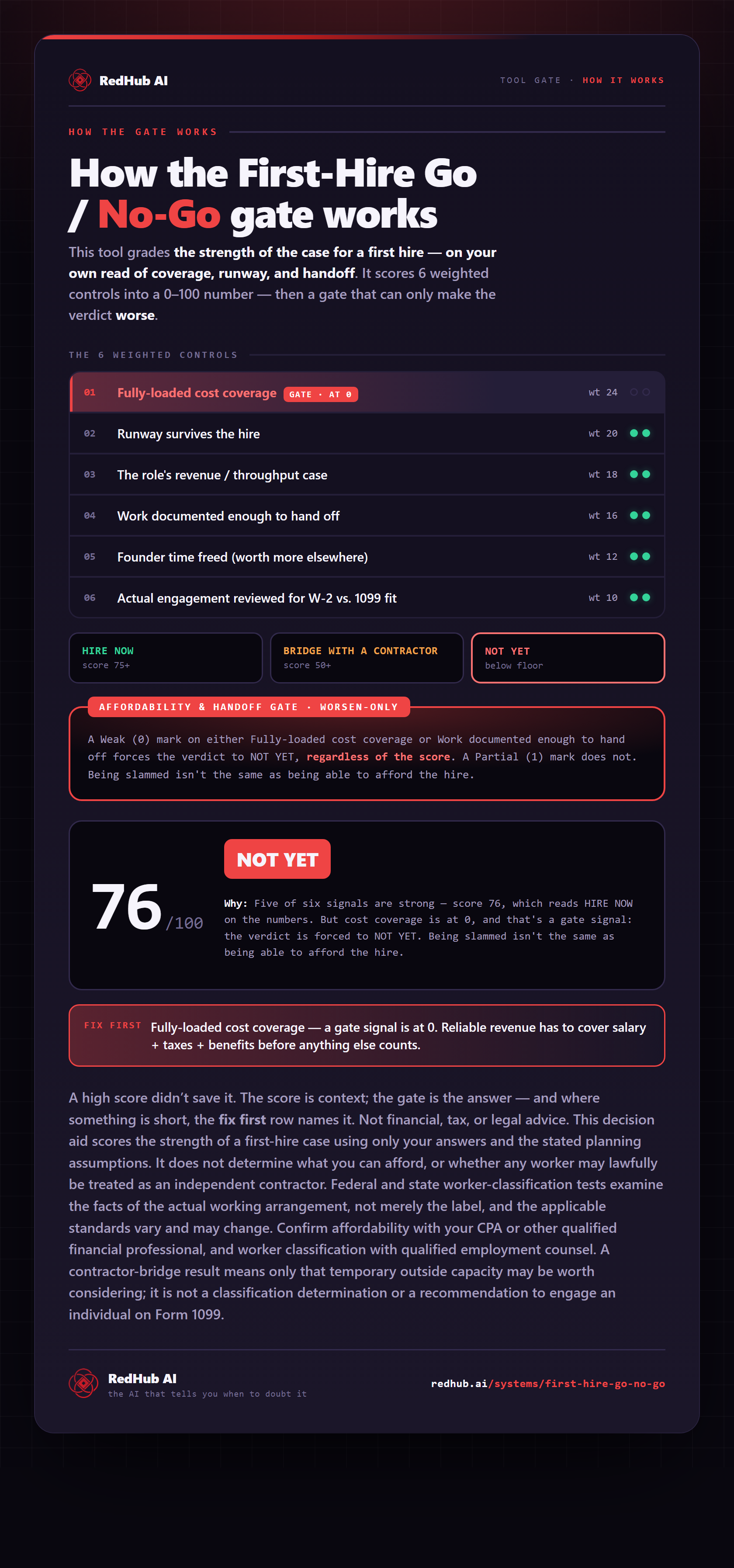
The gate this post refers to, drawn from the tool’s own logic. See the tool.