Can Claude Design Hardware? What Fable 5.2 Built
Todd Brooks, Founderupdated November 12, 202610 min read
Jump to a section12
- TL;DR
- Can Claude design hardware?
- "Hardware design" is six different files
- What the model got right, from easiest to hardest
- Fitting is not the same as getting it in
- What the people did
- What the prototypes have not proven
- Where a small business can start
- A careful path from idea to print
- The rest of this set
- Pairs well with
- Decision Guide
TL;DR
- Yes, with an asterisk: Anthropic says Claude Fable 5.2 designed three working electronic devices, from specification to circuit board to 3D-printable case to firmware.
- People built them: engineers at Diode manufactured, assembled and tested the prototypes under Claude's direction. The model was not connected to test equipment or factory machines.
- The best detail is not the board: Claude worked out that one circuit board could not be lowered straight into its case and wrote a 25-degree tilt into the assembly steps.
- What is not proven: the devices have not been through electrical validation, thermal testing or certification, and nobody knows yet how they hold up over time.
- Where to start: low-stakes parts you can measure, reprint and throw away, never anything carrying mains power, weight or a safety claim.
Can Claude design hardware?
Anthropic reports that Claude can now produce a full electronics design: specifications, schematics, a routed circuit board, a parts list, a 3D-printable enclosure and firmware. In tests published November 9, 2026, Anthropic and the board maker Diode had Claude Fable 5.2 design a speakerphone, a voice-assistant hub and a handheld virtual pet. Diode built them, and all three worked without electrical changes. They are early prototypes that have not been validated, certified or tested for durability.
Best for: product founders and small shops weighing AI for physical design. Before you automate any step of it, run that step through the free Decision Fit Check.
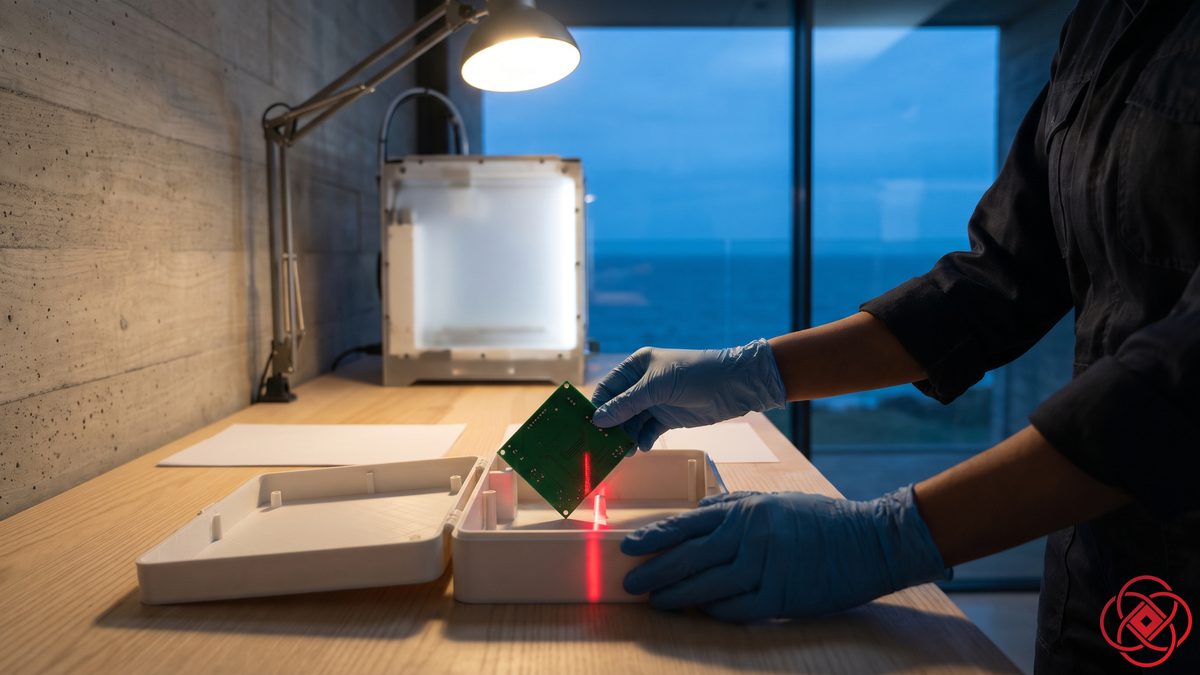
The speakerphone's circuit board would not go into its case. It fit fine once it was inside. The trouble was getting it there, because a mute switch on the board hit the back wall on the way down. Claude found that before anything was built, modeled the board tilting about 25 degrees and then swinging flat, and added that step to the assembly instructions. That one detail says more about where AI hardware design stands than any render does.
RedHub is not affiliated with Anthropic or Diode. This post summarizes Anthropic's published research as of November 11, 2026. Anthropic states it has a commercial relationship with Diode. Nothing here is engineering, safety or certification advice.
So, can Claude design hardware? Anthropic's write-up of the Diode project (opens in a new tab) says yes, in a specific and limited sense. This post walks through what the model did, what humans did, and what a business can sensibly try with it now. For the wider launch and pricing, start with our Claude Fable 5.2 guide.
"Hardware design" is six different files
Most launch posts talk about AI "designing hardware" as if it were one output. It is a stack of separate files, each checked a different way. Here is what Anthropic says Claude produced, and the one step it did not.
| File | What it does | Did Claude make it? |
|---|---|---|
| Specification | What the device must do | Yes, from a short prompt |
| Schematic | Which parts connect to which | Yes |
| Circuit board layout | Where each part sits and how copper connects them | Yes, four layers |
| Parts list | What to buy, from whom | Yes, from US distributors' stock |
| Enclosure model | The case, in CAD | Yes, 3D-printable |
| Firmware | The code the device runs | Yes |
| Printer instructions | Toolpaths for one printer and material | Not described |
That last row matters if your plan is "describe it, then print it." A 3D printer does not read a CAD model or a schematic. A program called a slicer turns the enclosure model into instructions for one specific printer, nozzle and material, and someone has to choose those settings and look at the preview. A printable shape is not yet a print.
The prompt for the speakerphone, as Anthropic quotes it, asked for "a puck that plugs into a computer over USB-C and includes microphones and a speaker, supporting Bluetooth with a PCB antenna." Anthropic says each board was ready for manufacturing in under a day.
What the model got right, from easiest to hardest
It laid out boards that a factory could build
Earlier models placed supporting parts too far from the chips they served or oriented connectors incorrectly. Anthropic says Fable 5.2 routed the sensitive connections first, such as the high-speed USB and Ethernet pairs, keeping each pair the same length. On Diode's internal layout test, which Anthropic calls PCB Gym, Fable 5.2 scored 69% against 25% for Fable 5. Both are numbers from the companies that ran the test.
It threw away its own work when the work was wrong
This is the part I would have bet against. Diode had designed many boards with earlier models that were "95% complete but still unusable," because the models would not back out of a bad choice. Fable 5.2 did. Routing the voice-assistant hub, it noted the connections were "getting too tangled to trace visually" and decided to "rip these traces and start fresh." When routing the long tracks from a 100-pin connector one at a time would have taken too much step-by-step guidance, it wrote its own router in about half an hour.
It tracked one decision across several disciplines
A 25 mm microphone port in the hub's case would ring near 3.4 kHz, which the model noted sits "right in the voice band." It redesigned the case as a wedge, shortening the ports to about 10 mm and pushing the resonance to about 8.9 kHz. In the speakerphone, it wrote firmware that dims the LED ring as the audio gets louder, so the device stays under the current limit it had designed into the board. Acoustics, case shape, electronics and code, all from one design decision.
It knew which warnings to ignore
Manufacturing checks flagged six slivers of protective coating as too thin to make. Claude fixed them by widening the openings in the coating, without moving any parts. The checks also flagged a connection between two grounds as an error. Claude judged that the connection was deliberate and left it. Diode then manufactured all three boards straight from Claude's files, with no rounds of back-and-forth, which Anthropic says surprised the Diode team.
Read that list again and notice the last item. Ignoring a warning correctly is the hardest skill on it, because ignoring one wrongly looks identical until the board comes back.
Fitting is not the same as getting it in
Back to the tilted board, because it carries a lesson that applies far beyond electronics. Most checks ask whether the finished thing fits: does the board sit inside the case without anything touching? Claude asked a second question, whether there is a path from outside the case to that finished position. An assembly can pass the first check and fail the second.
Software has the same shape. A feature can work once it is running and still have no safe way to get there, such as a database change with no route back. Anyone reviewing AI-made work should ask both questions: does it work, and how does it get there?
What the people did
The headline says Claude designed the devices with minimal human input, and Anthropic's account supports that for the design. It is also clear about the rest. Claude "wasn't connected to test equipment or to the machines that make and assemble circuit boards," so Diode manufactured the boards and its engineers did the physical building and testing while Claude guided them. A footnote says Diode's prompts were short directives such as "clean up the schematic" and "continue."
Here is the complication. The people typing "continue" were engineers who have designed boards with Anthropic since 2025. They knew what a good layout looks like and when a warning matters. Anthropic does not say how the project would have gone with a founder who has never held a soldering iron, and I would not assume it goes the same way. Minimal prompting by experts is a different experiment from minimal prompting by a beginner.
What the prototypes have not proven
Anthropic lists the limits plainly. The three devices "haven't been through electrical validation, antenna tuning, thermal testing, or certification, and they weren't designed for mass production." The speakerphone still worked after weeks of use, but Anthropic says it does not yet know how the devices will hold up over time.
Launch week also showed how easily a design gets mistaken for a product. A popular roundup showed a creator's AI-designed virtual pet as a board layout, a case design and a rendered image of the finished product. Another creator video featured an AI-routed board whose poster said they had not reviewed it yet. Both are interesting. Neither a render nor an unreviewed layout shows that a device works.
We are not going to estimate how much engineering time this saves. Anthropic's test used three devices, one partner and an expert team, and no published number tells you what it would save on your product.
Where a small business can start
Start where a mistake costs a reprint and nothing else: desk fixtures, organizers, mounts, display stands, cases for boards you bought off the shelf, and fit-check models before a real part is ordered. Keep AI-designed parts away from anything that carries mains power, holds weight over people, goes near children, or makes a safety or medical claim, unless a qualified engineer signs off on it.
A careful path from idea to print
- Write down the use and the limits. Where the part lives, what it holds, the temperatures it sees, and what happens if it fails.
- Give verified dimensions. Measure the real parts or use the maker's drawings. Never let the model guess a size.
- Ask for an assumptions log. Everything the model decided without being told goes on a list you can check.
- Check the fit and the path. Does it fit when finished, and can a person assemble it?
- Slice it yourself. Choose the printer, nozzle and material profile, and look at the preview before printing.
- Print one, measure it, write down what changed. The revision record is worth more than any single print.
- Get a qualified review for anything electrical. A design that powered on is not a design that is safe.
Decide which steps should be automated at all
The free Decision Fit Check places one task on a five-level ladder, from deterministic code to a frontier reasoning model to a person, and names the one change that would move it down a level. Its irreversibility gate routes any task to human judgment when a wrong answer cannot be undone and nobody sees it before it takes effect. Eight questions, answered in your browser. Nothing is sent anywhere.
Run the free Decision Fit Check →The rest of this set
- Claude Fable 5.2: what it changes for your business covers the launch, the price, and when to pick it over Opus 5.5.
- The Claude Blender connector explains why a marketing scene should never become the source for a part you print.
- Fable 5.2 vibe coding applies the same "does it work, and how does it get there" test to software.
- Fable 5.2 business ideas includes controlled customization, the safer version of "describe anything and we print it."
Pairs well with
Before an agent sends files to a factory or places a parts order, the Agent Side-Effect & Blast-Radius Checkpoint grades that action RUN UNATTENDED, RUN WITH APPROVAL, or DO NOT AUTOMATE on reversibility and reach. If you are deciding whether to build an AI design service at all, the Agent Use-Case Fit & Proof-of-Value Gate returns BUILD, PILOT FIRST, or DON'T BUILD from your own numbers.
Decision Guide
Try it now if: you make low-stakes physical parts, can measure them, and a failed print costs you an hour and some filament.
Bring in an engineer if: the part carries power, holds weight, touches food or skin, or will be sold with a safety or performance claim.
Best first step: pick one part you already make by hand and ask for a design plus an assumptions log. Check the log before you check the model.
FAQ
Can Claude design hardware?
Anthropic reports that Claude Fable 5.2 designed three working electronic prototypes with the board maker Diode, producing specifications, schematics, four-layer circuit board layouts, parts lists, 3D-printable enclosures and firmware. Diode's engineers built and tested the devices. They are early prototypes, not certified products.
Can Claude make files for a 3D printer?
Claude can produce an enclosure model that is designed to be 3D printed. A printer still needs a slicer program to turn that model into instructions for a specific printer, nozzle and material, and someone should check the preview and measure a test print.
Did Claude build the devices itself?
No. Anthropic says Claude was not connected to test equipment or to the machines that make and assemble circuit boards. Diode manufactured the boards from Claude's files, and its engineers assembled and tested the devices while Claude guided them.
Are the AI-designed devices certified or ready to sell?
No. Anthropic says the devices have not been through electrical validation, antenna tuning, thermal testing or certification, were not designed for mass production, and have unknown long-term durability.
What is the 25-degree tilt in Anthropic's test?
While designing the speakerphone, Claude found that a mute switch would hit the case wall if the board were lowered straight in. It modeled tilting the board about 25 degrees and then swinging it flat, and added that step to the assembly instructions.
What hardware is safe to try designing with AI?
Low-stakes parts where a mistake costs a reprint: fixtures, organizers, mounts, display stands and cases for off-the-shelf boards. Anything that carries mains power, holds weight, touches food or skin, or makes a safety claim needs review by a qualified engineer.
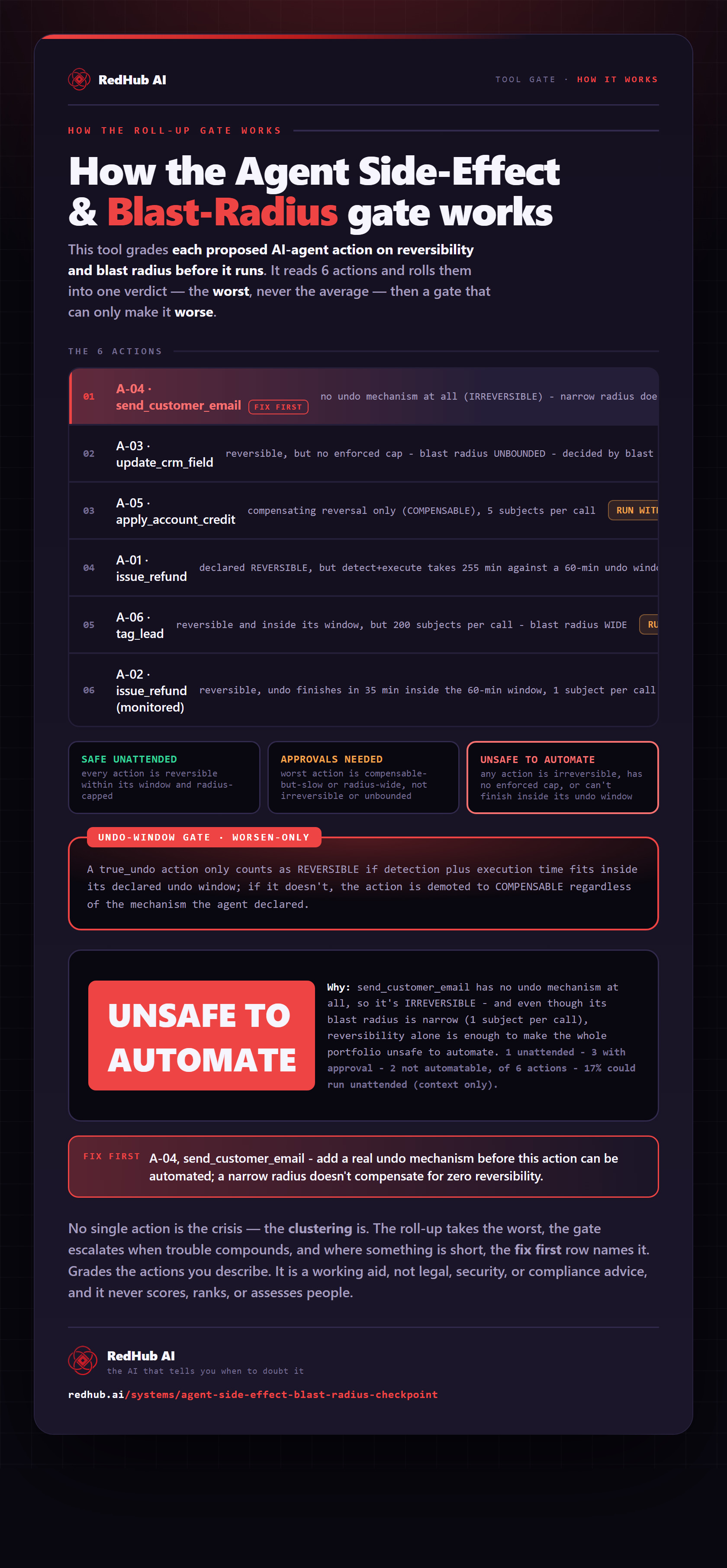
The gate this post refers to, drawn from the tool’s own logic. See the tool.