Fable 5.2 Business Ideas: Seven That Survive the Demo
Todd Brooks, Founderupdated November 12, 20269 min read

Jump to a section12
- TL;DR
- What are good Fable 5.2 business ideas?
- Why the value moves from making to proving
- Seven ideas that sell proof instead of output
- What the seven have in common
- The skills that make these work
- The complication: the same model makes you easy to copy
- What we will not tell you
- How to pick one
- The rest of this set
- Pairs well with
- Decision Guide
TL;DR
- The shift: Claude Fable 5.2 makes building cheaper. When building gets cheaper, the scarce thing becomes knowing whether what was built is right.
- Seven ideas: each one sells proof, records or judgment around AI output, not the output itself.
- The complication: the same model that makes these businesses possible also makes them easy to copy.
- What we will not do: promise you revenue from any of them. These are hypotheses to test with real buyers.
- How to pick: start where you already know what "correct" looks like better than most people.
What are good Fable 5.2 business ideas?
The strongest Fable 5.2 business ideas sell certainty, not output. Claude Fable 5.2 can design hardware, migrate code and build working software from short prompts, so plain building gets cheaper for everyone. Ideas that hold value check AI-built work against real conditions, keep records of what failed, maintain approved versions, or rescue old files. Each one depends on expertise a buyer cannot get from the model alone.
Best for: consultants, agencies and specialists deciding what to build around AI. If your idea means building an AI agent, grade that agent first with the Agent Use-Case Fit & Proof-of-Value Gate.
Launch weeks bring lists of businesses to build on the new model. Most of the ideas on them sell the model's output, so they get cheaper every time the model improves. The Fable 5.2 business ideas worth your time do the opposite. They get more valuable as building gets cheaper, because they sell the part the model cannot supply on its own.
RedHub is not affiliated with Anthropic or any company or creator mentioned here. These are business hypotheses, not financial advice or a promise of results. Model facts are from Anthropic's published materials as of November 11, 2026.
For what Fable 5.2 is, what it costs and where it beats Opus 5.5, start with our Claude Fable 5.2 guide. This post assumes you know that and asks a narrower question: what is worth selling now?
Why the value moves from making to proving
Look at what Anthropic chose to show at launch. A critical production service migrated from Python to Rust that now starts about 26 times faster. A prototype operating system built by more than 1,000 subagents over eight days. Three electronic devices, each with a circuit board and a 3D-printed case, designed largely by the model. Every one of those is a build.
Now look at what had not been proven. Anthropic's hardware write-up says the devices had no electrical validation, thermal testing or certification. The operating system was built as a prototype. That candor is the business opening. When anyone can produce a convincing first version in a day, buyers stop asking "can you build it?" and start asking "how do I know it is right?"
Chris Ashby made the same point on his YouTube channel, Build Great Products, in a video on business ideas for the new model. His argument, in short: buyers want realism, and only someone with real expertise knows what is real. A model can draw a convincing circuit board. Knowing whether that board will survive a factory floor is a different skill.
Seven ideas that sell proof instead of output
Each idea below is a hypothesis, not a proven business. I have ordered them from the easiest to start to the hardest to copy.
1. Legacy file rescue
Many small manufacturers and agencies have years of old 3D files, drawings and spreadsheets in formats nobody can open well anymore. With tools like the new Claude Blender connector, rebuilding and cleaning those files gets faster. The service is not the cleanup. It is the before-and-after record showing what changed, so the owner can trust the rebuilt file.
2. An approved-configuration service
A company with five product variants does not need five new videos every month. It needs one approved version of each product that every asset is made from. You maintain that approved version, and every new image, page or manual starts from it. The value is that nothing drifts.
3. One source model for a product line
This is the bigger version of idea two. You build a single source model of a client's product, including dimensions, materials and options, and generate sales sheets, quotes and installation guides from it. When a spec changes, everything changes together. Fable 5.2's long working sessions make the generation cheap. Keeping the source correct is the part they pay for.
4. Simulations as an expertise business
A model can build a simulator. It cannot tell you whether the simulator matches reality. A specialist who knows how a warehouse, a clinic waiting room or a production line behaves in practice can sell simulations that are calibrated against real numbers. This is the idea closest to Ashby's point: the realism is the product.
5. Failure records
Every team now running AI agents learns the same lessons separately. A service that keeps a structured record of what an agent got wrong, why, and what fixed it becomes more valuable with every entry. It is slow to build and hard to copy, because the record only comes from real runs.
6. A verification layer
Here you sit between AI-built work and the person who signs off on it. You check generated code, documents or designs against a written standard before they reach a customer. Anthropic's own documentation warns that Fable 5.2 can end a turn before the work is done, and that when a prompt doesn't say who owns the code, it may report problems instead of fixing them. Someone has to catch that. The buyer pays for the catch, not the check.
7. Assurance packages
The hardest and most valuable version: a documented package that says what was tested, against what, with what result, and what was not tested. Think of it as the paperwork a cautious buyer needs before they approve an AI-built system. It takes real domain expertise and a willingness to write "not tested" in plain sight.
What the seven have in common
| What changes as models improve | What that does to the idea |
|---|---|
| Building gets cheaper | More AI-built work needs checking, so verification demand grows |
| Models run longer on their own | Fewer people watch each step, so records of what happened matter more |
| More assets come from one prompt | Drift between versions gets worse, so one approved source matters more |
| Output looks more convincing | Buyers can tell less by looking, so expertise about what is real matters more |
If an idea's value goes down when the model gets better, it is a race against Anthropic's next release. Each of these seven gets more useful.
The skills that make these work
- Domain knowledge deep enough to know what "correct" means in one field.
- Writing a standard down so someone else can check against it.
- Keeping records that are honest about what was not tested.
- Pricing by the decision, not by the hour, because the hours keep shrinking.
The first of those is often a judge's skill, not a maker's. Nate B Jones said in his launch video (opens in a new tab) that he could recognize the design he wanted far more easily than he could tell the model how to produce it, so he worked as the customer rather than the designer. Knowing a good result when you see one is the part of the job these businesses sell.
The complication: the same model makes you easy to copy
Here is the problem I cannot fully solve for you. Fable 5.2 lowers the cost of starting any of these seven businesses for you. It also lowers it for every competitor. A verification service that is just a checklist run by a model can be copied by anyone with the same model in an afternoon.
What protects you is the part the model does not have: your records, your calibrated numbers, your judgment about a specific field. If you strip those out, there is no business left. That is also why I would not start with idea seven. The assurance package is the most valuable, and it is the one most likely to fail if you do not already have the expertise to stand behind it.
What we will not tell you
We are not going to tell you how much any of these businesses can earn. We have not run them, and a revenue figure borrowed from someone else's market would tell you nothing true about yours. What we can give you is a way to test an idea before you spend months on it.
How to pick one
- List what you know better than most. One field where you can tell right from wrong on sight.
- Match it to one of the seven. Pick the idea that uses that knowledge most directly.
- Write the standard. One page describing what "correct" means for a customer's output.
- Find three buyers with the problem today. Not people who might have it later.
- Do it once by hand. Use Fable 5.2 for the build and do the checking yourself.
- Grade any agent before you build it. If the idea needs an AI agent, decide whether to build it, pilot it, or walk away.
Grade the agent before you build it
Most of these seven ideas run on an AI agent. The Agent Use-Case Fit & Proof-of-Value Gate returns BUILD, PILOT FIRST, or DON'T BUILD for each proposed agent. Two gates can override a high fit score: in the product's own worked example, an agent that scores 94 out of 100 still reads DON'T BUILD because the mitigation it needs erases the return. BUILD is earned on fit and on the math, not handed out by a high average. $99.
Get the Agent Use-Case Fit Gate →The rest of this set
- Claude Fable 5.2: what it changes for your business covers pricing and when to pick it over Opus 5.5.
- Can Claude design hardware? walks through the three devices and what they did not prove.
- The Claude Blender connector covers one approved 3D scene feeding many assets.
- Fable 5.2 vibe coding covers the gap between a demo and a product people trust.
Pairs well with
If the idea runs on model calls, the Token Economics Workbook puts cost per task and per user side by side before you set a price. If it puts an agent in front of money or customer data, the Gate-to-Tool Exposure Kit reads each guardrail FAIL-CLOSED, FAIL-OPEN, or DECORATIVE. To test the decision itself first, the free Decision Fit Check runs in your browser.
Keep going: read AI cost per task and AI agent reliability.
Decision Guide
Start now if: you have deep knowledge of one field, three people with the problem today, and you can write down what "correct" means.
Wait if: your idea sells the model's output itself, or its value drops every time a better model ships.
Best first step: do one job by hand for one real buyer, then grade any agent the idea needs before you build it.
FAQ
What are good Fable 5.2 business ideas?
The strongest ones sell certainty rather than output: checking AI-built work against a standard, keeping records of what failed, maintaining one approved version of a product, calibrated simulations, legacy file rescue, and assurance packages. Each depends on expertise the model cannot supply.
Why not just sell what Fable 5.2 builds?
Because everyone has the same model. When building gets cheaper for everyone, plain output gets cheaper too. Services that check, record or certify that output get more valuable as more of it is produced.
How much can these businesses earn?
We do not know, and we will not guess. RedHub has not run these businesses, and a figure from someone else's market would not describe yours. Test an idea with three real buyers before estimating anything.
Do I need to be technical to start one?
You need deep knowledge of one field more than coding skill. Fable 5.2 handles much of the building. The value you add is knowing what correct looks like and writing it down so it can be checked.
Can a competitor copy these ideas with the same model?
The parts a model can do, yes. What is harder to copy is your records, your calibrated numbers and your judgment in a specific field. A business with none of those is easy to replace.
Which idea should I start with?
Start with the one that uses the field you know best and has buyers with the problem today. Simpler ideas like legacy file rescue are easier to start than assurance packages, which need expertise you can stand behind.
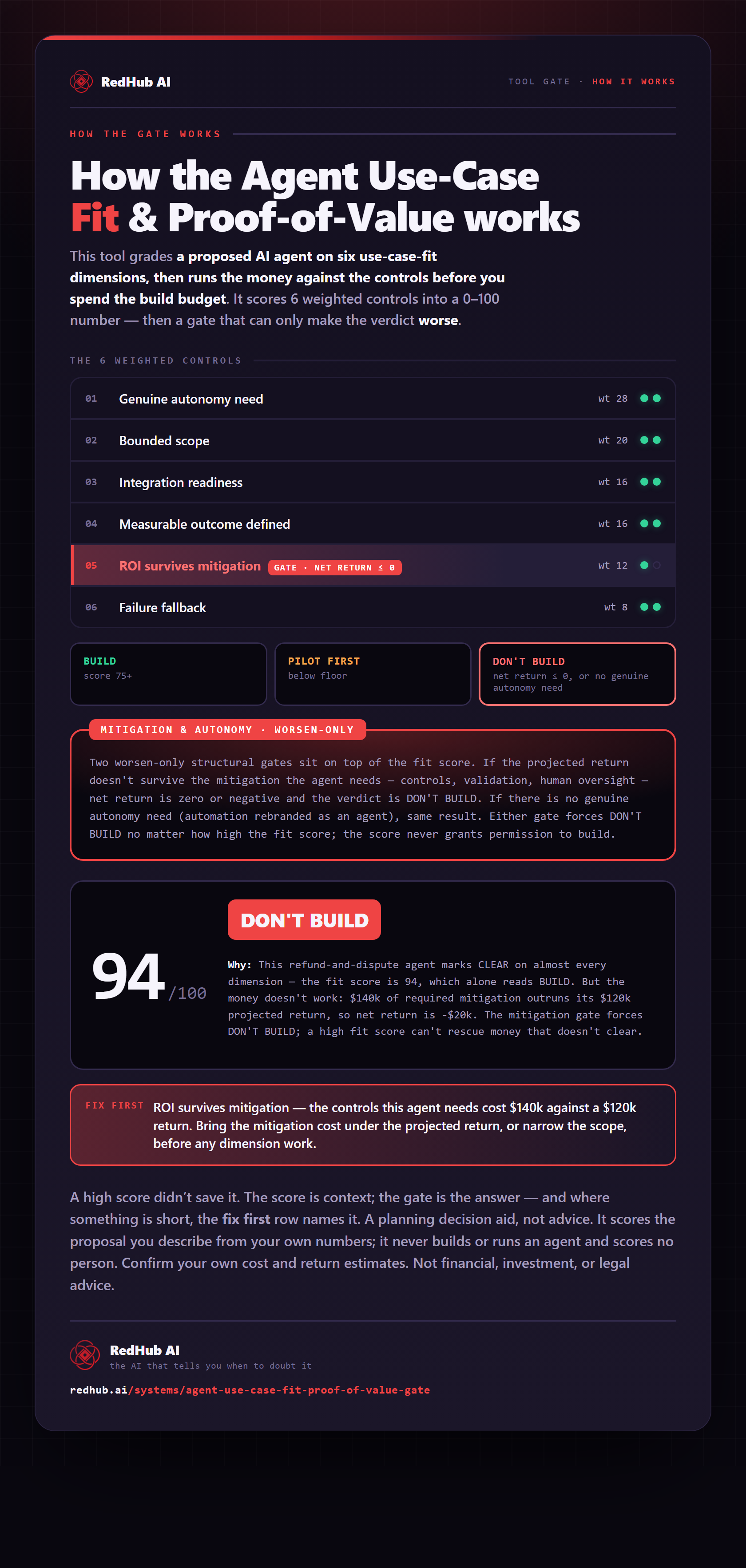
The gate this post refers to, drawn from the tool’s own logic. See the tool.