How to Calculate Burn Rate and Runway (Calculator)
RedHub AI Editorial5 min read

Jump to a section9
TL;DR
- What it is: Net burn = monthly expenses − monthly revenue. Runway = cash on hand ÷ net burn. Two subtractions and a division.
- Who it's for: Founders and operators who want the real number, not the comfortable one — see Cash-Flow Sentinel.
- How it works: Compute burn per month, average it over three months, flag lumpy one-offs, and divide cash by the current rate — then grade the answer against honest bands.
- Bottom line: The math takes five minutes. The mistakes — using one month, ignoring one-offs, trusting a stale number — are what make it dangerous.
How do you calculate burn rate?
Burn rate is how much cash your business consumes per month. Net burn = total monthly expenses minus total monthly revenue; if you spend $152K and bring in $72K, your net burn is $80K a month. Runway follows directly: cash on hand divided by net burn — $640K ÷ $80K = 8 months. For a trustworthy figure, use a trailing three-month average and normalize one-off items like tax payments or annual renewals, so a single lumpy month doesn't pose as your run rate.
Best for: anyone doing the division by hand today — Cash-Flow Sentinel runs the same math on your full monthly history and grades the result.
Knowing how to calculate burn rate is the closest thing small-business finance has to a survival skill. It's simple enough to do on a napkin, and important enough that getting it slightly wrong — the wrong month, the wrong average, an ignored one-off — quietly costs companies their margin for error. Here are the formulas, the traps, and a calculator that does the honest version.
The formulas
| Term | Formula | Example |
|---|---|---|
| Gross burn | Total monthly expenses | $152K spent in June |
| Net burn | Expenses − revenue | $152K − $72K = $80K/mo |
| Trailing average burn | Average net burn, last 3 months | ($50K + $50K + $50K) ÷ 3 = $50K/mo |
| Runway | Cash on hand ÷ current net burn | $640K ÷ $80K = 8.0 months |
| Revenue coverage | Revenue ÷ expenses | $72K ÷ $152K ≈ 47% |
Gross burn matters to your landlord; net burn is the one that determines your life expectancy. If net burn is zero or negative — revenue covers spend — you're default-alive, and runway stops being the constraint.
Run your own numbers
Burn rate & runway calculator
Defaults are the worked sample that ships inside Cash-Flow Sentinel — not a claim about your business. The full system runs this same math across your monthly history, checks the trajectory, and returns a graded verdict instead of a bare number.
The three traps that break the math
Trap 1: using one month as your burn rate
One month is an anecdote. A tax payment, an annual software renewal, or a client paying early can swing a single month wildly in either direction. Compute the trailing three-month average as your baseline, and treat the current month as a data point to compare against it — not as the truth by itself.
Trap 2: letting lumpy months hide in the average
The average has its own failure mode: a genuine one-off buried inside it distorts everything for three months. The fix is to flag lumpy months explicitly and normalize them — spread an annual renewal across twelve months, mark the tax hit as non-recurring. The goal is a representative burn: the number that describes how the business actually runs.
Trap 3: trusting a runway computed at a rate you no longer have
This is the quiet killer. Runway = cash ÷ current burn — and if current burn is running well above your trailing average, the answer is optimistic the moment you compute it. In the worked sample, $640K at the old $50K burn was 12.8 months; at the new $80K burn it's 8.0 — and because burn is accelerating, even 8.0 deserves a harsher grade. That's why the early-warning read matters as much as the formula: see cash runway early warning.
What the number means
A bare "8.0 months" is only useful with honest bands around it. These are the bands Cash-Flow Sentinel grades against:
| Runway | Verdict | What it means |
|---|---|---|
| 12+ months (or default-alive) | HEALTHY | Keep the discipline. |
| 6–12 months | TIGHT | Watchful — build buffer before it tightens. |
| Under 6 months — or burn accelerating | AT RISK | Cut burn or extend runway before it's critical. |
| Under 3 months | CRITICAL | Raise or cut now. No exceptions, no pipeline stories. |
If the burn is too high: the follow-up question is where. Before cutting people or product, find the spend that isn't earning its keep — the Profit Leak Finder ($49) walks your pricing, unbilled work, and creeping costs and names the leaks in dollars.
From a number to a system
The calculation is step one. The discipline — re-computing monthly, checking the trajectory, applying the floors without mercy — is what actually protects you, and it's laid out in the pillar guide to cash flow forecasting for small business. If you'd rather the discipline came built-in, that's the product below.
The same math, run honestly, every month
Cash-Flow Sentinel ($249, one-time) reads your monthly numbers, computes net burn against the trailing average, flags lumpy months, and returns the verdict — HEALTHY, TIGHT, AT RISK, or CRITICAL — plus the burn that restores a 12-month runway and the burn that clears the 6-month line. Engine, workbook, four Claude Skills, and the playbooks. Read-only; you make the calls.
Get Cash-Flow Sentinel — $249 →Decision Guide
Use this math if: you can pull monthly revenue and expenses for the last 3–6 months and you're willing to normalize the lumpy ones honestly.
Skip it if: you're reliably profitable every month — track the flip risk instead of the runway.
Best first step: run the calculator above with last month's real figures, then re-run it with your three-month average. If the two answers differ a lot, that gap is your first finding.
FAQ
What is the formula for burn rate?
Net burn = monthly expenses minus monthly revenue. Gross burn is total monthly expenses alone. Net burn is the figure to use for runway, because revenue offsets part of what you spend.
How do I calculate cash runway from burn rate?
Divide cash on hand by current monthly net burn. $640K in cash at $80K net burn is 8 months. If burn is running above your trailing average, treat the answer as optimistic.
Should I use gross burn or net burn?
Net burn for runway — it reflects what actually leaves the bank each month after revenue. Gross burn is still worth knowing: it shows your exposure if revenue stopped.
How many months should I average burn over?
Three months is the practical standard — long enough to smooth noise, short enough to reflect the current business. Six works if your months are very lumpy. Always compare the current month against that average.
What do I do with one-off expenses like tax payments?
Flag them and normalize: spread annual items over twelve months and mark true one-offs as non-recurring. A lumpy month left raw will either fake a crisis or hide one.
What counts as a good runway number?
Twelve or more months reads healthy; six to twelve is tight; under six is at risk; under three is critical no matter what else is true. And any number computed while burn is accelerating deserves a one-notch-harsher read.
Know the real number — and what to do about it
Five minutes of math, graded honestly, with the concrete burn targets that fix a bad answer.
Get Cash-Flow Sentinel — $249 →
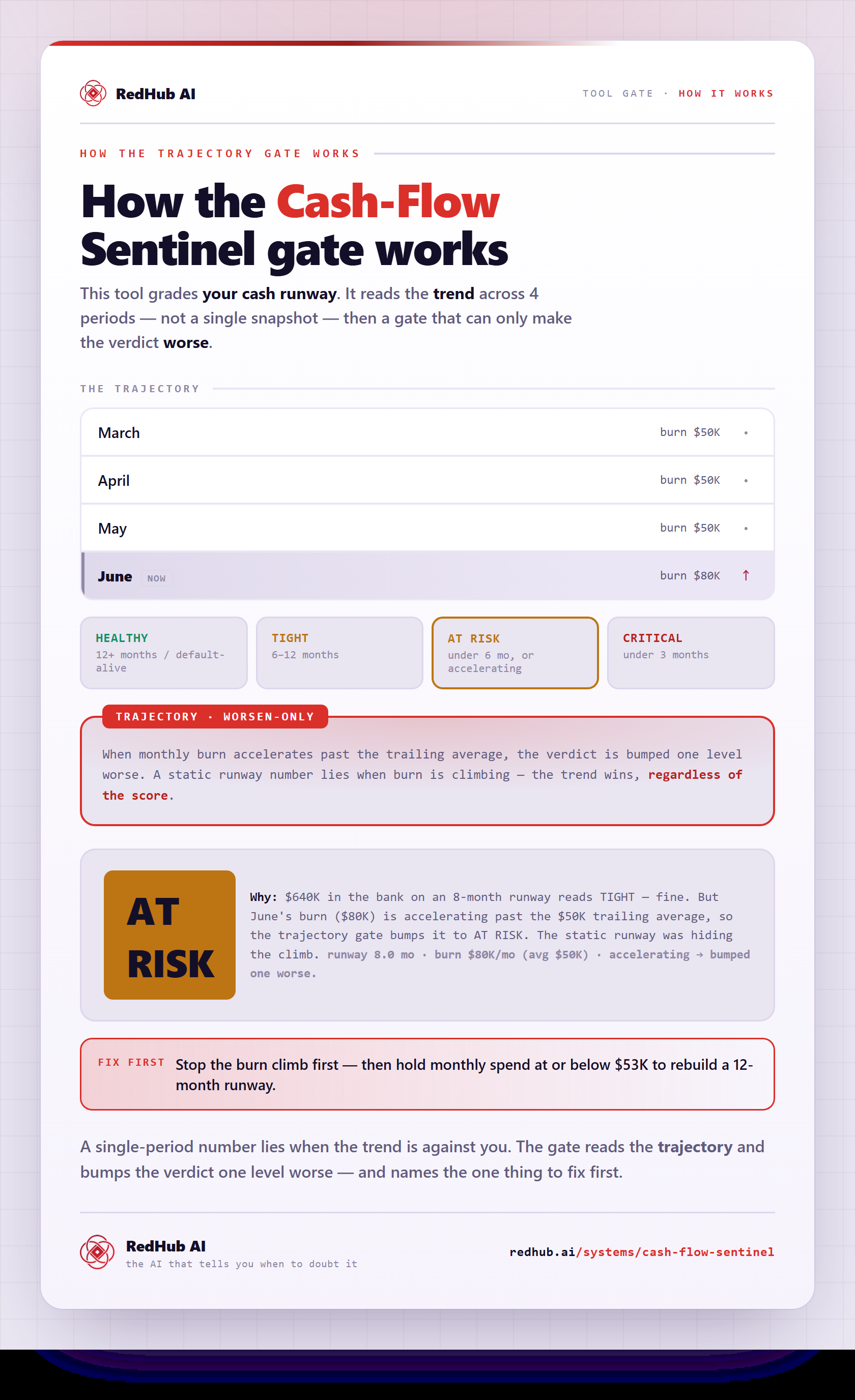
The gate this post refers to, drawn from the tool’s own logic. See the tool.