Chargeback Representment: How to Win Disputes
RedHub AI Editorialupdated October 5, 20266 min read

Jump to a section7
When a cardholder disputes a charge, you can accept the loss or contest it. Chargeback representment is the contest: you re-present the transaction to the cardholder's issuing bank with evidence that answers the reason code the dispute was filed under. You have to do it before the response deadline, which Stripe says is usually 7 to 21 days, depending on the card network. The issuer reads the packet and decides.
TL;DR: The reason code picks the evidence. Proof of delivery answers Visa 13.1, "merchandise not received," and does nothing for 10.4, card-absent fraud, where Visa's Compelling Evidence 3.0 rules apply. Before you build anything, check two things: the window is open, and you hold the one item that code turns on. If either fails, skip the case. A win recovers that order's money, but the dispute still counts in your chargeback ratio.
How representment works
The cardholder's bank files the dispute under a reason code, a standard label for the claim. Your processor passes it to you with a due date. You can accept the chargeback, or you can send back a short rebuttal and evidence that the charge was valid. The issuer reviews the packet against the claim. There can be a further round, called pre-arbitration, but the first response is where you put your best case.
The person reviewing your packet is checking it against the claim. Evidence that does not answer the specific reason code is noise, however much of it there is. And the deadline is hard. Stripe says that if you do not respond in time, you automatically lose the dispute.
A win does not clear your record either. Stripe's guide to the card networks' monitoring programs says those programs do not consider dispute outcomes. Representment recovers revenue. Protecting the merchant account is a separate job, covered in merchant account hold: why Stripe froze your account.
The reason code picks the evidence
Each network keeps its own code set. The five Visa codes below, taken from Stripe's reason-code reference, cover the claims online sellers run into again and again.
| Dispute claim (Visa code) | The decisive item | Common mistake |
|---|---|---|
| Card-absent fraud (10.4) | Proof that the same cardholder made earlier, undisputed purchases, under Visa's Compelling Evidence 3.0 criteria | Sending delivery proof, which does not answer "I never made this purchase" |
| Merchandise not received (13.1) | Proof of delivery to the address on the order, with tracking and a signature where it matters | Sending product pages instead of delivery evidence |
| Not as described or defective (13.3) | The listing as sold, plus your record of the customer's complaint and your response | Sending delivery proof; the customer agrees it arrived |
| Canceled recurring (13.2) | Signup consent, the terms shown, and usage after the claimed cancellation, or no cancellation on record | Sending a generic terms-of-service PDF with nothing tied to this customer |
| Credit not processed (13.6) | Your refund policy as shown at purchase, and the record of what was owed | Arguing the product's quality when the claim is about a refund |
Proof of delivery, the item merchants reach for first, is decisive in one row out of five.
Compelling Evidence 3.0, and who it leaves out
Card-absent fraud is hard to win, because "someone else used my card" is hard to disprove. Visa's Compelling Evidence 3.0 gives merchants with repeat customers a way in. Stripe's summary of the rules for code 10.4:
- At least two earlier transactions on the same payment method that were never disputed.
- Those transactions fall 120 to 364 days before the disputed one.
- The disputed transaction and both earlier ones match on two main data elements, such as purchase IP address and device fingerprint, or on one main element plus a secondary one, such as shipping address or email.
The catch is plain once you read the list. A first-time buyer who claims fraud has no history to match, so the CE3.0 route does not exist for that dispute. CE3.0 helps the subscription business and the store with loyal customers. It does little for a shop whose fraud claims come mostly on first orders.
It also touches the ratio in one narrow way. Visa's VAMP fact sheet excludes TC40 fraud reports that qualified for Compelling Evidence 3.0 from the VAMP count, "contingent on the timing of the data extract." The dispute record itself still counts. How often that timing works in a merchant's favor is something Visa's fact sheet does not say.
The two checks before any packet
Either check failing ends the case, whatever else you hold.
- Is the response window still open? Find the due date on this dispute and compare it with today. Past it, stop. Disputes sit in queues longer than anyone admits, so check the date first, not last.
- Do you have the decisive item? Name the evidence the code turns on and confirm you have it. No delivery confirmation, no usage logs, no purchase history that meets CE3.0: the rest of the packet is decoration. Skip the case.
Deciding not to fight is a legitimate result. The skipped hour goes into prevention work that moves your rate.
Building the packet
Once a dispute passes both checks, build narrow and clean:
- Open with a one-page summary. State the reason code, your position in two sentences, and a numbered list of what is enclosed.
- Put the decisive item first. Supporting items go after it.
- Support, do not pad. Two or three supporting items, such as the order record, the message history and the policy as shown, help. Ten attachments bury the one that matters.
- Tie every claim to a document. If the summary says the customer used the product after canceling, the usage log is attached and labeled.
- Stay factual. Dates, records and the code's own criteria persuade a reviewer. Indignation does not.
You can do all of this correctly and still lose. The issuer decides, its reasoning is not published, and outcomes vary by issuer and case. Fight the cases with an open window and the decisive item, and judge the results over a quarter, not one dispute. If the dispute is a real customer gaming the process, read friendly fraud: what it is and how to fight it.
Know which disputes are worth the hour before you spend it
The Chargeback-Proof Order Evidence Kit is one spreadsheet. Pick the reason code the bank filed, mark the evidence you have, and get a verdict: SUBMIT-READY AS DESCRIBED, STRENGTHEN or DON'T FIGHT. A blown deadline or a missing decisive item forces DON'T FIGHT whatever the score, so a 93/100 packet reads DON'T FIGHT once the window has closed. It includes the CE3.0 criteria for Visa 10.4 and opens in Excel, Google Sheets or Numbers.
Get the Evidence Kit — $49Pairs well with
The Chargeback Threshold & MID-Survival Gate ($89) computes your Visa VAMP and Mastercard ECP ratios from your own numbers and reads each merchant account HEADROOM, APPROACHING or OVER THE LINE, which tells you how hard to fight. The Customer Churn Autopsy Kit ($69) gives you an exit-interview script, a churn classifier and win-back sequences, useful when "canceled recurring" disputes are really cancellations nobody caught. The Returns & Refund Profit Analyzer ($39) shows the true profit on each product after returns, with a keep, fix returns or drop-or-fix verdict.
More in this guide
What is chargeback representment?
Representment is contesting a chargeback by sending the cardholder's issuing bank a rebuttal and evidence that the charge was valid. You answer the dispute's specific reason code before the response deadline, and the issuer decides the outcome.
What evidence wins a chargeback dispute?
The evidence that answers the reason code. Delivery proof answers "merchandise not received." Earlier undisputed purchases that meet Visa's Compelling Evidence 3.0 criteria answer card-absent fraud. Consent records and usage logs answer "canceled recurring." There is no universal winning packet.
How long do I have to respond to a chargeback?
Stripe says the window is usually 7 to 21 days, depending on the card network, and that missing it means you automatically lose. Other processors set their own due dates, so check the date on each dispute.
What is a chargeback reason code?
A standard label for the cardholder's claim, such as fraud, merchandise not received, not as described, canceled recurring or credit not processed. Each network keeps its own code set. Visa's card-absent fraud code, for example, is 10.4, and each code defines which evidence is relevant.
Can the right evidence guarantee a win?
No. The issuing bank decides every case, and well-built packets still lose sometimes. Matching evidence to the reason code and meeting the deadline improve your odds. Anyone promising a reversal or a specific win rate is claiming control they do not have.
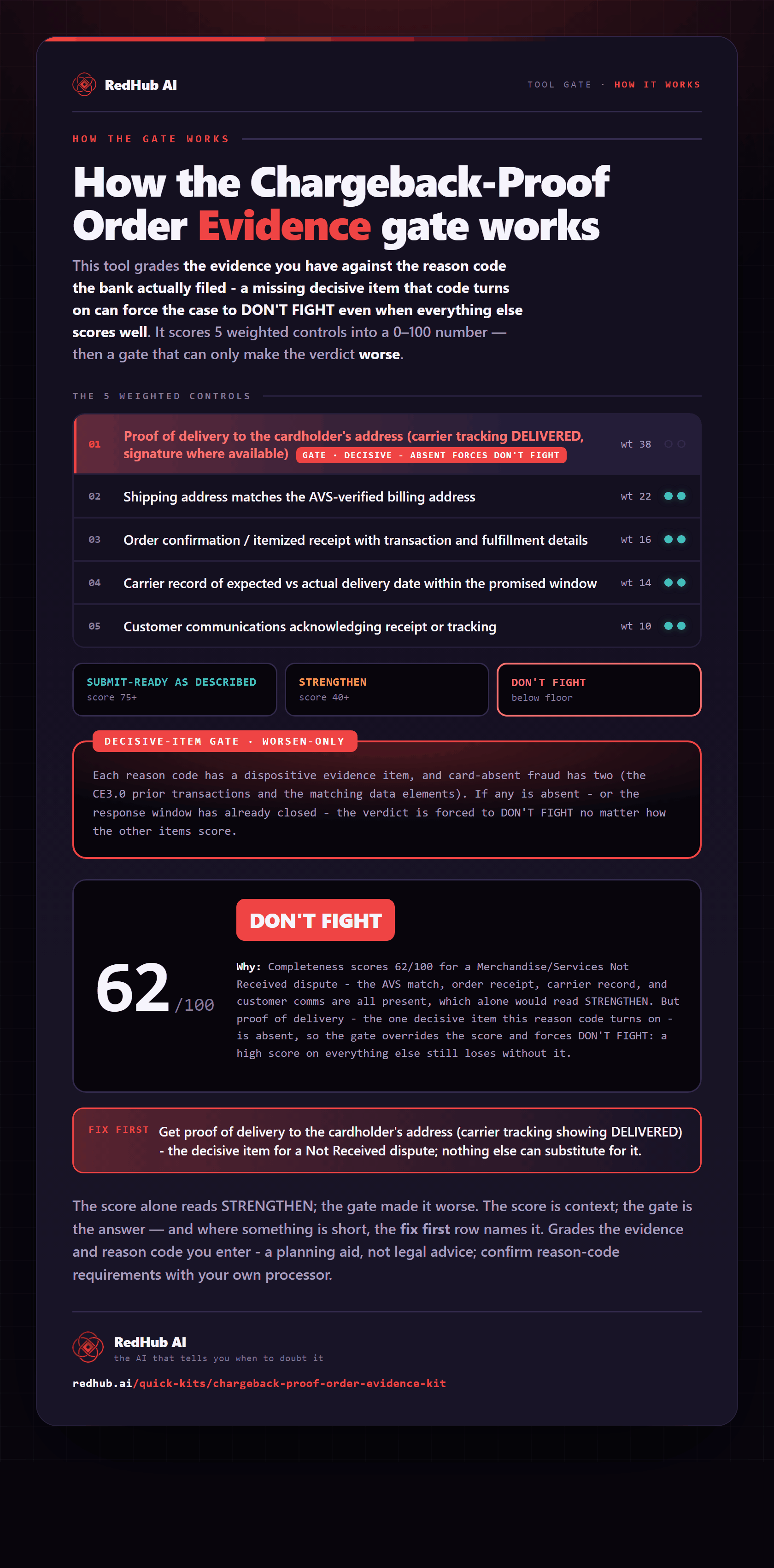
The gate this post refers to, drawn from the tool’s own logic. See the tool.