Why Stripe Froze Your Account (and Fixes)
RedHub AI Editorialupdated October 5, 20267 min read

Jump to a section7
Stripe's documentation says it might create a reserve balance so that an account can cover expected refunds and disputes, and that reserved funds cannot be paid out until the hold period ends. That sentence explains most of what sits behind a merchant account hold. If your customers' chargebacks outrun your balance, the processor pays, so when your dispute numbers climb, it holds money back. The lines that trigger it mostly come from Visa's and Mastercard's monitoring programs.
TL;DR: Holds escalate from a rolling reserve to a payout hold, a freeze and termination. Behind them sit two network formulas: Visa's VAMP and Mastercard's Excessive Chargeback Program. Visa's merchant Excessive line in the US, Canada, the EU and Asia Pacific dropped from 2.2% to 1.5% on April 1, 2026. Winning disputes does not lower either ratio, because the programs ignore outcomes. The way back is to know your exact number, cut counted events and string together clean months.
The escalation ladder
A processor has more than one lever, and each rung prices your risk a little higher:
- Rolling reserve. A slice of each sale is held for a set window before it pays out. You keep selling, with some revenue on delay.
- Payout hold. Payouts pause while the processor reviews the account, often after a dispute spike, a sudden jump in volume or a move into riskier products.
- Account freeze. Processing stops while the review runs.
- Account termination. The account closes, and remaining funds can be held for months to cover chargebacks still on their way. Stripe's monitoring-program guide notes that one of Visa's programs can end in a listing in the Visa Merchant Screening Service, which other acquirers can view.
The network math your processor is watching
Two ratios do most of the work, and they are built differently. A single blended "dispute rate" on a dashboard can hide which one you are close to.
| Program | The math | The catch |
|---|---|---|
| Visa VAMP (Visa Acquirer Monitoring Program) | Count of TC40 fraud reports plus TC15 disputes, divided by settled card-not-present transactions, per Visa's fact sheet | Stripe says a transaction in both reports counts twice, once as fraud and once as a dispute |
| Mastercard ECP (Excessive Chargeback Program) | This month's chargebacks divided by last month's transactions, per Stripe's guide | The denominator is last month, so a slow sales month pushes the ratio up even if disputes hold steady |
Visa's fact sheet sets the line by region. Latin America was already at 1.5%, and Central Europe, the Middle East and Africa (CEMEA) stays at 2.2%, with its own count and dollar floor. Below the monthly count floor, Visa is not counting you yet, and your processor still sees the trend. Visa's fact sheet does not publish an exit rule the way Mastercard's program has one, so ask your acquirer what leaving VAMP takes. Confirm every number here against your acquirer and the current network documents before you act on it.
Why your dashboard and Visa can disagree
Stripe's guide lists several reasons its numbers and the network's can differ, and two of them catch merchants off guard.
First, Visa counts accounts by statement descriptor and acquiring bank, not by your company. Stripe's own example: a business that uses one descriptor in Canada and a second one in both Canada and the US is three accounts to Visa. One of them can be over the line while your company-wide average looks fine.
Second, some disputes never show in your Stripe Dashboard because Stripe handles them for you, such as a dispute filed after you had already refunded the payment. Stripe says the monitoring programs still include them. If you refund a lot, the network's number can run above yours. We cannot tell you how large that gap is for your account. Stripe's VAMP dashboard shows Visa's figures by descriptor next to Stripe's own estimates, which is the place to look.
Fighting disputes does not fix the ratio. Stripe's guide says the monitoring programs "don't consider dispute outcomes," and that Mastercard counts a chargeback regardless of its outcome. Representment recovers revenue, a separate job covered in chargeback representment. The ratio moves when fewer disputes get filed.
If you have been flagged: the sequence
- Answer the review with documents. Fulfillment records, refund policy, dispute history and what changed. Silence and spin both read as risk.
- Compute your real numbers. Work out VAMP and ECP for each merchant account, with the double count applied, against thresholds you have confirmed with your acquirer.
- Cut counted events now. Refund quickly when a customer complains, before they go to the bank. Look at dispute alert and deflection programs such as Visa's Rapid Dispute Resolution, Verifi CDRN and Ethoca alerts. Visa's fact sheet excludes disputes resolved through pre-dispute solutions from the VAMP count.
- Fix the sources. Reason codes point at the leaks: descriptor confusion, cancellation friction, delivery gaps, fraud getting through. Work them by volume. The full lever list is in how to reduce your chargeback rate.
- String together clean months. For Mastercard, that means three in a row below the threshold. Re-measure monthly, and keep measuring after you are out.
If you have not been flagged
All of the above is easier before a freeze than after. Peacetime is one monthly habit: compute both ratios for each descriptor and merchant account, compare them with confirmed thresholds, and read your position as headroom, approaching or over the line. That read tells you how hard to fight disputes and when to push prevention, months before your acquirer writes to you.
If you run several merchant accounts, read each one on its own numbers and fix the worst first.
See your number before your acquirer shows it to you
The Chargeback Threshold & MID-Survival Gate computes your Visa VAMP and Mastercard ECP ratios from your own numbers, against thresholds you confirm, and reads each merchant account HEADROOM, APPROACHING or OVER THE LINE, with Visa's 1,500-event monitoring floor respected. A separate six-control prevention scorecard reads HARDENED, SOFT or EXPOSED and never averages into the verdict, which is why its sample account scores 100, HARDENED, and is still OVER THE LINE at 1.58%. It ships a Python engine, a workbook, a ratio-math SOP and a monthly runbook.
Get the MID-Survival Gate — $89Pairs well with
The Chargeback-Proof Order Evidence Kit ($49) tells you which disputes are worth fighting, with a SUBMIT-READY AS DESCRIBED, STRENGTHEN or DON'T FIGHT verdict for each. The Payment Processing Effective-Rate & Fee-Padding Audit ($79) reads your processor statement for the effective rate you really pay and the padded fees a clean-looking rate hides. The Customer Churn Autopsy Kit ($69) gives you an exit-interview script, a churn classifier and win-back sequences for the customers who leave instead of disputing.
More in this guide
Why did Stripe freeze my account?
Stripe's documentation says it might create a reserve balance so an account can cover expected refunds and disputes. In practice, a climbing dispute ratio, a spike in chargebacks or volume, or a sudden change in what you sell can raise that risk. The review notice usually names the category, so answer it with documents, quickly.
What is a merchant account hold?
A hold is your processor pausing or withholding payouts while it weighs risk. It sits on a ladder: a rolling reserve, a payout hold, a full freeze and, last, termination. Each rung is the processor pricing the chance that your chargebacks exceed what your balance covers.
What chargeback ratio triggers a monitoring program?
Visa's VAMP fact sheet sets the merchant Excessive line at 1.5% in the US, Canada, the EU, Asia Pacific and Latin America, and 2.2% in CEMEA, each with a monthly count floor. Stripe lists Mastercard's first level at a 1.5% ratio and 100 chargebacks. Rules change and acquirers apply them, so confirm with yours. This is general information, not legal advice.
Does winning chargeback disputes lower my ratio?
No. Stripe's guide says the card networks' monitoring programs do not consider dispute outcomes, and that Mastercard counts a chargeback regardless of its outcome. Winning recovers that order's money. Only fewer filed disputes move the ratio.
How do I get out of a chargeback monitoring program?
For Mastercard, Stripe says you are removed after three consecutive months below the program threshold. Visa's VAMP fact sheet does not publish an exit rule, so ask your acquirer. Either way, cut counted events now and re-measure monthly. This is general information, not legal advice.
Should I refund instead of waiting for a dispute?
When a customer complains and a dispute looks likely, a quick refund is usually the cheaper trade, because a dispute costs the order, a fee and a counted event. Timing matters: Stripe says the programs still count a dispute filed after you refunded, so refund before the customer goes to the bank.
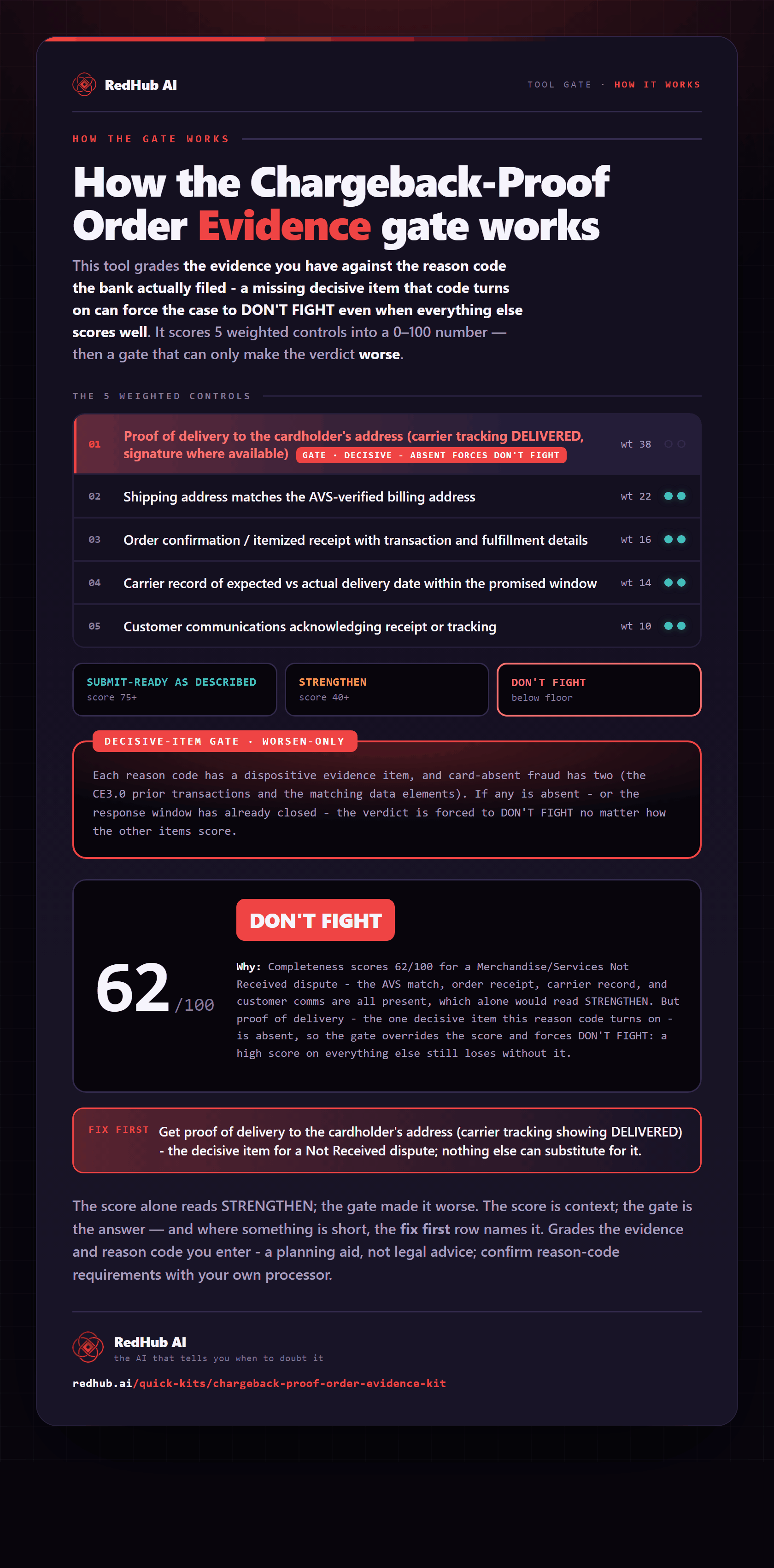
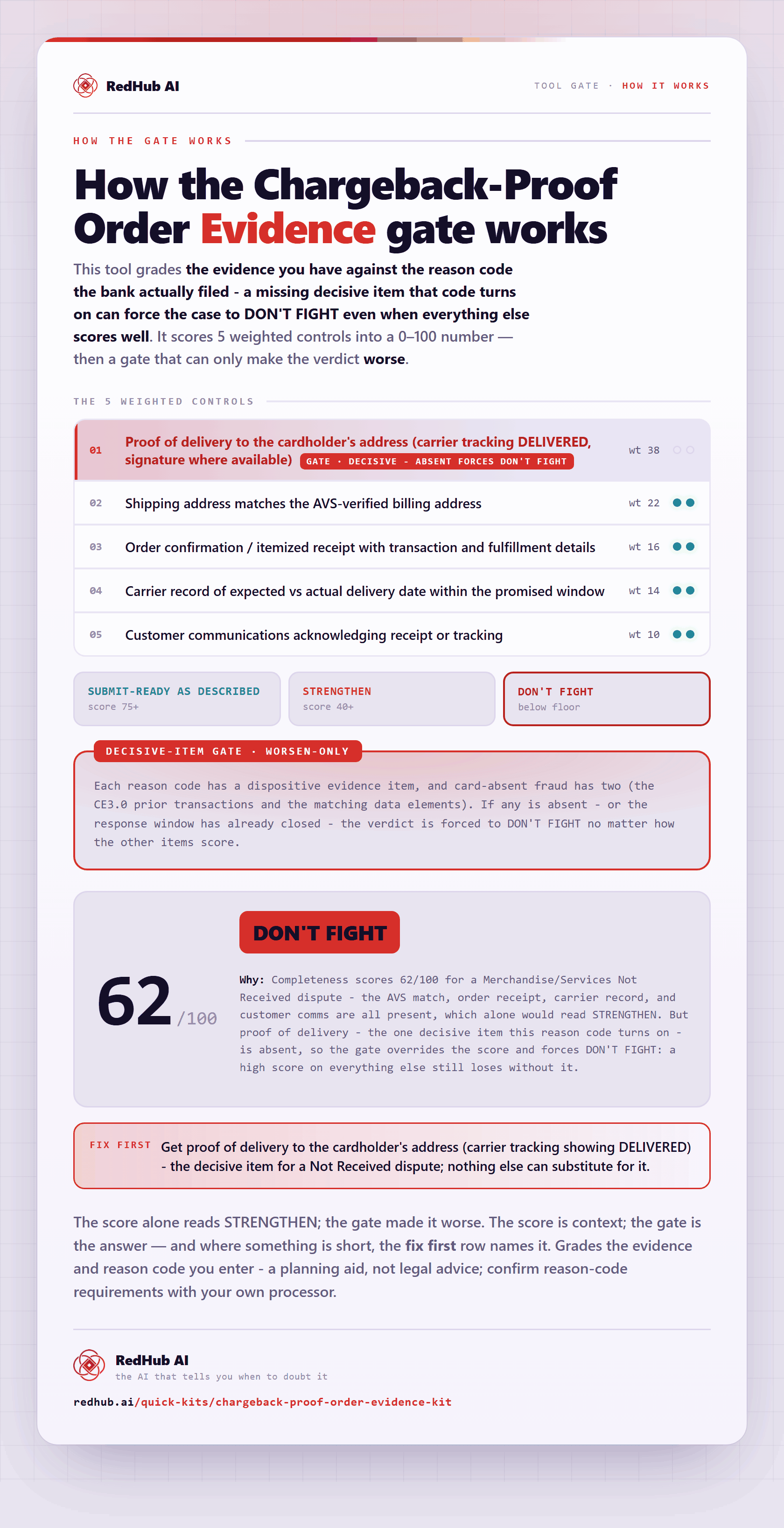
The gate this post refers to, drawn from the tool’s own logic. See the tool.