Friendly Fraud: What It Is and How to Fight It
RedHub AI Editorialupdated October 5, 20266 min read

Jump to a section7
The card was real, the customer was real, and the package reached their door. Then the customer told their bank they never made the purchase. That is friendly fraud, also called first-party fraud: a legitimate cardholder disputing a charge they made or authorized. Fraud screening built to catch stolen cards finds nothing wrong with the order, and the dispute still counts against your chargeback ratio.
TL;DR: Friendly fraud comes in four kinds: confusion, a household purchase, convenience, and deliberate abuse. Only the last one is an adversary. Fix the first three with a recognizable descriptor, clear confirmations and an easy refund path, and fight the deliberate cases with records that contradict the claim. A new problem sits beside it: AppZen reported that AI-generated images made up 70.8% of the fake expense receipts its platform flagged by mid-May 2026. Treat any document image as a claim, and check it against records you control.
The four kinds of friendly fraud
Lumping all friendly fraud together leads to the wrong response. Each kind needs a different fix.
| Kind | What happened | The response |
|---|---|---|
| Confusion | The cardholder did not recognize your billing descriptor or forgot the purchase | Prevention: a descriptor that matches your brand, clear receipts and confirmations |
| Household | A spouse, child or roommate made the purchase on the shared card | Prevention plus evidence: order details and delivery records |
| Convenience | The customer wanted a refund, and the dispute button was easier than your support flow | Fix the path: make refunds and cancellations easier than disputing |
| Deliberate | The customer wants the product and the money back | Fight it with records that contradict the claim |
The first three are process failures wearing a fraud costume. That is good news, because process is the part you control.
How much of your queue is friendly fraud? We will not hand you an industry average. Pull last quarter's disputes, group them by reason code, and read your own split. A pile of "not recognized" is mostly confusion. A pile of "canceled recurring" on accounts that kept logging in leans deliberate.
Why screening does not catch it
- The transaction is clean. Fraud screening looks for stolen-card signals such as mismatched addresses or odd velocity. A friendly-fraud order comes from the right card, the right address and normal behavior, so there is nothing to flag.
- The burden is on you. The issuer starts from the cardholder's claim. Your evidence has to change its mind, and you get one packet and a short deadline to do it.
- A win still counts. The dispute lands in the ratio when it is filed, and Stripe's guide to the card networks' monitoring programs says they do not consider outcomes. Enough of these and your processor can add a reserve whatever your win rate. The mechanics are in merchant account hold: why Stripe froze your account.
Deterrence: remove the innocent triggers
- Fix your billing descriptor. If the statement line shows your legal entity and your store has another name, every statement is an invitation to dispute. Make the descriptor match your brand, and add a support URL or phone number if your processor allows it.
- Confirm everything. Order confirmation, shipping notice, delivery notice, and for subscriptions a renewal reminder before the charge. A customer who expects the charge does not call the bank about it.
- Make refunds easier than the dispute button. A visible refund policy, one-step cancellation and fast support replies.
- Keep records as you go. Consent at signup, terms as shown, delivery confirmations, login and usage logs. Deterrence handles the honest cases. These records are what you fight the deliberate ones with.
Step three has a cost we cannot fully resolve for you. An easy refund path also serves the customer who wants the product and the money back, because a no-questions refund is easier to abuse than a dispute is. Some merchants answer with a return-before-refund rule on physical goods, or by flagging accounts with repeat refund requests. Each rule you add brings back some friction, and friction is what pushed the convenience disputer to the bank in the first place. Where to set that line depends on your margins and your customers, and only your own refund and dispute data will show whether you set it right.
Fighting the deliberate cases
Deliberate friendly fraud usually arrives as a fraud claim ("I never made this purchase") or a delivery claim ("it never arrived"). Each has a decisive item. For a Visa card-absent fraud claim, code 10.4, that is purchase history meeting Visa's Compelling Evidence 3.0 criteria. For a delivery claim, it is proof of delivery to the address on the order. Codes, deadlines and when to walk away are covered in chargeback representment: how to win disputes.
Be honest about the odds. The issuer decides, the cardholder is its customer, and strong packets still lose sometimes. Fight the cases where your records contradict the claim, and log the rest as prevention data.
The new front: AI-made documents
Faking a document used to take skill. Image generators removed that limit. The clearest numbers come from expense reimbursement, not disputes. AppZen, which sells expense-audit software, reported that AI-generated images made up 0% of the fake receipts its platform flagged in March 2025 and 70.8% by mid-May 2026, according to Accounting Today's June 2026 report. In that data, the fakes averaged about $100, against $182 for older template fakes.
For a merchant, the same tools cut two ways:
- Refund claims can carry fakes. A return or refund claim can arrive with a made-up photo or receipt. If your refund process trusts an image because it looks real, that process has a hole. Check the claim against records you control: your own order, shipment and payment data.
- The same fakes reach your expense desk. A fake receipt sized to slip under an auto-approval limit is the reimbursement version of the same trick. A control that amounts to "someone looks at the receipt" stops working against a perfect image.
Documents are claims, not proof. Proof is the cross-check: the card feed, the order record, the tracking log, the system a fraudster cannot edit.
Score your expense controls against a perfect fake
The AI-Receipt Fraud Exposure Gate is a one-spreadsheet self-assessment for the receipt-trust problem. Score six controls for each expense program, from a source-of-truth cross-check to approver accountability, and get one verdict per program: CONTROLLED, SOFT SPOTS or EXPOSED. A gate forces EXPOSED when either of the two controls AI fakes defeat is missing, so its sample Field-sales program scores 76 and still reads EXPOSED. It grades your controls, reads no receipt and grades no employee.
Get the AI-Receipt Fraud Exposure Gate — $69Pairs well with
The Chargeback-Proof Order Evidence Kit ($49) matches your evidence to the reason code the bank filed and rates each dispute SUBMIT-READY AS DESCRIBED, STRENGTHEN or DON'T FIGHT. The Chargeback Threshold & MID-Survival Gate ($89) computes your Visa VAMP and Mastercard ECP ratios from your own numbers and reads each merchant account HEADROOM, APPROACHING or OVER THE LINE. The Returns & Refund Profit Analyzer ($39) shows what refunds and returns cost on each product, with a keep, fix returns or drop-or-fix verdict.
More in this guide
What is friendly fraud?
Friendly fraud is a legitimate cardholder disputing a charge they made or authorized. It runs from honest confusion over a billing descriptor to deliberately disputing a delivered order to get it free. It is also called first-party fraud, because the person disputing is the real customer.
Is friendly fraud actually fraud?
The deliberate kind is a false claim made to a bank. Much of what gets the label is confusion or convenience: an unrecognized descriptor, a family member's purchase, or a refund sought through the dispute button. That is why the response splits: prevent the innocent cases and fight the deliberate ones.
Why doesn't fraud screening catch friendly fraud?
Because nothing is wrong at checkout. Screening looks for stolen-card signals such as mismatched addresses or odd velocity. A friendly-fraud order is placed by the real cardholder behaving normally, so the defense happens before checkout, through deterrence, and after the dispute, through evidence.
Can I win a friendly fraud chargeback?
Sometimes, when your records directly contradict the claim: delivery proof against "never arrived," usage logs against "I canceled," or purchase history that meets Visa's Compelling Evidence 3.0 criteria against "I didn't buy this." The issuer decides, so no outcome is guaranteed.
What are AI-generated fake receipts?
Receipts and documents made with AI image generators that look real to a human reviewer. AppZen reported that they made up 70.8% of the fake receipts its expense platform flagged by mid-May 2026. Checking the claim against card, order or shipment records works where looking at the image does not.
Should I block customers who file friendly fraud disputes?
For a deliberate case, you can block the account or require a different payment method. For confusion or a household purchase, blocking loses a customer over a fixable process gap. Read the reason code and your records before you decide which kind you are looking at.
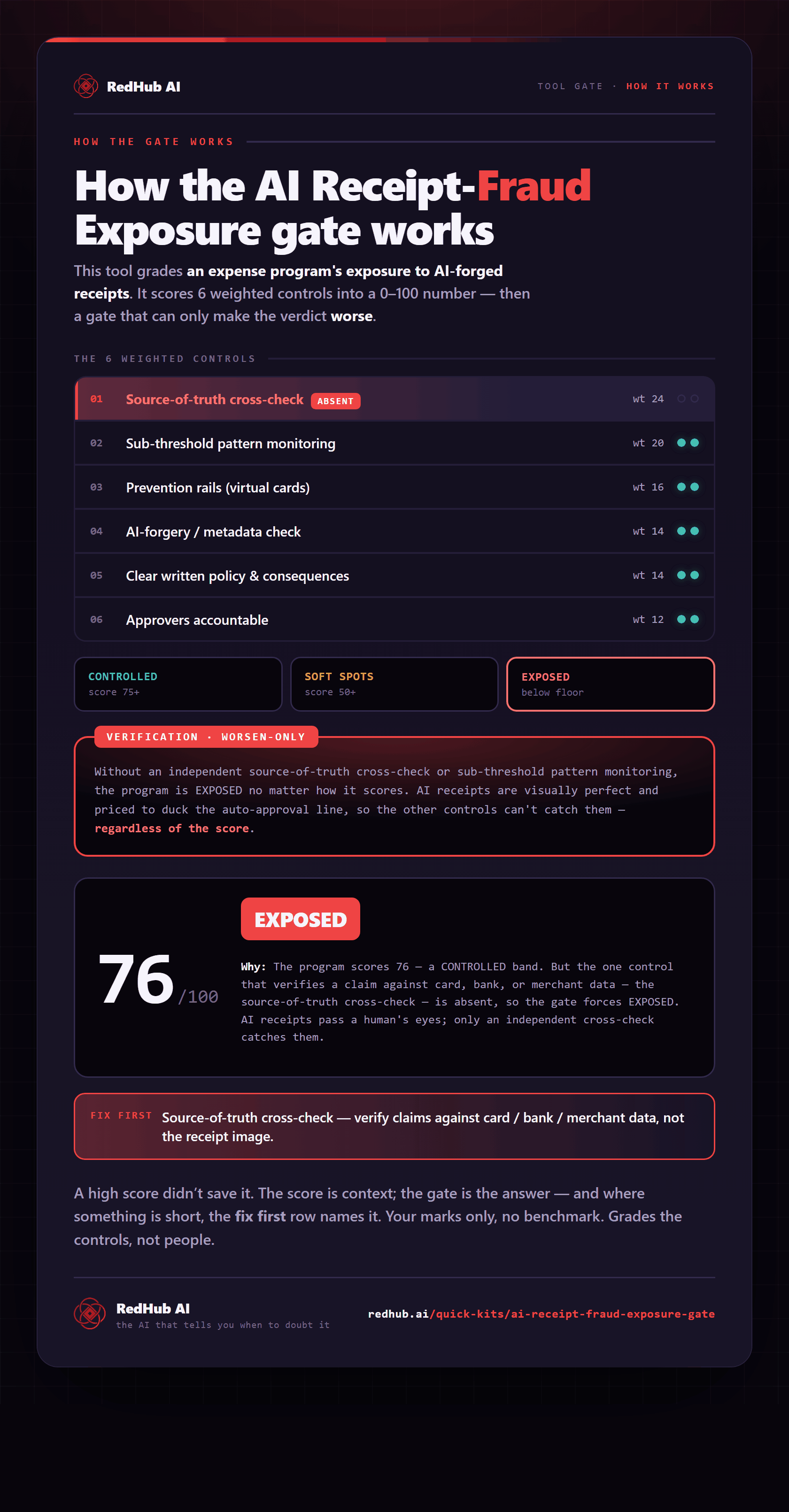
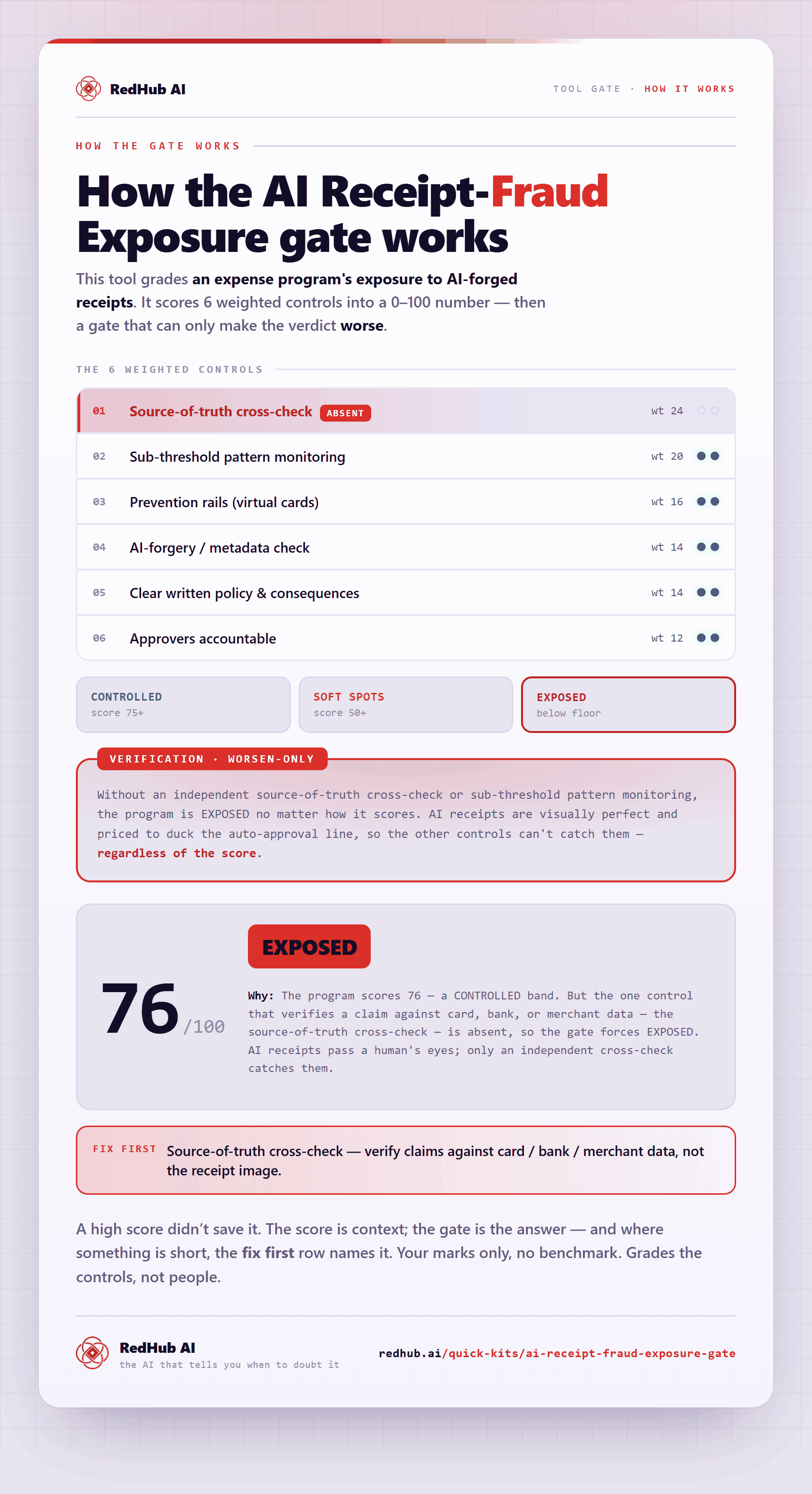
The gate this post refers to, drawn from the tool’s own logic. See the tool.