How to A/B Test Cold Emails Without Fooling Yourself
RedHub AI Editorialupdated October 4, 20266 min read

Jump to a section7
Cold email A/B testing tells you something only when each test changes exactly one variable, splits the send evenly, waits for a real sample of replies, and judges the winner by positive reply rate instead of by whichever version got more responses first. Plenty of cold-outreach "A/B tests" fall short of that: two emails that differ in five ways, sent to different lists, called after a dozen replies. That doesn't tell you what worked; it tells you a story you wanted to hear. Real testing means isolating one change and refusing to call it early.
TL;DR: One variable per test. Split the send evenly. Wait for enough replies that the gap isn't noise, which takes more sends than it feels like. Judge by positive reply rate, not raw replies. Don't A/B test copy on a broken list. The Cold Email Reply-Rate Optimizer ($39) scores each variant and helps you write the next clean test. Part of the guide on improving your cold email reply rate.
The one-variable rule
The whole value of an A/B test is attribution: knowing which change caused the result. Change two things at once and that knowledge is gone. If version B has a new subject line, a new opener and a shorter CTA, and B wins, you can't carry the win forward, because you don't know what to keep. So each test isolates a single variable: this subject line against that one, everything else identical. It feels slow. It is slow.
The Optimizer's own sample data makes the point. Its pre-loaded Variant B pairs a timeline hook with a narrower list, two changes in one row. That's fine for showing how the scoreboard reads. As a test, it couldn't tell you which change earned its 28 positive replies, the hook or the list.
Run the test so the result means something
- Pick one variable. Subject line, first line, CTA or send time. Write it down before you start so you can't retrofit the story afterward.
- Split evenly and randomly. Version A and version B go to comparable halves of the same list. Sending A to your warm accounts and B to cold ones tests the list, not the copy.
- Wait for a real sample. A handful of replies is a coin flip. The next section shows how many sends it takes before a gap means anything.
- Judge by positive reply rate. Rank on interested replies, not total replies, or the version that provoked the most people "wins."
- Keep the winner, change one new thing. The winner becomes the control, and the next test isolates a different single variable.
How big a sample is real
Positive replies are rare, so samples have to be large. Take an illustrative case: two variants, 250 delivered emails each. A gets 5 positive replies (2.0%) and B gets 8 (3.2%), so B looks 60% better. A standard two-proportion test says a gap that size would show up about 40% of the time even if the two emails were identical.
Run it the other way. To reliably detect a lift from a 2% to a 3% positive reply rate, the textbook sample-size formula (two-sided test, 5% significance, 80% power) asks for about 3,825 delivered emails per variant. A lift from 2% to 4% needs about 1,141. These figures are arithmetic, not research, and your own rates will move them.
A small team may never send 7,650 emails to one segment for one test, and there is no clean fix for that. You can test bigger changes, since a bigger gap needs a smaller sample. You can let a test run across several weeks, accepting that the list and the season shift underneath it. Or you can act on a directional read and label it that way in your notes, so nobody later treats it as settled. Which one is right depends on what a wrong call would cost you.
Don't test copy on a broken foundation
An A/B test assumes both versions reached the inbox. If your list is stale and a chunk of your sends bounce, or your domain is landing in spam, the test measures deliverability differences dressed up as copy differences. You'll "learn" that a subject line works when it just happened to go out to cleaner addresses. Fix targeting and deliverability first (see why cold emails get no replies), then test wording. The Optimizer helps by marking any variant whose bounce rate tops 2% "Fix list," so you can see when a copy conclusion rests on a list artifact.
Turn each result into the next test
A good test also hands you the next hypothesis. Won on a shorter subject line? Test shorter still, or test whether the same brevity helps the opener. The Optimizer's ninth prompt formula takes your A/B result and writes the next test as a hypothesis in one shape: "If I change [one variable], positive reply rate will rise because [reason]." You log that hypothesis in the scoreboard's "What changed" column, so each row is one experiment.
Score each test on positive replies
Log every variant's delivered emails, replies, positive replies, meetings and bounces. The Optimizer ranks them on positive reply rate, flags a bounce rate too high to trust, and its next-test prompt sets up the following single-variable experiment.
Get the Cold Email Reply-Rate Optimizer — $39Pairs well with
When a tested email starts landing positive replies, the Lead-to-Meeting Engine ($149) scores each new reply BOOK NOW, NURTURE or DECLINE and drafts a response proposing real open times from your calendar, for you to send. The Sales Enablement Battlecard Builder ($79) builds objection-handling and talk-track cards from your own intel. And before you spend a test on a list, the Lead Source ROI Scorecard ($49) grades each lead source SCALE, FIX or CUT on qualified-lead rate, cost per qualified lead, close rate and return on spend.
More in this guide
How do I A/B test cold emails correctly?
Change one variable per test, split your send evenly across a comparable list, wait for a real sample of replies, and judge by positive reply rate. Then keep the winner as the control and test one new variable. Changing several things at once tells you nothing about what worked.
How many emails do I need for a valid test?
It depends on your rate and the size of the gap you're trying to detect. As an illustration, telling a 2% positive reply rate from 3% takes about 3,825 delivered emails per variant under a standard sample-size formula, and 2% from 4% takes about 1,141. If three more replies would change your mind, you don't have a result yet.
What variable should I test first?
Whatever you think has the biggest effect and the least certainty, often the subject line or first line, since they decide whether the email is read at all. Test only one, and only after targeting and deliverability are sound. Testing copy on a broken list measures the list, not the copy.
Should I judge the test by replies or meetings?
Primarily by positive reply rate, with meetings as a sanity check. A variant can earn warm replies that never convert, which signals shallow interest or broken follow-up. Watching both catches that. Watching raw replies alone hides it.
Why do cold-email A/B tests go wrong?
Three usual reasons: too many variables changed at once, samples too small to trust, and winners called by raw reply count. Any one of them turns a test into a guess.
How does the Optimizer help with testing?
It scores each variant by positive reply rate, marks a variant "Fix list" when its bounce rate is above 2%, and includes a prompt formula that turns your latest result into the next single-variable hypothesis, which you log against the next row of the scoreboard.
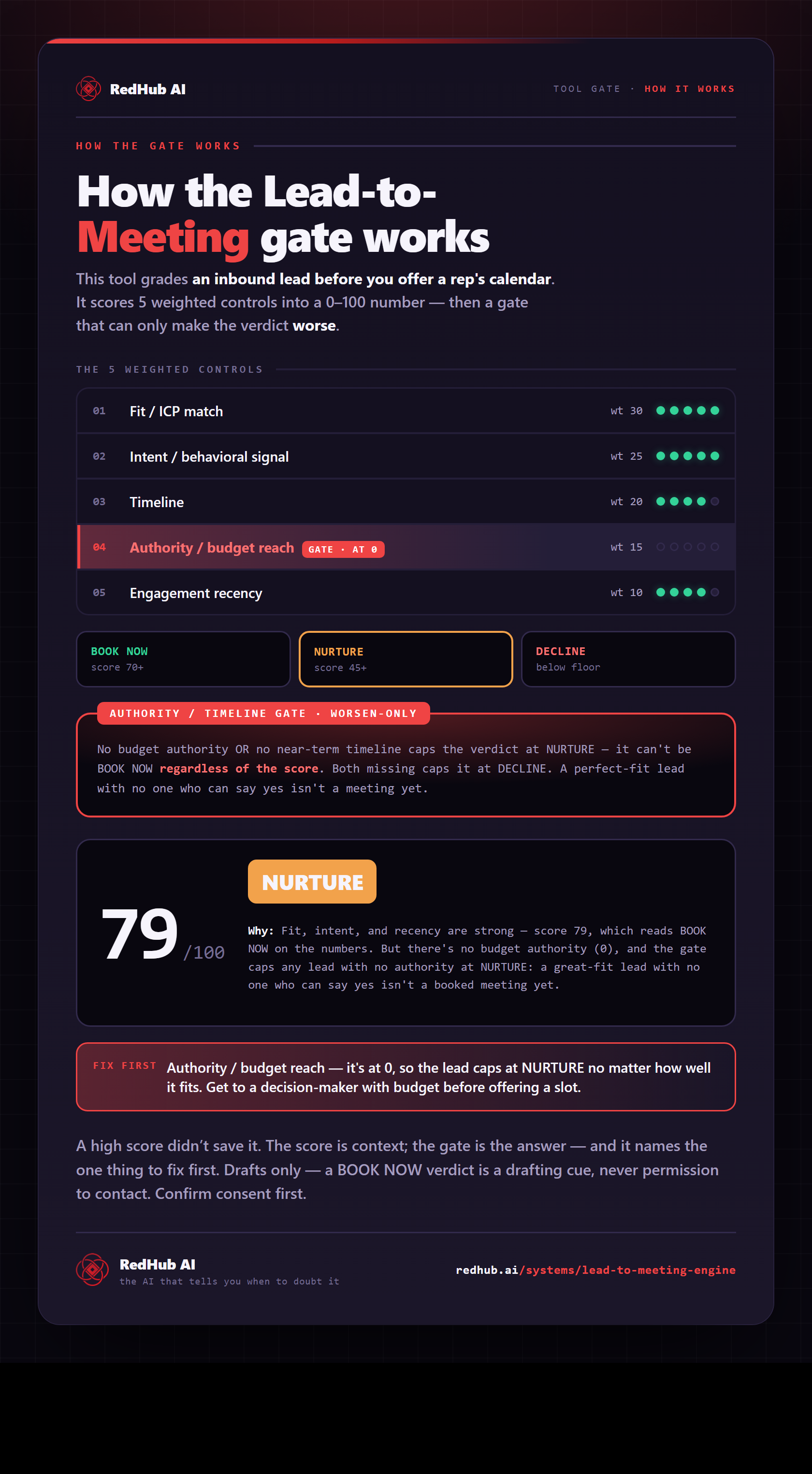
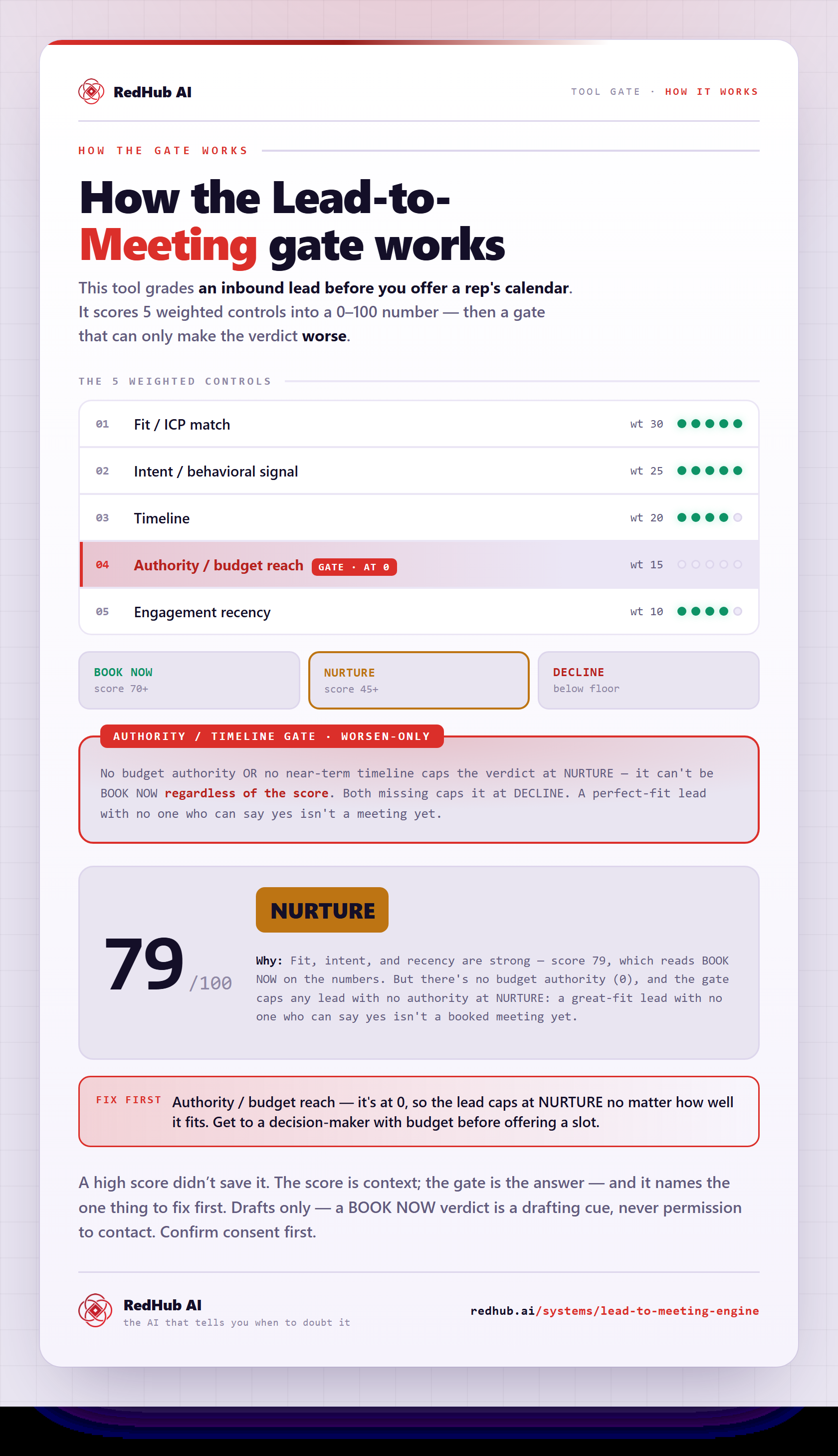
The gate this post refers to, drawn from the tool’s own logic. See the tool.