Conversion Copywriting: How to Write Offers and Landing Pages That Convert
RedHub AI Editorialupdated September 7, 20266 min read

Jump to a section10
TL;DR
- What it is: conversion copywriting is writing offers and landing pages so more of the visitors you already have take action — built on clarity, proof, and low friction, not hype.
- Who it's for: founders and growth marketers who want to convert existing traffic better instead of buying more of it. See the conversion kit.
- How it works: sharpen the offer first, then write the page section by section, then check every claim against real proof before you ship.
- Bottom line: honesty is the mechanism, not the compromise — specific, provable copy out-pulls vague superlatives. Marketing guidance, not legal advice; no guaranteed conversion rate.
What is conversion copywriting?
Conversion copywriting is writing an offer and a landing page so that a higher share of visitors take the action you want — buy, book, or sign up. It's less about clever wording and more about four durable levers: clarity (the visitor instantly gets what you offer and why it's for them), proof (real evidence sits next to every important claim), relevance (the page matches the ad or search that sent them), and low friction (nothing slows or confuses the decision). The honest version treats those levers as the mechanism, so the copy converts because it's clear and provable — not because it's loud.
Best for: founders and marketers converting existing traffic — the AI Offer & Landing-Page Conversion Kit builds it and checks its own claims. Marketing guidance, not legal advice.
Most teams try to fix conversion by buying more traffic. But every visitor who lands and leaves without acting is wasted acquisition spend — usually the biggest silent leak in the funnel. Conversion copywriting plugs that leak by making the traffic you already have work harder. It comes down to two things done in order: a sharp offer, then a page that carries it.
Start with the offer, not the page
A beautiful landing page can't rescue a weak offer. Before you write a single headline, get the offer right: what's the core result, what's stacked around it that makes it worth more than the price, and what risk reversal removes the buyer's fear of saying yes. This is the offer stack — value on one side, risk on the other. When the offer is genuinely compelling, the copy's job gets easy: it just has to communicate clearly. When the offer is weak, no amount of copy will save it.
Key insight: conversion problems that look like "copy problems" are often offer problems. If the page reads clearly and still doesn't convert, fix the offer before you rewrite the words.
The five things a converting page gets right
Once the offer is strong, a landing page converts when it scores well on five dimensions. Think of it as a scorecard, not a style guide.
| Dimension | The question | What "good" looks like |
|---|---|---|
| Clarity | Do I get it in 5 seconds? | A specific headline that names the outcome and the audience |
| Proof | Why should I believe you? | Real evidence — numbers, testimonials, demos — next to each claim |
| Relevance | Is this what I came for? | The page matches the ad or search that sent me |
| Friction | What's slowing me down? | One clear CTA, minimal form fields, fast load, no confusion |
| Honesty | Does this smell like hype? | No overclaiming, no fake scarcity, claims backed by proof |
Write the page section by section
A landing page isn't one block of copy — it's a sequence that answers the visitor's questions in the order they ask them.
- Hero: the outcome and who it's for, in one specific line. This is where clarity is won or lost.
- Proof: the evidence that you can actually deliver — right after you make the promise, not buried at the bottom.
- Objection handling: answer the "yeah, but…" that's stopping the sale, often as a short FAQ.
- The offer: the value stack and risk reversal, laid out so saying yes feels safe.
- CTA: one clear action, repeated, with nothing competing for the click.
Build the offer and the page — honestly
The AI Offer & Landing-Page Conversion Kit gives you the offer-stack worksheet, section-by-section templates, prompts, a Conversion-Ready Scorecard, and a claim-honesty check that flags overclaiming and missing proof before you ship.
Get the Conversion Kit — $79 →Why honesty is the mechanism, not the compromise
There's a myth that hype converts and honesty is the polite, weaker option. In a hype-fatigued market, the opposite is increasingly true: inflated claims trigger skepticism instead of action, while specific, provable claims out-pull vague superlatives. "Cuts your close time in half, here's the data" beats "the #1 revolutionary solution." Honesty isn't a tax on conversion — clarity, real proof, and low friction are the levers that move it. That's why the last step before shipping is checking every claim against the proof behind it.
Check your claims before you ship
The final step is a claim-honesty pass: scan the page for the things that quietly sink conversion and invite trouble — overclaiming ("guaranteed," "instant," "#1"), fake scarcity (countdowns that reset, "only 3 left" that never changes), missing proof near important claims, and risky testimonial language. Log every claim against its evidence. If a claim has no proof, either prove it or cut it. This is where honesty stops being a value and becomes a checklist.
What this is not
Straight talk on the limits: this is marketing guidance, not legal advice, and there's no guaranteed conversion rate — conversion depends on your traffic, offer, price, and fit. Substantiate your claims and use only real testimonials. The durable levers (clarity, proof, low friction, honesty) are what you control; the rest is math you can't promise.
Go deeper: how to write a high-converting landing page section by section, how to write an offer people actually buy, why honest copy converts better than hype, and the landing-page mistakes that quietly kill conversions.
Decision Guide
Use it if: you have traffic but too few of those visitors convert, and you'd rather fix the page than raise the ad budget.
Skip it if: you have almost no traffic yet — fix the traffic problem first; a great page with no visitors converts nothing.
Best first step: sharpen the offer, then score your current page on the five dimensions and fix the weakest one.
FAQ
What is conversion copywriting?
It's writing offers and landing pages so more of your existing visitors take action. It rests on four levers — clarity, proof, relevance, and low friction — plus honesty as the mechanism that makes them work, rather than clever wording or hype.
Should I fix the offer or the copy first?
The offer. A strong page can't rescue a weak offer, and many "copy problems" are really offer problems. Get the value stack and risk reversal right first; then the copy just has to communicate it clearly.
Does honest copy convert as well as hype?
Usually better. In a market tired of inflated claims, hype now triggers skepticism, while specific, provable statements out-pull vague superlatives. Honesty works because clarity, real proof, and low friction are the actual conversion levers — not because it's a moral choice.
Will a conversion kit guarantee a higher conversion rate?
No — and any kit that promises one is overclaiming. Conversion depends on traffic, offer, price, and fit. What a good kit gives you is the durable levers you control: clarity, real proof, low friction, and honesty.
How do I know if my landing page is the problem?
Score it on the five dimensions — clarity, proof, relevance, friction, honesty. If it reads clearly and still doesn't convert, the offer or the traffic-to-page match is likely the culprit. If it's confusing or hype-heavy, start with the copy.
Can AI write my landing page for me?
AI can draft fast, but unguided it tends to produce vague, hype-leaning copy that overclaims. The useful pattern is AI plus a structure and an honesty check: templates to keep it specific, and a claim pass to catch overclaiming and missing proof before you ship.
Convert the traffic you already have
Sharpen the offer, write the page section by section, and check every claim against real proof. Marketing guidance, not legal advice.
Get the Conversion Kit — $79 →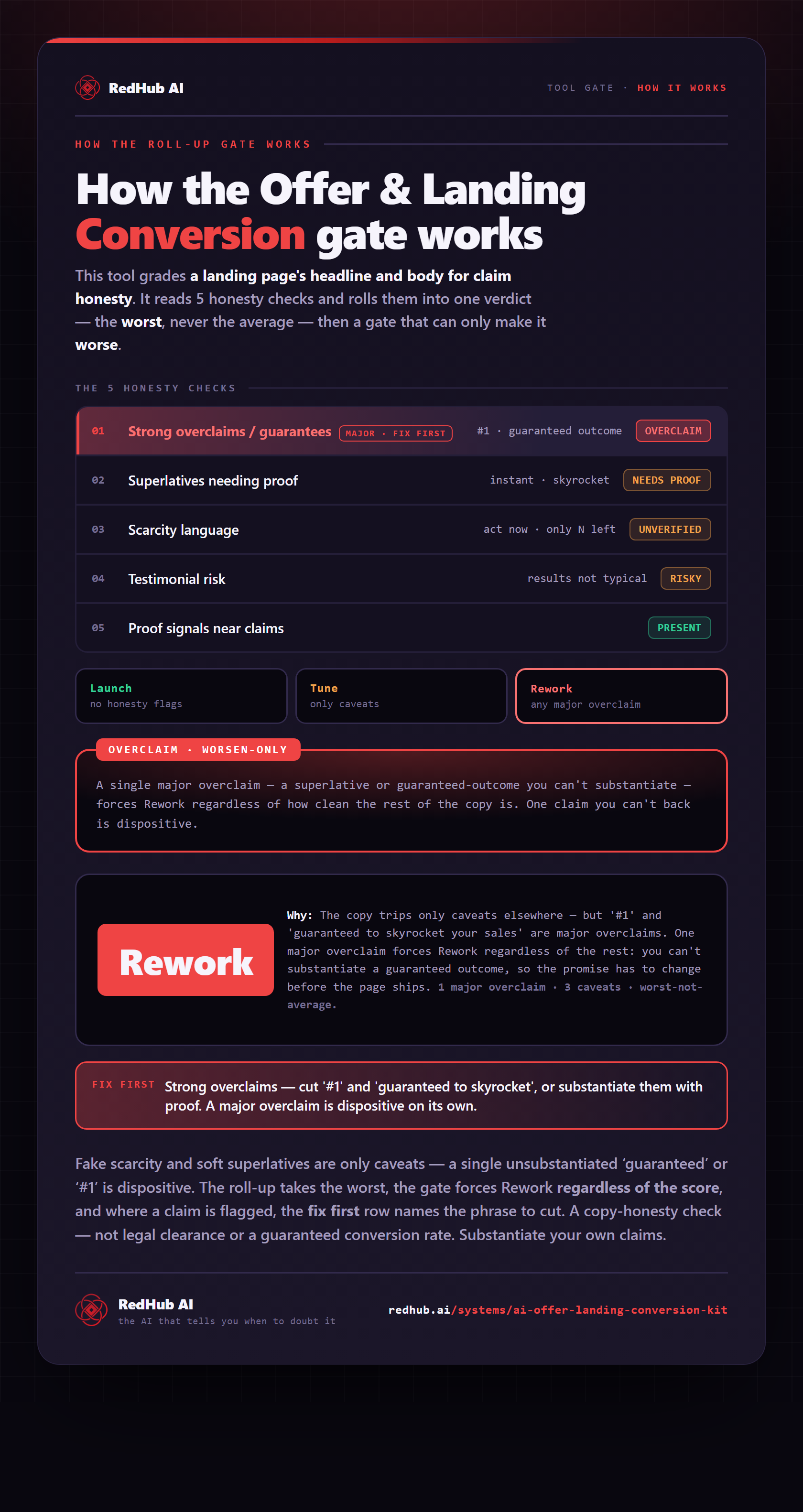
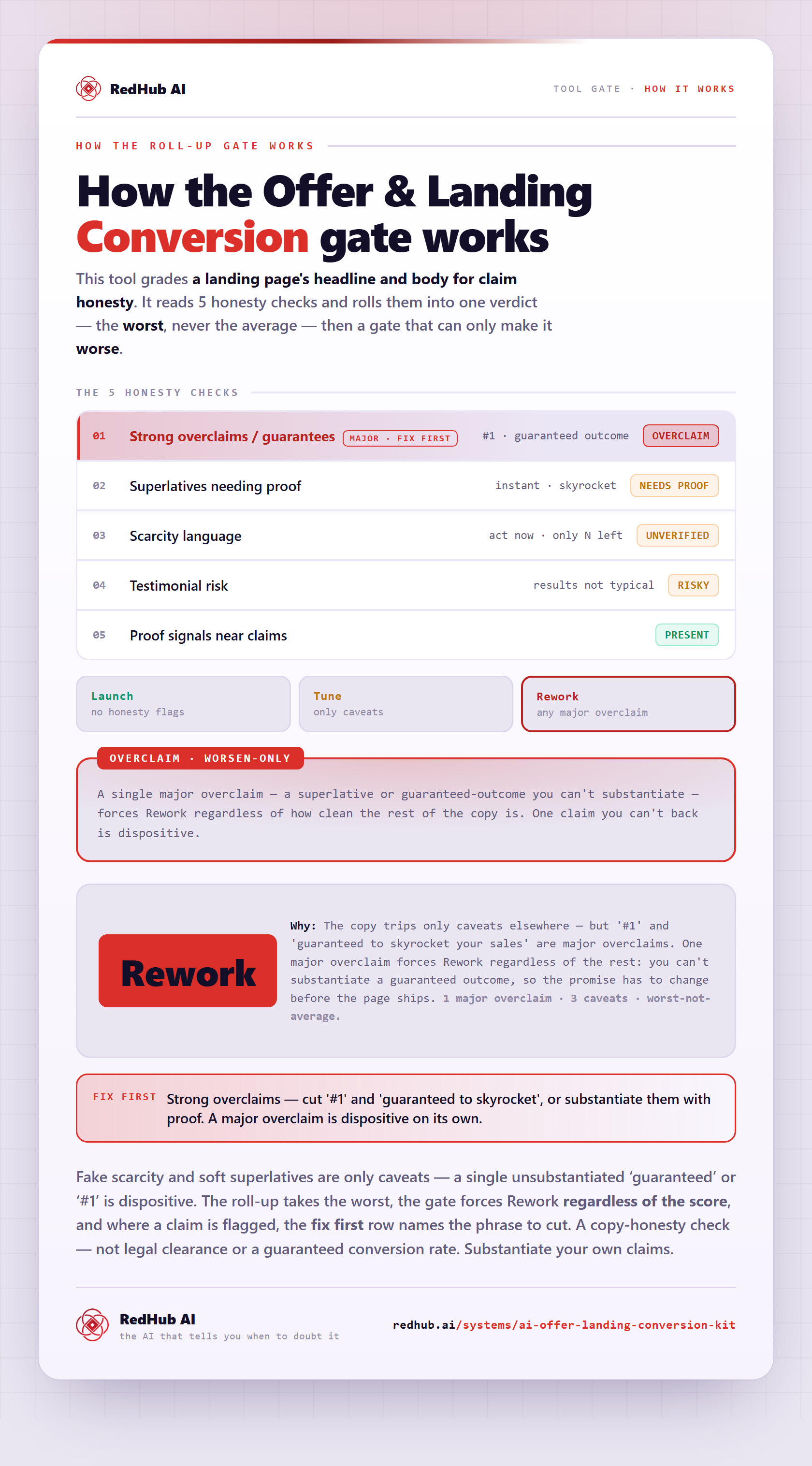
The gate this post refers to, drawn from the tool’s own logic. See the tool.