Why Honest Copy Converts Better Than Hype
RedHub AI Editorialupdated September 7, 20265 min read

Jump to a section8
TL;DR
- What it is: the case that specific, provable copy out-pulls hype — and how to catch the hype in your own pages.
- Who it's for: founders and marketers tired of writing "the #1 ultimate solution." See the conversion kit.
- How it works: hype now triggers skepticism; clarity plus real proof plus low friction is what actually moves conversion.
- Bottom line: honesty isn't the polite, weaker option — it's the mechanism. Marketing guidance, not legal advice.
Does honest copy convert better than hype?
Usually, yes. In a market saturated with inflated claims, hype now triggers skepticism instead of action — the reader has seen "guaranteed," "#1," and "revolutionary" a thousand times and discounts them on sight. Specific, provable claims do the opposite: "cuts drafting time from an hour to ten minutes, here's the recording" is believable in a way "the ultimate productivity solution" never is. Honest copy converts because clarity, real proof, and low friction are the actual levers — not because honesty is a moral nicety. The catch is that hype is easy to write by accident, so the discipline is catching it before you ship.
Best for: anyone whose copy keeps drifting into superlatives — the Conversion Kit includes a claim-honesty check that flags it. Marketing guidance, not legal advice.
"Hype sells" is old advice that's aging badly. It worked when inflated claims were novel; now they're wallpaper. Buyers have built up antibodies — the moment copy reaches for a superlative, they brace for a letdown. That doesn't mean you write timid copy. It means you win with specificity and proof, which read as confidence, while hype reads as compensation for a weak offer.
Why hype stopped working
Three things quietly turned hype from an asset into a liability:
| What hype does | What the reader hears |
|---|---|
| "The #1 revolutionary solution" | "Everyone says that — prove it." |
| "Guaranteed instant results" | "Nothing's guaranteed or instant. What's the catch?" |
| "Only 3 spots left!" (that never changes) | "That's fake, so what else here is fake?" |
The last one is the real damage: a single obviously-fake claim makes the reader doubt every claim on the page, including the true ones. Hype doesn't just fail to persuade — it poisons your credible claims by association.
Key insight: the cost of one inflated claim isn't neutral. It retroactively discounts your honest claims, because the reader can no longer tell which of your statements to trust.
What converts instead: specific and provable
Swap every superlative for a specific, provable statement and the copy gets stronger, not weaker:
- Replace claims with numbers. "Saves you tons of time" → "turns a 60-minute task into a 10-minute one." A number is checkable, which is exactly why it's believed.
- Put proof next to the promise. Every important claim gets adjacent evidence — a screenshot, a demo, a real testimonial — so the reader never has to take it on faith.
- Use real scarcity or none. If spots are genuinely limited, say the real number. If they're not, don't invent a countdown. Fake urgency is the fastest way to lose trust.
Catch the hype before you ship
Hype creeps in by accident — especially when AI drafts your copy, since unguided models lean on superlatives. So the practical move is a quick honesty check before publishing. Paste a headline or a claim below and see what a simple hype scan flags. It's an illustrative taste of the discipline, not a verdict on your whole page.
Quick hype check
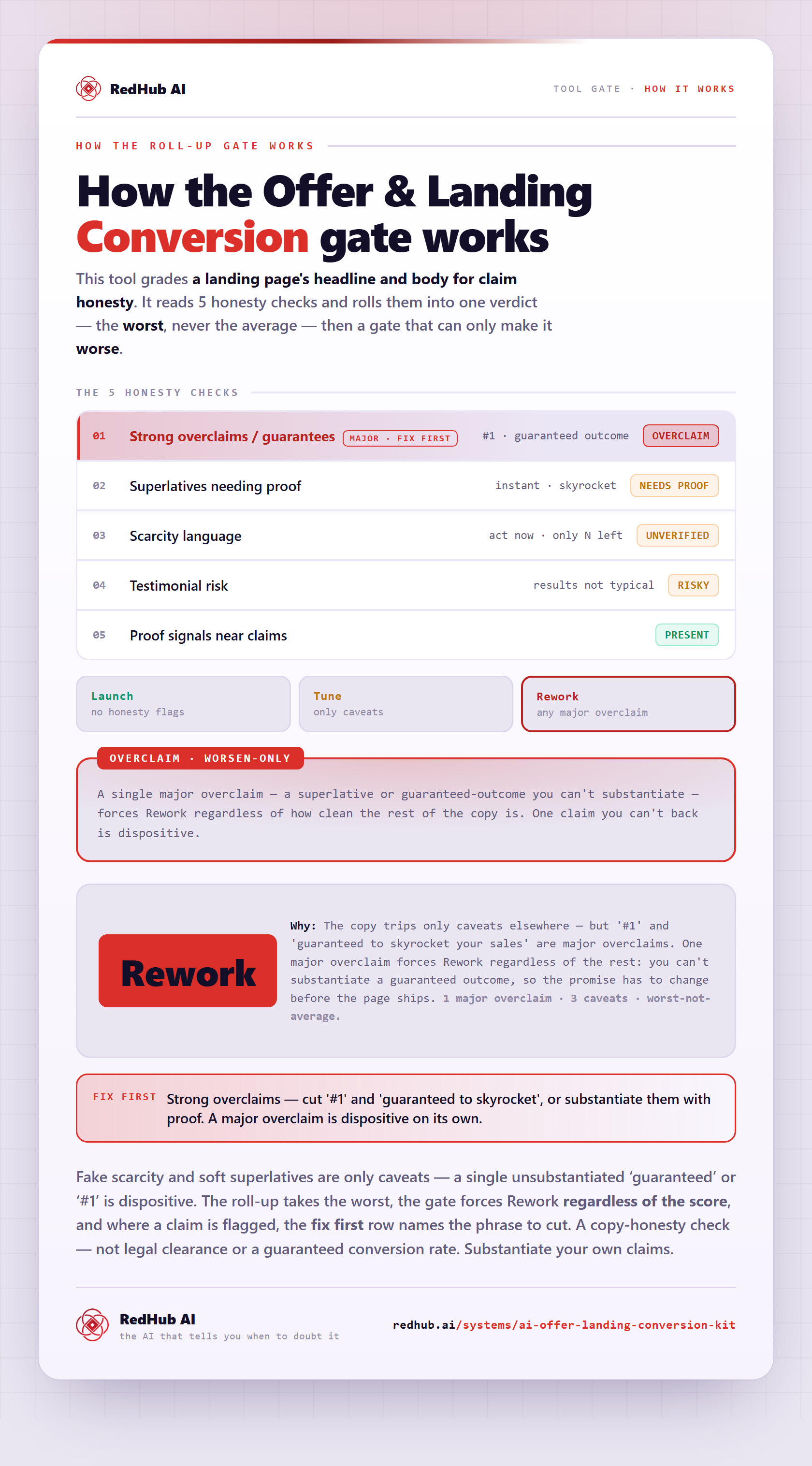
Whatever it flags, the fix is the same: swap the superlative for something specific you can prove, or cut it. That's the entire discipline — and it's what the kit's built-in claim-honesty engine does across a whole page, returning a Launch, Tune, or Rework verdict.
Write copy that reads honest and converts
The Conversion Kit pairs section-by-section templates with a claim-honesty check that flags overclaiming, fake scarcity, and missing proof — so you ship clear, provable copy, not accidental hype.
Get the Conversion Kit — $79 →Honesty is a competitive edge now
Here's the part that's easy to miss: because so much copy is inflated, honest copy stands out. When every competitor claims to be the best, the one that says "here's exactly what we do, here's the proof, here's what we don't do" reads as the trustworthy adult in the room. Honesty isn't just lower-risk — in a hype-fatigued market, it's a differentiator. It also keeps you clear of the substantiation problems that come with claims you can't back.
Read the pillar on conversion copywriting, and see the landing-page mistakes that hype tends to cause. To keep the honest copy sounding like you, the Brand Voice Engine locks your voice.
Decision Guide
Use it if: your copy keeps reaching for superlatives, or AI drafts are coming back full of "ultimate" and "guaranteed."
Skip it if: your pages are already specific and proof-backed with no scarcity theatrics.
Best first step: run your hero and top three claims through a hype check, then replace each flagged superlative with something you can prove.
FAQ
Does honest copy really convert better than hype?
In most modern markets, yes. Buyers have grown skeptical of inflated claims, so hype triggers doubt while specific, provable statements build belief. Honesty works because clarity, real proof, and low friction are the actual conversion levers — not because it's the virtuous choice.
Why does one fake claim hurt so much?
Because it's contagious. A single obviously-inflated claim — a countdown that resets, a "#1" with no basis — makes the reader doubt every other claim on the page, including the true ones. You lose credit on your honest statements by association.
How do I make copy specific instead of hype?
Replace superlatives with numbers ("saves tons of time" → "turns 60 minutes into 10"), put proof directly next to each promise, and use real scarcity or none at all. Specificity reads as confidence; vagueness and superlatives read as compensation.
Why does AI-written copy tend to be hype-y?
Unguided models lean on superlatives and vague enthusiasm because that pattern is everywhere in their training data. The fix is structure plus a check: give the AI a specific template, then run the output through a claim-honesty pass to catch the overclaiming before you ship.
Is toning down claims just a legal thing?
It helps you stay substantiated, but the main reason is conversion — honest, provable copy simply sells better now. This is marketing guidance, not legal advice; still, substantiate your claims and use only real testimonials, because unbackable claims hurt both trust and compliance.
Can honesty be a marketing advantage?
Yes. When most copy is inflated, the page that says exactly what it does, shows proof, and names what it doesn't do stands out as trustworthy. In a hype-fatigued market, honesty is a differentiator, not a handicap.
Trade hype for proof
Specific, provable, low-friction copy converts better and reads honest. Check your claims before you ship. Marketing guidance, not legal advice.
Get the Conversion Kit — $79 →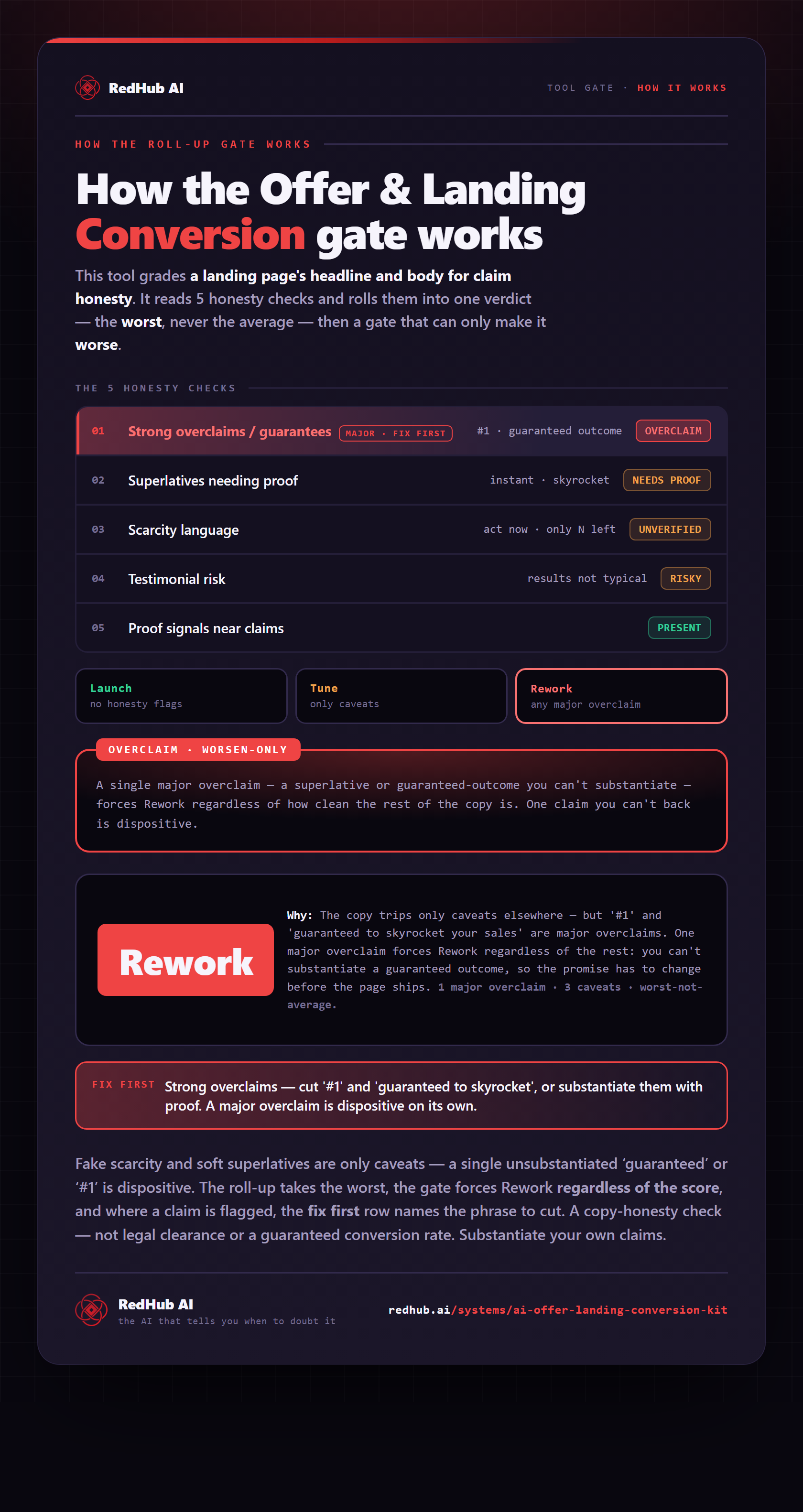
The gate this post refers to, drawn from the tool’s own logic. See the tool.