How to Write an Offer People Actually Buy (The Offer Stack)
RedHub AI Editorialupdated September 7, 20265 min read

Jump to a section8
TL;DR
- What it is: a way to build an offer — value stacked on one side, risk removed on the other — so buying feels like an obvious yes.
- Who it's for: founders and marketers whose page reads fine but still doesn't sell. See the conversion kit.
- How it works: lead with the core result, stack the value around it, then reverse the risk so saying yes feels safe.
- Bottom line: the offer does more selling than the copy. Get it right and the page just has to be clear. Marketing guidance, not legal advice.
How do you write an offer people actually buy?
You build an offer stack: start with the core result the buyer wants, add the pieces that make reaching it faster or easier (so the total value clearly exceeds the price), and then reverse the risk with a guarantee, trial, or easy exit so the fear of a wrong decision disappears. A strong offer answers "why is this worth more than what I'm paying?" and "what happens if it doesn't work for me?" before the buyer has to ask. When the offer is genuinely good, honest copy sells it; when it's weak, no clever copy will.
Best for: pages that read clearly but don't convert — the fix is usually the offer. The Conversion Kit includes an offer-stack worksheet. Marketing guidance, not legal advice.
When a landing page reads well and still doesn't convert, the problem is almost never the words — it's the thing the words are selling. A weak offer can't be rescued by copy, design, or a bigger ad budget. So before you polish another headline, build the offer itself. It has two sides: value and risk.
Side one: stack the value
An offer stack starts with the core result — the actual outcome the buyer is paying for — and adds the pieces that make that result faster, easier, or more certain. Each piece should move the buyer closer to the outcome, not pad a bullet list. The goal is that the total value visibly exceeds the price, so the buyer's math flips from "is this worth $X?" to "I'm getting all this for only $X?"
| Layer | What it is | Example |
|---|---|---|
| Core result | The main outcome | A landing page that converts |
| Speed | Gets them there faster | Section-by-section templates |
| Certainty | Makes success more likely | A scorecard + honesty check |
| Ease | Removes effort | Ready-to-use prompts and swipe files |
Key insight: only stack things that move the buyer toward the core result. Padding the offer with unrelated "bonuses" dilutes it — a focused stack that all points at one outcome is more persuasive than a long list that wanders.
Side two: reverse the risk
Even a high-value offer stalls if saying yes feels risky. Risk reversal moves the fear of a wrong decision off the buyer's shoulders: a guarantee, a trial, an easy exit, a "keep it even if you refund" bonus. The stronger and more specific the reversal, the easier the yes — but it has to be real. A guarantee you won't honor isn't risk reversal; it's a claim you can't back, and buyers increasingly sense the difference.
Build the offer before you write the page
The Conversion Kit's offer-stack worksheet and prompts turn a feature list into a reason to buy now — value stacked, risk reversed — so the landing page has something strong to carry.
Get the Conversion Kit — $79 →Make the offer honest, or it backfires
There's a temptation to inflate an offer — invent a "$2,000 value" for a checklist, bolt on fake urgency, promise outcomes you can't control. It backfires. Buyers are fluent in hype now, and an offer that oversells triggers the exact skepticism you're trying to overcome. An honest offer names real value and real risk reversal, and it converts because the buyer believes it. If you have to inflate the offer to make it look good, the offer isn't good enough yet — fix the offer, don't fake it.
Where the offer comes from
A great offer grows out of clear positioning — knowing exactly who you're for and why you're different. If your offer feels generic, the problem may be upstream: you haven't sharpened the positioning it should express. Nail down who it's for and what makes you the obvious choice, and the offer almost writes itself. Then the landing page just has to communicate it.
Read the pillar on conversion copywriting, then how to write the page that carries your finished offer. If the positioning underneath is fuzzy, the Founder's Positioning Forge sharpens it first.
Decision Guide
Use it if: your page reads clearly but still doesn't sell — the offer is the likely culprit.
Skip it if: your offer already converts well and you're only tuning copy details.
Best first step: write the core result in one line, then list only the pieces that make reaching it faster, more certain, or easier.
FAQ
What is an offer stack?
It's an offer built as layers: the core result plus the pieces that make reaching it faster, more certain, and easier — so the total value clearly exceeds the price. A good stack all points at one outcome rather than padding a long bonus list.
What makes an offer irresistible?
Two things together: value that visibly outweighs the price, and risk reversal that removes the fear of a wrong decision. When the buyer sees big value and low risk, saying yes stops feeling like a gamble.
What is risk reversal?
Anything that shifts the risk of buying off the buyer — a guarantee, a free trial, an easy exit, a keep-it-anyway bonus. It has to be real and honored; a guarantee you won't stand behind is a claim you can't back, and buyers sense it.
Should I inflate the offer's stated value?
No. Invented "$2,000 value" tags and fake urgency trigger the skepticism you're trying to overcome. Name real value and real risk reversal. If you have to inflate the offer to make it look good, the offer isn't strong enough yet — improve it instead.
My copy is fine but I'm not selling — what's wrong?
Usually the offer, not the copy. A weak offer can't be rescued by wording, design, or more traffic. Rebuild the offer stack first — value and risk reversal — then let the page communicate it clearly.
Where does a strong offer come from?
Clear positioning. If the offer feels generic, the positioning upstream is probably fuzzy — you haven't pinned down who it's for and why you're the obvious choice. Sharpen that and the offer follows naturally.
Fix the offer, and the page gets easy
Stack real value, reverse real risk, keep it honest. Marketing guidance, not legal advice.
Get the Conversion Kit — $79 →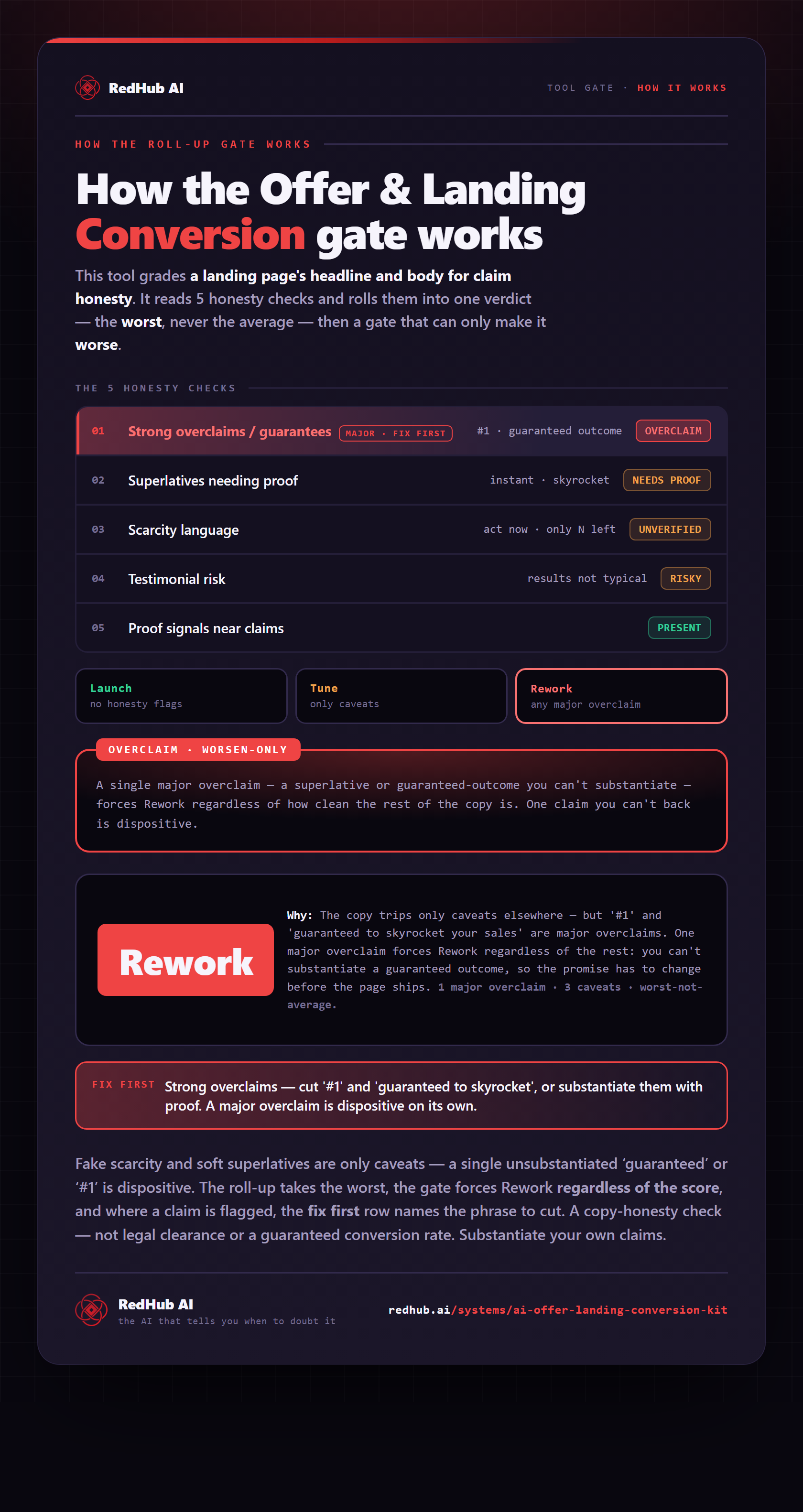
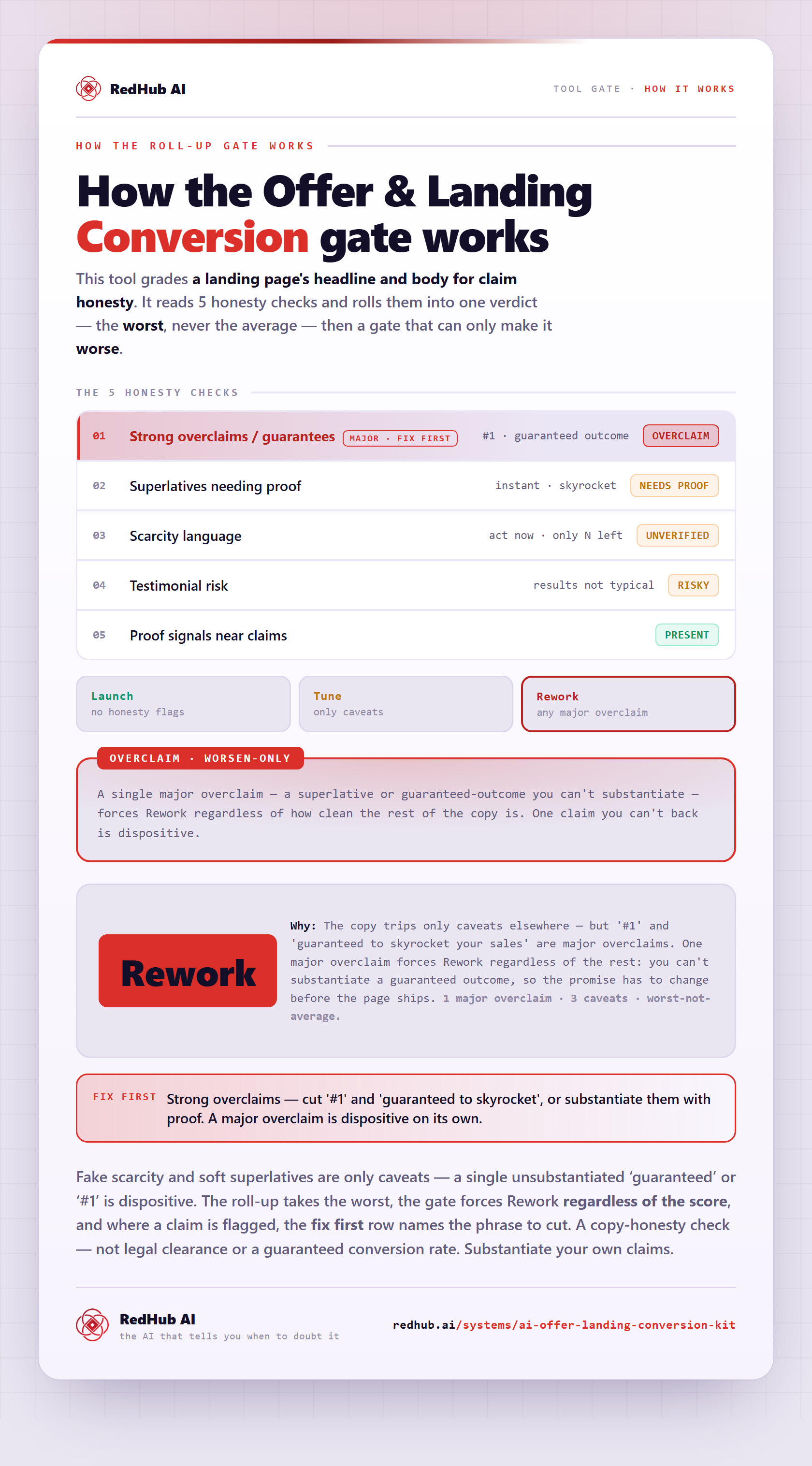
The gate this post refers to, drawn from the tool’s own logic. See the tool.