Landing Page Mistakes That Quietly Kill Conversions
RedHub AI Editorialupdated September 7, 20264 min read

Jump to a section7
TL;DR
- What it is: the seven quiet mistakes that leak conversions on pages that otherwise look fine.
- Who it's for: anyone whose page gets traffic but too few conversions. See the conversion kit.
- How it works: most are fixable in an afternoon — a vague hero, missing proof, fake scarcity, too much friction, competing CTAs.
- Bottom line: you rarely need a redesign. You need to fix the specific leaks. Marketing guidance, not legal advice.
Why isn't my landing page converting?
Most underperforming landing pages share the same handful of mistakes: a vague hero that doesn't say what you offer or who it's for, claims with no proof beside them, fake scarcity that reads as dishonest, too much friction (long forms, slow load, competing links), and multiple calls to action that split the visitor's attention. None of these require a redesign — they're specific, fixable leaks. Score the page against them, fix the biggest one first, and conversion usually moves without touching the design.
Best for: diagnosing a flat page fast — the Conversion Kit's scorecard turns this list into a checklist. Marketing guidance, not legal advice.
A landing page rarely fails all at once. It leaks — a few visitors lost to a vague headline, a few more to a missing proof point, a few to a confusing second button. Each is small; together they quietly halve your results. Here are the seven that do the most damage, and the fix for each.
The seven quiet conversion killers
| Mistake | Why it leaks | The fix |
|---|---|---|
| 1. Vague hero | Visitor can't tell what you offer or if it's for them | One specific line: the outcome + the audience |
| 2. Claims with no proof | Promises read as boasts | Put evidence next to each claim |
| 3. Fake scarcity | One fake signal makes everything look fake | Real scarcity or none |
| 4. Too much friction | Long forms, slow load, competing links | Cut fields, speed it up, remove nav |
| 5. Competing CTAs | Split attention = no action | One action, repeated |
| 6. No objection handling | The "yeah, but…" goes unanswered | A short objection FAQ |
| 7. Wall of hype | Superlatives trigger skepticism | Specific, provable statements |
The three that cost the most
All seven leak, but three do the heaviest damage:
- The vague hero. If a visitor can't tell what you offer in about five seconds, nothing below the fold matters — they're already gone. This is almost always the highest-leverage fix on the page.
- Missing proof. Every promise you make without adjacent evidence is a claim the reader has to take on faith, and most won't. Moving proof up next to each claim often lifts a page more than any rewrite.
- Fake scarcity. A resetting countdown or a permanent "only 3 left" doesn't just fail — it makes the reader distrust every other claim on the page. Remove it and your honest claims regain their weight.
Key insight: fake scarcity is uniquely expensive because its damage spreads. One obviously-fake signal retroactively discounts your true claims, so removing it can lift conversion even though you "took something off" the page.
Turn this list into a scorecard
The Conversion Kit's Conversion-Ready Scorecard grades your page on clarity, proof, relevance, friction, and honesty, and its claim check flags fake scarcity and missing proof — so you fix the real leaks, not guess.
Get the Conversion Kit — $79 →Fix the leaks before you redesign
The instinct with a flat page is to redesign it — new layout, new colors, new everything. That's expensive and usually unnecessary. Most conversion problems are copy and structure, not visual design: a page that looks great but has a vague hero and no proof will still leak. Work the seven-mistake list first. If the page scores clean on all seven and still underperforms, then look upstream at the offer or the traffic-to-page match — and only then consider design.
Cheap, high-impact fixes
- Rewrite the hero to be specific
- Move proof next to claims
- Remove fake scarcity and extra CTAs
Expensive, often unnecessary
- Full visual redesign
- New brand and imagery
- Rebuilding before diagnosing
For the full method, read the pillar on conversion copywriting and how to write the page section by section.
Decision Guide
Use it if: your page gets traffic but converts poorly and you want the specific leaks, not a redesign.
Skip it if: you have no traffic yet — there's nothing to convert until visitors arrive.
Best first step: score your page against the seven mistakes and fix the vague hero first — it's usually the biggest leak.
FAQ
What are the most common landing page mistakes?
A vague hero, claims with no adjacent proof, fake scarcity, too much friction (long forms, slow load, competing links), multiple competing CTAs, no objection handling, and a wall of hype. Most are copy and structure problems, not design.
What's the single biggest conversion killer?
The vague hero. If visitors can't tell what you offer and whether it's for them within about five seconds, nothing below matters — they've already left. Fixing the hero is usually the highest-leverage change on the page.
Why is fake scarcity so damaging?
Because its damage spreads. A resetting countdown or a permanent "only 3 left" reads as dishonest, and one obviously-fake signal makes the reader distrust every other claim on the page. Removing it can lift conversion even though you took something off.
Do I need to redesign my landing page?
Usually not. Most conversion problems are copy and structure, not visual design — a beautiful page with a vague hero and no proof still leaks. Fix the seven mistakes first; only consider a redesign if the page scores clean and still underperforms.
How many CTAs should a landing page have?
One action, repeated. You can place the same CTA several times, but it should always ask for the same thing. Competing calls to action split the visitor's attention and give them a reason to leave without choosing.
Is any of this a legal issue?
This is marketing guidance, not legal advice, but two mistakes touch on it: fake scarcity and unbackable claims can create substantiation problems, not just conversion ones. Use real scarcity or none, substantiate your claims, and use only genuine testimonials.
Fix the leaks, keep the design
Vague hero, missing proof, fake scarcity — the quiet killers, and the cheap fixes. Marketing guidance, not legal advice.
Get the Conversion Kit — $79 →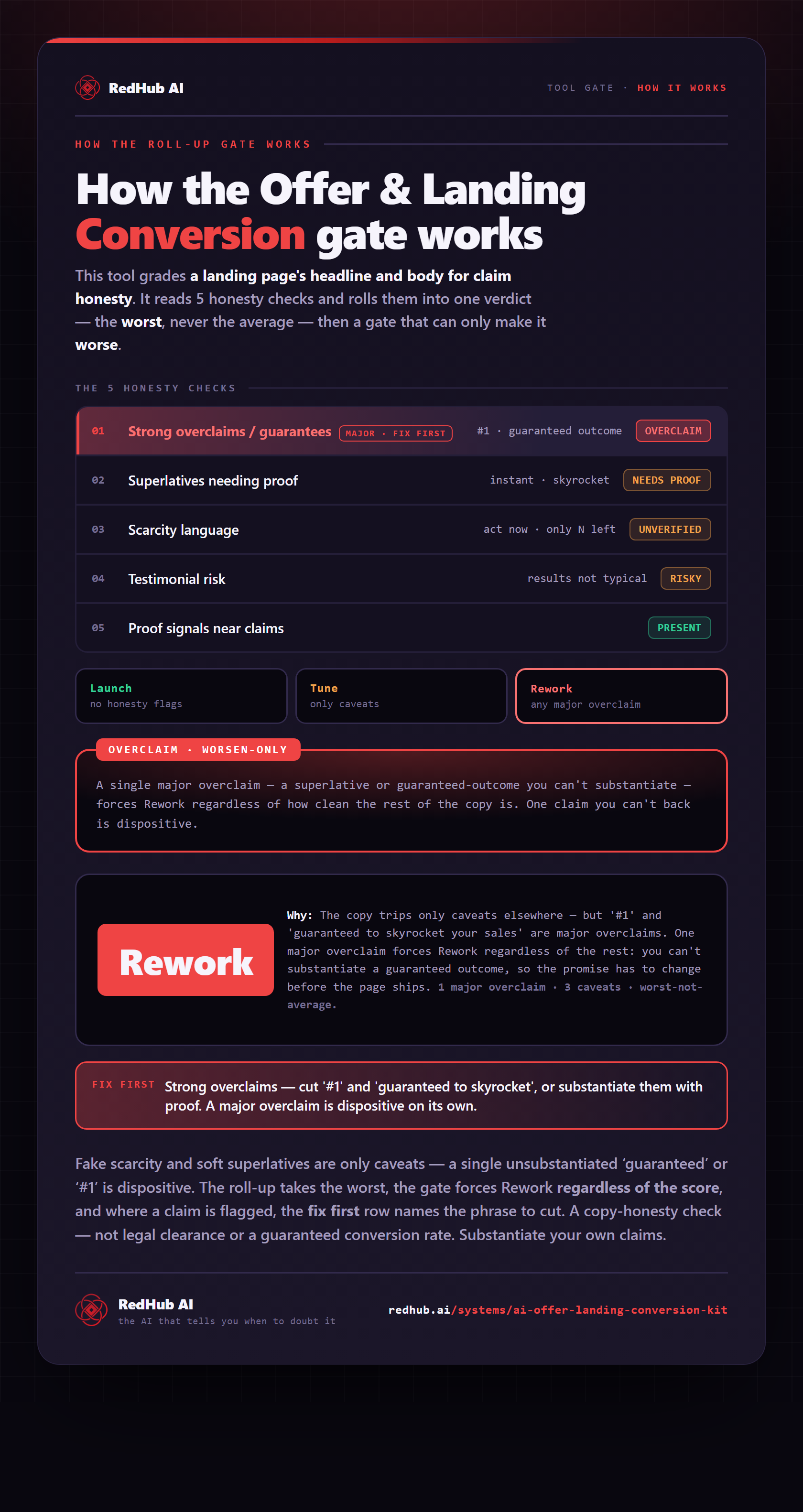
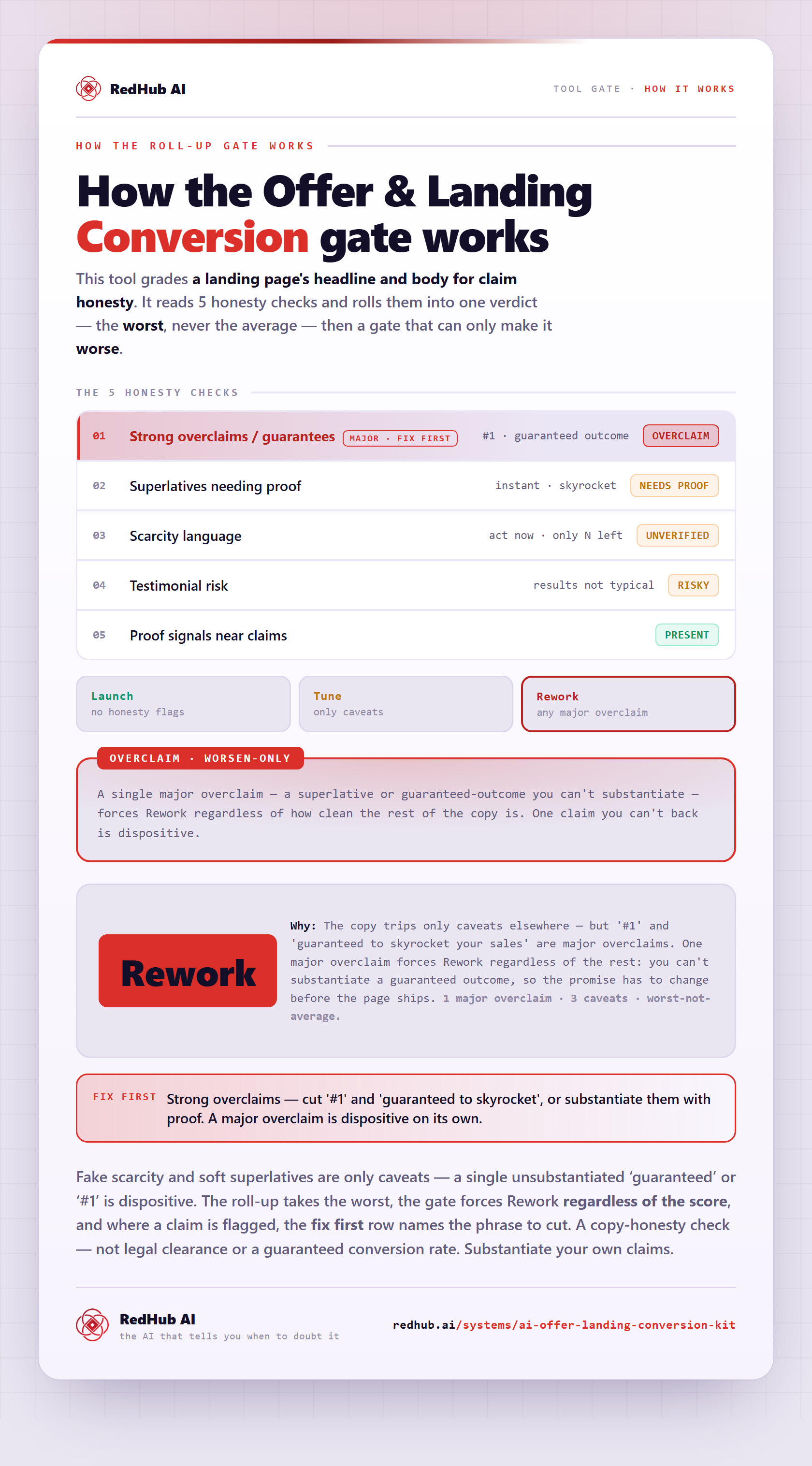
The gate this post refers to, drawn from the tool’s own logic. See the tool.