Correlation vs Causation: The Mistake AI Will Confidently Make for You
RedHub AI Editorialupdated October 5, 20265 min read

Jump to a section8
Correlation vs causation comes down to one question: did one thing make the other happen, or did the two only move together? A spreadsheet can show that they moved together. It almost never proves the cause. AI blurs the line because "the promotion drove sales" sounds more useful than "sales rose while the promotion ran," and the model delivers the stronger sentence in the same tone it uses for everything else.
TL;DR: Two things moving together in a spreadsheet are correlated. That does not show one caused the other. AI routinely collapses the difference with words like "drives," "causes" or "leads to." Read every AI-stated cause as a hypothesis, ask what evidence beyond the spreadsheet supports it, and match the proof you demand to how costly the decision is to reverse. The AI Data Analysis Starter Kit ($79) tells the model to keep the two apart in every prompt.
Why AI keeps making this mistake
Language models write fluent sentences, and "the promotion drove the sales increase" is more fluent and more satisfying than "sales rose during the promotion, and other factors weren't ruled out." The model is producing the sentence that sounds most like a useful conclusion, and causal language sounds more decisive than correlational language. So the error tends to run one way: toward overclaiming cause.
What a spreadsheet can and can't tell you
- Can tell you: two variables moved together, in which direction, and how strongly.
- Can't tell you on its own: which one, if either, caused the movement, whether a third factor caused both, or whether it was coincidence.
Showing a cause usually takes something the spreadsheet does not hold: a controlled comparison, a known mechanism, or a change isolated from every other variable. Historical data on its own rarely clears that bar.
Phrases that mean "correlation, not causation"
Watch for these in AI output. Each one is a correlational finding written as a causal one:
- "X drives Y" or "X is driving the increase in Y"
- "X caused, led to or resulted in Y"
- "Because of X, Y improved"
- "X is responsible for the change in Y"
A worked example of the trap
A support spreadsheet shows average response time falling the same month a new hire started. AI will often say outright that the new hire caused the improvement. But that month might also have had lower ticket volume, a process change or a seasonal dip. The correlation is real. The single-cause story is a guess. The accurate version reads: "Response time improved in the month the new hire started; other changes that month weren't ruled out."
When acting on a likely cause is reasonable
Most businesses cannot run a controlled test for every question, and waiting for proof has a cost too. If the new hire looks like the reason response time fell, giving that person the hardest queue next month is cheap and easy to undo. Acting on the likely story there is sensible, as long as everyone knows it is a likely story.
The same story is a poor basis for a decision you can't easily walk back, such as hiring three more people on the theory that headcount fixes response time. Where the line falls between those two cases depends on your budget and your patience, and no rule settles it for you.
How to prompt against it
- Tell the model: "State correlations only. Do not use causal language unless I ask you to evaluate causation."
- When a causal claim shows up anyway, ask "what would rule out other explanations here?" and judge whether the answer is convincing or only plausible.
- Ask the model to name the confounders worth ruling out: the other things that changed in the same period.
- Re-read your own summary before sharing it and turn any leftover "drives" or "causes" back into "correlates with."
Keep correlation and causation apart in every prompt
One of the five honesty rules in the AI Data Analysis Starter Kit tells the model never to imply X causes Y from the data alone and to name plausible confounders worth ruling out. It is an instruction to the model, so every analysis also ends with a VERIFY BEFORE ACTING list. One-time $79.
Get the AI Data Analysis Starter Kit — $79Pairs well with
The AI Over-Reliance & Critical-Thinking Check ($69) seeds AI text with plausible-but-false claims, biased framing and a fabricated statistic, then scores how many you catch as INDEPENDENT, ASSISTED or RELIANT. The AI Fluency Diagnostic ($79) scores a team across six AI skills, verification among them, and holds anyone below 3 out of 5 on verification or safety at AWARE however strong the rest. And because a spurious pattern can come from sources that disagree, the Multi-Source Data Reconciliation Engine ($89) checks that your systems agree, key by key, returning RECONCILED, FIX or NOT RECONCILED before you analyze.
More in this guide
Can I trust AI when it says one thing in my data caused another?
Not without checking. Look for real evidence such as a controlled test or a known mechanism rather than accepting the claim because the sentence sounds confident. A spreadsheet alone usually can't prove causation.
What's the difference between correlation and causation in plain terms?
Correlation means two things moved together. Causation means one of them made the other happen. A spreadsheet can show you the first. Proving the second usually needs evidence from outside the spreadsheet.
Why does AI keep phrasing correlation as causation?
Causal words like "drives" and "causes" sound more decisive and useful than correlational ones, and language models are built to produce fluent text, not to match a claim's strength to what the data proves.
How do I stop AI from making causal claims in my data analysis?
Tell it to state correlations only and to avoid causal language unless you ask it to evaluate causation. Ask it to name the confounders worth ruling out, and re-read the output for "drives," "causes" and "leads to" before you share it.
Is it ever okay to act on a cause the data only suggests?
Yes, when the decision is cheap and easy to reverse and everyone knows it rests on a likely story, not proof. For costly or hard-to-reverse decisions, look for a controlled comparison or a known mechanism first.
Does the AI Data Analysis Starter Kit handle correlation vs causation?
Its prompts tell the model never to imply X causes Y from the data alone and to name plausible confounders, alongside confidence levels and small-sample flags. That is an instruction, not a guarantee, so each analysis ends with a VERIFY BEFORE ACTING list. $79, one-time.
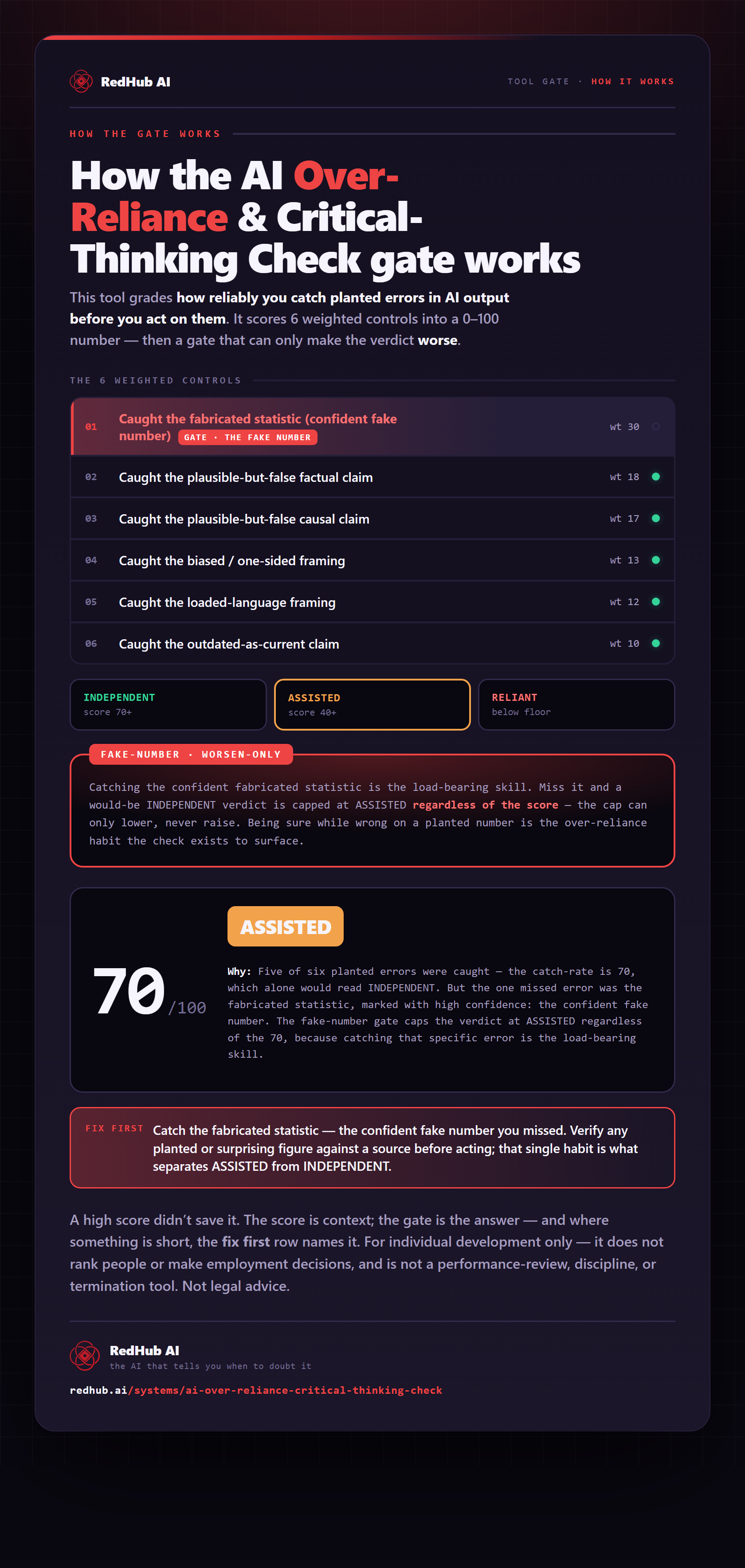
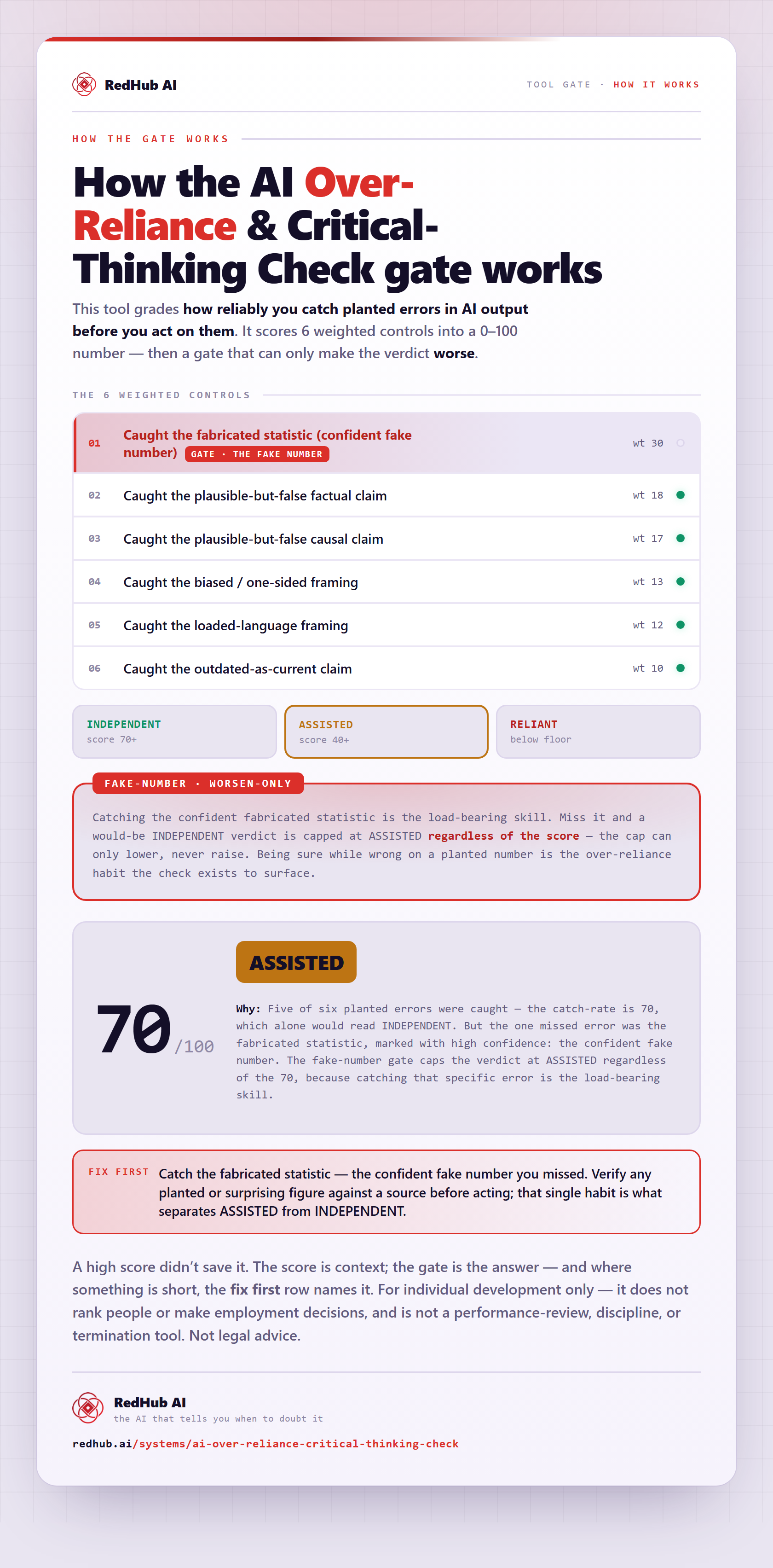
The gate this post refers to, drawn from the tool’s own logic. See the tool.