How to Create Content Consistently (Solo)
RedHub AI Editorialupdated August 18, 20264 min read

Jump to a section9
TL;DR
- What it is: a repeatable system for planning, making, and publishing content on your own without burning out.
- Who it's for: solo creators and founders who are the whole content team — see the Content Engine for One Person.
- How it works: four parts — pillars, a calendar, batching, and idea capture — that remove the daily "what do I post?" decision.
- Bottom line: consistency comes from a system that removes decisions, not from more motivation or more hours.
How do you create content consistently on your own?
You create content consistently by building a system that removes decisions, not by finding more willpower. For a team of one, four parts do it: content pillars (a few topics you always post about), a simple calendar (so you're never staring at a blank week), batching (make many pieces in one focused session), and a way to capture ideas before they vanish. Consistency isn't a personality trait — it's what's left when you stop deciding what to post from scratch every day.
Best for: the one-person show. The Content Engine for One Person puts all four in one spreadsheet.
Solo content doesn't die from lack of talent. It dies from decision fatigue: every day you have to decide what to post, then make it, then publish it — and on a busy week, the deciding is what breaks first. The fix isn't trying harder. It's a system that answers "what do I post?" before you ever sit down. Here are the four parts, and how they fit for a team of one.
Why solo content breaks (and it's not motivation)
The one-person creator has no editor, no calendar someone else fills, no teammate to hand a rough draft to. Every stage is you. So the load isn't just making content — it's the constant deciding, remembering, and context-switching around it. That's what causes the burnout-then-silence cycle every solo creator knows: three great weeks, then nothing for a month. A system removes the deciding so the making is all that's left.
The four parts of a one-person content system
| Part | The decision it removes |
|---|---|
| Pillars | "What am I even about?" — a few topics you always post on |
| Calendar | "What do I post today?" — the slot is already filled |
| Batching | "When will I find time?" — you made a month in one session |
| Idea capture | "What's a good idea?" — you already wrote it down |
Each part has its own method — the linked posts go deep on all four. Together they turn content from a daily improvisation into a system you run.
What cadence can you actually keep?
Before you promise yourself "daily," do the honest math. The best cadence is the one you can sustain for a year, not the one that looks impressive for three weeks.
Your sustainable cadence
A directional estimate on your own numbers — batching lowers the minutes per piece, which is the whole point.
The anti-generic rule
The risk of any content system — especially one using AI to draft faster — is sounding like everyone else. A system should make you more consistent, not more generic. Use AI to beat the blank page and speed the draft, but keep your own voice, your own take, your own examples on top. The Content Engine ships prompt blocks that draft from your pillars, and pairing it with a Brand Voice Engine keeps the output sounding like you, not like a feed of sameness.
Consistency beats virality for a solo creator. One good post a week for a year builds an audience; ten posts in a burst then silence doesn't. The system optimizes for the thing that actually compounds — showing up.
Your whole content team, in one spreadsheet
Pillars, calendar, a repurposing matrix, and 13 AI prompt blocks — the one-person system for posting consistently without burning out.
Get the Content Engine — $39 →What the system doesn't do
Honest scoping: a content system makes you consistent — it doesn't make you go viral, and it won't write the content for you. You still bring the ideas, the voice, and the work; the system removes the friction and the decisions around it. If you're making video specifically, the consistency system feeds it, but the platform-specific craft (hooks, watch time, repurposing clips) is its own thing — see the Short-Form Video System for that layer.
Decision Guide
Build a system if: you start strong and go silent — the burnout-then-nothing cycle is a system problem, not a you problem.
Keep it light if: you're tempted to over-engineer — four simple parts beat a complex workflow you won't keep.
Best first step: set your pillars, then batch one week of content in a single session.
Common Questions
How do I stay consistent with content alone?
Build a system that removes decisions: pillars (what to post), a calendar (when), batching (make many at once), and idea capture. Consistency is a system, not willpower.
Why do I keep starting and stopping?
Decision fatigue. Deciding what to post every day is the load that breaks first on a busy week. A system decides ahead of time, so only the making is left.
How often should a solo creator post?
At the cadence you can keep for a year, not the one that looks impressive for three weeks. Do the honest math on your real available hours first.
Will AI make my content generic?
It can, if you let it write for you. Use it to beat the blank page and draft faster, then add your voice, take, and examples on top. A brand-voice layer helps keep it yours.
Do I need a big tool or team?
No — four simple parts in one place cover a solo operation. The Content Engine fits it all in a single spreadsheet.
Does a content system guarantee growth?
No. It makes you consistent, which is what compounds — but it won't make you go viral or write the content for you. You bring the ideas and the voice.
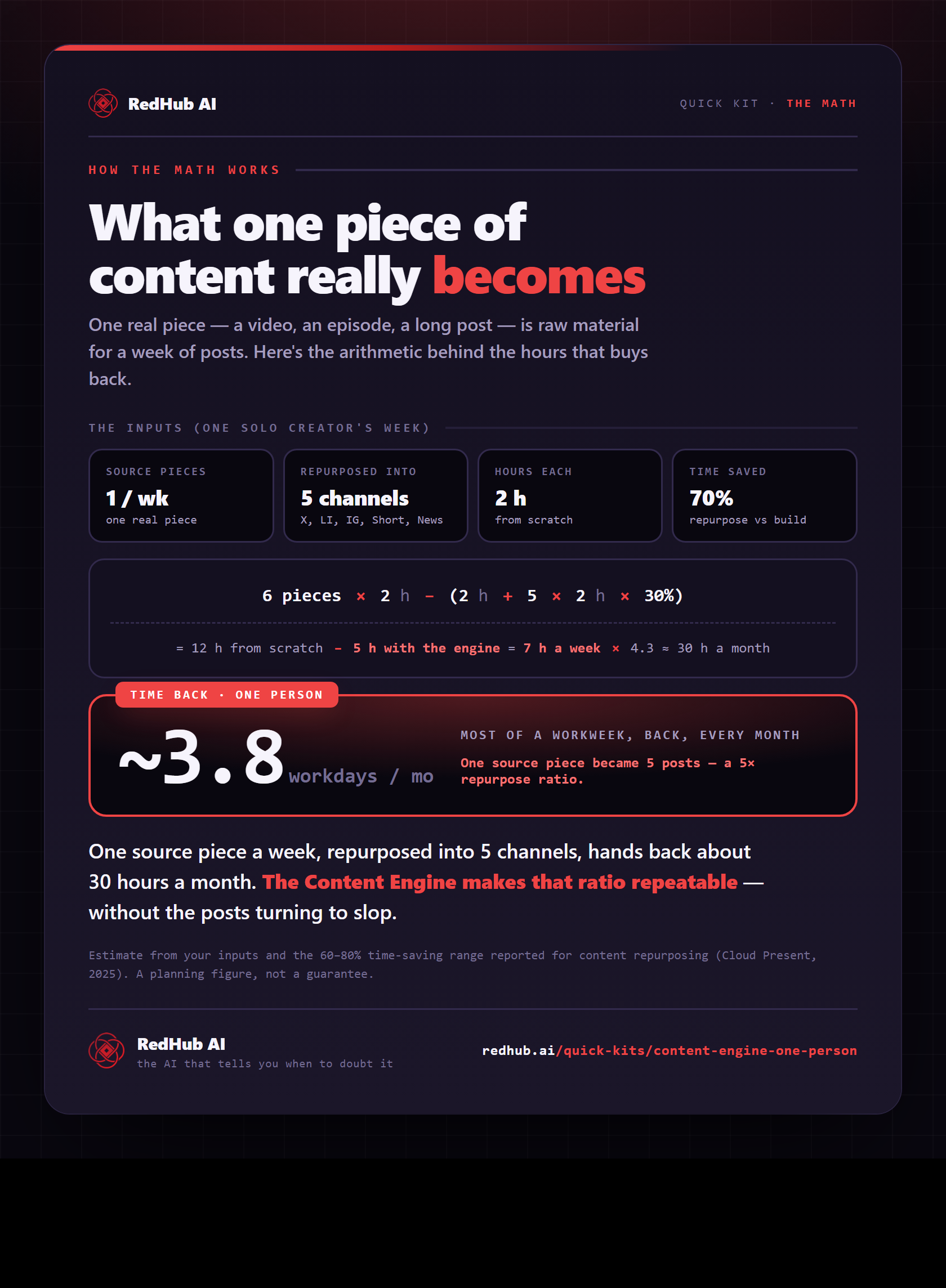
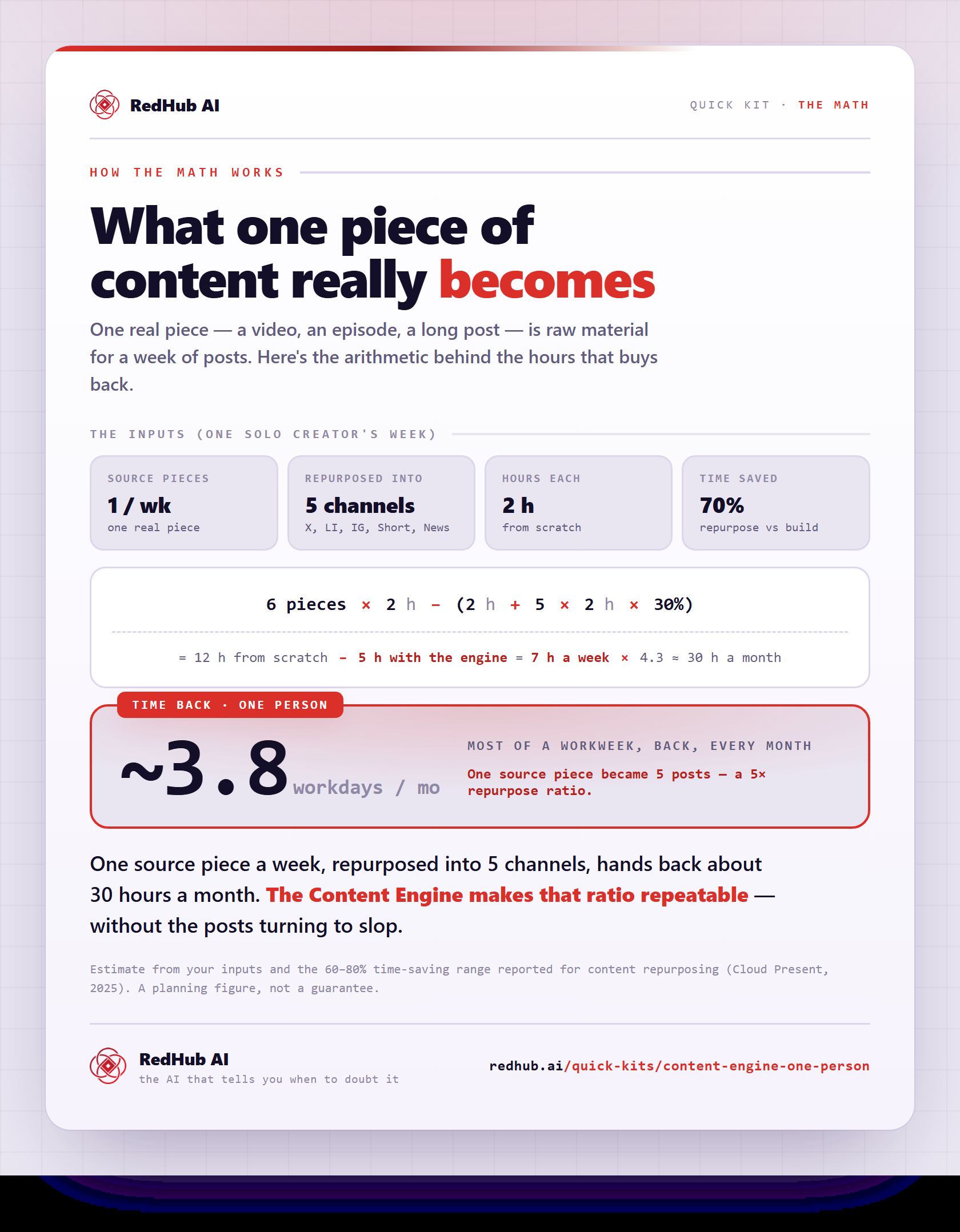
The gate this post refers to, drawn from the tool’s own logic. See the tool.