CAC: How to Calculate Customer Acquisition Cost (and What It Should Be)
RedHub AI Editorialupdated October 5, 20266 min read

Jump to a section8
Customer acquisition cost (CAC) is the average amount you spend to win one new paying customer: your total sales and marketing spend for a period, divided by the new customers you closed in that same period. The division takes a second. The judgment sits in three places: what you count as spend, which period you pick, and what you compare the result with. A CAC figure alone cannot tell you whether $200 a customer is cheap or ruinous. That depends on what the customer is worth to you and how fast they pay you back.
TL;DR: CAC = (sales spend + marketing spend) ÷ new customers acquired, for the same period. Count salaries, commissions and tools, not only ad spend. There is no universal "good" CAC. Read it next to payback period and the LTV:CAC ratio, and turn it into a payback timeline with gross margin, not revenue. Every figure here is an estimate built from your own inputs, not an audited number. This is general information, not financial advice.
The CAC formula
CAC = total sales and marketing spend ÷ new customers acquired
Spend $10,000 in a month, close 50 new customers, and your CAC is $200.
The usual error is in the numerator. It is easy to count what shows up on an ad invoice and skip what shows up on payroll, and that makes a losing channel look fine for another quarter.
What counts as spend
- Ad spend, the one everyone remembers.
- Salaries and commissions for anyone whose job is winning new customers, not serving existing ones.
- Marketing salaries and the tools they run on: email platform, ad manager, landing-page builder.
- Content and creative: freelancers, agencies, and internal design and copy time spent on acquisition.
- Acquisition data and tech: attribution tools, CRM seats for sales development reps, paid data enrichment.
If a person closes your deals, their cost belongs in CAC. Leaving it out does not make acquisition cheaper. It moves the cost to a line nobody connects to growth.
Pick your period, and know what it hides
CAC is a period metric: a month, a quarter, whatever matches your sales cycle. The trouble starts when spend and customers come from different months. Say deals take about a month to close. You spend $10,000 in March and $15,000 in April, and 50 customers close in April. Same-month CAC divides April's spend by April's customers and reads $300. Lagged CAC divides March's spend by those same customers and reads $200. Same customers, two answers.
A lag is closer to the truth when the cycle is steady. It gets harder when some deals close in a week and others take a quarter, because no single lag fits every deal. A rising budget makes same-month CAC look worse than it is, and a falling one makes it look better for a month or two. Pick one rule, write it down, and use it every period. A sudden jump in CAC right after a budget change deserves a second month of data before anyone acts on it.
Try it: CAC and payback from your own numbers
Enter your own numbers below. The calculator divides spend by customers to get CAC, then divides CAC by monthly gross margin per customer to estimate how many months it takes to earn that cost back. It uses gross margin, not revenue, because revenue you didn't keep hasn't paid anything back. It is a decision aid built from your inputs, not an audited number and not financial advice.
CAC & payback — quick estimate (illustrative)
What CAC should be
There is no fixed target CAC. A $200 CAC is cheap for a customer who stays three years at a healthy margin and reckless for one who leaves in four months. CAC becomes useful when you pair it with two other numbers:
- How long until it pays back? That is the payback period: CAC divided by the monthly gross margin the customer generates.
- What is the customer worth? Lifetime value divided by CAC is the LTV:CAC ratio.
The two guidelines quoted most often come from venture investor David Skok. In SaaS Metrics 2.0 (opens in a new tab) (2013), he wrote that "the best SaaS businesses have a LTV to CAC ratio that is higher than 3," and that profitability is "anemic" when recovering CAC takes longer than 12 months. He also stressed that "these are only guidelines." They were written about subscription software. A local service business funding growth from this month's cash may need a much shorter payback, and a company with cheap capital can wait longer.
Why a blended CAC hides the decision
The number that runs your budget is CAC per channel. In the sample data that ships with the CAC & Payback Calculator, five channels average out to a blended CAC of about $212. Underneath it, referral wins customers for $25 each and influencer one-offs pay $625. Neither channel looks like the average. Split spend and customers by channel and each one gets its own call. The CAC by channel post walks through the split, and how to lower CAC covers what to do with it.
See which channels pay back
The CAC & Payback Calculator is one .xlsx. Enter each channel's monthly spend, new customers, gross margin per customer per month and average lifespan. It returns CAC, payback period, LTV and LTV:CAC per channel, an Invest, Hold or Cut verdict, your blended CAC, and the monthly spend sitting in Cut channels.
Get the CAC & Payback Calculator — $49Pairs well with
The AI Marketing Measurement Kit ($99) covers the measurement behind your spend and customer counts, with a field guide to attribution models, a KPI tracker and a channel ROI workbook. The Investor-Ready Metrics Pack ($89) puts CAC beside the rest of a fundraising metrics set, including LTV, CAC payback, burn multiple and the Rule of 40. The Channel Continuation Assay ($99) asks a narrower question about one channel, whether it earned another cycle, and reads CUT IT when a channel produced nothing attributable and cost more per action than the ceiling you set.
More in this guide
What is a good CAC?
There is no universal good CAC. It only means something relative to payback period and LTV:CAC. A $500 CAC can be excellent for a customer worth $10,000 over three years and terrible for one who leaves in two months.
How do you calculate customer acquisition cost?
Divide total sales and marketing spend for a period by the number of new customers acquired in that same period. Include salaries, commissions and tools, not only ad spend, or you will understate the real cost.
Should CAC include salaries, or just ad spend?
Include salaries. Anyone whose job is winning new customers, such as sales reps, campaign managers and content producers, belongs in the numerator, along with the tools they use.
Is CAC the same as cost per lead?
No. Cost per lead divides spend by leads, before any of them become paying customers. CAC divides spend by closed customers, which is the number that matters for unit economics.
How often should I recalculate CAC?
Monthly at minimum, and by channel every time you change budget allocation. Use the same period rule each time, because a change in how you line up spend and customers can move CAC more than any real change in the business.
Does a lower CAC always mean a better channel?
Not by itself. A cheap channel that brings in customers who leave fast or spend little can be worse than an expensive channel with high-margin, long-staying customers. Read CAC next to payback period and LTV:CAC before deciding.
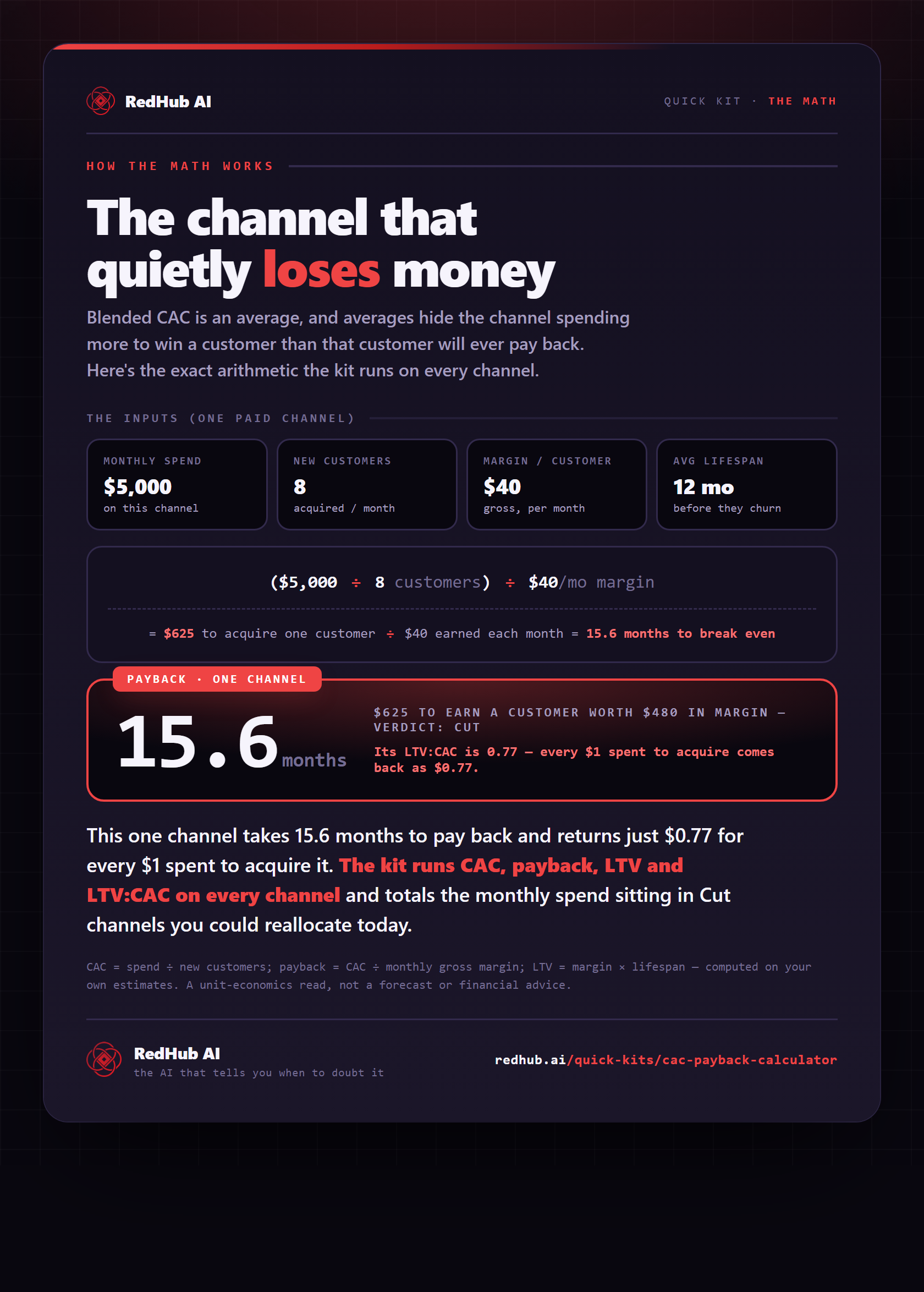
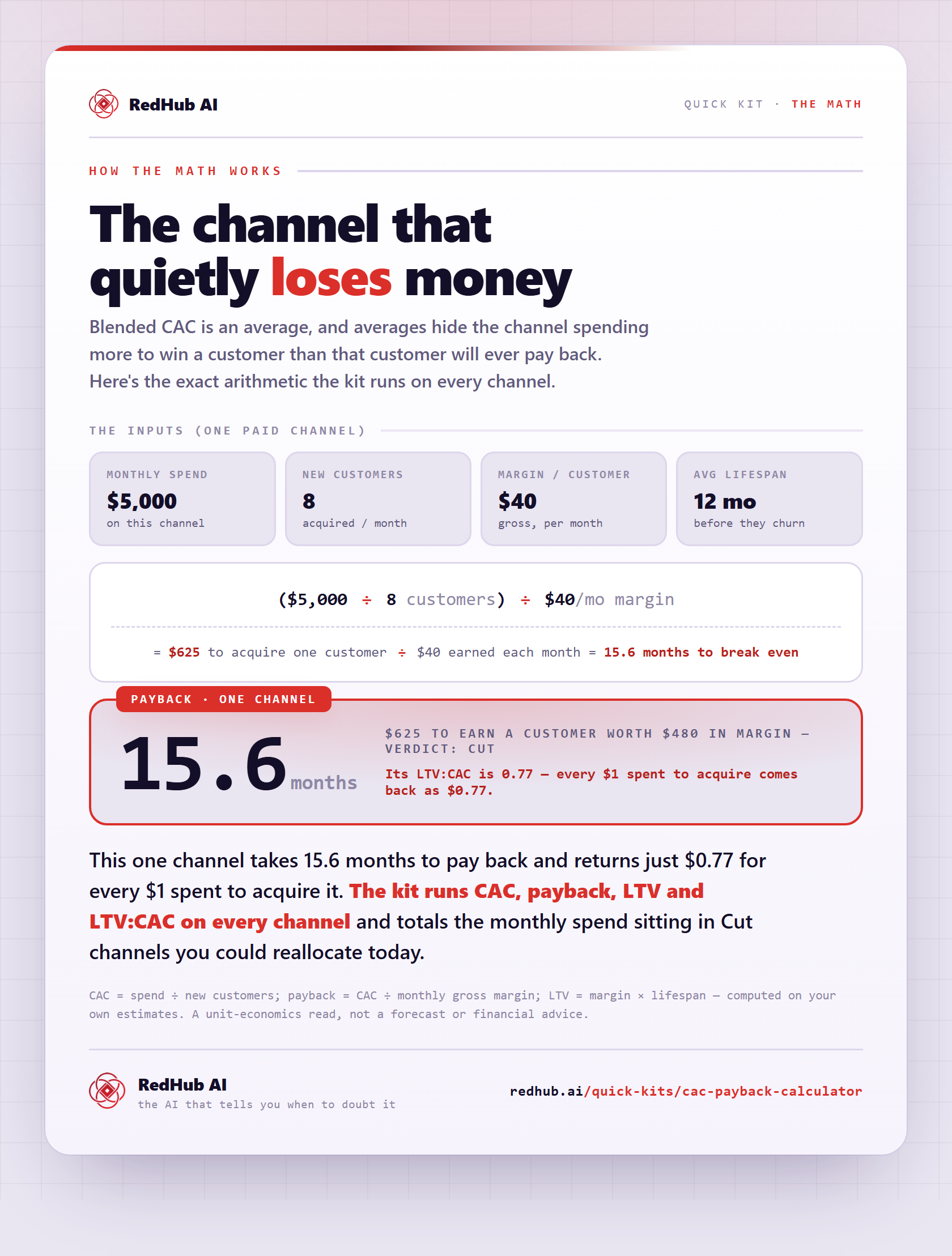
The gate this post refers to, drawn from the tool’s own logic. See the tool.