How to Calculate CAC by Channel (and Cut the Ones That Don't Pay)
RedHub AI Editorialupdated October 5, 20265 min read

Jump to a section7
A blended CAC of $212 can contain one channel winning customers for $25 and another paying $625 for each one. To calculate CAC by channel, divide each channel's own spend by the new customers attributed to that channel, using one attribution rule for every channel, then read payback period and LTV:CAC beside each result. The blended number is still correct arithmetic. It cannot tell you where to move budget, and the per-channel numbers can.
TL;DR: Channel CAC = that channel's spend ÷ customers attributed to that channel. A blended average hides your best and worst channels behind each other. Attribution is imperfect at any budget, and the rule you pick can change which channels look worth keeping, so pick one rule and apply it to every channel. This is general information, not financial advice.
The formula, applied per channel
Channel CAC = channel spend ÷ customers attributed to that channel
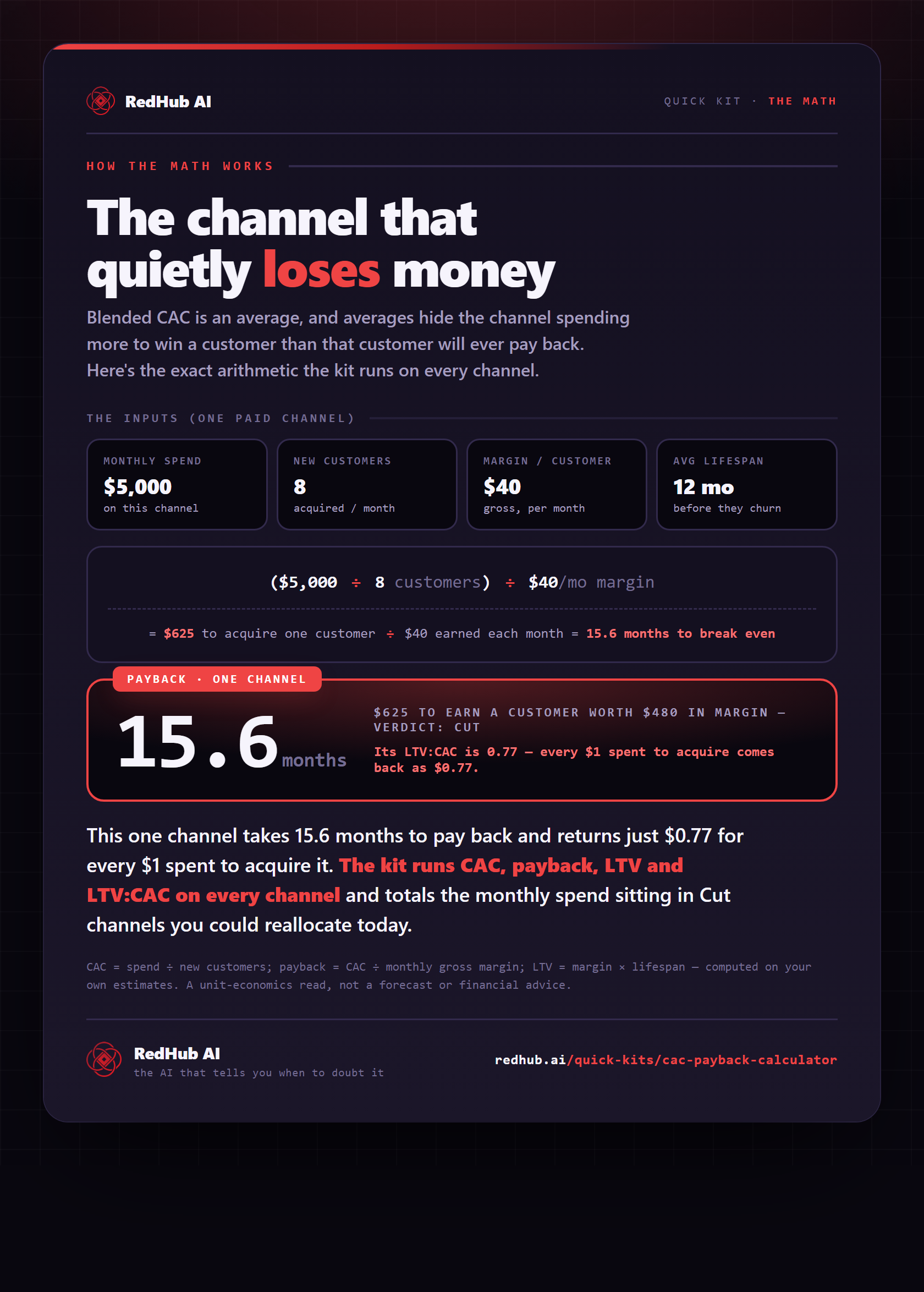
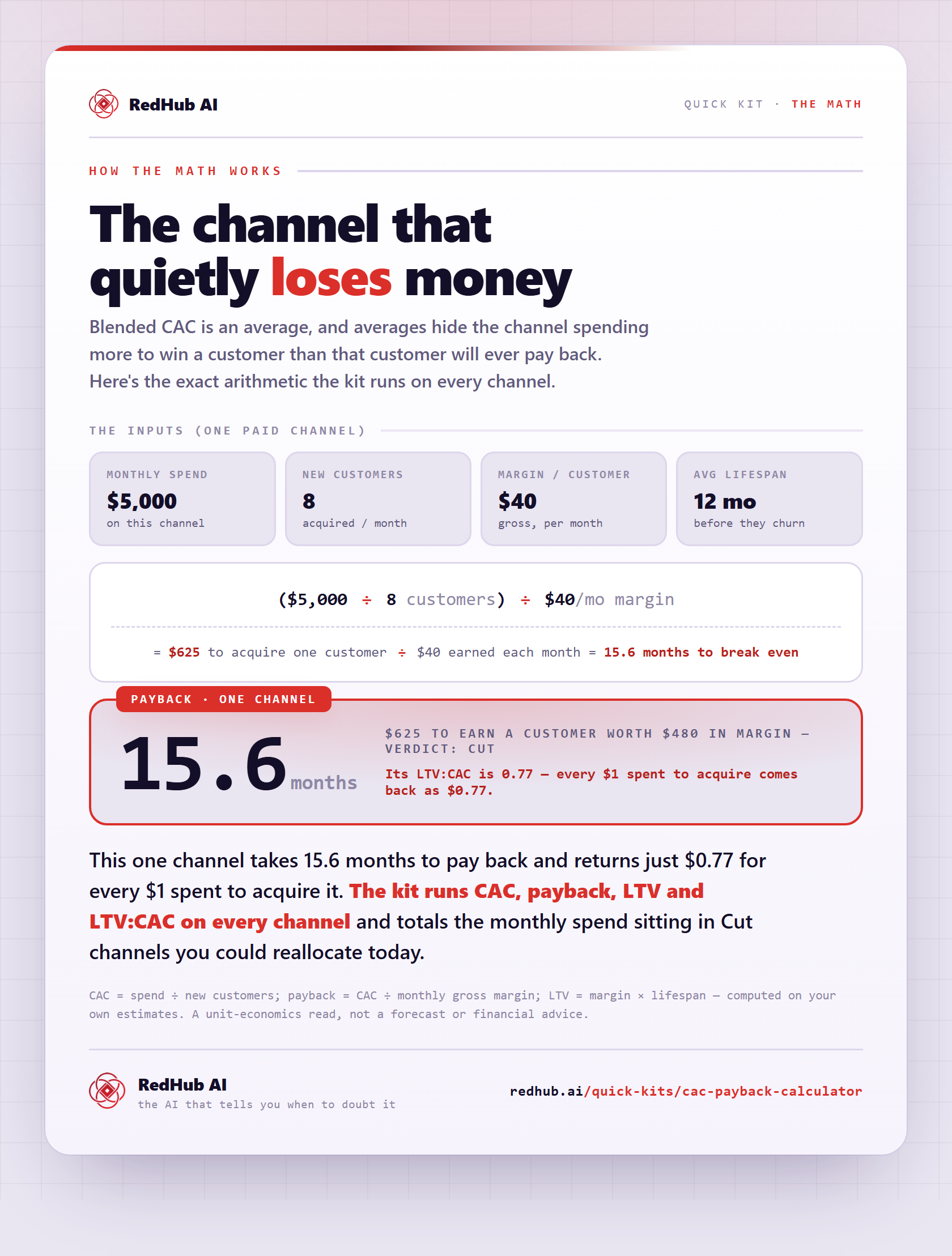
Paid search spend of $8,000 that brings in 25 customers is a $320 CAC. Influencer spend of $5,000 that brings in 8 customers is a $625 CAC. Same company, same month.
Five channels, one blended number
The table below is the sample data that ships with the CAC & Payback Calculator. Margin is $40 per customer per month on every channel except paid social, at $38, and average lifespans run from 12 to 24 months.
| Channel | Spend / mo | New customers | CAC | Payback | LTV:CAC | Verdict |
|---|---|---|---|---|---|---|
| Referral | $500 | 20 | $25 | 0.6 mo | 38.4:1 | Invest |
| Content / SEO | $3,000 | 30 | $100 | 2.5 mo | 9.6:1 | Invest |
| Paid social | $7,000 | 28 | $250 | 6.6 mo | 2.28:1 | Hold |
| Paid search | $8,000 | 25 | $320 | 8.0 mo | 2.25:1 | Hold |
| Influencer one-offs | $5,000 | 8 | $625 | 15.6 mo | 0.77:1 | Cut |
| All channels | $23,500 | 111 | $212 blended |
The blended $212 sits closest to paid social's $250 and describes neither end of the table. Referral is about one-eighth of it. Influencer one-offs are nearly three times it and lose money on every customer: each one stays 12 months on average and needs about 15.6 to pay back. Sample figures, not a real business.
Step by step: building the channel breakdown
- List every acquisition channel separately. Paid search, paid social, organic search, referral, outbound sales, partnerships, events: whatever brings you new customers.
- Assign spend to each channel. Direct ad spend is easy. Split shared costs, such as a marketer running three channels or a shared content budget, by time spent or share of leads, rather than dumping them into one bucket.
- Credit each new customer to one channel. First-touch, last-touch or a defined split: pick one and use it for every channel.
- Divide spend by customers, per channel. That is each channel's CAC.
- Add payback and LTV:CAC per channel before deciding anything. CAC alone does not tell you whether a channel is worth keeping.
The attribution rule can flip a verdict
Every per-channel CAC depends on which channel gets credit for each customer. Suppose 3 of paid search's 25 customers first heard of you from an influencer post and later searched for your name. Last-touch credits them to paid search, as in the table. First-touch moves them to the influencer line: 11 customers, a $455 CAC, an 11.4-month payback and a 1.06:1 ratio. Under that rule, the Cut becomes a Hold. Paid search drops to 22 customers and a $364 CAC, and stays a Hold.
Neither rule is the true one. Last-touch over-credits the channel that closes the sale; first-touch over-credits the channel that made the introduction. What you control is consistency: one rule for every channel, kept from month to month, never switched to rescue a channel you like. When a channel's verdict flips between rules, treat it as undecided and look for better evidence, such as an open "how did you hear about us?" field on your sign-up form. Our post on marketing attribution covers why the tools disagree in the first place.
Turning per-channel CAC into Invest, Hold or Cut
The CAC & Payback Calculator applies one rule to every row, reading the ratio and the payback together:
- Invest: LTV:CAC of 3 or better and payback within 12 months. Put more budget here.
- Hold: workable but not strong. Keep it steady, and tighten CAC or lift retention before scaling it.
- Cut: LTV:CAC under 1, or payback beyond 18 months. Reallocate the spend.
The 3:1 and 12-month bands are common rules of thumb, not guarantees, and the LTV:CAC ratio post covers where the 3:1 figure comes from and when it bends. In the sample, the Cut line holds $5,000 a month of spend that could go to the two Invest channels. How to lower CAC covers what happens when you move it.
Get an Invest, Hold or Cut call for every channel
The CAC & Payback Calculator is one .xlsx with the five-channel example above built in. Overwrite it with your own channels' spend, new customers, margin and lifespan, and it returns CAC, payback, LTV, LTV:CAC and a verdict per channel, plus your blended CAC and the monthly spend sitting in Cut channels.
Get the CAC & Payback Calculator — $49Pairs well with
Before you trust a per-channel CAC, check the attribution under it. The Attribution Integrity Ledger ($89) grades an attribution report and floors it to BLACK BOX when any deal's credit fails to add up to 100%. The Channel Continuation Assay ($99) decides whether one channel earned another cycle, with a gate that caps or cuts a channel that cannot show a result you can attribute at a cost under the ceiling you set. The AI Marketing Measurement Kit ($99) is the wider measurement method, including self-reported attribution and a channel ROI workbook.
More in this guide
How do you calculate CAC by channel?
Divide each channel's own spend by the new customers attributed to that channel, using the same attribution rule for every channel. Total company spend divided by total customers is blended CAC, not channel CAC.
Why not just use blended CAC?
A blended average hides your best and worst channels behind each other. It gives you the company-wide cost to acquire a customer but no lever to pull. Per-channel CAC shows which channel to fund and which to cut.
How do you attribute a customer to a channel fairly?
Pick one rule, such as first-touch, last-touch or a defined split, and apply it the same way to every channel, every month. Switching rules channel by channel makes the comparison meaningless.
Can the attribution rule change a channel's verdict?
Yes. Moving a few customers between channels can push a channel across a threshold. When a verdict flips between first-touch and last-touch, treat the channel as undecided and gather better evidence before cutting it.
What do I do with shared marketing costs?
Split them by a reasonable, consistent rule, such as time spent per channel or share of leads generated, rather than loading all of the shared spend onto one channel.
Is CAC alone enough to decide whether to cut a channel?
No. Read CAC alongside payback period and LTV:CAC for that channel. A channel with a higher CAC can still be worth keeping if its customers stay long and pay back fast.
The gate this post refers to, drawn from the tool’s own logic. See the tool.