CAC Payback Period: What It Is and How to Calculate It
RedHub AI Editorialupdated October 5, 20265 min read

Jump to a section8
Spend $200 to win a customer who leaves you $40 a month after delivery costs, and your CAC payback period is five months. That is the whole formula: CAC divided by monthly gross margin per customer. The denominator is where payback math usually goes wrong. Divide by the customer's $100 monthly revenue instead and you get two months, a number built on money you never kept.
TL;DR: Payback period = CAC ÷ monthly gross margin per customer. Use margin, never revenue. The 12-month line you see everywhere is a guideline from venture investor David Skok, not a rule, and your own ceiling is however long your cash can wait. Payback also assumes the customer is still paying when the payback month arrives, so check it against how long customers stay. This is general information, not financial advice.
Why margin, not revenue
A customer pays you $100 a month. Delivering the product or service costs you $60 of that. Your gross margin is $40, and only the $40 can pay back the $200 you spent acquiring them. Divide CAC by revenue and you get a 2-month payback. Divide by margin and you get 5. The revenue version is 2.5 times too optimistic here, and the gap widens as margins thin: at a 20% margin it would be 5 times.
Payback period (months) = CAC ÷ monthly gross margin per customer
$200 CAC ÷ $40 monthly gross margin = 5 months to earn back that acquisition.
A worked example, step by step
- Get your CAC. You spent $12,000 on sales and marketing and closed 60 new customers. CAC = $200.
- Find monthly gross margin. Average revenue per customer is $100 a month and delivery costs $60, so gross margin is $40.
- Divide CAC by margin. $200 ÷ $40 = 5 months for this cohort at this CAC.
Every input is an estimate you control, so the output moves when they do. If a supplier raises your delivery cost from $60 to $70, margin falls to $30 and the same $200 CAC now takes about 6.7 months to earn back. Nothing about your marketing changed, and payback got a third longer.
What's a good payback period?
The 12-month figure has a traceable source. Venture investor David Skok wrote in SaaS Metrics 2.0 (opens in a new tab) (2013) that profitability is "anemic" when recovering CAC takes longer than 12 months, and that "many of the best SaaS businesses are able to recover their CAC in 5-7 months." He stressed that "these are only guidelines." The CAC & Payback Calculator uses 12 months as part of its Invest bar and treats payback beyond 18 months as a Cut. Its own page calls those bands common rules of thumb, not guarantees.
The ceiling that matters is the one your cash sets. A business funding growth from operating cash needs a short payback, because each new customer is a cash hole until the payback month. A business with a fresh raise can wait longer. If you know your runway, compare the two: a payback longer than your runway means you run out of cash before the customers you are buying pay for themselves. How to calculate burn rate shows how to get the runway number.
Payback assumes the customer stays
The formula has a blind spot. It divides CAC by a monthly margin and assumes that margin keeps arriving until the cost is covered. If customers leave first, the payback month never comes. In the CAC & Payback Calculator's sample data, influencer one-offs cost $625 a customer at $40 of monthly margin, a payback of about 15.6 months. The average customer from that channel stays 12. That channel loses money on every customer, and its payback number on its own does not say so.
Comparing payback with average lifespan catches cases like that one. It still misses a subtler one. An average lifespan of 18 months can hide a group of customers who leave by month four, and those customers never pay back even when the average says they should. A cohort view, which follows each month's sign-ups over time, shows them. A single payback figure cannot.
Payback period vs. LTV:CAC
Payback answers "how long until this customer stops costing me cash?" LTV:CAC answers "how much will I get back in total, compared with what I paid?" A channel can pay back fast and lose its customers soon after, or pay back slowly and keep them for five years. You need both numbers, because each one misses what the other catches. The LTV:CAC ratio post covers the second one.
Calculate payback per channel
Two channels with the same $200 CAC can pay back on different schedules. If one brings customers onto a plan with $40 of monthly margin and the other onto a plan with $25, payback is 5 months against 8. A blended payback number averages those together and hides which channel is funding growth. The CAC by channel post walks through the split.
Get payback period for every channel
The CAC & Payback Calculator is one .xlsx. Enter each channel's monthly spend, new customers, gross margin per customer per month and average lifespan, and it computes CAC, payback period, LTV and LTV:CAC for each, with an Invest, Hold or Cut verdict that reads payback and the ratio together.
Get the CAC & Payback Calculator — $49Pairs well with
The Cash-Flow Sentinel ($249) grades runway and the direction of your burn with a HEALTHY, TIGHT, AT RISK or CRITICAL verdict, the cash picture a payback ceiling should be set against. The Investor-Ready Metrics Pack ($89) computes CAC payback alongside burn multiple and the Rule of 40, with LTV:CAC as a formula card, for founders preparing a raise. When a customer you paid to acquire tries to leave before paying back, the Churn-Save Offer Decision Kit ($49) compares keeping them with an offer, pausing them, and letting them go, counting what a replacement would cost to acquire.
More in this guide
What is CAC payback period?
The number of months it takes to earn back your customer acquisition cost from that customer's monthly gross margin. It tells you how long a new customer is a net cash cost before becoming a net cash contributor.
How do you calculate CAC payback period?
Divide CAC by the customer's average monthly gross margin, which is revenue minus the cost to deliver, not revenue alone. A $200 CAC against $40 of monthly gross margin gives a 5-month payback.
Why use gross margin instead of revenue?
Revenue includes delivery costs you pay out again. Dividing by revenue overstates how fast you are paid back: at a 40% gross margin it makes payback look 2.5 times faster than it is.
What's considered a good payback period?
It depends on your cash. Venture investor David Skok's 2013 SaaS guidelines treat more than 12 months as a warning sign and note that many of the best SaaS businesses recover CAC in 5 to 7 months, but he calls them only guidelines. The right ceiling is however long your business can fund the wait.
Does payback period account for churn?
No. The formula assumes the customer keeps paying until CAC is recovered. If customers from a channel usually leave before the payback month, that channel never earns its cost back, so compare payback with average customer lifespan.
Should payback period be calculated per channel?
Yes. A single company-wide payback number can hide a channel that takes over a year to pay back behind one that pays back in two months. Split spend, customers and margin by channel.
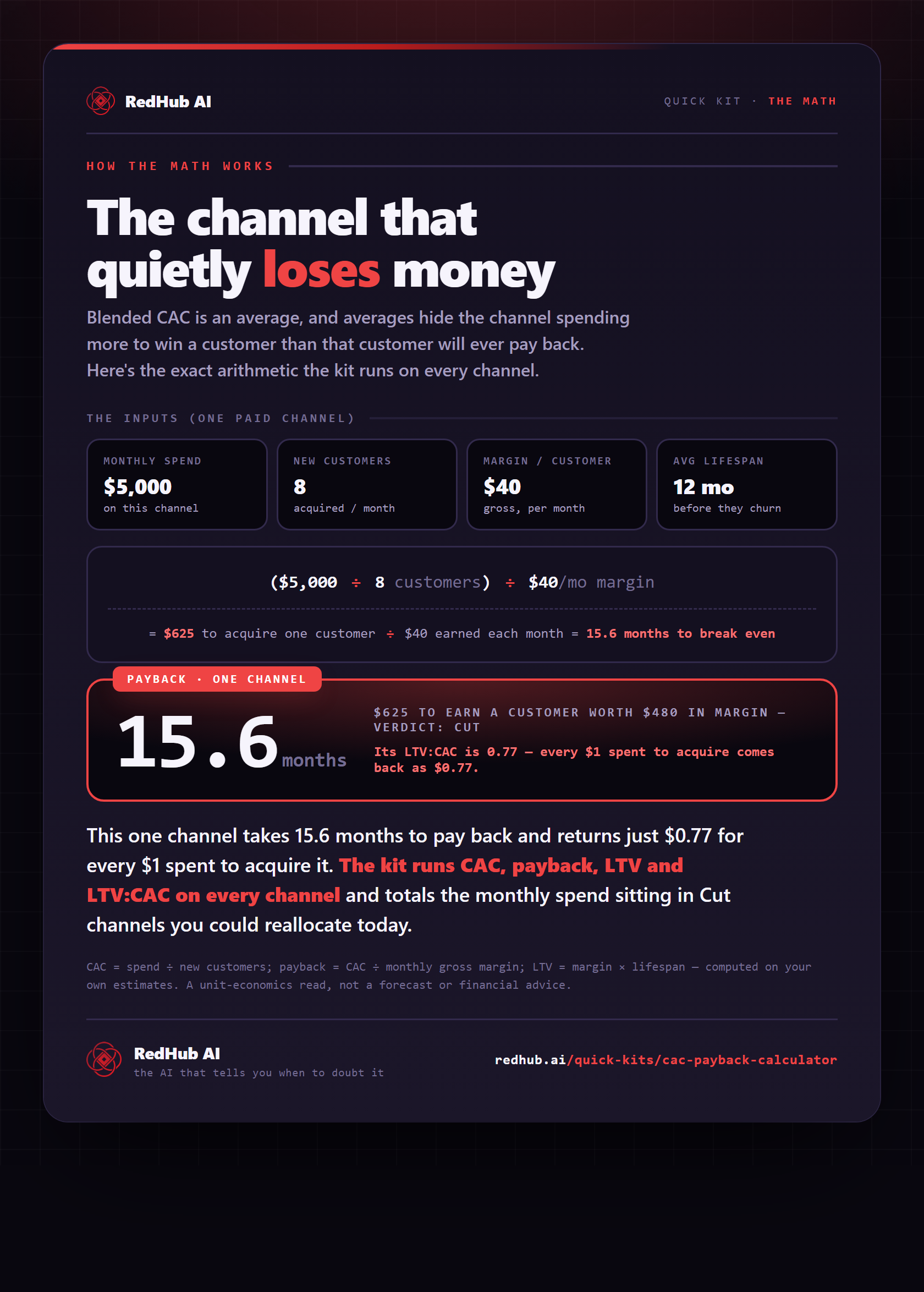
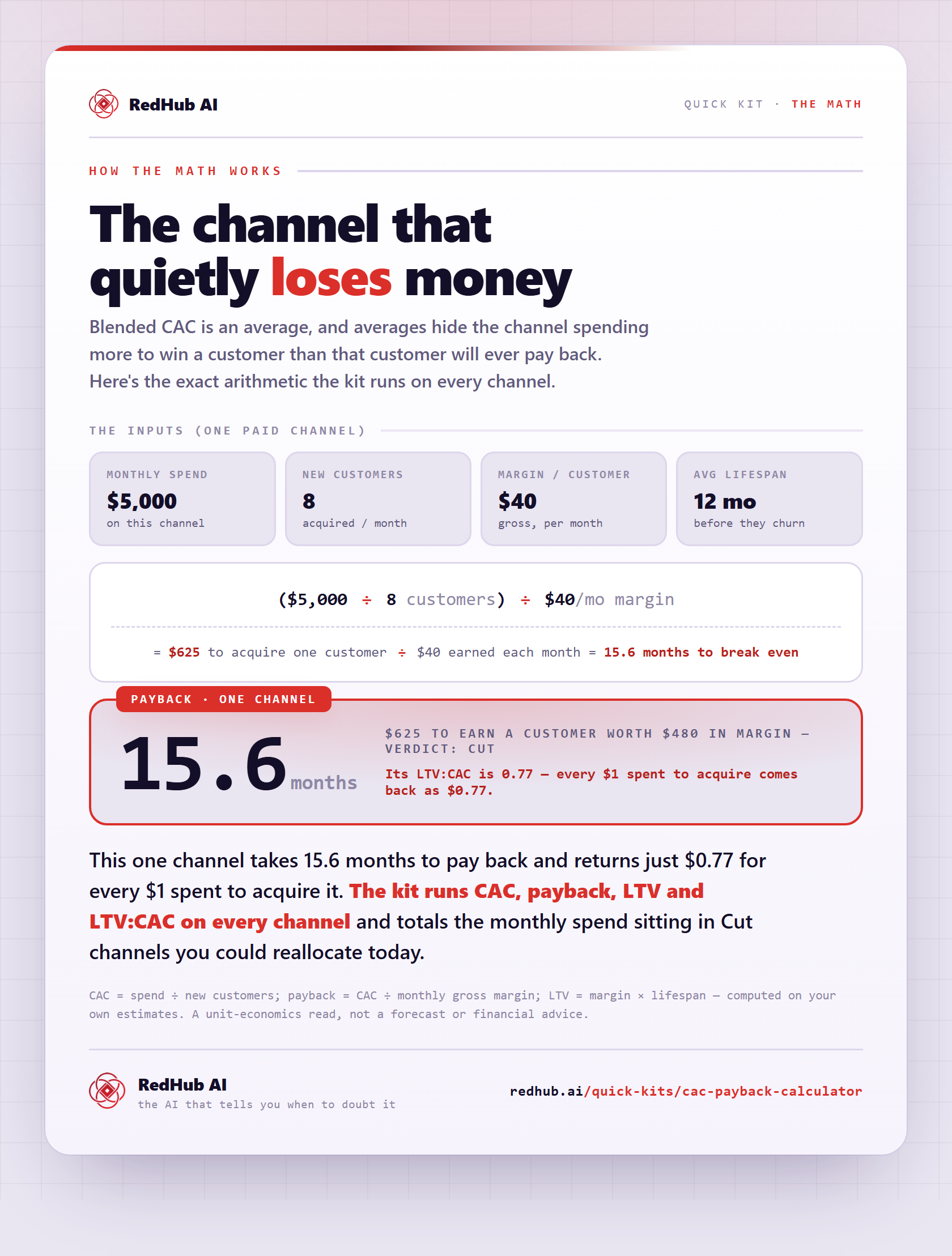
The gate this post refers to, drawn from the tool’s own logic. See the tool.