How to Lower Your CAC Without Slashing Growth
RedHub AI Editorialupdated October 5, 20265 min read

Jump to a section7
Cutting the marketing budget is the quickest way to make CAC fall, and it is usually the wrong answer to how to lower CAC. In an illustrative month, a company spends $20,000 and wins 100 customers, a $200 CAC. It halves spend to $10,000, keeps its cheapest channels, and wins 60. CAC drops to about $167. New customers drop 40%. The levers that lower CAC without shrinking the business are moving budget between channels, converting more of the traffic you already pay for, and cutting only the channels that fail your bar.
TL;DR: Lower CAC by moving budget toward your lowest-CAC, fastest-payback channels, fixing conversion before buying more traffic, and cutting channels that fail your own bar, not by cutting spend everywhere. Retention does not change CAC, but it raises the CAC you can afford. A lower blended CAC that comes with fewer total customers is a budget cut, not an efficiency gain. This is general information, not financial advice.
Move budget toward the channels that already pay
Shifting dollars from your worst channel to your best one lowers blended CAC without cutting total spend. It only works once you have calculated CAC by channel. The calculator's built-in example shows the gap: influencer one-offs take $5,000 a month at a $625 CAC, while content and SEO win customers at $100.
The catch is that an average CAC is not the next customer's price. Content at $100 a customer does not mean another $5,000 buys 50 more. Many channels get more expensive as you push budget into them, because the cheapest audiences and searches are bought first. The way to learn a channel's next-dollar cost is to move budget in steps, say $1,000 a month, and re-measure after each one. That is slower than the spreadsheet suggests, and no spreadsheet can tell you in advance where a channel's cost starts to climb.
Fix conversion before you buy more traffic
Converting more of the traffic you already pay for lowers CAC without spending a dollar more. Say $6,000 buys 10,000 visits, 2% sign up, and one in five sign-ups becomes a customer. That is 40 customers at a $150 CAC. Get the sign-up rate to 3% with a clearer offer, a shorter form or better proof, and the same $6,000 brings 60 customers at $100. One point of conversion cut CAC by a third. The figures are illustrative; the arithmetic holds at any scale.
- Find where people leave: the ad, the landing page, the form, or checkout.
- Fix the step with the most traffic first, because a small gain there moves more customers than a large gain on a page few people see.
- Re-measure CAC on that channel after the fix, at the same spend, to see the real change.
Our post on landing page mistakes covers the most common leaks on the page itself.
Cut the channels that fail your bar
Once you have CAC, payback and LTV:CAC per channel, some channels fail clearly enough that funding them is a choice. The CAC & Payback Calculator marks a channel Cut when LTV:CAC is under 1 or payback runs beyond 18 months. The influencer line in its sample fails on the ratio, at 0.77:1, because it needs about 15.6 months to pay back customers who stay 12. Moving that $5,000 to a channel that earns its cost back keeps total spend the same and puts it where customers pay for themselves.
Cut in steps too. A channel can look bad because of how customers are credited, and the attribution rule can flip a verdict. If a channel's call changes between first-touch and last-touch, reduce it gradually and watch whether total customers fall before you switch it off.
Retention raises the CAC you can afford
Retention does not change CAC, and it does not change payback either. Payback is CAC divided by monthly margin, and neither number moves when customers stay longer. What moves is lifetime value. At $40 of monthly margin, a customer who stays 24 months is worth $960. Keep them 36 months and they are worth $1,440. Against a $200 CAC, the ratio goes from 4.8:1 to 7.2:1, so the same channel can carry a higher CAC and still clear 3:1. Our post on reducing early churn covers the first 30 days of onboarding, where that work starts.
Check the win before you report it
Before you call a lower CAC a success, put two numbers beside it: total new customers and total spend, both against last period. If CAC fell and customers held steady or grew, efficiency improved. If CAC fell because spend and customers both shrank, as in the $20,000-to-$10,000 month above, the business bought fewer customers more cheaply. That can be the right call when cash is tight. Report it as a cut, so nobody plans next quarter around growth that is no longer being bought.
Find the spend sitting in Cut channels
The CAC & Payback Calculator is one .xlsx. Enter each channel's spend, new customers, margin and lifespan, and it returns CAC, payback, LTV:CAC and an Invest, Hold or Cut verdict per channel, with the monthly spend sitting in Cut channels totaled on the dashboard.
Get the CAC & Payback Calculator — $49Pairs well with
The AI Offer & Landing-Page Conversion Kit ($79) works on the conversion lever, with a Conversion-Ready Scorecard, landing templates and a claim linter that returns Launch, Tune or Rework. The Customer Churn Autopsy Kit ($69) works on the retention lever: an exit-interview script, a churn classifier and win-back sequences by churn reason. The Channel Continuation Assay ($99) helps with the cut decision, scoring whether a channel earned another cycle against a cost-per-action ceiling you set.
More in this guide
What's the fastest way to lower CAC?
Move budget from your worst-performing channel toward your best-performing one, in steps. It lowers blended CAC without cutting total spend, as long as the better channel does not get more expensive as you add budget.
Does cutting marketing spend lower CAC?
Often, because the channels you keep tend to be the cheap ones. But if total new customers fall with it, the lower number reflects a budget cut, not better efficiency.
How does conversion rate affect CAC?
CAC moves in proportion to conversion. If the same spend turns a 2% sign-up rate into 3%, you get 50% more customers and CAC falls by a third, with no change in spend.
Does retention change CAC or payback period?
Neither. Payback is CAC divided by monthly margin, and staying longer changes neither. Retention raises lifetime value, which raises how much CAC a channel can carry and still clear your LTV:CAC bar.
Is it ever right to cut a channel entirely?
Yes, when it fails your bar on LTV:CAC or payback and still fails under a different attribution rule. Reduce it in steps and check that total customers hold up before switching it off.
How do I know if a lower CAC is a real improvement?
Check whether total new customers held steady or grew alongside it. If spend and customers both shrank, the business bought fewer customers more cheaply. That can be the right call, but report it as a cut.
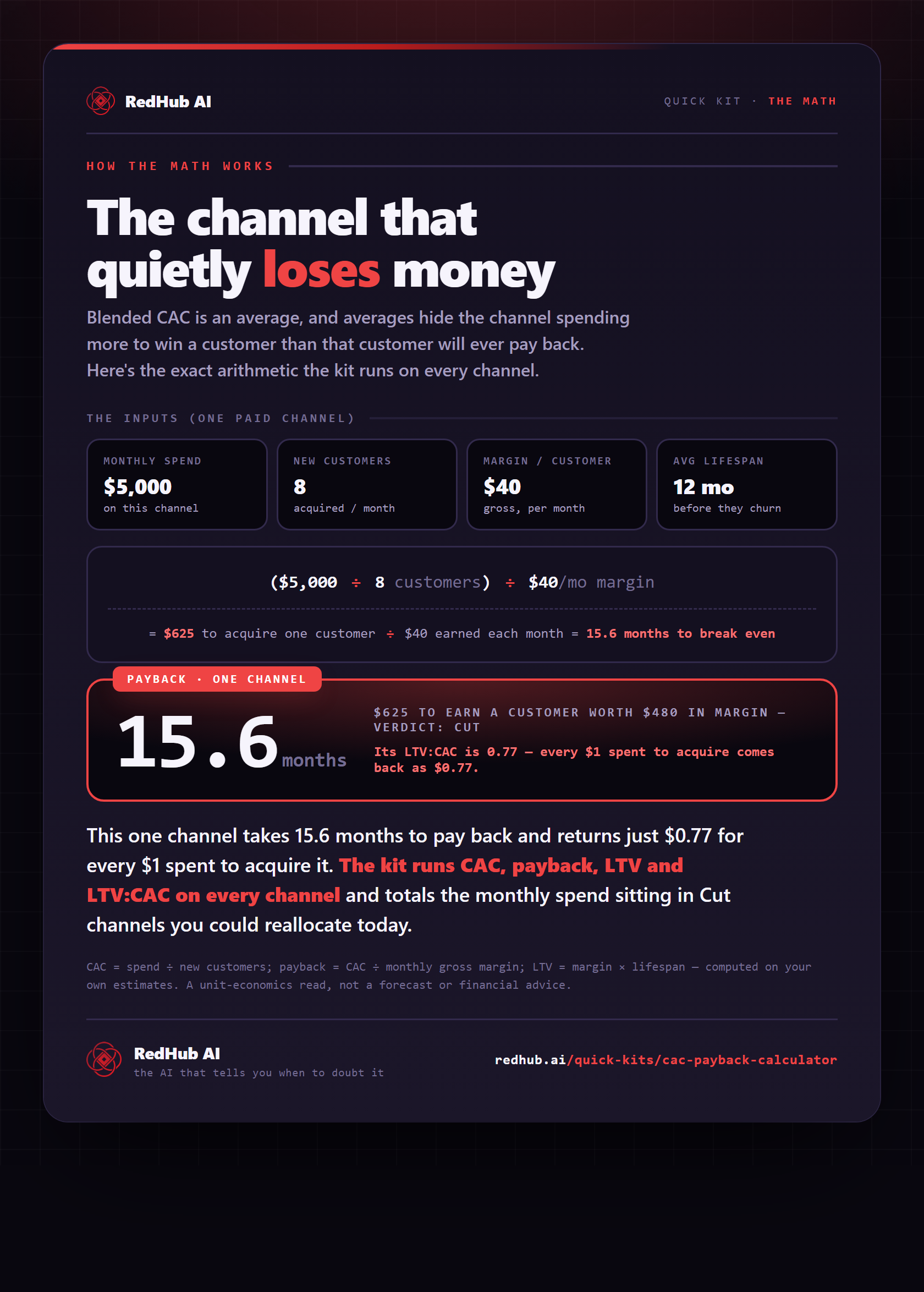
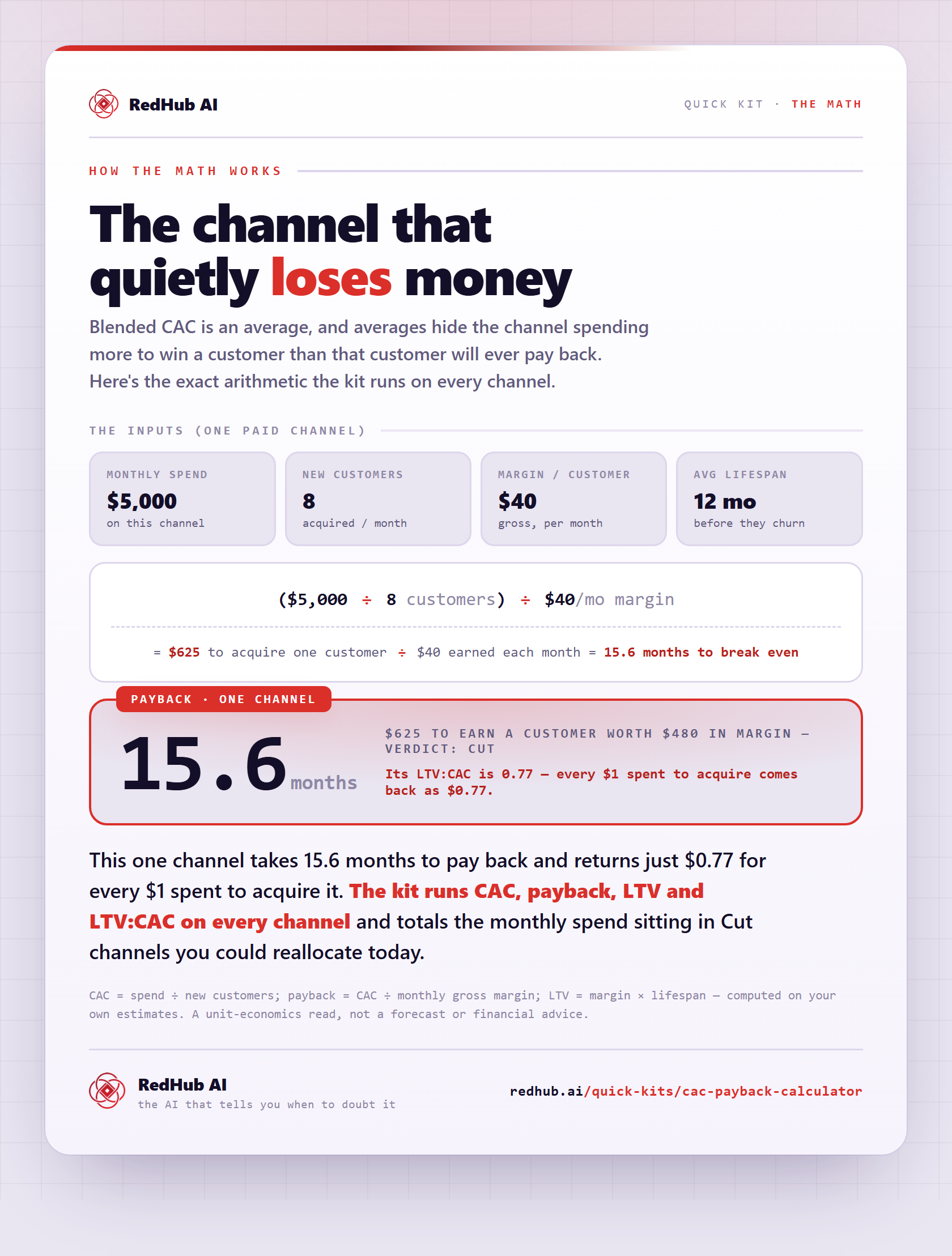
The gate this post refers to, drawn from the tool’s own logic. See the tool.