LTV:CAC Ratio: What's a Good One (and Why 3:1 Isn't Gospel)
RedHub AI Editorialupdated October 5, 20266 min read

Jump to a section8
Venture investor David Skok wrote in 2013 that "the best SaaS businesses have a LTV to CAC ratio that is higher than 3," and 3:1 is now the answer you will hear most often to what makes a good LTV CAC ratio. The ratio itself is simple: customer lifetime value divided by customer acquisition cost. What it leaves out is time. A ratio says nothing about when the value arrives, so a channel can clear 3:1 and still drain your cash for two years.
TL;DR: LTV:CAC = customer lifetime value ÷ CAC. 3:1 is a guideline from subscription software, not a law, and Skok himself called his benchmarks "only guidelines." A lower ratio can be fine when payback is fast; a higher one can still be dangerous when payback is slow. LTV rests on a guess about how long customers stay, so test the ratio at a shorter lifespan before you trust it. This is general information, not financial advice.
The formula
LTV:CAC = customer lifetime value ÷ CAC
A simple LTV estimate is monthly gross margin per customer × average customer lifespan in months. A customer worth $40 a month in gross margin who stays 24 months has an LTV of $960. Against a $200 CAC, that is a 4.8:1 ratio.
This is the simple version: gross-margin LTV with no discounting for the fact that a dollar in month 24 is worth less than a dollar today. The CAC & Payback Calculator uses the same simple version and says so on its page. For a fast read across channels that is enough. For a board deck or a fundraise, expect someone to ask for the discounted version.
Where 3:1 comes from
Skok's SaaS Metrics 2.0 (opens in a new tab) was written for subscription software companies. In it he reports that the best SaaS businesses run above 3, "sometimes as high as 7 or 8," and that he validated his guidelines "with many SaaS businesses." He also wrote that "there are always situations where it makes sense to break them." The number traveled further than that caveat did.
A local service business, a low-margin marketplace and a one-time-purchase product have different margins, different lifespans and different cash cycles. The 3:1 guideline was not built on them. Use it as a sanity check. The CAC & Payback Calculator does the same: its Invest bar is 3:1 or better with payback inside 12 months, and its page calls those bands common rules of thumb, not guarantees.
When a lower ratio can still be healthy
- Fast payback. If you recover CAC in two or three months, cash is not tied up long, and you can put it back into acquisition quickly. In the calculator's sample data, paid search runs 2.25:1 with an 8-month payback. That is a Hold, not a Cut.
- A deliberately conservative LTV. If you assumed a short lifespan or trimmed the margin on purpose, the ratio on paper may understate the business.
- An early land grab. A business buying market share at thin near-term margins may accept a lower ratio for a while, as long as it is a choice someone is watching and not an accident.
When a higher ratio can still be dangerous
Take a channel with a $2,400 CAC, $100 of monthly gross margin per customer and an average lifespan of 96 months. LTV is $9,600, a 4:1 ratio, comfortably above 3:1. Payback is 24 months. For two years, every customer that channel brings in is a cash cost you are carrying, and the more you spend on it, the bigger that cost gets. The CAC & Payback Calculator reads that channel as a Cut, because its payback runs past 18 months, whatever the ratio says.
A high ratio can also point to the opposite problem: you may be spending too little on a channel the market and your margin would support. Skok reported the best SaaS businesses reaching 7 or 8 only "sometimes." A ratio well above that deserves a question before it gets a celebration.
Stress-test the lifespan before you trust the ratio
CAC is built from money already spent. LTV is built from a guess about the future, and the lifespan input carries most of the weight. Young companies cannot observe it directly: a business that is 14 months old has no customer who has stayed 24 months. In the formula example, a 24-month lifespan gives 4.8:1. Halve it to 12 and LTV falls to $480, a ratio of 2.4:1, below the 3:1 line. Same customers, same CAC, different guess.
Run the ratio at the lifespan you can defend from your own churn data, then again at half of it. If your decision changes between the two runs, you do not know the answer yet, and more retention data will settle it faster than a better formula.
Read LTV:CAC next to payback period
LTV:CAC and CAC payback period answer different questions, and neither is safe alone. A channel can post a strong ratio and a long payback at the same time: worth it eventually, and capable of running you out of cash before it gets there. Pull both numbers for each channel before you decide where the budget goes.
Read the ratio and the payback together
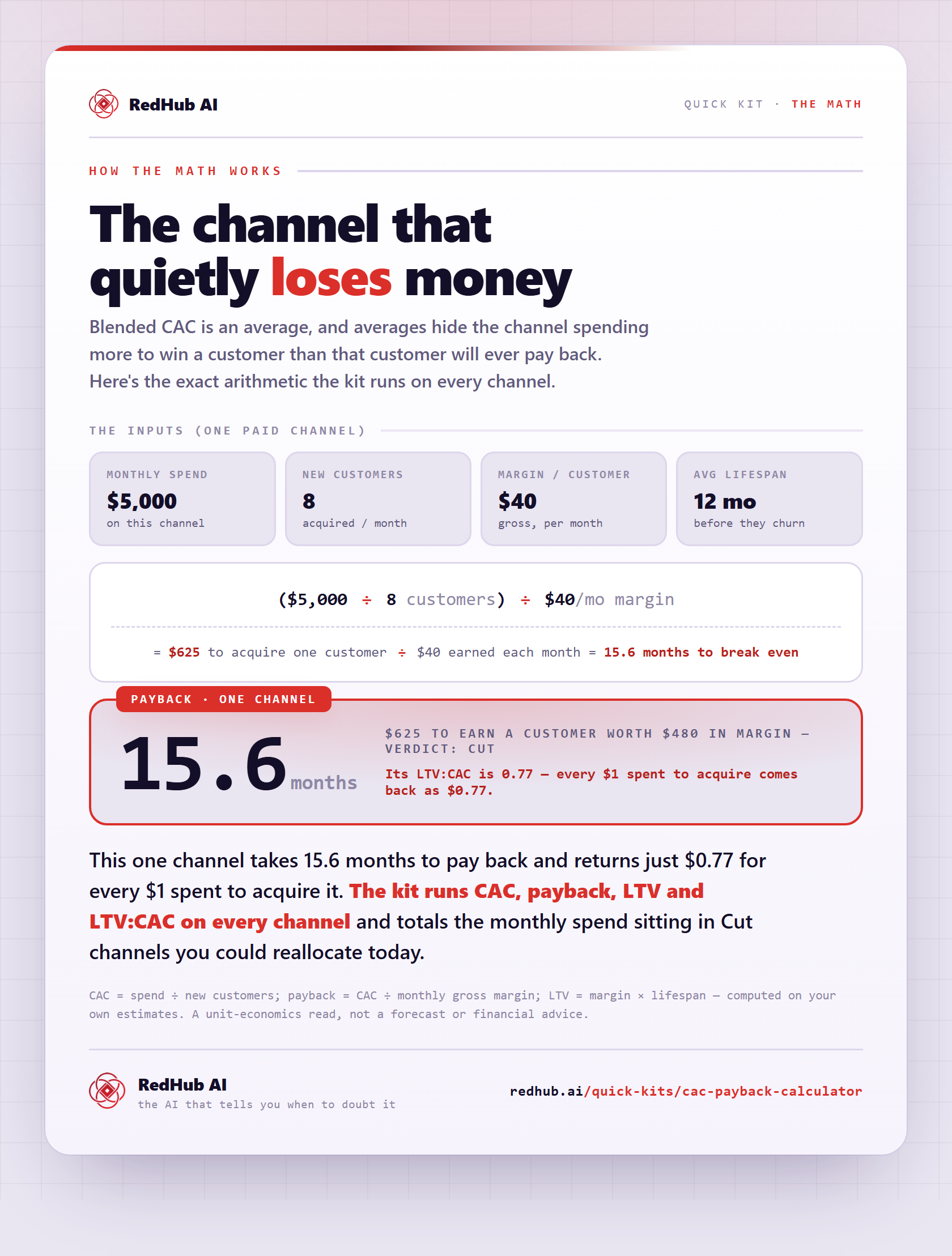
The CAC & Payback Calculator computes CAC, payback period, LTV and LTV:CAC for each acquisition channel from your own spend, customers, margin and lifespan. A channel earns Invest only with LTV:CAC of 3 or better and payback within 12 months, and it reads Cut below 1:1 or past 18 months.
Get the CAC & Payback Calculator — $49Pairs well with
LTV is only as good as its margin input. The Profit Leak Finder ($49) ranks existing clients by true profit after the cost to serve them, which tests whether your average margin per customer holds for the customers you have. The Customer Churn Autopsy Kit ($69) works on the lifespan input, with an exit-interview script, a churn classifier and a cohort retention analyzer. The Expansion & Upsell / NRR System ($89) covers the other way lifetime value grows, by expanding customers who are already succeeding, with an NRR and GRR calculator.
More in this guide
What is a good LTV:CAC ratio?
3:1 is the most commonly cited figure, from venture investor David Skok's 2013 SaaS guidelines, but it is a rule of thumb, not a universal target. A lower ratio can be fine with fast payback, and a high ratio can still be risky when payback takes years.
How do you calculate LTV:CAC?
Divide customer lifetime value by CAC. A simple LTV is monthly gross margin per customer multiplied by average customer lifespan in months. $40 a month for 24 months is $960, which against a $200 CAC is 4.8:1.
Is 3:1 the right target for every business?
No. It comes from subscription software. A local service business, a low-margin marketplace or a one-time-purchase product may run above or below it and still be healthy, depending on payback and cash.
Can LTV:CAC be too high?
Yes, in two ways. A high ratio paired with a long payback ties up cash for years per customer. A ratio far above the usual range can also mean you are spending too little on a channel that would support more.
Why is LTV harder to trust than CAC?
CAC is built from money already spent and customers already closed. LTV is a projection built on an assumed lifespan. Halving the lifespan halves LTV, so test the ratio at a shorter lifespan before acting on it.
Should I look at LTV:CAC alone or with other metrics?
Always with payback period. The two answer different questions, and a channel can look strong on one and dangerous on the other.

The gate this post refers to, drawn from the tool’s own logic. See the tool.