Customer Onboarding Email Sequence: The 6-Part Build
RedHub AI Editorialupdated August 17, 20266 min read

Jump to a section10
TL;DR
- What it is: A customer onboarding email sequence is six sequences, not one drip — welcome, activation, adoption, stall-recovery, expansion, and milestone messages.
- Who it's for: Lifecycle marketers and founders whose current "sequence" is a welcome email and a hope — see the Customer Onboarding Sequence Kit.
- How it works: Anchor every message to one activation milestone, trigger on behavior where you can, and make each touch remove exactly one obstacle.
- Bottom line: The sequence that wins is the one aimed at the customer's first real value — not the one with the best open rate.
What should a customer onboarding email sequence include?
A complete customer onboarding email sequence includes six parts: a welcome sequence that sets expectations and points at the first win, an activation sequence that guides the customer to first real value, an adoption sequence that turns that win into a habit, a stall-recovery sequence that catches customers who go quiet, an expansion sequence for accounts where value is already real, and milestone messages that celebrate wins as they happen. Every message is anchored to one defined activation milestone — not to opens.
Best for: teams building their sequence this week — part of our customer onboarding playbook.
Most teams have a customer onboarding email sequence. Few have one that works. The typical version is a single drip — welcome, feature tour, tips, discount — written once, sent to everyone on the same calendar, and measured on opens. It reads fine. It just doesn't change whether the customer reaches value before they drift.
The difference between a drip and a sequence that activates customers isn't better subject lines. It's structure: six sequences with distinct jobs, all aimed at one milestone. Here's the build.
Before you write: name the milestone
Every message in an onboarding sequence should move the customer toward the activation milestone — the earliest moment they get real value. If you haven't defined that moment in one sentence the whole team agrees on, stop and do that first. (Here's how to find and measure your activation milestone.) A sequence without a milestone is a newsletter with a countdown.
The six parts, message by message
- Welcome (day 0). One or two touches. Confirm the decision, set an honest expectation of what happens next, and point at one concrete first action — not five. The welcome email's job is to make the first win feel close, not to tour the product.
- Activation (days 1–14). The core of the whole system. Each touch removes one specific obstacle between signup and the milestone: the setup step people skip, the confusing screen, the teammate invite that unlocks the value. Sequence the obstacles in the order customers actually hit them.
- Adoption & habit (post-activation). One win isn't retention. This sequence turns the first value moment into a routine — a weekly use case, a second workflow, a reason to come back that isn't your email.
- Stall-recovery (triggered on silence). Fires when a customer goes quiet before activating — triggered by inactivity, not a calendar date. Tone matters most here: helpful and specific ("here's the step most people get stuck on"), never guilt-tripping ("we miss you!").
- Expansion & renewal (earned, later). Only fires once value is demonstrably real. Pitching an upgrade to a customer who hasn't activated is the fastest way to teach them your emails are ads.
- Milestone messages (event-triggered). Short celebration touches when the customer hits a real win. These are the smallest messages in the system and often the highest-leverage — they name the value the customer just got, in the moment they got it.
Key insight: the parts are triggered differently on purpose. Welcome and activation run on a schedule; stall-recovery, expansion, and milestones run on behavior. A sequence that's all calendar treats every customer identically — including the ones who already activated and the ones who never opened the app.
Cadence rules that keep it helpful
| Rule | What it means | What it prevents |
|---|---|---|
| One obstacle per touch | Each message asks for exactly one action | The overwhelming "here's everything" email nobody acts on |
| Exit on success | Customers who activate leave the activation track | Getting-started emails sent to power users |
| Earn the next send | If a message can't help the customer, don't send it | Padding the sequence to hit an email count |
| No invented claims | Every feature and outcome named is real | Oversold onboarding that churns disappointed customers |
Email is the spine — not the whole body
Email carries the narrative, but onboarding usually works best as a mix. An in-app message catches the customer at the moment of action; an SMS (where they've opted in) works for time-sensitive nudges. Build the sequence for the channels your customers actually use, and adapt the length to each — an in-app nudge is a sentence, not a letter.
Voice consistency matters across all of it. If your onboarding emails sound like a different company than your marketing, trust leaks. If that's your gap, the Brand-Voice Email & Newsletter Engine ($69) handles the on-voice email layer.
Writing the sequence with Claude
You can draft all six sequences by hand over a few weeks — or generate honest first drafts in an afternoon and spend your time editing. The Customer Onboarding Sequence Kit runs three ways: paste the master prompt into Claude with your product facts, install the included Claude skill so it fires on request, or drop it into a Claude Project that holds your product details and milestone. It makes you define the activation milestone before it writes a word, grounds every claim in what your product actually does, and outputs sequence copy plus cadence you run in your own tool — Klaviyo, HubSpot, Customer.io, Mailchimp, in-app, SMS.
Six sequences, drafted from your real product
The Customer Onboarding Sequence Kit ($69, one-time) ships the master prompt, focused prompts, templates and cadences for all six sequence types, an installable Claude skill, and a worked example. Helpful and honest by design — it flags gaps instead of inventing features.
Get the Onboarding Sequence Kit — $69 →How you'll know it's working
Not by opens. Track the share of new customers who reach the activation milestone, and how long it takes them. If those numbers don't move, the sequence isn't working no matter what the email dashboard says. And watch the early-churn number alongside it — the whole point of the sequence is to close the gap between signup and value before customers drift. We cover that measurement side in reduce early churn: the first 30 days decide.
Decision Guide
Rebuild your sequence if: it's one calendar-based drip, it's measured on opens, or nobody can say which obstacle each email removes.
Leave it alone if: new customers reliably reach first value fast and your early-churn number is healthy — then your time is better spent on adoption and expansion.
Best first step: map the three biggest obstacles between signup and your activation milestone. Those three obstacles are your activation sequence.
FAQ
What is a customer onboarding email sequence?
The set of emails (and in-app or SMS touches) that guides a new customer from signup to first real value. A complete system has six parts — welcome, activation, adoption, stall-recovery, expansion, and milestone messages — all anchored to one activation milestone.
How many emails should be in an onboarding sequence?
As many as it takes to remove the real obstacles to activation, and no more. For most products that's a handful of activation touches plus the triggered sequences. Message count is an output of obstacle-mapping, not a target.
When should onboarding emails send?
Welcome and activation run on a schedule over the first two weeks. Stall-recovery triggers on inactivity, milestone messages trigger on wins, and expansion waits until value is real. Behavior-triggered beats calendar-only wherever your tool supports it.
What makes an onboarding email naggy instead of helpful?
Nagging asks the customer to come back for your benefit; helping removes an obstacle for theirs. The test: does this message make the customer's next step easier? If it only exists to generate a session, cut it.
Should onboarding emails ever upsell?
Not before activation. Expansion messages belong after the customer has real, sustained value — pitching upgrades to someone who hasn't gotten the first win teaches them to ignore you.
What tool do I need to run the sequence?
Whatever you already use. The Customer Onboarding Sequence Kit writes the copy and cadence; you run it in Klaviyo, HubSpot, Customer.io, Mailchimp, in-app messaging, or SMS. It writes the onboarding; it doesn't send it.
Write the sequence this week, not this quarter
The Customer Onboarding Sequence Kit ($69, one-time) builds all six onboarding sequences with Claude from your product facts and activation milestone — grounded, on-pace, never naggy. Runs as a prompt, a Claude skill, or a Claude Project. 30-day guarantee.
Get the Customer Onboarding Sequence Kit — $69 →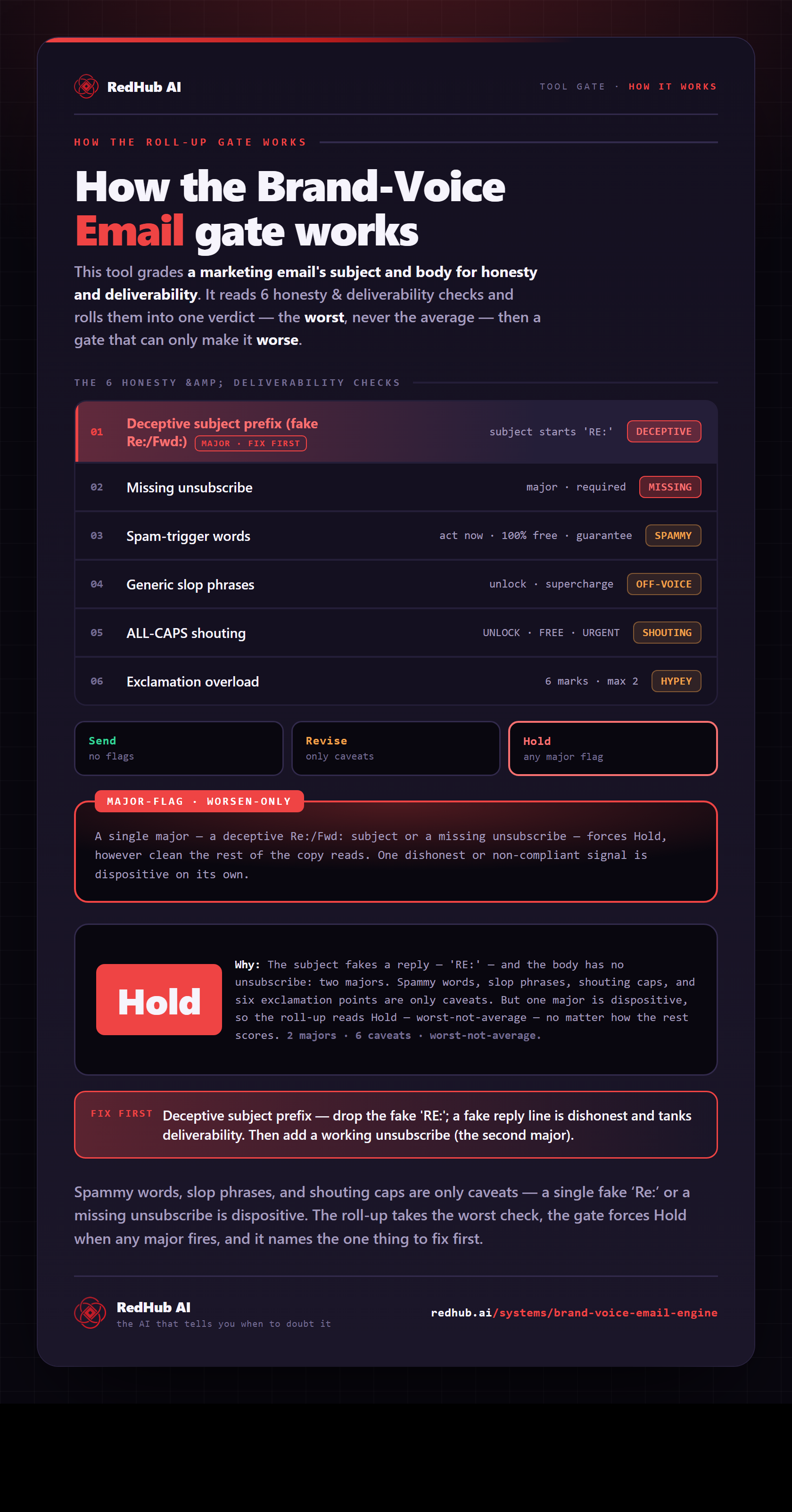
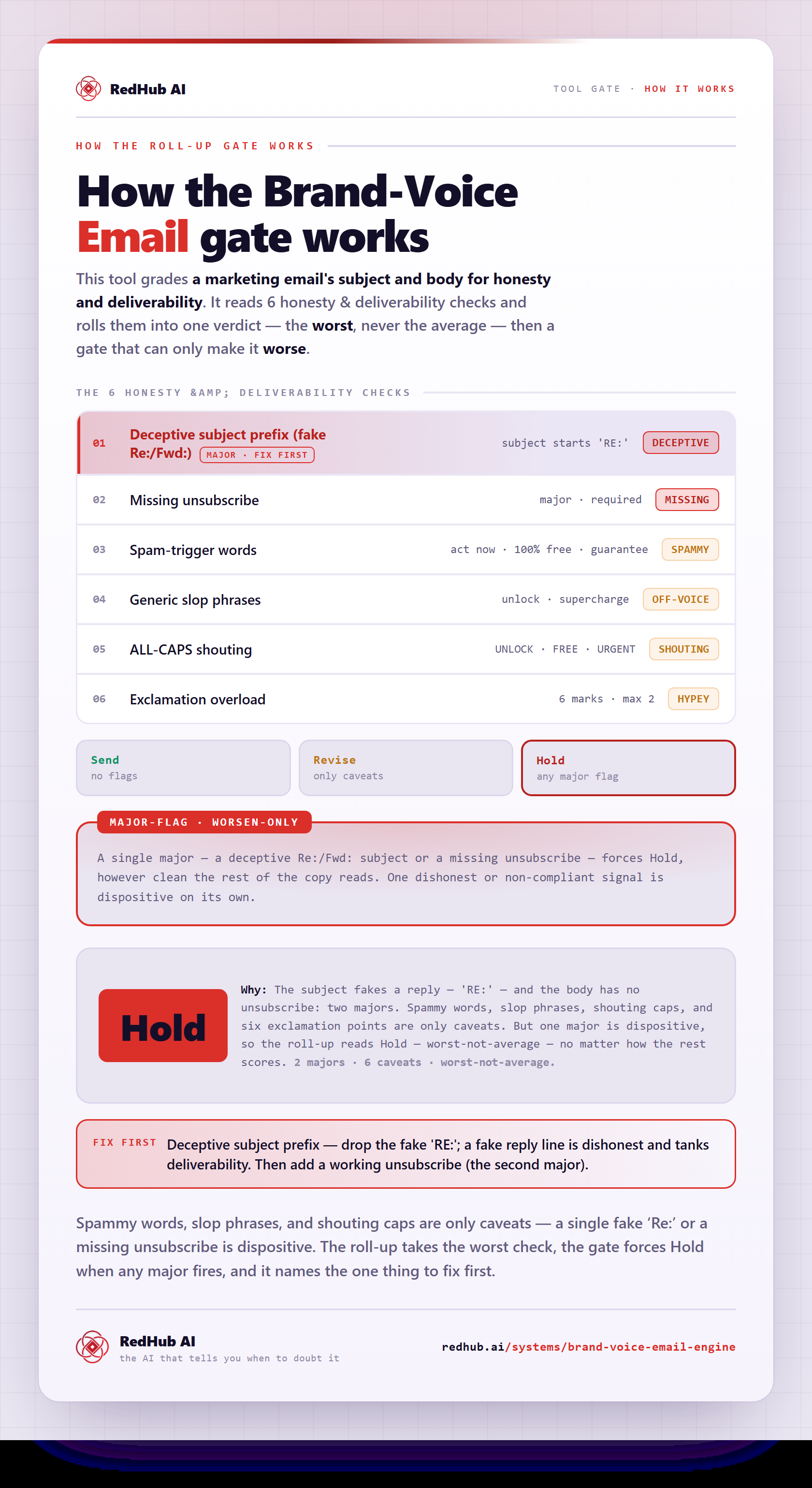
The gate this post refers to, drawn from the tool’s own logic. See the tool.