Document Automation ROI: Is It Worth It?
RedHub AI Editorialupdated August 18, 20263 min read

Jump to a section7
TL;DR
- What it is: whether automating a document process returns more than it costs — in time, errors, and money.
- Who it's for: anyone justifying a document-automation spend — see intelligent document processing.
- How it works: ROI comes from volume × time saved × accuracy — and it's real only when you fix the right stage.
- Bottom line: low-volume processes often shouldn't be automated. Honest ROI sometimes says "don't."
Is document automation worth the ROI?
Document automation is worth it when the process is high-volume and repetitive, and when you fix the stage that's actually the constraint — those two conditions drive almost all the return. It's often not worth it for low-volume or highly-variable documents, where setup costs more than the manual work it replaces. The honest ROI question isn't "can this be automated" (almost anything can) but "does the volume justify it, and am I fixing the right stage" — because automating the wrong stage returns nothing.
Best for: building an honest business case. Diagnose first so the ROI is real.
Every document-automation pitch promises ROI. Most ROI models are optimistic because they assume the automation fixes the real bottleneck and that volume is high enough to matter — and quietly skip the cases where neither is true. Here's how to estimate document-automation ROI honestly, including when the honest answer is "don't."
The three things ROI actually depends on
| Driver | Why it matters |
|---|---|
| Volume | Automation has fixed setup cost; only volume pays it back. Low volume rarely clears it. |
| Time saved per document | The manual minutes removed — but only at the stage you actually fix. |
| Error cost avoided | Bad data caught early is cheaper than fixing it downstream; this is often the hidden bulk of ROI. |
Multiply volume by time saved by how reliably it holds up, subtract setup, and you have an honest first estimate. The number is only real if the stage you're automating is the bottleneck — time "saved" at a non-constraint stage doesn't turn into throughput.
The honest disqualifier: if a document type is low-volume or every one is different, automation setup can cost more than the manual work it replaces. A good process tells you not to automate it — and that's a real result, not a failure.
Why fixing the wrong stage kills ROI
This is the ROI trap most models ignore. If you spend on faster extraction but the bottleneck was validation, your "time saved" is imaginary — documents still queue at validation, total output is unchanged, and the return is zero no matter how good the tool. ROI isn't a property of the tool; it's a property of whether the tool fixed the constraint. That's why diagnosing first isn't overhead — it's the single biggest factor in whether the ROI shows up.
Build the case honestly
Score the pipeline, confirm the bottleneck, size the volume through that stage, and estimate the time and error cost you'd actually remove. The Pipeline Diagnostic does the first, decisive part — it tells you which stage to fix so the ROI you model is the ROI you get, and it routes you to a specific fix rather than a platform whose cost sinks the math. Anything touching personal data also needs a redaction check in the ROI picture — compliance risk is a cost too.
Make the ROI real, not optimistic
Diagnose the bottleneck first so the stage you automate is the one that actually moves output — and the return shows up.
Get the Pipeline Diagnostic — $79 →ROI is the business case; the pipeline is the mechanism. See all six stages in the intelligent document processing guide.
Decision Guide
Automate if: the document type is high-volume and repetitive, and you've confirmed the bottleneck.
Don't automate if: volume is low or every document is different — setup can cost more than the manual work.
Best first step: diagnose the bottleneck, then size ROI on that stage's real volume.
Common Questions
Is document automation worth it?
When the process is high-volume and repetitive and you fix the real bottleneck, yes. For low-volume or highly-variable documents, often not — setup can cost more than the manual work.
How do I calculate document automation ROI?
Volume × time saved per document × how reliably it holds, plus error cost avoided, minus setup. It's only real if the automated stage is the actual bottleneck.
When should I NOT automate documents?
When volume is low or every document is different. A good diagnostic will tell you not to automate — that's an honest result, not a failure.
Why do ROI estimates miss?
They usually assume the automation fixed the bottleneck. If it didn't, "time saved" never becomes throughput and the return is zero.
What's the biggest hidden source of ROI?
Errors caught early. Bad data fixed at validation is far cheaper than the same error fixed downstream after it's caused a problem.
Does diagnosing first really change ROI?
It's the biggest single factor. Fix the wrong stage and ROI is zero regardless of the tool; fix the constraint and the return shows up.
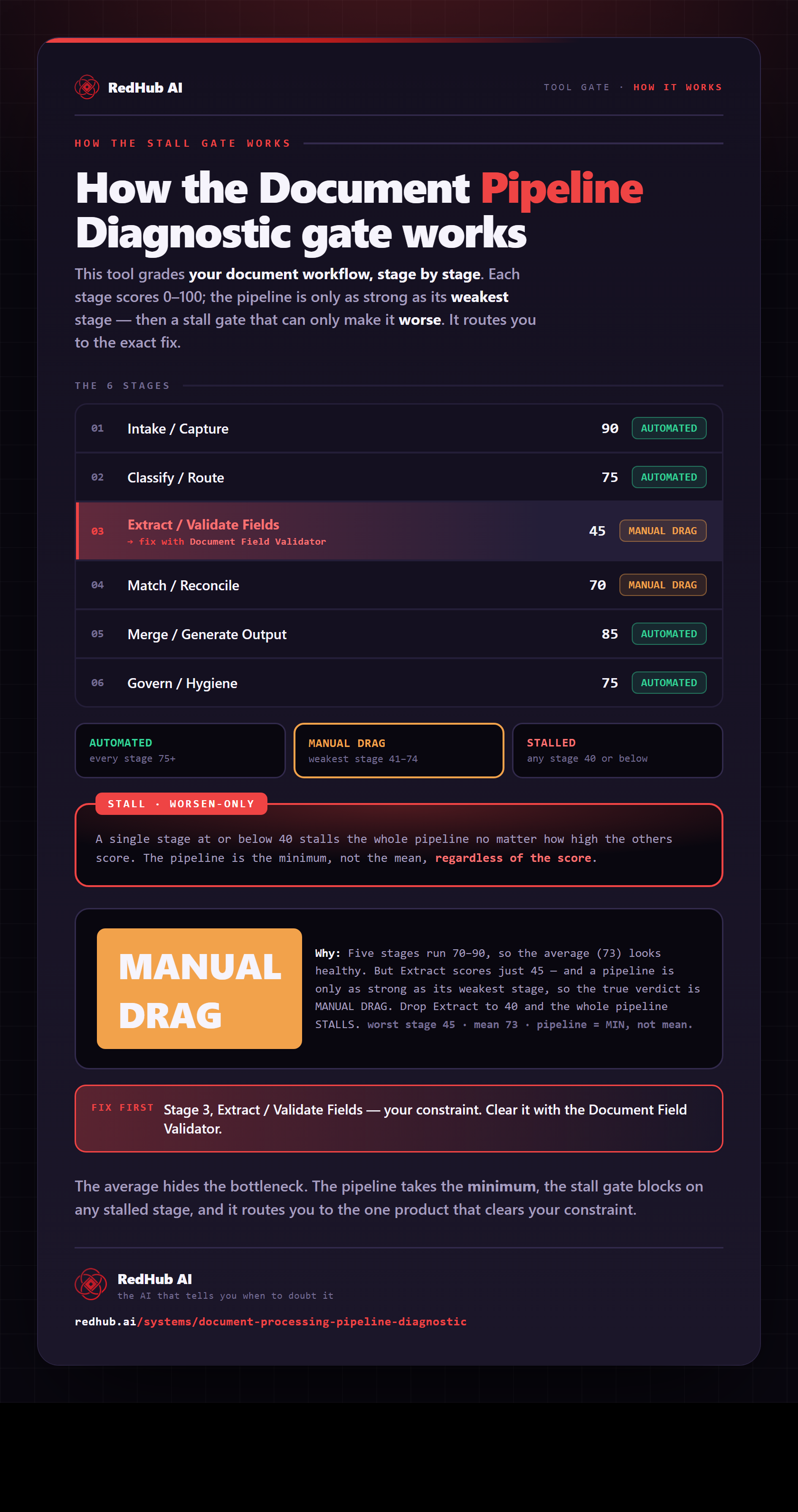
The gate this post refers to, drawn from the tool’s own logic. See the tool.